The Other Other White Meat, Ctd

53776601_723864b67c_b

A reader writes:

Your reader’s story about Peru reminded me of my ex-girlfriend.  She was a doctor and spent quite a bit of time volunteering for a poor village in the Andes.  She said that nearly everyone raised guinea pigs at home and they were considered a good dish to serve a special guest.  As a visiting doctor from America providing free medical care, everyone considered her a special guest. Nearly every night some family would invite her over for dinner and they’d all insist on serving her guinea pig.  By the end of her stay, she would spend the better part of each evening begging her host for the night to please serve anything other than guinea pig.  She was a well-traveled woman, not a picky eater in the slightest, but apparently that was one taste she was never able to acquire.  Granted, I was never able to discern if this was due to the taste itself or the notion of eating a common childhood pet.

Another quotes Michael Todd:

[G]uinea pig is good for you, with more protein and less fat than flesh from pigs, cows, sheep, or chickens. Guinea pig is also good for Mother Earth—you don’t need a Ponderosa-sized spread to raise them, and they convert their feed into edible protein twice as efficiently as a cow.

That could be in large part because any animal that is raised for food is raised today in a way that makes it bad for you, and guinea pigs aren’t currently raised for food. If they were raised for food, they would be raised in vast numbers in horrid factory farms.

They would be bred to gain tons of weight and get very fat very fast. They would be virtually immobilized in intense confinement for their entire lives and fed a diet that is not natural for them (all corn and/or soy, including pesticides). They would live in their own waste and every breath would be filled with the ammonia that the waste emits, burning their lungs and eyes as it enters their bodies.

Their food would contain antibiotics. They would likely be given growth hormones. Their flesh would cease even to resemble the flesh of their non-factory-farmed ancestors – just like meat today has very little in common with the meat that used to exist in the wild, and is far less healthful to consume than the meat that used to exist in the wild. Oh, and just like the eggs, meat, and dairy from factory farms today, it would have deceptive “humane myth” labeling such as “Cage-Free”; “Free-Range”; “All Natural”; “Humane Certified” and other such non-defined marketing terms.

Guinea pig flesh would no longer have “more protein and less fat than flesh from pigs, cows, sheep, or chickens.” It would have a far higher fat content than it does today. Further, “twice as efficiently as a cow” is still horribly inefficient compared to plant-based foods. And to the extent their flesh replaced the flesh of larger animals, there would be more suffering in the world because it would take more individuals to produce the same quantity of flesh as larger animals. Everything that industrial agriculture touches gets destroyed.

Another reader:

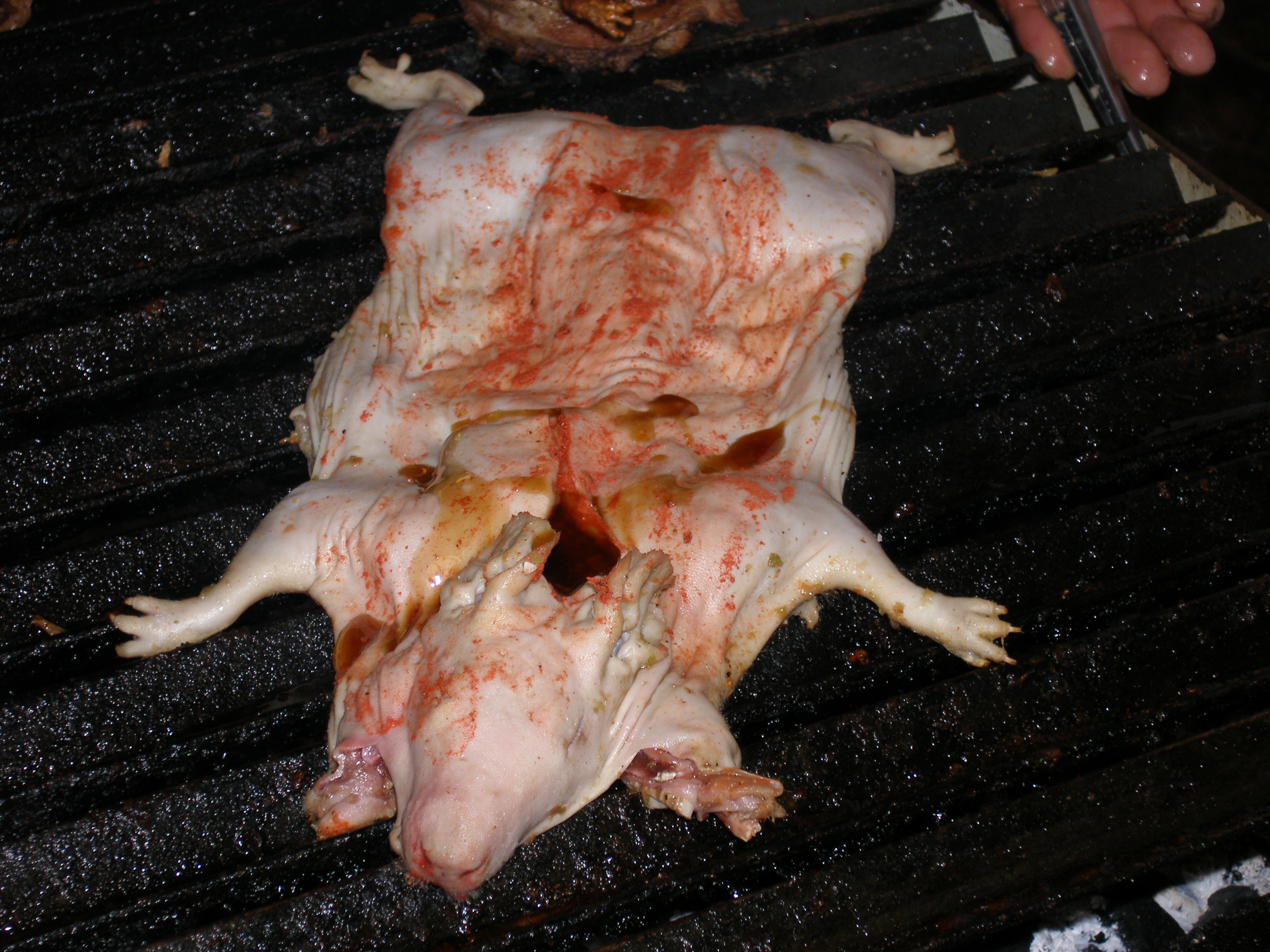
OLYMPUS DIGITAL CAMERAI couldn’t resist sending in the attached photo of a guinea pig roasting on the grill, taken in Otavalo, Ecuador back in 2006.  I tasted some of the finished product, and it wasn’t terrible, more or less like somewhat greasy quail.  We subsequently visited the home of an indigenous family, who had dozens of them running around the dirt floor of the house.  The grandmother would toss them some grain to keep them fed, and I guess would just grab one or more of them up when it was time to make dinner.  As far as I could tell, guinea pigs are very much a rural/Indian thing in Ecuador, as I did not see any on the menu when I was in the capital, Quito.

Aside from the cuteness issue, I can’t really see guinea pig taking off as a food item in lieu of poultry or other meats.  There’s not very much meat on those bones.
Another:

Anecdotal evidence from friends who have visited Peru: if you order guinea pig in a restaurant, be sure to ask that it be served with the head attached, so you can be sure you’re getting guinea pig and not rat.

Another:

I had an odd feeling that I had read about eating guinea pig on your blog previously, and thanks to your highly functional and awesome new search bar, I confirmed my suspicion: “Eating The Family Pet“. Okay, I’m not sure how likely it really is that I remembered this small item from five years ago. I probably read about it somewhere else and this is a coincidence. Still, the new search is awesome!

One more:

At the Cathedral in Cuzco, Peru, there is a wonderful Last Supper with guinea pig as the main course:

181DCFD6-1E02-4FE1-BA2A-3E5C46DEFAE8

(Top photo of “home grown” guinea pigs in Peru by Sam Judson)
Low-Caliber Gun Control

Waldman is unimpressed by the Senate’s gun control bill:

Toomey and Manchin’s proposal would close the “gun-show loophole,” meaning if you buy a gun at a show you’ll have to submit to a background check. It also covers sales over the Internet. What it doesn’t cover is private sales between one person and another. You’ve probably heard the figure that 40 percent of gun sales happen outside licensed dealers, and while the evidence for this figure is thin, nobody really knows if it’s too high or too low. Furthermore, nobody knows what proportion of that 40 percent occurs at shows, and what proportion happens when a guy sells a gun to his neighbor’s cousin or to some dude he met at a party or to one of the attendees at his garage sale.

Jacob Sullum asks how background checks relate to Sandy Hook:

Since Manchin describes that requirement as a response to the Sandy Hook massacre, you might reasonably surmise that Lanza bought the rifle he used in the attack from a private seller at a gun show or after seeing it advertised online. But you would be wrong, since the rifle belonged to Lanza’s mother, who purchased it legally from a federally licensed gun dealer after passing a background check. And if Lanza had tried to buy a gun on his own, it looks like he also would have passed a background check, since it seems he did not have a disqualifying criminal or psychiatric record, which is typically the case for mass shooters.

Judis would prefer that Congress focus on the economy:

It would be ridiculous to say that reducing inequality in the United States, and providing much greater opportunity in cities would eliminate homicide as a problem. But it would be equally ridiculous to say that an improvement in the country’s economic fortunes, and the reduction in the wild disparities in income, would have no effect on diminishing the homicide rate. Why, for instance, did the homicide rate in the United States start to decline in the mid-1990s? Some of it had to do with declining access to crack cocaine; but it also had to do with the economic expansion that took place. Gun control is part of the solution to homicide; but so, too, is economic improvement.

Will Readers Finally Pay For Content? Ctd

My thoughts on the feasibility of pay-meters for most bloggers:

On a related note, the Dutch continue to experiment with pay models:

De Nieuwe Pers recently launched in the Netherlands as an online platform for freelance journalists. Users pay €4.49 a month for access to all content on its app or website. But what stands out is the possibility to subscribe to individual reporters, for €1.79 a month. Think True/Slant, but with paywalls. “News has become more personal,” Alain van der Horst, editor in chief of De Nieuwe Pers, told me. “People are interested in the opinions, the beliefs, the revelations of a certain journalist they know and trust, much more than an anonymous person who writes for a large publication.”

Karskens concurs, stressing that a personal brand is key in this business model. “People read my stuff because I have a clear, crystalized opinion based on over 32 years of war correspondence,” he said. “This really works well for journalists with a distinctive character. It’s not for the average desk slave.”

Van der Horst also thinks paying per journalist is fairer to the readers than subscribing to a publication as a whole. “When you subscribe to a newspaper, you’ll get the full package. Even if you always throw out the sports section, you’ll still get it. With this model you decide: ‘This is what I want to read, so I’ll pay for it — what I don’t read, I don’t pay for.’”

We recently spotlighted another Dutch experiment, De Correspondent. Nieman Lab’s profile of the newspaper reveals several parallels with the Dish model:

De Correspondent’s record-breaking [$1.3 million crowdfunded] campaign is remarkable, not least because even those paying up aren’t clear on what the platform will look like when it launches in September. “That’s for a very good reason,” Wijnberg said — “we don’t really know yet.”

“When you try to sell an idea, it’s very easy to refer to what people know — ‘the platform looks like this, and you can compare the writing style with that’,” he said. “We didn’t want to do that, because we really wanted to be able to create something new — start with a clean slate.”

Here’s what we do know about De Correspondent: It promises to break away from the daily news cycle by focusing on context, not just what happened in the past 24 hours — new content that isn’t driven by “the news.” Individual correspondents, many of them famous or semi-famous in the Netherlands, will lead as “guides” — deciding the news agenda, and making their choices explicit. …

For an idea of what the new publication might look like, check out its 10-item manifesto (translated into English): Daily, but beyond the issues of the day. From news to new. No political ideology, but journalistic ideals. Themes and interconnections. Journalism over revenues. From readers to participants. No advertisers, but partners. No target groups, but kindred spirits. Ambitious in ideals, modest about wisdom. Fully digital.

A-fucking-men. And may sponsored content die on its corrupting vine. One reader who finally decided to pay for content writes:

I just wanted to pass along a thought on subscribing today. I’ve been mulling over subscribing since this all started, but hadn’t yet made the plunge, partly because I am unsure about the long-term feasibility of the direct pay-for-content model on the larger scale for the media. But this week I realized what it is about your site that’s different and worth stepping out and supporting this model: you don’t just offer a point of view on the blog, but a perspective. Except for the wire services, there’s little out there that doesn’t support a point of view, but you go beyond that in speaking personally, something I realized as I’ve read your pieces on David Kuo (as an evangelical living in DC with tangential connections to David) and Margaret Thatcher (as a struggling conservative) this week. I am grateful that you can admit to your readers that areas are only important when they are lived.
So, thank you for being authentic. It’s what makes the Dish rise above everything else out there today.

What’s Wrong With “Good Looking”? Ctd

scott-brown-cosmopolitian-leno-bp

A reader writes:

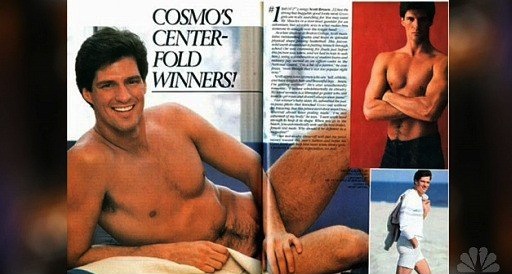
The notion that we don’t judge male politicians by their appeance is absurd.  People comment endlessly about Chris Christie’s weight. Sarah Palin joked that if she had won the election, Joe Biden would be promoting his book, Going Rogaine. Reagan once pulled back his ears to demonstrate to a reporter that he didn’t have face-lift scars, and invited the reporter to run his fingers through Reagan’s hair to show that it didn’t feel like it had been dyed. Even when we don’t talk about male politicians’ appearance, we judge them by it.  It’s been 112 years since there has been a U.S president who was shorter than 5’9” – the average height for an adult American male today.

Another is on the same page:

Ask Aaron Shock or Paul Ryan about covering men in this fashion.  The fact is, most politicians just aren’t remarkably good or bad looking and especially aren’t young and “hot” enough to objectify. I’d contend that is more the reason why it’s rare to see these comments about politicians of either gender. That said, I doubt the breathless cooing and shirtless pics of Shock and Ryan measurably hurt their image. There’s the real difference. Attractive women are unserious or dumb, unattractive women have something to prove, and men are just a little more glamorous when they’re pretty and it’s irrelevant when they’re not particularly easy on the eyes.  Maybe someday we’ll get to the point where we see Shock and Ryan as the bimbos they really are.

What’s A Silencer For? Ctd

Readers counter Goldblog over the question:

I’m no gun nut. I don’t even own a gun (although I do sometimes go shooting). I’m a San Francisco liberal. I believe first and foremost that this is mainly about silencer sales. That being said, I think Jeffrey Goldberg is on the losing side of this argument. Guns are really loud. Goldberg acknowledges that and says that it’s true that “hunters who don’t wear ear protection may eventually damage their hearing.” That’s an understatement. Most guns are around 150-160 db. Just one shot can be enough to damage your hearing. “Silencers” (aka suppressors) can’t actually silence a gun or even get anywhere near that. It’s absolutely nothing like the pfft pfft you’d hear in a Bond film. It’s still about 130-145 db. This brings it down to the level of a military jet taking off. A car horn going off a meter from your ear is still quieter than a gun with a silencer. Even with a silencer, you should still be wearing hearing protection.

In other words, neighbors are still going to hear your shots if you fire a gun with a suppressor. On the other hand, it may be just enough quieter to save the hearing of many gun enthusiasts.

Another reader:

A hunter can wear ear protection.  The guy getting up in the middle of the night to an intruder doesn’t have that luxury, and a suppressed weapon will allow him to fire more than one shot without it being as though a bomb has gone off and potentially deafen him and his family for the rest of their lives (since being indoors magnifies the sound from a fired gun many times over).

A gun owner writes:

What’s a silencer for? Hearing protection. Goldblog’s glib dismissal of the utility of silencers is a prime example of why gun people get so fed up with non-shooters and the idiocy about guns that Hollywood propagates.

Here is a pretty high-tech and very well established suppressor company, AAC. Here is a listing of all their large caliber suppressors. The “best” one in terms of dampening reduces noise levels by 39 decibels (dB); the typical suppression value is about 30 dB. Whats 30 dB? In an echo chamber, that’s the sound of someone whispering in a library six feet away from you. Typical rifle calibers have sound levels in excess of 150 dB. A jet engine at full throttle 100 feet away is only 140 dB (and please keep in mind, the scale is logarithmic). So attaching a silencer to a hunting rifle might reduce the loudness from 150 to, at most, 110 dB. Well, what else is around 110 dB? Running a circular saw 3 feet away (108), or a motorcycle (100), or an amplifier 4′ away from your head (120).

Should suppressors be available to everyone? No, probably not. But they should definitely be more available then they currently are, where you need to pay a $200 tax stamp to the federal government, subject yourself to a six-month FBI background check, and then get personal approval from your local police chief or sheriff, who hey, might want to “ask” you for political donations (just ask anyone at calguns.net for their CCW approval process).

Another passes along a video demonstrating how oil filters can be used as effective suppressers:

Perhaps Mr. Goldberg can explain how while a suppressor is as readily available as an oil filter (if you’re willing to break Federal Law), they’re not frequently used in violent crimes?

Western Criminology Review “Criminal Use of Firearm Silencers” (pdf) puts the number of suppressors related to crime (including cases where the unlawful possession of a suppressor was part of the charges) at around 30-40 federal cases/year between 1995-2005, and only 12 federal cases (not per year – just 12 total) where the suppressor was used in the commission of the crime. Partially-reported case data for California shows similarly rare incidence of use.

Bruce Schneier coined the term “movie-plot threat” when talking about security and risk analysis in terms of terrorism, but it certainly applies to the use of “silencers” here.

Northern Overexposure

Erin Sheehy documents the latest extraction-based industry to hit Alaska:

Over the past few years, the number of reality television shows set in Alaska has skyrocketed. In 2012, more than a dozen aired on major cable networks. Most of the programming is of the “man versus nature” variety: shows like Deadliest Catch, Gold Rush Alaska, and even Ice Road Truckers tend to focus on the strange and dangerous professions of the Last Frontier. But forays into human drama have been made. This past fall the Military Wives series held a casting call in Anchorage, and in 2011, TLC aired the short-lived Big Hair Alaska, a show about Wasilla’s Beehive Beauty Shop, where Sarah Palin used to get her hair done. The film and television industry in Alaska has grown so rapidly that in 2010 the Anchorage Daily News started a blog called “Hollywood Alaska,” which reports on the latest industry news and routinely asks whether the state is getting enough return on this media gold rush.

The Lower 48’s obsession with the Last Frontier isn’t the only cause of the boom. In 2009, the Alaskan government began offering subsidies that allowed producers to recoup up to 44 percent of their spending in the state. The subsidy program—one of the most generous in the country—has been controversial.

Before 2009, shooting an entire feature film or TV series in Alaska tended to be prohibitively expensive. (Northern Exposure, the famous 1990s show about a Jewish doctor from New York who moves to a small town in Alaska, was shot entirely in Washington State.) More filming means more out-of-state film crews spending money on food and lodging, and could potentially be a boon for tourism, but the latest reports from the Alaska Film Office show that only around 15 percent of the total wages paid by these tax-subsidized productions have gone to Alaskans over the past three years. On the 2010 season of Deadliest Catch, Alaskan workers earned less than $20,000, while out-of-state workers took home more than $1.3 million. And although an Alaskan setting is central to the plotline of most of the films and shows that are shot here, some production companies have come under fire for abusing the subsidy. Baby Geniuses 3, a movie about crime-fighting babies and toddlers, paid less than 6 percent of all wages to in-state employees, and its plot brought little attention to “Alaskan issues.”