Is North Korea A Paper Tiger?

by Patrick Appel

After assessing the range North Korea’s missiles, Max Fisher concludes that, even “if North Korea did decide to start a war against the U.S., or even if a second Korean War begins accidentally, there is very little reason to think that it could carry out any part of its purported battle plans against the U.S. mainland.” Evan Osnos spells out the real threat:

U.S. military commanders used their Winter Wargames last month to play out what would happen if Kim’s regime were to collapse in a coup or civil unrest, leaving his nuclear arsenal exposed. “It’s a scenario that some believe is more likely than a North Korea attack on the South,” ABC News reported. (Previous studies have suggested that the U.S. would need at least a hundred thousand troops to secure the nukes, and three times that to begin to sustain and stabilize the country—more than peak commitments in Iraq and Afghanistan combined.)

The Harlem Shake-Down?

by Brendan James

Kevin Ashton claims the meme had “nothing to do with community and everything to do with commerce”, noting that one of the first imitations of the original “Harlem Shake” videos was from a company called Maker Studios trying to promote itself, and that soon after the song’s record label, Mad Decent, got in the game as well. Then came the advertisers and media companies:

[T]hese companies started posting and promoting their own “Harlem Shake” videos. They included College Humor, a website owned by IAC, a publicly traded company that also owns Newsweek; Vimeo, a YouTube rival also owned by IAC; and BuzzFeed, a viral content website that promoted its video with a story subtitled “If you haven’t done one yet, you better get on it right away!” (The Huffington Post also ran a story, “The Harlem Shake: A ’00s Classic, Having Another Moment“). Thousands of “Harlem Shake” videos were uploaded during the week of Feb. 11, many of them from businesses with something to sell.

This is abnormal. “Single Ladies,” “Somebody That I Used To Know,” Carly Rae Jepson’s “Call Me Maybe,” and Psy’s “Gangnam Style” were made by professionals and first imitated by professionals–Saturday Night Live in the case of “Single Ladies,” indie Canadian band Walk Off The Earth in the case of “Somebody That I Used To Know,” and Justin Bieber in the case of “Call Me Maybe”–then later by fans and amateurs. “Harlem Shake,” was a meme made by an amateur, George Miller, but its rapid replication was driven by media and marketing professionals, led and orchestrated by three companies: Maker Studios, Mad Decent, and IAC.

Leor Galil yawns:

It’s an interesting theory, and Ashton has a great handle on the evolution of the “Harlem Shake” meme from its beginning … through its viral comedown, but the underlying statement is loaded in a way that skirts certain details—like the fact that fan-made “Harlem Shake” videos amassed several hundred thousand views, a number strong enough to be considered “viral,” prior to any “corporate” involvement in the meme. Ashton also goes to great pains to point out the corporate ties for some of the outlets responsible for contributing to the “Harlem Shake” meme that directly benefited from its popularity while glossing over the fact that the meme, like many before it, got its footing through corporate-funded channels: Maker Studios got wind of the meme after employee Vernon Shaw discovered it on uber-popular social site Reddit, which is owned by monolithic media empire Advance Publications, and all the fan-made videos were largely uploaded to a hugely popular corporate entity, YouTube. While Reddit and YouTube foster unique digital communities and everyday contributors have the ability to affect every denizen that doesn’t negate the fact that they are corporations.

In Defense Of Expensive Weddings

by Zoe Pollock

Even though he didn’t have one himself, Noah Berlatsky believes there may be some merit to a $27,000 wedding, currently the average cost in America:

In his book Debt: The First 5000 Years, for example, David Graeber notes that “for most people in the world…the most significant life expenses were weddings and funerals.” It’s not like we’re the first civilization on the planet that has ever gotten it into its heads that marriage is a big deal, nor the first people to commemorate it, in one way or another, with a large outlay. Major life events are major life events. What are you saving for, if not for them?

Along those lines, Eugene Genovese points out in Roll, Jordan, Roll, that there is something more than a little indecent in the eagerness with which middle-class folks have, throughout history, chastised the poor for paying too much for funerals. Genovese argues that “respect for the dead signifies respect for the living—respect for the continuity of the human community and recognition of each man’s place within it.” Similarly, it seems like wedding expenses—whether totaling $1,000 or $27,000—aren’t extravagant waste but a way of showing respect for the community, and of the place of love within it.

Ann Friedman proposes other life events that deserve a big bash.

Are Prenups Pernicious? Ctd

by Chris Bodenner

Screen Shot 2013-04-01 at 3.00.37 AM

The results of our Urtak survey show that 7% of married readers have had a prenup, 24% of unmarried readers say they plan to get a prenup, and 24% say it would be a dealbreaker if their intended spouse insisted on having a prenup. Regarding the question graphed above (where orange means “no” and blue means “yes”), male and female readers were both evenly split. A reader writes:

I write in response to the reader who had to declare bankruptcy after a divorce, I don’t think a prenup would have helped his case.  First, it’s not realisitic to think that a guy who couldn’t afford $10k for a divorce lawyer could afford to pay a lawyer for a prenup.  Second, I’m not sure a typical prenup would include a “no getting credit cards without the consent of both parties” clause because, if you need one of those, you probably shouldn’t get married.  Third, a prenup can be challenged in court, and a good divorce lawyer can find ambiguities in the prenup to drag out litigation.  So he could have been faced with $10k in legal bills even with a prenup.

Another:

I have a bit of a different perspective on prenups in one niche demographic group: Orthodox Jews.

You see, Orthodox Judaism is a patriarchal religion in which women have less rights – or, as it is sometimes spun by the “Modern Orthodox” wing of Orthodoxy (as opposed to the haredi, or fundamentalist, wing) – “different” rights.  When it comes to divorce, an Orthodox woman cannot get a religious divorce (and therefore cannot remarry) unless her husband grants her the divorce. When a man refuses to do so, the woman is referred to as an agunah, or a “chained woman.”  They can still get a civil divorce on the woman’s initiative, but not a religious divorce.

When I got married, my rabbi required me to sign a prenup that stated that in the event we get a civil divorce, I am required to grant my wife a religious divorce.  Many Modern Orthodox rabbis will not perform a wedding unless such a prenup is first signed.  It is impossible, in the view of Orthodoxy, to change the religious divorce requirements, but they are using the modern prenup as a way to equalize the power between men and women and ensure that women do not become chained.  For an example of what happens when such a prenup is not entered into, one needs to look no further than the US Congress.


One Of These Weapons Is Not Like The Other

by Patrick Appel

A US Army veteran who fought alongside Syria’s rebels is accused of using “a weapon of mass destruction, i.e. a Rocket Propelled Grenade,” a violation that could get him life in prison. In response, Ackerman argues that it’s time to retire the term WMD:

It’s very easy to kill lots of people with a nuclear weapon. It’s harder, but possible, for a nuclear exchange to disrupt planetary climate patterns and kill vastly more once crops die and famines result. These are not things that chemical and biological weapons, as dangerous as they are, can do. Chemical weapons are subject to atmospheric dissipation and need people packed into a dense area to do maximum damage, as with Saddam Hussein’s chemical massacre at Halabja. Biological weapons are potentially more deadly, but their distribution patterns — particularly when passed through humans or animals — can limit their virulence. Rocket-propelled grenades, missiles, bombs, mines — just, no.

Energy Codependence

by Doug Allen

Concerns about shale gas resources hindering renewable-energy development are likely overblown:

[R]ather than replacing renewables, the [Citigroup] analysts suggest that the shale gas industry will actually be dependent on the broader deployment of wind and solar for its future. … Far from competing with each other, [Citigroup] suggests renewables and shale gas will be co-dependent as the world’s energy systems are weaned away from the baseload model that has dominated the industry for the last century. That is until forms of dispatchable renewable energy, such as solar thermal with storage, and technologies such as smart grids, push gas out of the market.

Map Of The Day

by Doug Allen

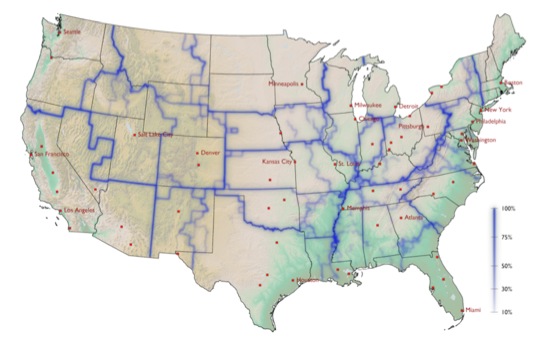
mainborders

Theoretical physicist Dirk Brockmann used data entered on the dollar-bill tracking site wheresgeorge.com to explore boundaries in the US:

Brockmann took data for how the dollar bills traveled, and used network theory to draw lines where dollar bills are less likely to cross. In places they follow state borders, but not always; Missouri is divided into East and West, as is Pennsylvania. The “Chicago catchment area” includes a big chunk of both Indiana and Wisconsin.

The resulting map shows how “effective communities” don’t necessarily follow state lines. “I don’t know so much about the culture of the U.S.,” says Brockmann, who grew up in Germany. “But when I give talks on this, normally someone in the audience says, ‘Oh, this makes perfect sense.”

Update from a reader:

I’d like to point out that the “effective communities” that Mr. Brockmann references in his map may not be as organic as he implies. The boundaries roughly correspond to the districts serviced by the Federal Reserve Banks, which exchange old bills collected by banks for new bills.

(Image from Dirk Brockmann)

Why Can’t The IRS Do Your Taxes?

by Zoe Pollock

For most Americans, it could:

Imagine filing your income taxes in five minutes — and for free. You’d open up a pre-filled return, see what the government thinks you owe, make any needed changes and be done. The miserable annual IRS shuffle, gone. It’s already a reality in Denmark, Sweden and Spain. The government-prepared return would estimate your taxes using information your employer and bank already sent it. Advocates say tens of millions of taxpayers could use such a system each year, saving them a collective $2 billion and 225 million hours in prep costs and time, according to one estimate.

But the TurboTax lobby is strong: 

[Maker of the tax software] Intuit has spent about $11.5 million on federal lobbying in the past five years — more than Apple or Amazon. Although the lobbying spans a range of issues, Intuit’s disclosures pointedly note that the company “opposes IRS government tax preparation.” … Roughly 25 million Americans used TurboTax last year, and a recent GAO analysis said the software accounted for more than half of individual returns filed electronically. TurboTax products and services made up 35 percent of Intuit’s $4.2 billion in total revenues last year.

Paul Waldman adds:

For many people, this wouldn’t work. Let’s say you have a lot of investment income, which varies from year to year. Or you’re a freelancer, and your income comes from multiple sources and your expenses also vary. But many people just have one source of income (their job) and a stable set of deductions, and this kind of thing would work perfectly well, saving them the $40 or so it would cost for Turbo Tax, or the even greater expense of going to a tax preparer.