As much an ad for Brooklyn as it is for the beer:
Brooklyn Brewery Mash – A trip through BK in 3000 photos from Paul Trillo on Vimeo.
Julia Fierro contemplates a challenge of many novelists:
When I asked literary writers about their experience writing sex, their responses ranged from, “I am terrified of sex scenes!” to “I fear the reader will think I’m a pervert, or terrifically immature, or both.” Why do so many literary writers fear writing about sex? Why do we add to the collective anxiety by celebrating The Literary Review’s “Bad Sex Award” — the annual public humiliation and literary stoning of one published writer?
In my experience as both a writer and a teacher, this fear of writing about sex is tied to the fear of sentimentality that takes root in a writer’s formative years. Writing instructors chastise writers in class — a setting that can feel quite public — when the writer risks sentiment, which a naïve writer might mistake for emotion. Writers accrue a kind of scar tissue, blocking their ability and their confidence to imply emotion, inevitably leading to a clouding of meaning in their work.
Meanwhile, Amanda Hess wonders when erotica will be taken seriously:
Fifty Shades has only cemented erotica’s reputation as juvenile, poorly-constructed, and—perhaps most damning—totally feminine.
In a world where most mainstream pornography is filmed with a male viewer in mind (and often, with guys manning the camera and the promotional machine), written erotica has been traditionally more accessible to women, who can produce it cheaply and anonymously, with few resources, no institutional support, and reduced risk of public shaming. That’s only reinforced the idea that women prefer to read their smut as opposed to watching it—and that they’re so hard up, they’ll accept whatever amateur bodice-rippers are offered to them.
The Internet has changed only some of that. Online, it’s easy to click away from traditionally feminine stuff and into “some crazy fetishes and things that are clearly not ‘girly,’ ” [Lux Alptraum, publisher and editor of the sex-centered blog Fleshbot] says. “Erotica can be Harry/Draco slash fiction. It can be aliens raping farmers. It can be whatever you want, and it doesn’t have to be in this soft purple packaging with the heaving bosoms and Fabio.” (Trust: I’ve read plotlines on Literotica.com that would not be legal to film in the United States.)
Game Theory splices together iconic game soundtracks, with a dash of Doctor Who:
2013 marks 35 years of video game music (Space Invaders, released in 1978 was the first game to feature a continuous soundtrack). So we took the opportunity to take a look back at some of our favourite examples of video game music and build a 19 track mashup, combining them with some other tracks we love.
Stephen Marche is disappointed by the Kindle’s lack of development:
The smartphone has become more magical every six months or so. The Kindle and various competitors compete for price point and a few little screen details and virtually nothing else. I am certainly not like Andrew Piper at Slate, who recently argued that e-reading isn’t reading at all. But on the other hand the experience of reading a book on an e-reader is significantly more irritating if you are reading for meaning. E-readers are designed for people who consume books. If you’re knocking back a thriller that you can’t put down, they’re perfect. If you’re reading a book that you have to try to understand, they’re dreadful.
Clearly the focus of their development has been to replace mass-market paperbacks. E-readers are not designed for people who interpret books. No effort has been put into design questions for serious readers, for people who try to figure out the meaning of texts. They are hard to flip back to an old section and they are still awkward for note-taking. … I’m not giving up my beloved Kindle because I’m particularly in love with paper. I’m giving it up because it fails to do what I need it to do.
Meanwhile, Barnes & Noble is giving away free Nook Simple Touch e-readers to anybody who buys a Nook HD+ tablet. Jeremy Greenfield smells desperation:
The margins on these devices are already razor-thin. The company, having sold far fewer e-readers and tablets than expected during the 2012 holiday season, is likely in need of getting rid of excess inventory. This is a very bad sign for the continued viability of the device business struggling bookseller. One digital media observer noted in a recent blog post that he saw a similar pattern of discounting and giveaways right before HP killed off its tablet business.

La Cinquina-Bufalotta, Italy, 5.40 pm
Maria Bustillos pens a love letter:
There is nothing that can soothe such terrors like the calm and reasonable words of an editor, a professional reader, the wise and honest friend who has the wherewithal and the desire to perfect your work, and apprehend any fugitive viewpoint. The writer who doesn’t understand that a good editor’s interests are entirely aligned with his own is a big idiot, and I leave him, with all the pity in the world, to all his entirely unnecessary sufferings. …
The idea of the Creative Person dropping his wisdom down like manna upon the heads of a grateful public is, I venture to say, really dumb. At least, I’ve never met or heard of a writer of any skill at all who wasn’t far more interested in the genius of the reader than in his own. And yet the idea of the literary genius, the lone visionary unencumbered by any imperatives outside those of his own revelations, is still peddled hither and yon. But not by me! I consider it the height of lunacy. No writing can be any good at all unless people are participating in it together, reading it, and enjoying it, and with any luck quarreling with it and being interested in it and talking about it and making new things out of it.
James Parker puts the TV franchise under the microscope:
There are universalities to real housewife–hood: the wincing air kisses with which they greet one another, and the cries of “You look hot!” or “You’re so skinny!”; the shifting alliances and behind-the-back bitcheries; the viperous lunch parties, with their protestations of friendship. But there are differences, too, city to real-housewife city. Atlanta has the most businesslike businesswomen; New Jersey is the most tribal, the families moving in large, noisy packs; Miami’s real housewives throw petals into the sea to rid themselves of negativity; in Beverly Hills they have psychics flush their houses. In Beverly Hills and Miami, too, the plastic surgeon plies most visibly his sinister trade: here we see the stretched eyes and the rubberized smiles, the reaction shots that show no reaction. To be a real housewife is to be in a cage match with middle age. Existence is weightless but, oh, gravity—it drags at the sagging epidermis.
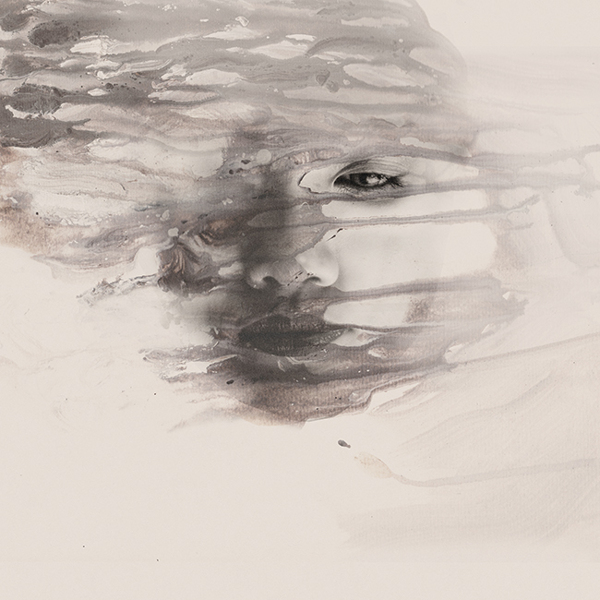
Mixed media by Januz Miralles, from the series “Nothing To See Here.”
Author Barry Hannah’s response:
Twenty years ago I was out in the woods alone. The weather was clear and very cold, but felt good. I had a Pall Mall in my hand and I walked into an old abandoned cabin of the Roosevelt era. Inside the cabin was just a bit warmer than out. A dusty tin bed with a thin mattress on brown springs. I wanted to light the Pall Mall very badly but I waited a while for the dark. The hairs of a feral dog lay in a circle on the planks in front of the hearth. In the last grip of faint grays, I lit the cigarette and the smoke felt exquisitely good inside me. I knew I was pledged to something. This lonesomeness, this cold lost place I would soon warm up. Nobody knew where I was, nobody. It wanted to be lived in here. I knew life would be sad but quite fine then. I felt a hum of joy in my head. Like some old muttering conquistador stumbled up with a flag to ram the staff into God knows what mud.
Forever afterward I would crave abandoned rooms in lost places, me with my pencil and paper. I would mount a small country here. The frame was already there, you were not really a conquistador, let’s not kid our girlfriends. But you would warm up and put something in this hole. It might leak a little bit but it would be yours. From all my military readings I have gleaned the comment most pertinent to me and the gals and pals desperately given over to the writing life. The writer meant Korea and Vietnam, but he put his truth to the exact same glory and grief of our efforts: It’s the war we can’t win, we can’t lose, we can’t quit.
I’m waiting, however, for the future priest to be kicking around the shards of our old cabins. He finds some pages. My God, it’s paper, ancient paper. He bends over, holding the cigarette pack-size computer to his shirt pocket so it won’t fallout. Poor devils, the old scribes, jabber jabber, yadda yadda, he says.
But wait, this is pretty good.
In a review of Barbara Fredrickson’s Love 2.0, Barry Schwartz latches on to another theory:
“Do you love your spouse?” becomes the wrong question; “Are you loving your spouse?” is the right one.
A critic might quarrel with Fredrickson for calling these moments of resonance “love” rather than something else. Why not keep “love” as we have always used it and coin a new term for the moments of positivity that Fredrickson is talking about? I don’t think this is a big deal, but, aside from helping to sell books, the virtue of redefining love in this way is that it encourages people to think hard about whether what they’ve been doing in the service of love is actually meeting its objective. And I can’t overemphasize how striking the evidence is that Fredrickson marshals in support of her position. Not just psychological evidence, which would be important enough. But also neural evidence, neurochemical evidence, cardiovascular evidence, and even evidence of effects on gene expression. This line of work may end up changing both what we mean by love and what we take as evidence for love and its effects.

