The Reputation Economy

Om Malik wonders what effect the ability to rate everything will have on employer-employee dynamics. He notes that freelance drivers for Uber, the app that connects people to luxury car service, protested after their “accounts were deactivated because of passenger feedback”:

It is easy to understand [Uber co-founder and CEO Travis Kalanick’s] standpoint – our customers don’t like these drivers, so we are cutting them out. And I can understand the drivers’ point of view: They have never been rated and discarded like this before, and are rightfully angry. … In the industrial era, labor unrest came when the workers felt that the owners were profitting wrongfully from them. I wonder if in the connected age, we are going to see labor unrest when folks are unceremoniously dropped from the on-demand labor pool. What are the labor laws in a world where workforce is on demand? And an even bigger question is how are we as a society going to create rules, when data, feedback and, most importantly, reputation are part an always-shifting equation?

Meanwhile, in an effort to highlight the benefits of this “state of connectedness,” Ryan Lawler points to a recent case in which an Uber driver was accused of sexual assault:

Do a quick search on Google or Google News for “cab driver rape” and you’ll find no shortage of articles detailing such cases. What stands out about the news stories in those links is the unfortunate and sad truth that sexual assaults by taxi drivers are not as unusual as they should be.

But Uber’s got something that regular taxi or limo services don’t have. So do SideCar and Lyft. They have an identity system that connects a driver to a ride. They have rating systems to help determine which drivers are doing a good job, and which aren’t. They have feedback systems through which unhappy passengers can report something that went wrong. And, in the case of a crime, they have time, date, and ride logs so they can quickly identify perpetrators. Which means, if you were a criminal and somehow got through the pre-vetting process for any of these new services, you’d have to be an absolute idiot to commit a crime while on the job.

The Iraq War Still Has Supporters

Iraq Mistake

Gallup found that 53% of Americans think the war was a mistake and 42% percent do not. Kevin Drum is puzzled:

How is it, ten years after the fact and with the benefit of hindsight, that 42 percent of the country still believes that invading Iraq wasn’t a mistake? What would it take to convince these people?

A HuffPost/YouGov poll asked a slightly different question: “All in all, considering the costs to the United States versus the benefits to the United States, do you think the war with Iraq was worth fighting, or not?” The response:

Only 24 percent of respondents to the new poll said they thought the war had been worth fighting, while 54 percent said it had not been. Another 22 percent said they were not sure. Three-quarters of Democrats and 55 percent of independents said the Iraq War was not worth fighting. But Republicans were more likely to say that it was worth the cost than it was not — by a 47 to 30 percent margin.

Climate Change Can’t Be Undone?

Joe Nocera makes the claim (NYT) that reducing emissions from Chinese coal plants “would do far more to help reverse climate change” than preventing the construction of the Keystone pipeline. Joe Romm fumes:

This notion that we can reverse climate change by cutting emissions is one of the most commonly held myths — and one of the most dangerous, as explained in this 2007 MIT study, “Understanding Public Complacency About Climate Change: Adults’ mental models of climate change violate conservation of matter.”

The fact is that, as RealClimate has explained, we would need “an immediate cut of around 60 to 70% globally and continued further cuts over time” merely to stabilize atmospheric concentrations of CO2 – and that would still leave us with a radiative imbalance that would lead to “an additional 0.3 to 0.8ºC warming over the 21st Century.” And that assumes no major carbon cycle feedbacks kick in, which seems highly unlikely.

He goes on to insist that this “doesn’t mean climate change is unstoppable — only that we are stuck with whatever climate change we cause before we get desperate and go all WWII on emissions.”

Choosing To Stay Home

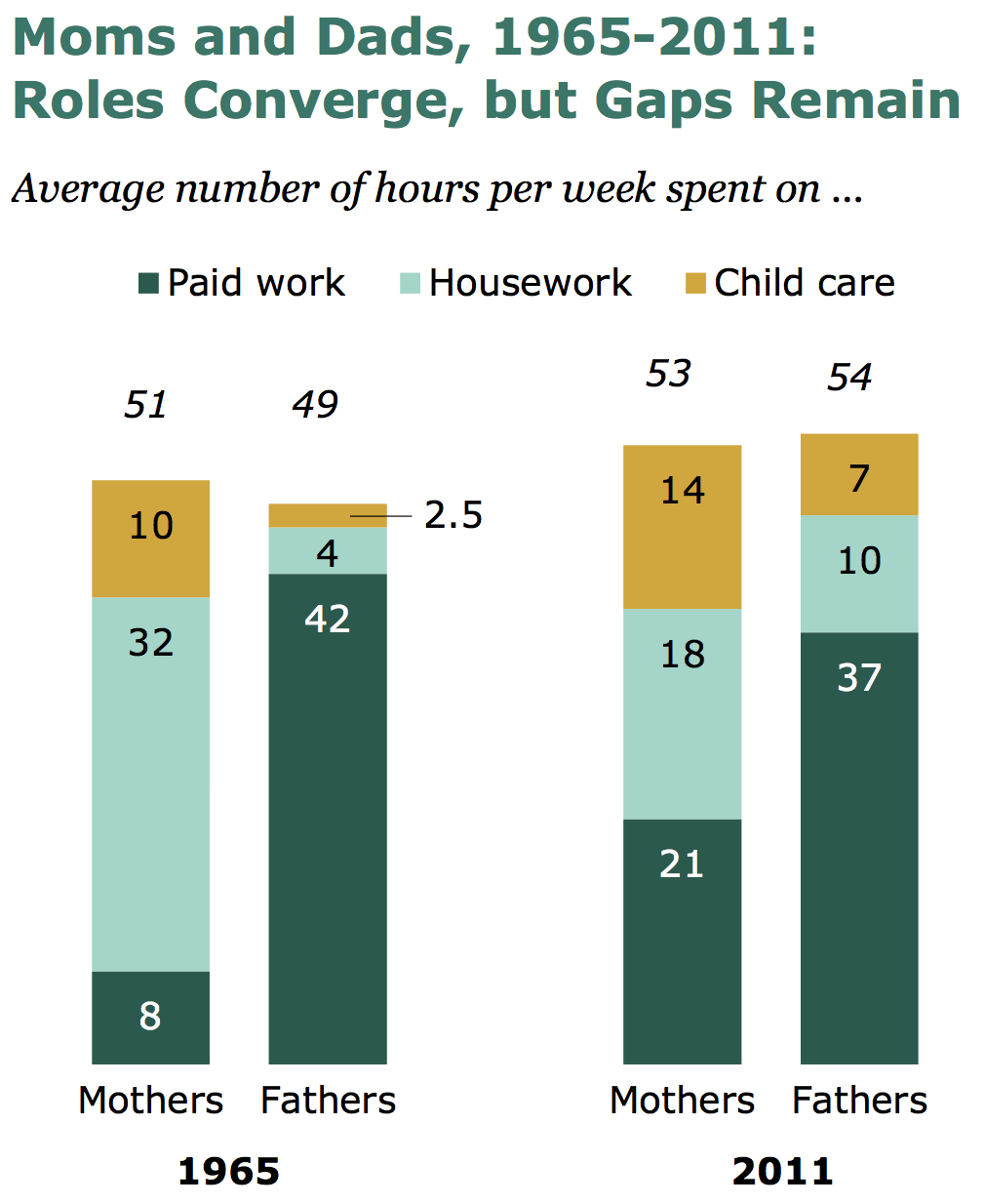
Work week by sex

Lisa Miller sticks up for feminist stay-at-home moms:

Feminism has never fully relieved women from feeling that the domestic domain is theirs to manage, no matter what else they’re juggling. There is a story, possibly apocryphal yet also believable, of an observer looking over Secretary of State Madeleine Albright’s shoulder during a Cabinet meeting in the late nineties. On the pad before her, the secretary had written not “paths to peace in the Middle East” but “buy cottage cheese.” (Albright declined to comment for this story, but while promoting a book in 2009, she told an audience that all her life she made it a point always to answer phone calls from her children, no matter what else she was doing. “Every woman’s middle name is guilt,” she said.)

Jessica Grose objects to the premise of Miller’s article and reframes the issue:

[W]hen you strip away the weird gender essentialism and the fact that the article is ginning up a trend where there is none, you do see the core of what the current “problem that has no name” is. It’s time. When you’re in a marriage where both people have not-extremely-lucrative careers and you throw a child into the mix, something, someone has to give. As Miller puts it, “When two people need to leave the house at 6 a.m., who gets the children ready for school? When two people have to work late, who will meet that inflexible day-care pickup time? And who, finally, has the energy for those constant transactions?” No wonder some families are deciding one parent will take on primary responsibility for the kids in this morass.

(Chart from Pew)

How Likely Is Immigration Reform?

Rand Paul has announced his support for a pathway to citizenship. Chait upgrades immigration reform’s chances:

If figures like Rubio look around and see other Republicans edging for the exits, they’ll in turn beat a retreat.

As of now, though, all the 2016 contenders can support a bill in the anticipation that their major rivals will be locked in to the same stance. The most plausible vehicle for a grassroots insurgent candidacy was Paul, who had harnessed his father’s grassroots appeal with shrewd cultivation of the party elite. With Paul signed up with the pro-reform cartel, nobody is going to make Rubio, Bush, or Ryan nervous, which means there’s little right now to stop a bill from passing the House this summer.

When Your Dog Gets A Personal Trainer

Joshua Rothman profiles “dog runners”:

The market for dog runners, [Running Paws manager Joshua] Stine explained, is more specialized than the market for dog walkers. Running Paws has four kinds of customers. There are owners of aggressive or over-active dogs—dogs “who need some type of physical or mental release.” There are fitness enthusiasts: “people who, I guess, kind of, in a sense, project onto their dogs. They like the idea that their dog is jogging while they’re at work.” Show-dog owners hire Running Paws to keep their dogs in shape: “Some of them have given us a huge amount of credit for the muscle tone, the overall fitness of their dogs.”

And then there are people with overweight dogs. Getting a dog in shape, Stine said, can be surprisingly easy. “Dogs being animals, they bounce back far more quickly to an athletic state than a person.”

Tick-Tock

Rob Tisinai identifies one reason various conservative politicians are suddenly voicing their support for marriage equality:

Imagine you’re a conservative. And you support marriage equality. And you’ve been silent. But now you realize this may be your last chance to say you supported same-sex marriage before it becomes the law of the land. How mortifying must it be to know you sided the angels with the great civil rights struggle of our day, but that no one will ever believe you?  To know you’re on the right side of moral history, but might be seen for the rest of your life as one of its opponents? To know you believe in the American ideals of freedom and human dignity, but sat out this historic struggle to turn America into a more perfect union?

How mortifying must it be to know you are right, but your silence now could brand you forever as having been deeply and morally wrong?

Frum, Greenwald And Iraq

US Secretary of Defense Donald Rumsfeld

Frum reflects, at length, on the Iraq War. This is where it gets really interesting:

The last time I saw Chalabi was in his London apartment, on the very eve of war. My little group arrived past midnight. Chalabi was listening to the evocative strains of Sufi music. He showed me a black-and-white photograph of seven men, wearing the clothes of the 1940s. They were the board of directors of a company his father had founded: a mixed group of Sunni, Shiite, and Christian, and even a Jew. Chalabi remarked that this picture was taken while Europe was tearing itself apart in genocidal violence. He didn’t add that it was taken shortly after British forces defeated a pro-Axis coup in Baghdad—but failed to prevent a murderous pogrom against Baghdad’s Jewish population.

I was less impressed by Chalabi than were some others in the Bush administration. However, since one of those “others” was Vice President Cheney, it didn’t matter what I thought. In 2002, Chalabi joined the annual summer retreat of the American Enterprise Institute near Vail, Colorado. He and Cheney spent long hours together, contemplating the possibilities of a Western-oriented Iraq: an additional source of oil, an alternative to U.S. dependency on an unstable-looking Saudi Arabia.

Greenwald claims this is proof the war was for oil, not against WMDs. But the two are not mutually exclusive. As for good faith, I’ve long since stopped believing that Dick Cheney believed there really were WMDs in Iraq – but I remain unsure about Bush. (As the archives show, I was seriously convinced by the WMD argument, because I wanted to be convinced, i.e. a useful idiot). But Glenn is not done with David, though:

Frum claims that he “was less impressed by Chalabi than were some others in the Bush administration”. But, as Ruben Bolling just reminded me, Frum wrote a long and angry defense of Chalabi in 2004 at National Review, hailing him as “one of the very few genuine liberal democrats to be found at the head of any substantial political organization anywhere in the Arab world”, and ended with this proclamation: “Compared to anybody [sic] other possible leader of Iraq – compared to just about every other political leader in the Arab world – the imperfect Ahmed Chalabi is nonetheless a James bleeping Madison.” James bleeping Madison. Whatever attributes characterized David Frum back in 2003 and 2004, a skeptic of Ahmed Chalabi was not one of them, his present-day suggestions notwithstanding.

(Photo: US Secretary of Defense Donald Rumsfeld (C) speaks to the media with Ahmed Chalabi (R), leader of the Iraqi National Congress, and Paul Bremer (L), top US civilian administrator in Iraq, prior to a meeting of the new Governing Council in Baghdad on September 6, 2003. By Rabih Moghrabi/AFP/Getty Images)

Is Iraq The GOP’s Vietnam?

Daniel McCarthy makes the case:

While Republicans wage a war on the past, Barack Obama has staked claim to the future—in the same way that Richard Nixon and Ronald Reagan once did. The reputation for competence in wielding power that Nixon (before Watergate) and Reagan accumulated now accrues to Obama’s advantage. He brought the troops home from Iraq—however reluctantly—and is on course to end the war in Afghanistan next year. His foreign policy, like Nixon’s and Reagan’s, involves plenty of military force. But like those Republicans, the incumbent Democrat has avoided debacles of the sort that characterized the administrations of Lyndon Johnson and George W. Bush.

Millman pushes back:

I’m unconvinced that Vietnam is the key reason why the Democrats lost their status as the majority party. Rather, I believe it was overwhelmingly domestic policy considerations – and particularly the nexus of race and crime – that overwhelmingly drove the “Silent Majority” into the arms of Richard Nixon, and, subsequently, motivated the Democrats of Macomb County, Michigan, to pull the lever for Ronald Reagan.

That doesn’t mean Vietnam was irrelevant, but in the absence of the currents of domestic social change, I suspect the Vietnam debacle would have looked more like, say, the Korean War, the memory of which did contribute to the Democrats’ losses in 1952 and 1956, but did not lead to a long-term realignment.

Larison’s view:

The war was instrumental in driving younger voters away from the GOP and into the Democratic coalition in 2006 and 2008, and most of them have remained there since then. Of course, Iraq was not the only thing about the Republican Party and mainstream conservatism that alienated Millennials, but it is correct to say that the Iraq war increased and hastened Millennial alienation from both. The important point is that the GOP was already going to be struggling to appeal to a more diverse, more liberal younger generation, and a foreign policy defined by the Iraq debacle has made that task even more difficult. So the sobering thing for Republicans to consider is that the Iraq war is a liability for them with Americans of all ages, and it has already proven to be a disaster for them with younger voters.

I wonder how that may affect the GOP’s clear desire for a new Middle East war against Iran. For the first time, I suspect, the party will be deeply split between the Paul and Rubio camps. Which is when it gets really interesting – and when America’s decision to remain the global hegemon for the indefinite future will come under the deepest strain.