The “Bush” Stigma

US President George W. Bush (R) is embra

After watching Jeb Bush’s Sunday show interviews, Beinart was convinced that “Jeb Bush will never seriously challenge for the presidency—because to seriously challenge for the presidency, a Republican will have to pointedly distance himself from Jeb’s older brother”:

No Republican will enjoy credibility as a deficit hawk unless he or she acknowledges that George W. Bush squandered the budget surplus he inherited. No Republican will be able to promise foreign-policy competence unless he or she acknowledges the Bush administration’s disastrous mismanagement in Afghanistan and Iraq. It won’t be enough for a candidate merely to keep his or her distance from W. John McCain and Mitt Romney tried that, and they failed because the Obama campaign hung Bush around their neck every chance it got. To seriously compete, the next Republican candidate for president will have to preempt that Democratic line of attack by repudiating key aspects of Bush’s legacy. Jeb Bush would find that excruciatingly hard even if he wanted to. And as his interviews Sunday make clear, he doesn’t event want to try.

(Photo: US President George W. Bush is embraced by his brother, Florida Governor Jeb Bush, at University Air Center 31 in  Gainesville, Florida on October 2004. By Stephen Jaffe/AFP/Getty Images)

Quote For The Day

“The interesting thing about the New Albion was that it was so completely modern in spirit. There was hardly a soul in the firm who was not perfectly well aware that publicity – advertising – is the dirtiest ramp that capitalism has yet produced. In the red lead firm there had still lingered certain notions of commercial honor and usefulness. But such things would have been laughed at in the New Albion. Most the employees were the hard-boiled, Americanized, go-getting type to whom nothing in the world is sacred, except money. They had their cynical code worked out. The public are swine; advertizing is the rattling of a stick inside a swill bucket. And yet beneath their cynicism there was the final naivete, the blind worship of the money-god,” – George Orwell, Keep The Aspidistra Flying.

(Hat tip: Shafer.)

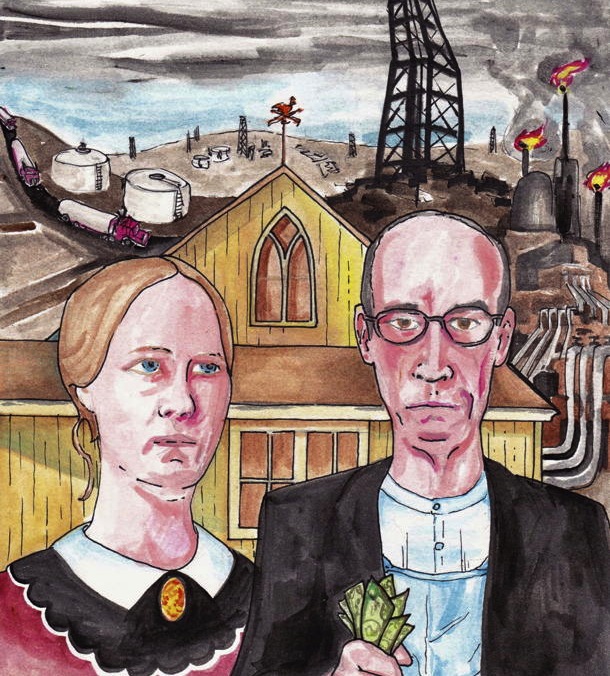
Frack, Baby, Frack

american-gasland

Kevin Bullis makes the case for fracking as the least worst alternative to the more carbon-heavy alternatives:

The USA is the global climate leader, while Europe and Germany are returning to coal. The main reason is gas, which increased last year by almost the exact same amount that coal declined.” Fracking certainly isn’t without its problems (see “Can Fracking Be Cleaned Up?” and “Measuring the Climate Impact of Natural Gas”).

But if fracking is done properly, the natural gas power it supports can better for the environment than coal power. So why are so many environmentalists against it? Part of the reason may be that some environmentalists are comparing fracking not to coal but to solar and wind power, on the assumption that we could easily abandon fossil fuels for renewables. That’s a mistake. Solar and wind aren’t yet ready to replace even a large fraction of fossil fuel power. Costs need to come down, especially for solar, and we need better ways to deal with the fact that the sun doesn’t shine at night and the wind is unreliable. It will also take a long time to build enough solar panels–in spite of phenomenal growth recently, solar power still provides less than a percent of electricity.

(Image by River Side courtesy of Marcellus Outreach Butler, July 2011.)

How Can Obamacare Be Improved? Ctd

After diving into the latest Congressional Budget Office projections for Obamacare, Jed Graham predicts an ominous future for the exchanges set up by the law:

CBO projections now not only imply that the subsidized exchange pool will shrink more precipitously, but the average benefit will rise 5.7% a year — faster than the 5% seen last August. This combination of fewer beneficiaries and faster benefit growth implies that low-income and older beneficiaries will make up an increasing share of the insurance pool. ObamaCare subsidies rise with age and decline as incomes rise; falling to zero for households who earn more than 400% of the poverty level. …

CBO’s new forecasts suggest more healthy people will opt not to pay an ever-growing chunk of their income, when they can pay a smaller fine and still get the same coverage at a fixed price when they need it, perhaps with a several months delay. More people who skip coverage will be exempt from the mandate because minimum coverage exceeds the law’s affordability threshold, the CBO noted.

Justin Green sees an easy-to-miss opportunity for Republicans:

Attention Eisenhower conservatives: this might just be your moment to offer reforms to fix ObamaCare. Just maybe. Instead, we’ve got Marco Rubio joining Ted Cruz’s effort to defund ObamaCare. Can such a push work?

Weigel unpacks the reasoning behind what he calls an “empty threat”:

Rubio’s ploy is easy to understand. He’s trying to push through an immigration reform bill that’s anathema to Republicans. His most famous co-sponsors, John McCain and Lindsey Graham, spent yesterday attacking Rand Paul for a filibuster that the base embraced immediately. So he needs to get behind the occasional stunt.

Previous Dish on Holt-Eakin and Roy’s suggestions for improving Obamacare here.

“It’s Not An Ad, It’s Thought-Leadership”

Shafer tackles sponsored content:

When Web publishers deliberately blur the visual and textual divide that separates editorial from advertising, as The Atlantic did, they force readers to judge whether a page is news/opinion or a commercial advertisement. But they’re not confused; it’s the publisher and the advertiser who are confused. The publishers and advertisers have polluted their own tradition by erasing the traditional line. Suddenly, it’s completely reasonable for readers to blame controversial news stories directly on advertisers and blame controversial advertisements directly on reporters and editors, because publishers and advertisers have essentially merged operations. Such calamities injure both publisher and advertiser, even already controversial advertisers like Scientology …

I’m not an absolutist. I’ve never feared advertising that advertises itself as advertising. I’m prepared to accept that an advertiser could produce content worthy of my time, though I’ve yet to witness that miracle. I don’t even fear “thought leadership,” as long as the wallet financing the composition and promulgation of the thoughts can be identified, as was the case when Herb Schmertz, Mobil Oil’s vice-president for public affairs, routinely published his company’s “low-key advocacy ads” on the New York Times op-ed page beginning in the early 1970s. Just make sure I can see the line.

As a great wag once said, a newspaper is nothing but an advertisement with a news story printed on the back. That arrangement has worked well for American publishers, readers and advertisers for two centuries. But can it work if you have to guess which side contains the ad?

Three cheers for Shafer writing that stuff for Reuters. It’s amazing how little public debate this media-corporate whoring has generated … in the press. Writers at the Atlantic have been formally warned not to talk to anyone from the press. And you can see why: the “sponsor-content” press doesn’t want to expose its sordid desperation. Which itself lends credibility to the idea that the Fourth Estate – if it cannot easily be distinguished from corporate and government power – is fast disappearing.

This is not about media narcissism. It’s about a critical independent pillar of our democracy, a truly independent press, a pillar that is being demolished even by magazines with as distinguished a past as the Atlantic.

The Dish’s sponsored content thread can be read in full here.

Holy Father, Holy Mothers, Ctd

As all old men in frocks deliberate about which one of them will become Pope, one obvious thing is missing: half of humanity. That half was not missing in the Synoptic Gospels, John’s or the less reliable Gnostic ones. A former priest, now scholar and anam cara – friend of the soul – John O’Donohue, in an interview worth reading in full, here touches on the Church’s problem with women:

Before I criticize it, let me say what I love about the Catholic Church. I think the seven sacraments are the most beautiful liturgical rituals. The Christian mystical tradition is populated by such giants as Meister Eckhart, John of the Cross, Hildegard von Bingen, and Julian of Norwich. The dogmas of the Catholic Church are sophisticated, poetic, speculative doctrines; they invite imagination, not  dogmatism. I love Magdalen_with_the_Smoking_Flame_c1640_Georges_de_La_Tourthe Church’s teaching on the communion of saints. I love the theology of the Trinity, which is not often preached because it is such a complex thing, yet it remains one of the most exciting discoveries of the nature of the divine.

On the other side, I do not trust the Catholic Church with Eros. I never did, even when I was a priest. The Church does have a pathological fear of the feminine. It would sooner allow priests to marry than it would allow women to become priests. This awful mistrust of the feminine goes all the way back to Genesis, where Eve is blamed for offering the apple to Adam. And the doctrine that a woman, after giving birth to a child — the most beautiful thing a human being can do — has to go to the Church to be cleansed: this is a demonization of women that I cannot understand.

All extremes create a mirror of themselves. So when you have the demonization of the feminine, you also have the crea­tion of the ideal feminine type: Mary as the perfect woman, on whom no stain of mortality — or complexity — was allowed to fall. None of the awkward, subtle, different, or dark faces of the feminine were allowed near her image. I think it’s a shame, and it has consequences. I think the Church is in danger of losing women. As I’ve said for the last twenty years: if tomorrow all the women in the Catholic Church decided to walk, the Church wouldn’t last three months.

Catholic Judith O’Reilly’s desperate thoughts on the same question can be read here.

(Painting: Mary Magdalen, Magdalen with the Smoking Flame, Georges de La Tour, 1640.)

The Climate Game-Changer

This graph seems to me to reconcile aspects of legitimate skepticism with a devastating reality. Here’s the earth’s temperatures going back 11,000 years – far further than the 2,000 years previously viewed in popular culture as the “hockey stick”. You can see that stick at the far right of the following graph:

marcott-B-MJ

So, yes, the earth has been warmer than it now is while humans inhabited it. Yes, climate has shifted over the millennia, depending on a variety of non-human factors which could also be affecting us now. Yes, in the last half a millennium, we hit what was described as a mini-ice-age, bringing temperatures down to record lows for ten millennia. In 1683, for example, the river Thames was frozen completely for two months. Here’s a painting of the river in 1677, as the Little Ice Age, as we now call it, set in:

The_Frozen_Thames_1677

I can remember a cover-story in the New Republic predicting a new ice age in the 1980s – based on the long-term chilling of the planet. So you can see why those urging against hysteria have some historical climate variety to argue that change has always been here and that humans have lived on the planet for 2000 years and adapted to similar temperature variations before. So chill out, and keep drilling.

The problem with that reassuring scenario, as Tim McDonnell points out, is that we have never before experienced this sudden rate of heating before ever – certainly not since humans developed agriculture. It’s getting close to a vertical line now, which suggests to me that the likelihood of feedback loops actually intensifying the heat has also gone up.To put it mildly, I can see no external reason why the earth’s temperature would have suddenly gone haywire in the last 500 years, without factoring in carbon, capitalism and the industrial revolution. For a while, that carbon actually warmed us up out of a millennial-long cooling. But now, it’s out of control. And if you begin to imagine the impact of every Chinese or Indian reaching the same level of prosperity as Western Europe, using the same carbon sources of energy, we are clearly putting the planet through a stress test never before imposed by its inhabitants.

To be perfectly frank, this graph shows our civilization to be unsustainable unless we dramatically alter its source of energy. Maybe we can adapt – in ways our ancestors did. But they were able to do so over much, much longer periods of time, and were not actually creating the situation.

We have become gods. And we are destroying what we inherited as a species. I do not have an answer, and suspect only a technological breakthrough in energy resources will make a difference real enough to stop this looming catastrophe. But that this isn’t the priority of every government on Earth right now (apart from Russia and Canada) is beyond me. And a carbon tax – the simplest clearest inhibitor of turning our planet into an oven – would be a start.

But What If Three People Love Each Other? Ctd

800px-Joseph_F._Smith_family

Readers are responding to this post in droves. Below are all their best arguments against legal polygamy (with pro arguments coming shortly):

Your readers debate the polygamy objection to gay marriage, but they both miss the actual answer that has been provided by the courts a long time ago – and it makes perfect sense.  Bans on polygamy are constitutional because the discrimination is purely numerical and thus applies equally across racial and gender lines, etc.  The law says you can only have one spouse, and that law applies to blacks, whites, men, women and, yes, ultimately heterosexuals and homosexuals.  It is the same reason it is constitutional to legislate an age when you can marry, an age before you can vote, or the maximum speed that you can drive on a highway.

All laws discriminate in some sense.  But purely numerical discriminations do not discriminate based on a person’s inherent nature and, thus, are (usually) constitutional.  Its also why it is possible (if not necessarily advisable) to criminalize polygamy. Society is free to decide that polygamy is an accepted marital arrangement.  Indeed, we already accept serial polygamy (e.g., Newt Gingrich).  But constitutional considerations would be implicated if society tried to legislate that only whites or only heterosexuals could be polygamous.  At bottom, the polygamy question is a red herring to the gay marriage debate.

Another:

In addition to the excellent response from another reader which you posted, I have to add this: In societies that previously recognized polygamy, it was almost exclusively polygyny and not polyandry; a man could have more than one wife, but no wife could have more than one husband. I’m going to assume that we’re doing away with that scenario on the basis of gender equality alone, but a quick look at the details of what polygamous marriage would look like makes it clear why polygyny (provided legal gender inequality) is actually manageable but generalized polygamy isn’t in most cases.

Let’s do away with genders and just talk about three people, A, B, and C.  Person A wants to have a polygamous relationship with B and C.  In the US, the primary legal result of marriage is the formation of a single legal household entity that encompasses two people.  So, if A and B become one household, and C marries A, are B and C now married too?  If not, you have a legal mess on your hands that should be obvious.  And it gets worse if C wants to marry D as well, but A and B do not.

There is an argument to be made for “group marriage,” where an arbitrary number of people enter into a marriage contract with each other. Let’s also provide that any individual can voluntarily “divorce” him or herself from that married household.  I could see a legal basis for this, although my question would be: does this even resemble anything that we would call “marriage” anymore?  Is there any way in which the complex group dynamics inherent in human nature don’t split this “marriage” into factions?  And for that matter, what really is needed here that isn’t provided by, say, incorporation?

Perhaps there’s an argument to be made for arbitrary “adoptive families” that aren’t families at all.  For a less explosive example, let’s imagine two unrelated people who come to cohabitate as siblings and not romantically or amorously.  In the same way that four co-“married” polyamorous individuals might want hospital visitation rights and inheritance rules, these two people might want some protections without being married.  I can see an argument for that, but I can’t see calling it marriage.

Another way to look at it:

The reason for a two-person marriage works much better than three-person marriage is not due to government policy. It is entirely social. Pardon me going all geeky here but this is how I think:

Three-unit systems where all equal to each other are inherently more unstable than just two-unit systems. Imagine that the probability of two people having a great interpersonal relationship is x. In a two-unit system, probability of stability is x. But in a three unit system it has to be x to the power of 3, since three relationships have to be great. Note that x is less than 1. So x^3 is much much less than x. A stable society can not function with such a high divorce rate.

In ancient societies and in some places even now, polyandry and polygamous marriages are traditional. They work because of special social circumstances and in lot of cases one or more of the persons in the marriage has more weight than the rest and they stay cohesive only because of those special circumstances. Once everybody wants equal weight, things will collapse.

Another points to a variety of complicated scenarios:

What happens if Wife #1 wants a divorce but Wife #2 objects? When the husband dies, are the two women still married to one another? Does the estate get disbursed or do they have to keep on sharing it? The assumption is that if it’s one man and two women, if one of the women dies the remaining man and woman are still married. What do you do in community property states? What happens in the community property state when Wife #2 dies during the middle of the divorce of Wife #1. Does the husband get to keep everything or does the about-to-be-divorced wife get half instead of one-third? If they were divvying up things three ways before she died and she does it three hours before the final decree does the surviving wife have a half interest in the third? What about if she dies three hours after? The husband dies before both wives. Do the kids of Wife #1 get a say in the end-of-life decisions being made about Wife #2?

Another runs through a similar series of situations and concludes:

We do not have the laws in place to support plural marriage. I don’t know for sure, but I suspect that most of the countries that do allow plural marriage allow only one form of plural marriage: a single man and multiple wives. Our constitution will certainly not allow that restriction if we decide to go down that road. We would have to build those laws, and I don’t think we have anyone wise enough to craft laws to cover a fraction of the situations that would develop. People who want some sort of a plural marriage will have to resort to lawyers and contracts to formalize their relationships on a case-by-case basis. I realize that is what people used to say about same sex marriage. The difference between the two situations is that we already have a body of law to govern the marriage of two people.

One more for now:

Please continue to make a clear distinction between gay marriage and polygamy.  The best argument for gay marriage is that it harms no one and is good for gay people and their children.  No one has managed to come up with even a shred of evidence that gay marriage is harmful to anyone, and not for want of trying.  Polygamy, on the other hand, is demonstrably bad for women and children, in ways that go far beyond creating a surplus of unmarried men.  An excellent resource on this topic is A Cruel Arithmetic: Inside the Case Against Polygamy, by Craig Jones.

(Photo: the full family of one Joseph F Smith, c 1900, a known polygamist. This picture depicts members of his family, including his sons and daughters, as well as their spouses and children. Via Wiki.)