Face Of The Day

CORRECTION-SINGAPORE-ANIMAL-ORANGUTAN

A female Bornean orangutan named Mari is seen with her still-to-be-named son at the Singapore Zoo on March 6, 2013. The baby orangutan was born on January 21 at the zoo – the 40th orangutan birth to date – which has the largest social colony of endangerd Sumatran and Bornean sub-species orangutans. By Roslan Rahman/AFP/Getty Images.

Freelancing In The Digital Age

Earlier this week, freelance journalist Nate Thayer publicized an attempt by The Atlantic to get him to repurpose one of his recent articles into a new post, an offer he vehemently rejected once he learned they were not willing to pay him for it. Felix uses the case to take a broader look at the online freelance journalism scene:

The exchange has particular added poignancy because it’s not so many years since the Atlantic offered Thayer $125,000 to write six articles a year for the magazine. How can the Atlantic have fallen so far, so fast — to go from offering Thayer $21,000 per article a few years ago, to offering precisely zero now?

The simple answer is just the size of the content hole: the Atlantic magazine only comes out ten times per year, which means it publishes roughly as many articles in one year as the Atlantic’s digital operations publish in a week. When the volume of pieces being published goes up by a factor of 50, the amount paid per piece is going to have to go down. …

[In digital], everybody does everything — including writing, and once you start working there, you realize pretty quickly that things go much more easily and much more quickly when pieces are entirely produced in-house than when you outsource the writing part to a freelancer. At a high-velocity shop like Atlantic Digital, freelancers just slow things down — as well as producing all manner of back-end headaches surrounding invoicing and the like. The result is that Atlantic Digital’s freelancer budget is minuscule, and that any extra marginal money going into the editorial budget is overwhelmingly likely to be put into hiring new full-time staff, rather than beefing up the amount spent on freelancers.

Alexis sees both sides of the freelancer coin:

[T]he truth is, I don’t have a great answer for Nate Thayer, or other freelancers who are trying to make it out there. It was never an easy life, but there were places who would pay your expenses to go report important stories and compensate you in dollars per word, not pennies. You could research and craft. And there were outlets — not a ton, but some — that could send you a paycheck that would keep you afloat. … I don’t like to ask people for work that we can’t pay for. But I’m not willing to take a hardline and prevent someone who I think is great from publishing with us without pay. My main point and (to be normative about it) the main point in these negotiations is this: What do you, the writer, get out of this?

But the fact is, a lot of people *do* get stuff out of it. They’re changing careers into journalism, say. Or they’re a scholar who wants to reach a broader audience. Or they’ve got a book coming out. Or they’re a kid who begs you (begs you!) to take a flier on them, and you have to spend way too much time with her, but it’s worth it because you believe she’s talented, even if you know the story isn’t going to garner a big audience.

The Sanitation Worker Closet, Ctd

A reader writes:

For five years I directed the BBC’s top hidden camera show. One of our secrets to avoiding detection was to disguise our production stuff with sanitation outfits/men working coveralls. As Nagle points out in your post, it wasn’t the case that the people we pranked saw our production stuff yet ignored them because they were “common”. I’d argue they literally didn’t see them – the brain filtered them out before their existence reached the level of human awareness.

Another reader:

I worked on a production here in Austin that addressed this problem a couple years ago. Andy Garrison made a film about it, Trash Dance, and it’s won several awards at festivals and is about to be broadly released. The effect of the project was immense. People suddenly started asking their trash people their names, waving to the trucks and appreciating all the hard work they do to keep the city looking good. It was such a coup for Solid Waste Services, they asked us to do it again as a repeat performance, and it was even more successful the second time.

Another;

For a great Australian movie on the subject, see Kenny.

Trailer above.

On The Edge Of Their Ballots

KENYA-VOTE

Kenya is currently awaiting the results of its first election in years following voting on Monday. Traci Oshiro sets the scene:

The last time Kenya held elections in 2007, about 1,000 people were killed and thousands more injured. Violence has also marked this election with 19 killed this past Monday, attacks attributed to separatists. IEBC chairman Issack Hassan at a press conference called for people to “resist making early judgments about who has won,” and said final results would not be released for 48 hours. … A candidate must get 50% of votes cast plus one vote in order to win outright, in addition to at least 25% of votes in half of Kenya’s 47 counties. If no-one achieves that, the vote will go to a run-off, probably on 11 April.

Early results show Deputy Prime Minister Uhuru Kenyatta leading Prime Minister Raila Odinga. The International Criminal Court has charged Kenyatta with crimes against humanity for his role in the violence surrounding the 2007 election. Neha Paliwal highlights efforts to prevent a recurrence of that bloodshed:

In one of the most interesting monitoring initiatives surrounding the election, Uchaguzi, the electoral arm of the data visualization company Ushahidi, has used crowdsourced reports to collect information on irregularities happening around the country. Through Twitter, email, and a form on Uchaguzi’s website, Kenyans have submitted more than 4,456 messages from almost 1,700 locations. After going through an approval and verification process, these citizen-generated reports have helped paint a clearer picture of how the election really went.

Violence has been reported … in Nairobi, Nyeri, Kipsigak, Naivasha, and Mombasa, but most mishaps in the country seem to have stemmed from administrative failures and problems with new biometric voter registration machines that were meant to modernize the process.

Despite such problems, Duncan Onyango was inspired by how well the voting seemed to go:

We are in a crucial period right now and it is palpable. However, I – along with so many Kenyans – am hopeful that peace will endure. I say that because of how strikingly different this election feels compared with 2007. On Monday morning, I thought I’d be among the first to vote but there were others with a better idea – I understand that some people queued up at 3AM. Voter turnout estimates ranging from 70 to even 88 percent show that Kenyans were eager to exercise their democratic rights. Most importantly, it’s a clear sign that they’ve overcome the cynicism that followed the 2007 general elections. The queues were long but good-humored, a little disorganized at first (which caused significant frustrations at some polling stations) but things moved smoothly overall.

Meanwhile, Solomon A. Dersso worries about the number of rejected ballots that “could make a difference between winning and losing” and seemed related to confusion over the poorly differentiated color-coding of ballots and ballot boxes. Gregory Warner notes that voters with color blindness, as much as 4% of the population, were especially likely to have been disadvantaged. The number of rejected ballots has since dropped significantly, but Odinga’s campaign is now alleging that the results have been doctored. In 2007, Odinga made a similar claim that sparked the violence.

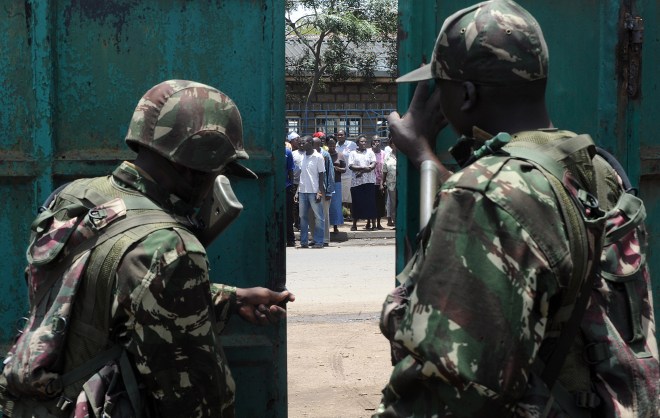
(Photo: Kenyan paramilitary soldiers stand guard outside of a polling station as ballot-counting continues on March 6, 2013 in Mathare slum, in Nairobi. By Simon Maina/AFP/Getty Images)


Gambling On Syria

The US is giving $60 million [NYT], but not weapons, to the Syrian rebels just as the EU is set to provide military training. Jon Lee Anderson views this as a calculated bet:

Syria’s diverse armed opposition is too engaged in war with the Syrian regime to be truly assessed, monitored, and somehow “made safe” in exchange for U.S. support, and that seems unlikely to change soon. This is a hydra-headed war, a bit like a high-stakes poker game, and the best Washington can likely do is take a deep breath and sit down at the table to try its hand, hoping to make some profit by doing so and not lose the family farm in the process.

Paul Mutter also checks in on Syria:

According to Syria Comment’s Joshua Landis, one of the main reasons the US government continues to demonstrate great reticence in openly backing any rebel force diplomatically, let alone militarily is because “the sort of received wisdom in Washington today is that Syria is going to become Somalia because all of these groups are going to end up in an extended civil conflict once they get through Assad.” Landis explains that “the main groups from the Islamic front [rivals to the FSA, and likely the preferential recipients of aid from the Gulf states] are trying to find [more] common ground, and these Salafists are willing to push aside Jahbat al-Nusra” despite a burst of initial support for it when it was designated a terrorist organization by the US. The foreign fighters’ haughty disdain for their Syrian brothers-in-arms, it appears, are playing a large part in the increasingly negative response to their presence in Syria.

The Beltway calculus is, he says, that “to pick an effective winner in Syria, you need to be able to pick an Islamist” and the White House does not think it can sell anyone in Syria that way to justify a more direct role.

Michael Weiss argues the policy of “non-lethal” aid an illusion, since smaller states and regional allies are already funding the opposition, possibly with America’s backing:

[Weapons] have apparently been purchased by Saudi princes and delivered to Jordan for distribution into Daraa, though they’ve lately been popping up all over the country, including, alas, in the hands of Ahrar al-Sham. Croatian newspaper Jutarnji List, reported that four cargo shipments were documented on December 14th and 23rd, January 6th, and February 18th. That fine publication even went to the trouble of producing a photograph of a Jordanian transport aircraft sitting on the tarmac at Zagreb’s Pleso airport. Croatia’s foreign ministry vehemently denies conducting business with any sheikhs for the purpose of any Arab revolution, yet sources tell me that prior to authorizing these arms sales, Croatian diplomats toured Washington asking US officials for their permission to do exactly that. They evidently got it. So, in effect, Washington is already involved in exactly the kind of “militarization” of the opposition it publicly claims to abjure as it still holds out for a “peaceful” transition of power.

Alia Brahimi takes this strategy as confirmation that the US has given up on any chance for negotiation or diplomacy with Russia and China:

Perhaps the US now fears that the radical Islamist flag is rising in Syria, with or without US intervention. Thus, the attempt to shore up more democratically inclined/”US-friendly” fighters is as much aimed at ensuring that US interests are secured in a proxy war, as it is at toppling Assad. This, more than anything, represents a firm acknowledgement that the future of Syria will be settled on the battlefield.

(Video: EA captions: “Residents of al-Raqqa topple statue of late President Hafez al-Assad on Monday”)

Covering Up Climate Change, Ctd

Drum searches for lessons over the shuttering of the NYT’s Green blog and Environment desk:

Obviously the Times editors are going to come in for plenty of criticism over this, and that’s fine. They deserve it. But let’s face it: the reason they did this is almost certainly that the blog wasn’t getting much traffic (and, therefore, not generating much advertising revenue). So a more constructive question is: Why do readers—even the well-educated, left-leaning readers of the Times—find environmental news so boring? Is it because we all write about it badly? Is it something inherent in the subject itself? Is it because most people think we don’t really have any big environmental problems anymore aside from climate change? Or is it because it’s just such a damn bummer to read endlessly about all the stuff we should stop doing because, somehow, it will end up destroying a rain forest somewhere?

Who Is Making The Argument Matters

Partisan Cues

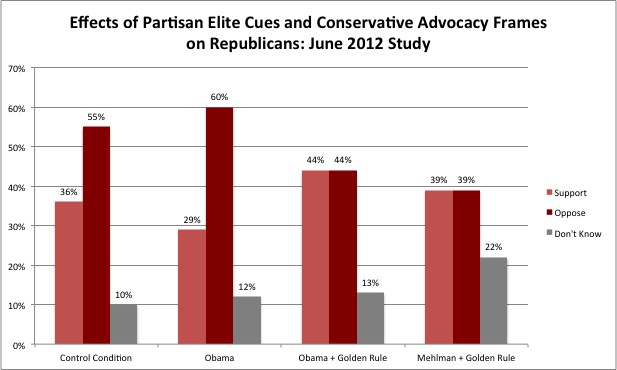
Ashley Koning and David Redlawsk studied whether the conservative case for marriage equality is effective. They “find no evidence that the conservative advocacy frames alone influence Republican support at the mass level.” But:

When we show that [former RNC Chairman Ken] Mehlman supports same-sex marriage and does so for reasons consistent with his partisanship and ideology, it appears to give Republicans “permission” to be more inclined to do the same – or to at least considerably reduce their opposition in exchange for increased indecision. This result suggests that as more Republican elites “come out” in support for the issue, their personal endorsements of the “conservative case” for same-sex marriage may have the potential to change the game among Republicans, who are otherwise lagging greatly as overall attitudes rapidly move in a more supportive direction. As Mehlman states, he fights for same-sex marriage “because [he is] a conservativ[e], not in spite of it.” And that’s likely to be the key to attitude change among conservatives as Mehlman and others lead by example to show that the values underlying same-sex marriage are ones that their fellow partisans already have.

The Dish Model, Ctd

NPR ran a five minute segment on it on All Things Considered yesterday. Check it out. And don’t forget to subscribe [tinypass_offer text=”here”]. It’s total access to the Dish, infinite scroll, infinite search, every post in full. The alternative is a lot of advertizing, less white space, and less time for us to focus on the journalism rather than the business. The more you look around the web and its economic models, the more I feel convinced that we need to start a movement in the direction of actual subscriptions for actual blogazines/blogs/news-sites. The Internet offered us a million different voices. But if they are all tied to corporate dollars, sponsored content and desperation for pageviews, they may all end up in the same noisy, confusing commercial maelstrom. We’re trying to jump-start a saner, calmer, stabler model. And we cannot do it without you.

A nickel a day. Help sustain quality online journalism the old-fashioned way. Subscribe [tinypass_offer text=”here”].

Green Shoots On The Right, Ctd

Spring Snowstorm Hits Northern Scotland

In the wake of Douthat’s column [NYT] noting that “today’s Republicans are more likely to channel Ayn Rand than Thomas Aquinas,” Matt K. Lewis pushes back against the trend of radical individualism, which he sees more as a result of reflexive anti-Obamaism than of sound moral reasoning:

Our founders believed self-imposed responsibility was essential to the preservation of freedom. An immoral majority will eventually discover that they can vote “themselves largess from the public treasury.” But a nation’s elite must also be moral — which is to say, not greedy. As Ed Morrissey noted, “Any society with a large class of exploited poor will have no end of social difficulties and instability, the costs of which in a properly ordered system would far exceed the assistance extended.” That’s the invisible hand at work.

Compassion isn’t just right. It’s also a matter of self-preservation.

But is compassion the right word? Why not “one-nation” conservatism instead? Or inclusive conservatism? Morrissey maintains that the pragmatism is the key to the conservative future:

Instead of reaching back to the past and “compassionate conservatism,” though, Republicans need to start considering an advent of practical conservatism. In practical terms, the entitlement programs we have cannot be dismantled, as Randian purists would prefer. Medicare, Medicaid, and Social Security are too popular for repeal, and more importantly, deliver a level of living standards on which millions of Americans rely — standards that would plummet in these programs’ absence. Instead of denying that, practical conservatism would embrace that — because on the trajectory of current policy, these programs will utterly collapse at some point. There is, after all, nothing compassionate about a default, or about sticking succeeding generations with the bill for benefits we enjoy in the present. …

The “Catholic center” still exists, ready to be claimed. Republicans need to learn from the past, and the present, to grasp that opportunity.

Justin Green cautions:

Morrissey should be careful to distinguish between Social Security, which only needs modest reforms, and Medicare/Medicaid, which will bring serious problems in the medium term. The GOP will give itself credibility by shoring up the program that works and seriously attempting to fix the one that doesn’t.

(Photo: Getty Images)

“Sleep Well My Love”

A deeply poignant letter from WWII veteran Brian Keith to Dave, a fellow soldier he fell in love with stationed in North Africa in 1943. These are the blurred memories of an all-American affair in wartime:

Two lieutenants who were smart enough to know the score, but not smart enough to realize that we wanted to be alone. A screwball piano player — competition — miserable days and lonely nights. The cold, windy night we crawled through the window of a GI theatre and fell asleep on a cot backstage, locked in each other’s arms — the shock when we awoke and realized that miraculously we hadn’t been discovered. A fast drive to a cliff above the sea — pictures taken, and a stop amid the purple grapes and cool leaves of a vineyard.

Later this month, I’ve been honored with an invite to West Point’s gay group. There are times when I cannot truly comprehend the change my generation has lived through. So instead of comprehending, I’m just trying to live it – for all those who, for centuries, couldn’t. And for all those in the future who are already looking back and not understanding any of it. We fought for their insouciance. It hurts at times that they do not know or remember or stop to think what it was like in decades past. But that obliviousness is also a sign of greater and greater integration.

Which was the point, wasn’t it?