The Daily Wrap

[youtube http://www.youtube.com/watch?feature=player_embedded&v=_cpUnUUQF3o]

Today on the Dish, Andrew meditated on the origins of modern conservative thought, saw spectres of the past in Israel’s segregated bus lines, and questioned the recent announcement of a baby “cured” of HIV. In home news, he wrapped up the first 30 days of the new Dish model.

In political coverage, Ta-Nehisi regretted his perceived powerlessness in the march to the Iraq war, while Dreher’s emotions swayed him in favor of it. Peter Person ascribed the slowdown in healthcare costs to the ACA, Adam Gopnik probed the limits of the market, and Jeb jumped back from his published stance on immigration. Seth Masket deliberated over politician perceptions, the GOP gave little ground in their latest budget, while Ponnuru made room in the party for Chris Christie. Scarborough pwned Krugman and the Daily Caller channeled Family Guy in its Ashley Judd coverage. Abroad, the Tories tussled with a perception problem and Syria schools felt the effects of the extended conflict.

In assorted coverage, Seattle weighed a tax on bikes, the cost of flying fell without our noticing, and Vince Beiser pushed back against the idea of “peak oil”. Readers continued the thread on doctor salaries while surgeons honed their skills on their smartphones, Lori Rotenberk went to DIY University, and Judith Glaser tried to wean us off of arguing. Dylan Bergeson dug through archaeological findings in the West Bank, chimpanzees savored their first taste of freedom, and luck loomed large in Hong Kong. Ruth Clark praised Jell-O’s ability to preserve and Evgeny Morozov protested Big Data-influenced punk.

Meanwhile, journalists sold their services to Malaysia, Marie Chaix found inspiration in pain, Madhavankutty Pillai chronicled the troubles of bringing great novels to the big screen, and Twain posed topless. We resorted to the tiebreaker for our Kagoshima VFYW contest and awoke to a Cancun sunrise in the VFYW, Spidey’s romance got the BLR treatment in the MHB, and Misao Okawa celebrated the big 1-1-5 in the FOTD.

– D.A.

The Writer’s Wound

Marie Chaix, a French novelist whose discovery of her father’s collaboration with pro-German fascists spurred her first book, The Laurels of Lake Constance, conveys her understanding of what moves a writer:

I think writing, or art, it comes from an injury. Something happened in your life and it opened a wound. Several times, I tried to write about what was around me. My father being on the wrong side, for one thing. I felt like I was on the wrong side, too. I think I have this guilt that’s not gone, even if I know it’s not my fault. I was a child. I was born in 1942, in the middle of wartime. What could I know? But when I was a seventeen-year-old girl, I felt exactly the same as I felt when I was ten or twenty. I will always be the daughter of a collaborator. I can’t escape that. The pain is in there, somewhere. It’s hidden. Even if I don’t see it in my everyday life…

Writers are very strange people and they need to suffer, I think. It sounds very selfish. I could write about different things, but I think what’s fascinating is that all these events are very simple, right? I don’t know if it’s true about my father, but—separations, love, and no more love. It’s so ordinary, and so all stories have it.

Face Of The Day

World's Oldest Woman Turns 115

Misao Okawa, who is recognised by Guinness World Records as the world’s oldest woman, receives a birthday cake during her 115th birthday celebration at Kurenai Nursing Home on March 5, 2013 in Osaka, Japan. Okawa was born in Tenma, Osaka on March 5, 1898. A descendent of Kimono merchants, she married in 1919 and had three children, of which a daughter and a son are still alive, and four grandchildren and six great-grandchildren. By Buddhika Weerasinghe/Getty Images.

The Deficit Hawks Dig In

Ezra previews the GOP’s budget:

[T]he Republican budget will reflect the newer, even harder-line House GOP. Their last budget didn’t balance until almost 2040. But in order to secure conservative votes to delay the debt ceiling for three months, House Speaker John Boehner and Budget Committee Chairman Paul Ryan promised that the next budget would balance within 10 years. They’re helped in that effort by the “fiscal cliff” deal, which added more than $600 billion in tax revenues to the bottom line. But that’s not nearly enough to get them to balance by 2024. And so they’re going to need to propose much deeper cuts than in their previous budgets. Ryan is reportedly considering breaking the GOP’s promise to keep Medicare unchanged for everyone over age 55.

Jonathan Cohn adds:

With this new budget, Ryan doesn’t appear to be offering new concessions. On the contrary, it looks like he’s making new demands. And plenty of Republicans seem to think this is the right thing to do. That’s perfectly within their rights: They believe it’s best for the country. But it’s a reminder that Republicans aren’t sincerely interested in compromise for its own sake—or in taking more moderate positions on the issues. Yes, the voters delivered a pretty devastating verdict about this agenda just a few months ago. But if the number two guy on the ticket doesn’t seem to care, why should the rest of them?

Map Of The Day

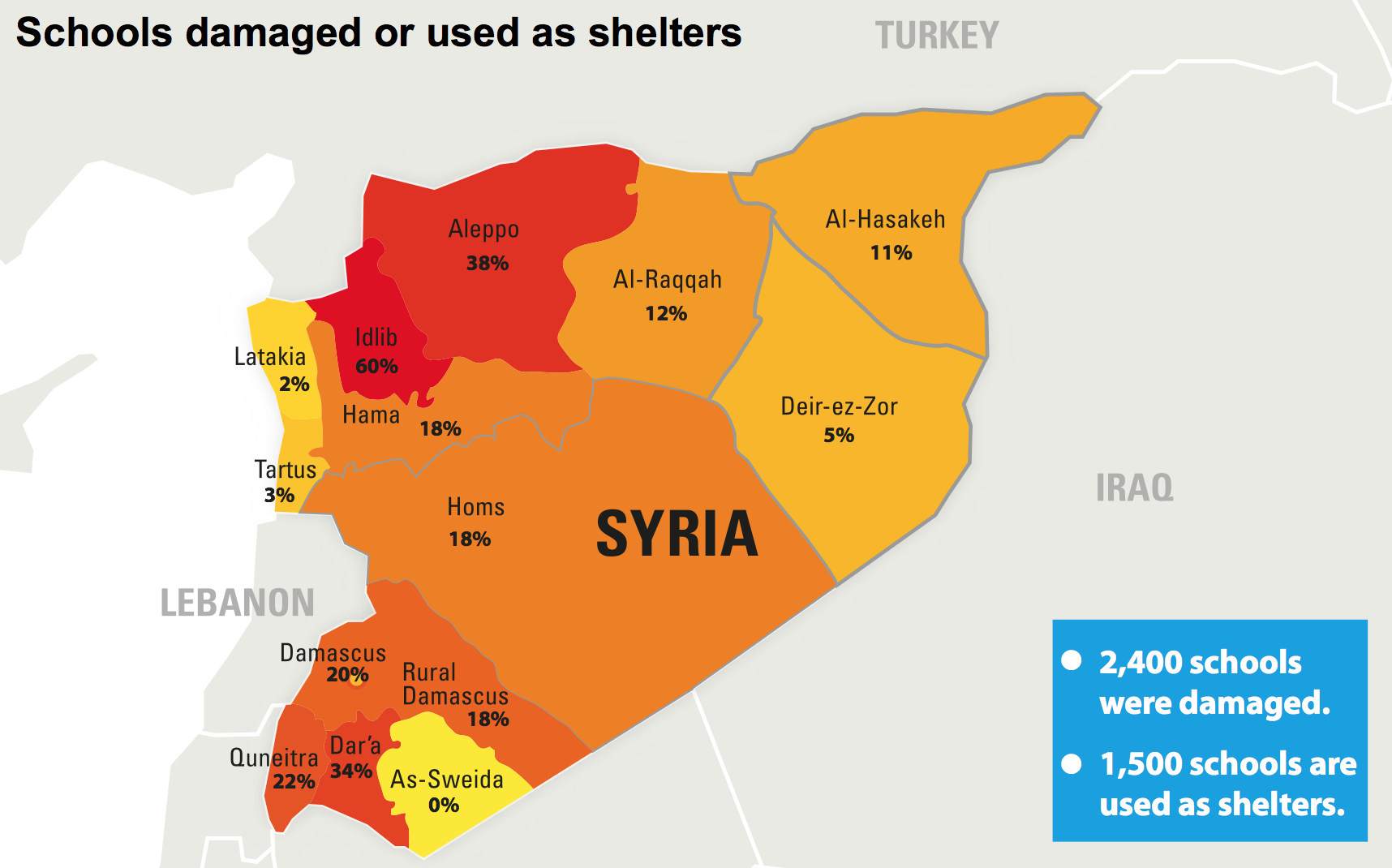
A recent UNICEF report (pdf) finds that Syrian schools are in dismal shape:

Syria Schools

Some key details from the report:

[A]ttendance rates have plummeted — down to 6% in some areas. UNICEF blames insecurity, lack of teachers and resources, and damaged buildings, along with the pressure to drop out and earn an income or get married early.

Peak After Peak

Vince Beiser paints an ugly picture for fossil fuel fighters such as McKibben:

The widely circulated fears of a few years ago that we were approaching “peak oil” have turned out to be completely wrong. From the Arctic to Africa, nanoengineered materials, underwater robots, side-scanning 3-D sonar, specially engineered lubricants, and myriad other advances are opening up titanic new supplies of fossil fuels, many of them in unexpected places—Brazil, Australia, and, perhaps most significantly, North America. “Contrary to what most people believe,” declares a recent study from the Harvard Kennedy School, “oil supply capacity is growing worldwide at such an unprecedented level that it might outpace consumption.” …

[T]he problem has never been exactly about supply; it’s always been about our ability to profitably tap that supply.

We human beings have consumed, over our entire history, about a trillion barrels of oil. The U.S. Geological Survey estimates there is still seven to eight times that much left in the ground. The oil that’s left is just more difficult, and therefore more expensive, to get to. But that sets the invisible hand of the market into motion. Every time known reserves start looking tight, the price goes up, which incentivizes investment in research and development, which yields more sophisticated technologies, which unearth new supplies—often in places we’d scarcely even thought to look before.

Frum points to the next emerging market:

Mexican oil production has been declining over the past decade, mostly because of under-investment and mismanagement by the state oil monopoly, Pemex. … In October, Pemex announced discovery of a big new field in the Gulf of Mexico. Newly elected Mexican President Enrique Pena Nieto is urging his country to amend its constitution to allow foreign investment in Mexican oil fields. Experts assess that opening the Mexican oil industry to global investment will revive Mexican oil production and boost Mexico’s economic growth by potentially 2 points a year. Nieto’s PRI party — the very party that nationalized Mexican oil 80 years ago — is expected to vote this weekend to approve the new policy.

Fighting Mold With Jell-O

Tom-in-front-of-gelatin-molds-from-our-Glistening-and-Jiggly-Contest-1024x883

Hunter Oatman-Stanford interviewed Ruth Clark about her website The Mid-Century Menu, where she recreates recipes from the 1950s. A cool discovery:

We’ve done a lot of different Jell-O stuff and noticed that freshness is basically extended when you encase things in Jell-O. We’ve done cakes covered with gelatin that the cake would still be moist after a week and a half. We made sandwiches with gelatin, so open-faced sandwiches and then you’re supposed to pour flavored gelatin over the top, which was supposed to be like mayo. I thought it was going to be disastrous. [Husband] Tom wolfed them down. He’s like, “These are really good and the bread isn’t soggy.” I’m like, “Are you kidding me?” It was like two days later, and they were still edible.

I don’t know if being frugal and using up leftovers was part of the Jell-O trend, putting them in gelatin and then trying to force them down that way. But that’s my theory.

(Photo of Ruth Clark’s husband about to dig into the herb-glazed open-faced sandwiches and other gelatin contest delights.)

“Never Forget That They Were All Wrong” Ctd

Dreher, who supported the Iraq war, recalls the run-up to war:

I covered a big antiwar march in Manhattan in the spring of 2002, and the radicals were a disgusting bunch. “Bush = Hitler” signs, and so forth. As foul as it was, the event was a pleasant thing to see, in a way, because it made me feel more secure in the rightness of the war the US was about to undertake. And it shouldn’t be forgotten in those days that some antiwar people were nasty and hysterical, and impossible to talk to.

For all that … they were right about the only question that counted — Should the US launch a war on Iraq? — and my side was wrong. I was wrong. I had allowed myself to be swayed by emotion, even as I spited the emotional hysteria of the antiwar crowd.

TNC’s earlier reflections here.

The Most Superstitious City On Earth

Hong Kong, according to Ben Carlson:

Here it’s completely normal to shell out for a lucky phone number from a night-market hawker. Tycoons pay millions for license plates with auspicious digits. People spurn secondhand goods because they may be infected with the prior owner’s bad luck. Around Chinese New Year, which just ended, all the shops hire a lion dance troupe to come in and chase out the last year’s bad fortune. Numbers, colors, fruits, clocks, and flowers all have a certain reputation for good or ill, often because they sound like other words. Everyone hates the number 4 because it sounds like the word for “death.” Sixes, eights, and nines are prized because they sound, respectively, like “success,” “fortune,” and “long-lasting.” (It was no accident the Beijing Olympics began at 8:08:08 p.m. on the 8th day of the 8th month of 2008.)

Update from a reader:

I can’t believe Carlson didn’t mention the most prominent piece of Hong Kong superstition: The Repulse Bay, one of the most famous buildings in HK, has a giant hole in the middle, which I was told allowed the dragons in the hills to see the bay. (Though Wikipedia says it’s just for Feng Shui.)

(Photo: Lucky charms at Wong-Tai-Sin Temple by Flickr user Raisa H)

What Cameras Can’t Capture

Madhavankutty Pillai argues that it is “easy to make a good movie of an ordinary or even bad novel” but that translating great novels onto the big screen remains elusive:

A novel’s quality often does not matter to its movie adaptation because cinema works at the surface level—there is no sophisticated way to depict thought as thought. … A good movie can be made of an ordinary book as long as there are strong plot points or a grand theme or potential for spectacle. In Life of Pi, Ang Lee’s visual grandeur compensates for the book’s clumsiness. Ironically, the reverse is also true—great novels are often not fodder for great cinema. There have been many movie versions of Crime and Punishment, but who remembers any of them? It is a work that hinges on inner monologue, which cinema cannot depict. Remove that and you have just the skin without the soul.