The Daily Wrap

tumblr_lni23xheku1qchhhqo1_1280

Today on the Dish, Andrew marked more signs of progress on the Right and found a silver lining in the ridiculousness of the sequester. Later, he demanded transparency on targeted assassinations and processed an historic Republican breakthrough on marriage equality.

In political news and views, we considered the impact of Senator Cruz, debated the pain of the sequester, and ideas actually mattered in 2012. In health care coverage, Yglesias focused on the impact of doctor salaries on costs. We forecast the effects of changing weather on work, Douthat fretted over the demographic profile of those dropping out of the workforce, and Yahoo! terminated telecommuting. Abroad, Italy voted for “Ingovernability” in their recent election.

In assorted coverage, Gabe Habash gawked at Matt Kahn’s reading list and Amber Forcey rejected self-righteous nostalgia. Jen Doll dove into the craaaaaazy language of Twitter, Erica Westly explored her fascination with outsourced paperwork, and a reader drew parallels between BuzzFeed and Politico. William Deresiewicz celebrated the timelessness of good food, J-P Metsavainio brought nebulas down to earth, and Thomas Dixon cast a critical eye over theories on tears. A reader pointed to a Portuguese middle-ground in bullfighting, Ambers corrected Glenn Beck on the party of pro wrestling, Laurie Santos and Jesse Bering discussed disgust and sex, readers chimed in on the merits of live music, and two Michelles had a dance-off.

Garance Franke-Ruta meditated on the ups and downs of an activist youth while we mourned the passing of an evangelical Surgeon General who refused to let faith trump science and navigated the tensions of faith, and . We revealed the home of the Rodeway Inn in this week’s VFYW contest, breezed through the Caribbean in the VFYW, de-memed the Harlem Shake in the MHB, and Marine recruits prepped for a test in our FOTD.

— D.A.

Coming Of Age During The Plague

[youtube http://youtu.be/LQbM4bb6Zpk ]

Garance Franke-Ruta reflects on her formative years spent as an AIDS activist:

The first time I saw How to Survive a Plague on the big screen was at its premiere at Sundance in 2011, where it was a selection in the documentary competition. I was a wreck the next day. To say that the movie brought up a lot would be an understatement. Maybe one day I’ll write the story of my life, and how I went from being a high school drop-out who left home two months after turning 16 to a magna cum laude college graduate and journalist after a years-long interlude devoted to fighting pandemic death. But I doubt it.

ACT UP made me and then ACT UP unmade me; it taught me to write and argue and speak and know that the world is full of exceptions and you just have to decide you are going to be one of them. But life on the other side of the knowledge of life and death meant also that by the time I was 21 I had seen and felt and experienced so much I became convinced that if I had to process one more thing —one more awful thing—I would just keel over and die. I had reached my limit, which might have been lower than that of some of the group’s other members, because I had no well of fortitude built up over time to fall back on, because, again, I’d barely had any “before” years. What I did have though was health and youth and what too many of my friends did not—a future.

And so at a certain point I made a decision to go on with my life. Because I could. But also because I had to. As Ingrid Bergman famously quipped, “Happiness is good health and a bad memory.” Most days I do not at all mind that I have forgotten as much as I have.

Faces Of The Day

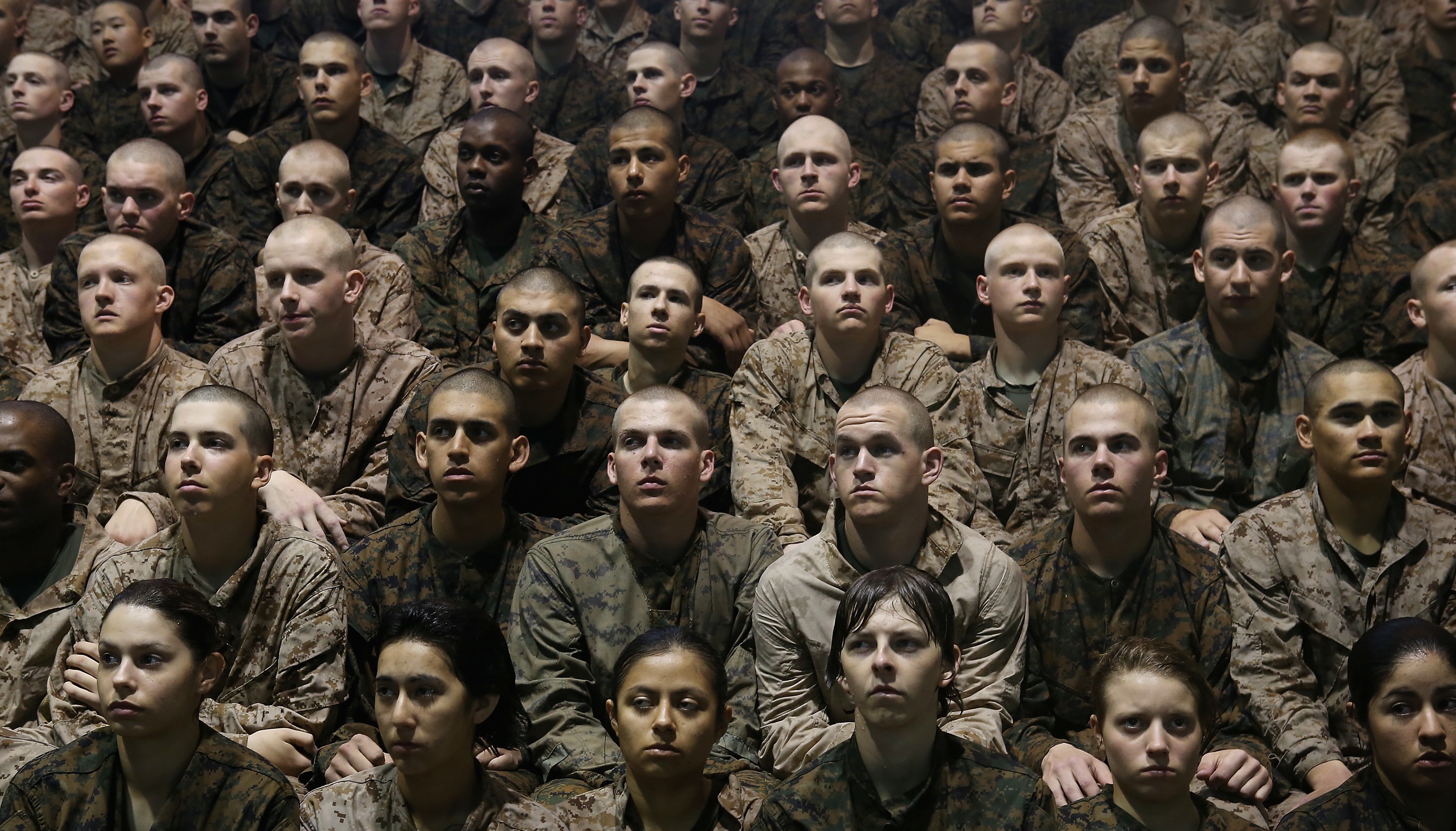
Female Marines Participate In Marine Combat Training At Camp LeJeune

Female and male Marine recruits listen to instructions as they prepare for a swimming test during boot camp at MCRD Parris Island, South Carolina. Male and female recruits are expected to meet the same standards during their swim qualification test. All enlisted Marines who were living east of the Mississippi River when they were recruited attend boot camp at Parris Island. About six percent of enlisted Marines are female. By Scott Olson/Getty Images.

Trusting The System

Bruce Schneier describes our need to:

In today’s society, we need to trust not only people, but institutions and systems. It’s not so much that I trusted the particular pilot who flew my plane this morning, but the airline that produces well-trained and well-rested pilots according to some schedule. And it’s not so much that I trusted the particular taxi driver, but instead the taxi licensing system and overall police system that produced him. Similarly, when I used an ATM this morning — another interesting exercise in trust — it’s less that I trusted that particular machine, bank, and service company — but instead that I trusted the national banking system to debit the proper amount from my bank account back home.

Here’s how I like to look at it. All complex ecosystems require cooperation. This is true for biological ecosystems, social systems, and sociotechnical systems. Also, in any cooperative system, there also exists an alternative parasitical strategy. Examples include tapeworms in your digestive tract, thieves in a market, spammers on e-mail, and people who refuse to pay their taxes. These parasites can only survive if they’re not too successful. That is, if their number gets too large or too powerful, the underlying system collapses.

Wrestling Isn’t Right-Wing

Last week, Glenn Beck objected to a new WWE wrestler, a racist Tea Partier, and theorized that the WWE is alienating its core audience. Ambers explains what WWE is thinking:

WWE’s reps concede that they’re promoting a storyline that makes anti-immigrant politics look bad because a significant and growing portion of their audience domestically and in Latin America is Hispanic. And here is where Glenn Beck gets his sense of WWE wrong: wrestling might not seem “progressive” to him, but wrestling fans are young. They’re of the Obama generation. They like to be on the right side of history. Actually, if you look at wrestling storylines years back, you’ll see how the script matches or tries to catch up with the political zeitgeist.

Texting Tone

Jen Doll investigates the rise of “word lengthening,” adding extra letters, in intimate messages:

Ben Zimmer, a linguist and lexicographer, notes that elongations, like emoticons and initialisms (OMG! LOL!), tend to flourish in those venues most starved for nuance. “When you’re dealing with IM, texting, and Twitter, those discursive functions that add to the simple message are really crucial,” he said. These tactics suggest that the process linguists call “accommodation”—the way speaking styles converge when humans talk to one another, facilitating both conversation and a sense of common identity—is not limited to spoken communication. “We’re navigating different registers all the time, finding out what’s appropriate,” Zimmer said. But “when those registers don’t match our expectations”—when our best friend begins a text with “Dear Jennifer,” or someone responds Hello to our Hiiiiiii—“that’s when we wonder if things are running afoul.”

In a follow-up post, Doll went in-depth on Twitter:

If you look at these words, a lot of them are from the expressive class. You’re already expressing some emotional state with them — aw — or you’re using them for augmentative purposes, like so and lots of affirmatives and negations: yeahhh, nooo, yesssss. But I think it’s telling that some of the other more frequent words that get extra letters are unpronounceable. People are trying to give some flavor to the communication.

What The Hell Just Happened In Italy?

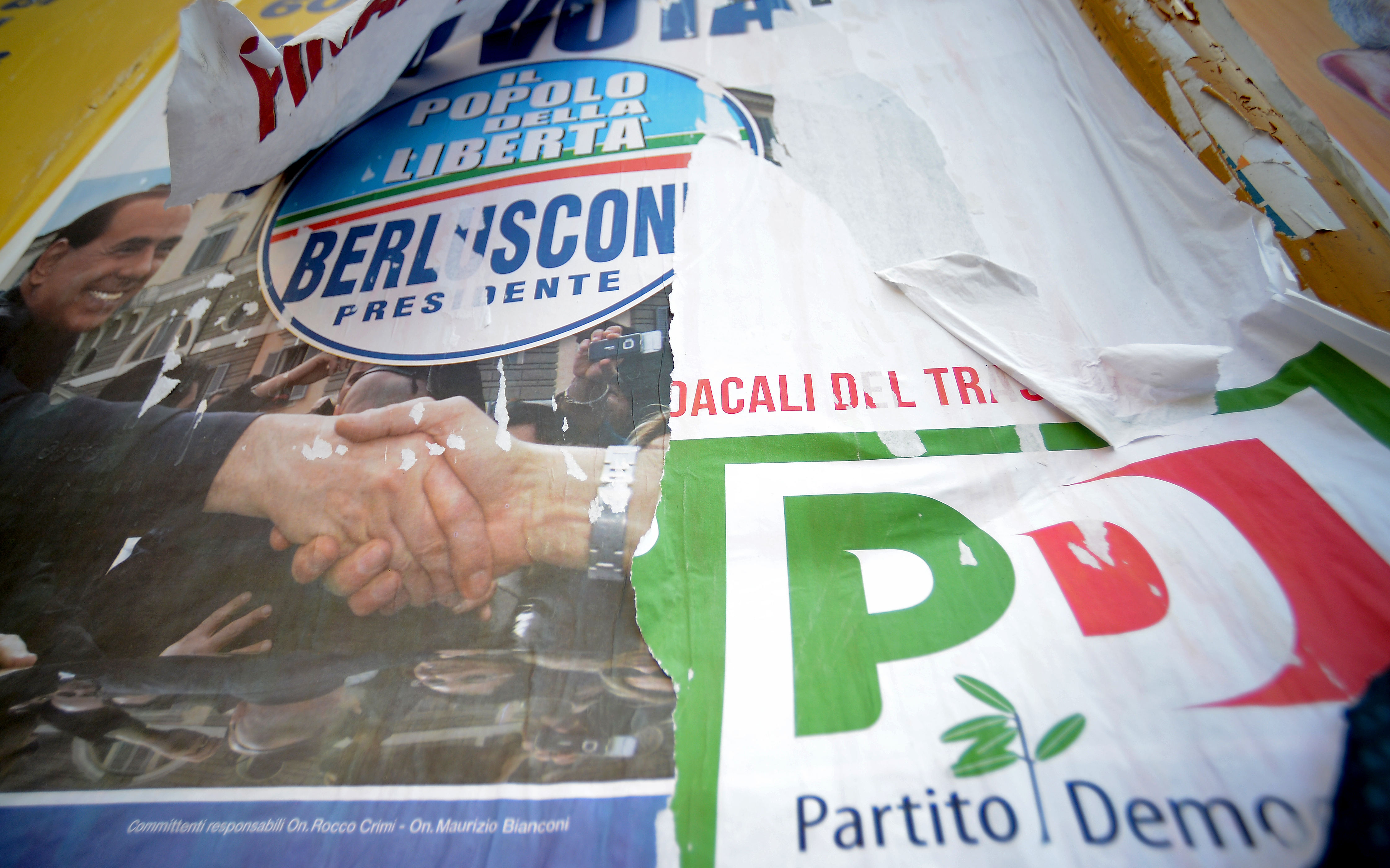
ITALY-VOTE-PLACARDS

This week’s general election has produced the country’s first-ever hung parliament, and the news wreaked havoc on world markets as fears rose of a new Eurozone crisis taking hold. Ryan McCarthy sets the scene:

This has been an election which featured an ex-prime minister who’s about to face trial for allegedly having sex with an underage night-club dancer and who was sentenced to four years in prison for tax evasion; a comedian running on an “antisystem” message; and Mario Monti, the country’s current prime minister, whose campaign a rival compared to a coma, and whose alliance is set to finish in fourth place.

As one Italian newspaper put it this morning: “The winner is: Ingovernability”. Barbie Latza Nadeau explains:

Pier Luigi Bersani’s [four-party] center-left coalition narrowly won in the lower house of parliament and will benefit by an automatic winner’s bonus of 54 percent of the house seats, but he barely eked out a win in the Italian senate, where it counts. There, the divisions are based on regions, and his win does not translate to a majority. His chief nemesis, Silvio Berlusconi, who rose from the ashes of a scandalous resignation in November 2011, was able to steer his center-right coalition to within a hair of the majority, but with no willing partners to help him reach the threshold.

Meanwhile, the anti-establishment “5-Star Movement” organized by comedian and blogger Beppe Grillo grabbed 25% of the vote in Italy’s lower house – more than any other party – as well as 23% of the vote in the country’s Senate. Grillo and his supporters have now earned an apparent kingmaker role for which, as Gavin Hewitt notes, they appear to want no part:

Mr Grillo has tapped into a mood of anger and resentment. He never gave a single interview to Italian TV and yet has nearly 170 seats. The country is in deep recession. Unemployment is rising and industrial production is at its lowest level since the 1990s. Mr Grillo raged against corruption, against budget cuts, against austerity and promised to hold a referendum on continued membership of the euro. He promised “a tsunami” and he delivered. His MPs are young, unproven and without political experience. … One unanswered question is whether Beppe Grillo will be open to a deal. Would his movement support, say, a centre-left coalition in exchange for widespread reforms of the political system? We don’t know. Buoyed up by success he has only promised to clear out the political class.

In fact, Grillo has has maintained his party would not join any coalition, though it would consider proposals on a “law by law, reform by reform” basis. For his part, Silvio Berlusconi has floated the idea of a grand coalition between his center-right coalition and the center-left. Douglas J. Elliot sees that as the most-likely possible solution to the gridlock, though not without its risks:

It would be unstable despite holding a clear majority of seats in both houses, because the views and interests of Berlusconi and the Center-Left only partially overlap. Further, the Democratic Party is fairly committed to continuing on the economic path agreed with its European partners, while Berlusconi campaigned on the idea of rejecting that path. Finding a set of policies that both groups could support and that would not trigger a rupture with Germany and Brussels, spooking the markets, will be difficult.

Joe Weisenthal points to austerity as the primary motivator in the election:

Voters hate austerity. And voters hate when their own politicians are taking their cues from an institution like the European Central Bank, rather than basing decisions on domestic needs. And that’s the phenomenon that came home to roost last night. The political parties seen as continuing along the existing ECB-preferred path did badly. The rebellion voters (Silvio Berlusconi and populist Beppe Grillo) did much better than expected. And this has the potential to undermine all of the progress made in Europe over the past several months.

Indeed 57% of the Italian electorate voted for anti-austerity parties. Nigel Cassidy indicates this sentiment could signal problems for other austerity-besieged countries like Ireland and Portugal. And he sees little hope for Italy:

As things stand, Italy’s economy is still shrinking and its debt is forecast to rise to 128% of GDP by the end of this year. Both the Silvio Berlusconi and Beppe Grillo political camps opposed some of the tax hikes and public spending cuts instituted by Mr Monti. Yet, even if some of these cuts were reversed, it seems doubtful that an economy that has hardly grown in two decades could be turned around anytime soon. Reversing the most recent reforms would also signal that the new government was unwilling or unable to deal with fundamental economic problems. This in itself could lead to spiralling bond yields and the flight of capital invested in Italy could resume. The Five Star Party’s avowed opposition to eurozone fiscal convergence might also slow future progress on banking union and other financial reforms.

(Photo: Ripped off electoral placards showing the Democratic Party (PD) logo and right-wing Silvio Berlusconi (L) are displayed on a wall in Rome on February 26, 2013. By Filippo Monteforte/AFP/Getty Images)
Bach To The Future, Ctd

A reader writes:

I’m a part-time musician, and I consider myself pretty fussy about sound quality, but I can’t tell you how tiresome I find these digital music Luddites and vinyl purists.  The only time anyone (including those with Golden Ears) can detect the “lower sound quality” is when they are sitting in front of a high-end stereo in a good-sounding room.  Not in the car, not while cooking dinner, not at a party.  The places that most people listen to most music doesn’t lend itself to detecting minuscule effects. Digital music has made the listening experience dramatically better for nearly everybody, and those who find it a step backward can still buy vinyl and four- figure turntables if they wish.

Another:

I have to disagree with the assertion that sound quality is going down, and that live, in-person concerts are superior.  I’m a decently musical guy who listens to a lot of classical music, and I thoroughly enjoy going to a classical concert.  But I would never say that the listening experience qua listening experience is better (I’m not talking about live pop/rock/etc concerts).  If I just want to listen to music, I’d prefer even my little iPhone ear buds to being in a concert hall.  There, you have to put up with coughing and sneezing, with people talking, rustling, shifting, and applauding at the wrong places.  Or (and this might be a L.A. thing) you get people who are there not because they like the music but because they like events – they like the concept of being at the symphony.  I can’t stand those people.  I listened to some terrible soprano shriek her way through Bach’s Cantata 51 and the woman beside me lept to her feet in rapturous applause for a performance for which I wanted my money back.

If I really want to deeply listen to something, my iPod/iPhone and a pair of headphone is all I need – jack the volume way up so I feel immersed in the sound.  You just never get that at live concerts.  And I’ll take any marginal loss in sound fidelity in exchange for no lay people sneezing and coughing and shifting around me.

Another:

As a classical musician who has worked for the last 36 years in symphony and opera orchestras, I would like to weigh in on whether old ways of listening are obsolete. I had a rather unpleasant argument with my boyfriend, which actually lead to the beginning of the end of our relationship.

He is a guy who loves technological wizardry, and was asking my opinion about the relative merits of some €12000 loudspeakers compared to some €6000 loudspeakers. My answer was that it didn’t really matter; all I needed was a satisfactory sound quality and my needs would be met. When he asked me why I had such a low bar for listening to music, I reminded him that we were only talking about recordings, which have their place, but that real music is the act of a human being creating music in the presence of other human beings, and that no matter how expensive the speakers, we were still only talking about a recording, which would never be (for me) a truly musical experience.

There followed a somewhat heated give and take about whether a fine recording is a better musical experience than a less-polished live performance, and after trying to get my point across, without success, I finally gave an example which probably crossed the line, but made my point. I asked him if he would make love to Brad Pitt’s dead body. In the silence that ensued, I told him that no matter how beautiful the body was, no matter how perfect, the body could not make love back to him. We musicians who still work in the world of live, unamplified music know that the energy that we stream to the audience is returned to us in an intense simultaneous interchange, an intimate human experience that can not happen with a recording, no matter how perfect.

I am the first to recognise the value of recordings in making all kinds of music available to all kinds of people, but a musician would never mistake one experience for the other. It saddens me that the majority of listeners today are content with their earphones, and don’t even know the the world they are missing.

Another would agree:

No, there is no substitute for live music: Live streaming or telecasts are not the same, nor are live recordings.  And I absolutely agree with Stefan Kanfer – it does not matter if we are talking about a large or a small venue, rock or jazz or classical music.

I was a casual fan of Pearl Jam until I saw them live.  In the space of two or three hours, I went from “Hey, those guys are pretty good!” to “I cannot believe I waited so long to see them live! Maybe if I hustle I can get tickets to every remaining show on their tour!”  The same can be said of classical music: I studiously avoided Mahler until my son showed a passion for music.  Being in Avery Fisher Hall when Alan Gilbert and everyone in the audience quite literally leapt into the air at the end of Mahler’s Fifth Symphony changed all that – what a rush!  No recording could have grabbed my interest and drawn me in like that.

I hope that our ever-advancing technology – and I do love it, my iPod is in so many ways superior to my first Walkman or my not-really-portable Discman – does not kill the concert-going experience.  I’m already watching in dismay as orchestras add “tweet seats” for customers who apparently just cannot bear the thought of turning off their phones and listening to the music they paid to hear.

No More Phoning It In

Yahoo recently distributed a memo prohibiting employees from working from home. Derek Thompson reviews the evidence and concludes that the policy might be misguided:

It’s understandable for executives to want to build an atmosphere where the office becomes a destination, a place where workers want to come together, where ideas percolate and bounce around an office and end up on a memo in the director’s inbox that becomes a Hot New Thing. But these reasonable arguments for building a dense and collaborative workplace culture should be weighed against the preponderance of statistical evidence, which suggests that (1) sometimes people just like to work from home for a change, and (2) they’re really good at it.

A former Yahoo employee with a different view:

For what it’s worth, I support the no working form home rule. There’s a ton of abuse of that at Yahoo. Something specific to the company.

Katie J.M. Baker criticizes the move:

[W]hat about the people — single parents, working mothers, employees with ill family members — who require a certain amount of flexibility? It’s doubtful that Mayer, who famously pooh-poohed maternity leave, really cares. According to Business Insider, Mayer might be making this move because “she knows that some remote workers won’t want to start coming into the office and so they will quit. That helps Yahoo, which needs to cut costs.”