The Big Rock Heading Our Way

But first, holy shit:

The footage was taken last night in the Urals, where over 1,000 were injured from the impact. The meteor was likely related to the asteroid 2012 DA14, which is scheduled to barely miss our planet today. Phil Plait provides a primer:

[E]xcluding actual impacts, 2012 DA14 will be still only be the eighth-closest approach by a known asteroid on record. The closest on record without actually hitting us was 2011 CQ1, which, in 2011, passed us by about 5500 km (3300 miles)—less than Earth’s radius! It was only about a meter across, so even if it had hit us we would’ve gotten a spectacular fireball, but probably no actual damage.

However, this is the largest asteroid we’ve seen come this close. Even then, it’s only 50 meters across, which is small as asteroids go.

Update from a reader:

The meteor is “likely related to asteroid 2012 DA14”.  This is untrue.  In fact, they approached the Earth from completely different directions.  See the statement from Don Yeomans, head of NASA’s Near-Earth Object Program: “This bolide event probably had nothing to do with the upcoming close Earth approach of asteroid 2012 DA14, which is due to pass closely (and safely) past the Earth at 19:24 GMT today [2:24 p.m. ET].” Yeomans added that the Russian bolide trail did not travel south to north as the asteroid will.

It won’t hit us, Plait argues, but it’s a sobering reminder of our weak NASA budget and our inability to deflect asteroids:

This threat is no joke. It’s quite real, and we need to take it seriously. We need more observatories watching the sky, and a plan in place in case we do see one with our number on it. Some new observatories will soon be coming online that will help. Also, both NASA and the privately-funded B612 Foundation have plans to launch space missions that can better look for near-Earth asteroids. B612 even has ideas on how to stop a potential impactor from ruining our day, too. I gave a TEDx talk on this very topic.

For more footage of that Russian meteor strike and its aftermath, including the sonic boom, go here.


Moneyball Politics

Seth Masket wonders why campaigns waste so much money:

Why did a sophisticated, data-driven, academically informed campaign like Obama-Biden ’12 do things that didn’t matter? Why did it, for example, spend hundreds of millions of dollars on advertisements during the summer of 2012 when any meager effect those ads might have had was almost assuredly gone within a few days?

Among his answers:

[I]t’s hard to imagine a campaign manager who is completely convinced by academic studies that a given campaign tactic is completely useless and is willing to bet his or her income and reputation on it. We’ll probably be seeing a lot of heavy investments in ineffective campaign methods for some time to come.

The Daily Wrap

5208973775_f0b6039b21_b

Today on the Dish, Andrew stood in awe of the ongoing radicalization of Gingrich-ified GOP and evoked Henry Fairlie’s words on the “America of fear” to put a name to the madness. He returned to the case of Marcial Maciel as a critical indictment of the Vatican’s degradation and echoed Jay Rockefeller’s condemnation of America’s black sites-torture program. Later, Andrew checked in on the struggling case against marriage equality, looked up the history of the ❤, and delivered a list of thank yous to the people who made the new Dish transition possible.

In political coverage, Weigel sized up the Republicans’ Hagel hysteria, Larison scratched his head, Kaplan chided the Senate Armed Services Committee, and readers offered thoughts on the whole mess here. We continued to analyze the president’s pre-K proposition, Josh Barro proposed a better but unlikely substitute for boosting the minimum wage, and Tried to parse new signs of easing health care costs. Readers sounded off on Andrew’s aversion to ribbons-for-a-cause, Rabbi David Novak recalled the time the Pope came across ACT-UP, and the Tax Policy Center let us tally up the benefits of marriage. Later we debated whether Rubio is a rising star or mere placeholder as Wickman wondered if it’s possible to keep nuke tests on the DL.

In Valentine’s Day coverage, Liza Hix served up a host of spiteful V-day cards, Natasha Vargas-Cooper discovered the “demonic power of sex,” and we casually attempted to nail the meaning of love. Freddie asked for a subtler rom-com formula while Josh Freedman dumped his girl by the numbers. Elswhere, Daniel Estrin followed an Israeli matrimonial detective around Eastern Europe, as Natasha Lennard revealed the pain of proving it to the feds.

After we paged through the poetry of Robert Graves and James Merrill for the occasion, readers recoiled at the ranking of poets in general. After Katie Boo divulged her pleasure reading, readers offered more thoughts on the show COPS, a genre of its own. Cass Sunstein introduced some social mores to combat obesity, Brodie Smith breezed through the MHB, and we glanced out at West Hollywood for the VFYW.

–B.J.

A Poem For Valentine’s Day

flower

“A Renewal” by James Merrill:

Having used every subterfuge
To shake you, lies, fatigue, or even that of passion,
Now I see no way but a clean break.
I add that I am willing to bear the guilt.

You nod assent. Autumn turns windy, huge,
A clear vase of dry leaves vibrating on and on.
We sit, watching. When I next speak
Love buries itself in me, up to the hilt.

(From Collected Poems by James Merrill, edited by J.D. McClatchy and Stephen Yenser © 2001 by the Literary Estate of James Merrill at Washington University. Used by permission of Alfred A. Knopf. Photo by AJ Batac)

A Rubber-Stamped Relationship

Natasha Lennard draws a distinction between a “green card marriage” and a “marriage green card” while commenting on the absurdity of proving “true love” to a federal agent:

Proof of love when it comes to green cards is something both specific and ephemeral. The idea is to show, as our immigration lawyer explained, not only that you love each other and want to be together in this country, but that you would have gotten married anyway. It’s an important hypothetical, which technically gives the government insurmountable leverage. Proving what you would have done anyway is impossible, and this is the catch. …

When amassing evidence of love for the USCIS, a couple essentially aims for a facsimile of doing what people who get married anyway do — which, going by government guidelines, refers to anachronistic, income-stable, middle-class American Dream aspirants. Such people barely exist among all-American couples, let alone green card hopefuls, but the simulation persists between the lines of USCIS guidelines for proof.

“We’re Just Like Any Other Person”

Ellen McCarthy tells one couple’s story:

Experts say it’s difficult to track the number of couples with intellectual impairments, because they often enter into committed relationships without getting married. In many instances, a legal marriage could interfere with Social Security or health-care benefits. But the intellectually impaired and their advocates say it should surprise no one that they often possess an abiding desire to find a partner in life.

What Is Love?

A unique definition from Barbara Fredrickson:

Fredrickson, a leading researcher of positive emotions at the University of North Carolina at Chapel Hill, presents scientific evidence to argue that love is not what we think it is. It is not a long-lasting, continually present emotion that sustains a marriage; it is not the yearning and passion that characterizes young love; and it is not the blood-tie of kinship.

Rather, it is what she calls a “micro-moment of positivity resonance.” She means that love is a connection, characterized by a flood of positive emotions, which you share with another person—any other person—whom you happen to connect with in the course of your day. You can experience these micro-moments with your romantic partner, child, or close friend. But you can also fall in love, however momentarily, with less likely candidates, like a stranger on the street, a colleague at work, or an attendant at a grocery store.

Relatedly, Nick Olson critiques the notion that love “can be whittled down to the observable moment in which we feel good or when we feel love’s resonance,” and brings Christian theology to bear on the matter:

Ironically, it’s this sort of narrow definition of love which often leads to – and embellishes – our loneliness.

When love’s definition derives from a singular focus on felt moments of happiness, we begin to selfishly seek them out like a high, and this sort of self-absorption perpetuates loneliness. Instead, love is better found in the purposeful gestures that occasion those emotions. We can enjoy the moments of feeling loved for they are part of love’s equation, but, foremost, these feelings ought to inspire a love qualified by gratitude, and then the desire for reciprocation. If love is not only facilitated and occasioned but embodied by persons – an all-encompassing reality to inhabit – then its expressions only make sense if there is a baseline, loving purpose. This purpose finds itself in the Person who is love – not the abstract idea of love. This is the hope found in embracing Christ – love incarnate – who is eternally loving and loved as the second Person in the Trinitarian landscape.

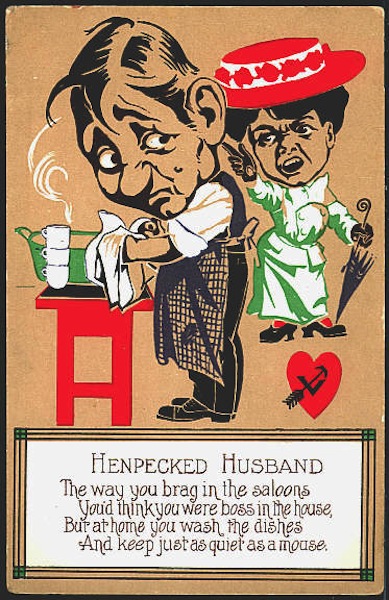
Vinegar Valentines

Lisa Hix unearths a treasure trove of them, which date from the 1840s to the 1940s. Much of the time, the senders weren’t joking:

You have to remember that often they were sent anonymously. They were to say “Your behavior vinegar_henpeckedis unacceptable.” For example, there are quite a few cards that mock men with babies on their laps as being henpecked—the kind of thing now we would think was a man doing the right thing by taking his share of child care. But these cards were specifically designed to make the man seem emasculated and disempowered by being left holding the baby. Or there’d be images of women holding rolling pins, threatening their husbands.

The people sending such cards were usually not either one of the couple. It wasn’t the wife sending to the husband or the husband sending to the wife. It was somebody outside, looking in at their relationship and saying, “This doesn’t conform with what’s expected.” In that way, they did enforce social norms. Sometimes they seemed to be saying, “Change your behavior, or else.” There’s almost this threatening element to them.

(Image from a vintage postcard on Ebay, via Hix)

The Purity Of Their McCarthyism

As a reader noted earlier, Weigel shows how the “Friends of Hamas” smear against Chuck Hagel may refer to an organization that doesn’t even exist and was hyped by the dregs of Breitbart and passed along by fanatics like Hugh Hewitt. I’m beginning to realize why we were told at the get-go that the Greater Israel Lobby was not going to fight this nomination. Because they were going to fight it to the bitterest end imaginable. Weigel asked Ben Shapiro, the sole source for this story, about it this morning:

“Have you found any more proof that this group exists?” I asked. “Is it just shorthand for some people who might support Hagel, or a real group?” “The original story is the entirety of the information I have,” he said.

You can observe what goods Shapiro had in the original piece. The source? “Senate sources”. None of whom have been able to be located since.