The Pope’s Anti-Capitalist Streak

Benjamin Dueholm highlights it:

While staunchly, even aggressively re-asserting Catholic teachings on homosexuality and birth control, he preached a recognizably left-wing version of economic justice. And while reiterating the special status of his church and his faith, he opened his rhetoric—much more than his predecessor did—to the reality of a pluralistic, secular Europe.

In countless speeches and letters, Benedict expressed an economic ethic that Fox News would label socialistic. In just that one address to the diplomatic corps, for instance, Benedict stressed the importance of universal education; the need for “new rules” stressing ethics over balance sheets to govern the global financial system; and the importance of fighting climate change in tandem with global poverty.

But this has been true of every Pope in modern times, including John Paul II whose brutal critique of communism was always accompanied by a dismay at the materialism of capitalism.

Rubio’s Pathetic, Exhausted, Vapid Response

Senate Candidate Marco Rubio Attends Election Night Event

In the reax below, I have to say I think Conor has it right. The question I have to ask is a simple one: could this speech have been given thirty years ago? Of course it could have. It was not a political speech; it was a recitation of doctrine, dedicated to Saint Ronald, guardian saint of airports. Here is an article of faith which is now so banal it does indeed sound, as Conor notes, like a song whose lyrics have become meaningless by repetition:

More government isn’t going to help you get ahead.  It’s going to hold you back. More government isn’t going to create more opportunities.  It’s going to limit them. And more government isn’t going to inspire new ideas, new businesses and new private sector jobs.  It’s going to create uncertainty.

Then this truism from the 1980s:

In order to balance our budget, the choice doesn’t have to be either higher taxes or dramatic benefit cuts for those in need.  Instead we should grow our economy so that we create new taxpayers, not new taxes, and so our government can afford to help those who truly cannot help themselves.

Wow. Never heard that before. And this utopian, Randian future:

If we can get the economy to grow at just 4 percent a year, it would create millions of middle class jobs. And it could reduce our deficits by almost $4 trillion dollars over the next decade. Tax increases can’t do this. Raising taxes won’t create private sector jobs.

They did in the 1990s. And cutting taxes irresponsibly in the 2000s reduced the rate of job growth. Nonetheless the dogma is in place, like some Animal Farm slogan: “Big government” is bad. “Small business” is good. And yet, Rubio, in the few instances when he mentioned specifics that might tackle actual problems, was in favor government action:

Helping the middle class grow will also require an education system that gives people the skills today’s jobs entail and the knowledge that tomorrow’s world will require. We need to incentivize local school districts to offer more advanced placement courses and more vocational and career training. We need to give all parents, especially the parents of children with special needs, the opportunity to send their children to the school of their choice. And because tuition costs have grown so fast, we need to change the way we pay for higher education. I believe in federal financial aid.

Is that not government? Yes, there were things that were dead-on and I’d prefer them to what Obama is offering. A simplified tax system? There are few indications Obama is interested. This I profoundly believe:

The truth is every problem can’t be solved by government. Many are caused by the moral breakdown in our society. And the answers to those challenges lie primarily in our families and our faiths, not our politicians.

But sadly, the speech was also full of lies, avoidance and misdirection. This one really pissed me off:

The President loves to blame the debt on President Bush. But President Obama created more debt in four years than his predecessor did in eight. The real cause of our debt is that our government has been spending 1 trillion dollars more than it takes in every year. That’s why we need a balanced budget amendment.

Seriously? A president who gave us two unfunded wars, massive tax cuts, and unfunded new entitlement in our biggest spending program, Medicare, in a period of growth was more fiscally prudent than a president who inherited a collapse in revenues to 60 year-lows because of the worst recession since the 1930s? And a balanced budget amendment, which in general I favor, would have been catastrophic in the last four years as demand was wiped out of the economy. For these statements to be true, you have to live in a sealed ideological universe that hasn’t changed since 1979.

On policies? No compromise on gun control. Immigration? Secure borders first. Growth? Drill, baby, drill – as if we haven’t. Climate change? “No matter how many job-killing laws we pass, our government can’t control the weather.” Please. Gay equality? Not a word. Foreign policy? Nothing on Afghanistan; nothing on what the last decade has taught us; nothing on drone warfare; nothing. No wonder the GOP has the lost its historical advantage on this topic.

Then this:

Presidents in both parties – from John F. Kennedy to Ronald Reagan – have known that our free enterprise economy is the source of our middle class prosperity.

But President Obama? He believes it’s the cause of our problems. That the economic downturn happened because our government didn’t tax enough, spend enough and control enough. And, therefore, as you heard tonight, his solution to virtually every problem we face is for Washington to tax more, borrow more and spend more.

This idea – that our problems were caused by a government that was too small – it’s just not true. In fact, a major cause of our recent downturn was a housing crisis created by reckless government policies.

This is unhinged. Obama has never said this, never given any indication that he believes this and has repeatedly said that the private sector is the engine of growth. And the recession was caused by government support for mortgages for low-income home-owners? Wall Street was a by-stander? This is a talk-radio talking point, not an analysis. And the sequester is now apparently an Obama policy, not just a short-term attempt to keep the government from a self-imposed credit crisis caused by nutball Republicans in 2011 that Obama wants to avoid.

We don’t have to raise taxes to avoid the President’s devastating cuts to our military.

Then there is this simple and obvious contradiction:

More government isn’t going to help you get ahead. It’s going to hold you back. More government isn’t going to create more opportunities. It’s going to limit them.

Only minutes later, he said this:

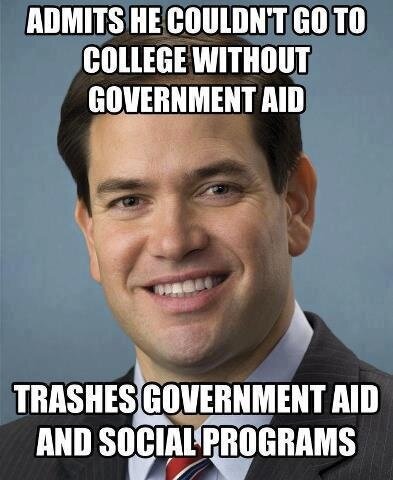
I believe in federal financial aid. I couldn’t have gone to college without it.

So does government help people get ahead? Or does it hold them back? Which one is it, Senator?

This was an intellectually exhausted speech that represents the intellectual bankruptcy of contemporary Republicanism. It was a series of Reaganite truisms that had a role to play in reinvigorating America after liberal over-reach in the 1960s and 1970s. It had precious little new in it. If reciting these platitudes in Spanish is what the GOP thinks will bring it back to anything faintly resembling political or intellectual relevance, they are more deluded than even I imagined.

(Photo: Photo by Joe Raedle/Getty Images.)
Why Don’t We Eat Horse?

It was recently discovered that various European beef products contained horsemeat. In response, Shafer ponders global meat-eating habits:

What defies simple cultural explanation is why so many modern French, middle Europeans, Latin American, Chinese or Japanese citizens enjoy nothing better than a nice cut of horsemeat now and again, while a handful of others — those in Ireland, the United Kingdom, the United States and English Canada—generally oppose its consumption. It’s not enough to say that we relate to our horses the way we relate to our pets (or “animal companions,” as some like to call them) from the canine and feline families. I doubt that many adults who don’t ride horses enjoy any such emotional attachment to them. Our avoidance seems to be rooted in custom, just outside of cultural or religious explanation, the way our nose-blowing and spitting norms differ from those of the Chinese. Because we don’t generally eat horsemeat, the thought of eating horsemeat repulses us.

SOTU: Blog Reax II

President Barack Obama State of the Union

Bouie sees little chance of Obama’s agenda becoming law:

To the elation of his progressive supporters, Obama laid out his progressive vision in forceful terms last night. But barring a change in Congress—which means a shift in the how the GOP does business—this agenda will have to serve as a signpost for future Democrats and not a plan of action.

On the other hand, Philip Klein notes that “on multiple occasions, these proposals were accompanied by vows to take executive action”:

For instance, he proposed the creation of 18 more “manufacturing innovation institutes,” but said he was launching three of them through the Departments of Defense and Energy. More significantly, Obama addressed global warming, urging “Congress to pursue a bipartisan, market-based solution to climate change,” before warning, “if Congress won’t act soon to protect future generations, I will. I will direct my Cabinet to come up with executive actions we can take, now and in the future, to reduce pollution, prepare our communities for the consequences of climate change, and speed the transition to more sustainable sources of energy.” This could be interpreted as a sign that he plans to have the Environmental Protection Agency to regulate carbon emissions without Congress.

Kornacki examines Obama’s remarks on gun control:

November 2014 is setting up as a crucial moment in the renewed battle for gun control. There may well be enough momentum for Obama to push through some new laws this year. They won’t be sufficient, but doing so will make gun control a major issue in the ’14 midterms. If those who support the news laws pay a price at the polls, the issue will again recede. But if they survive – and, especially, if those who vote against any of the laws Obama is calling for are defeated – it should create new momentum for further, more far-reaching reforms.

Jay Newton-Small focuses on foreign policy:

Much of the foreign policy segment of the speech was defined by what he didn’t mention: for the first time since the U.S. invasion a decade ago, a U.S. President did not mention Iraq in a State of the Union address. Obama was mum on the controversial Keystone-pipeline decision with Canada, Middle East peace, the pivot to Asia and closing Guantánamo. Most notably, he did not utter the words war on terror.

Fred Kaplan thinks the brief mention of foreign policy was appropriate:

He spoke for barely 10 minutes on foreign policy, then moved on to the night’s most compelling themes: voting rights, gun control, and the meaning of citizenship. “Gabby Giffords deserves a vote! The families of Newtown deserve a vote! The families of Aurora deserve a vote”—this, and not some exhortation to fight foes in distant lands, will be the passage remembered, the stirring call to action, from this speech. And so it should be, after a decade of war-weariness and so little to show for it.

Larison weighs in:

[T]here is no good reason to expect presidents to include extensive discussions of foreign policy issues in State of the Union addresses unless they are prepared to propose something new or celebrate a recent accomplishment. The modern purpose of the speech is to review the state of the U.S. and outline the president’s domestic agenda. Following the Bush years, it can be easy to forget that most of these speeches are like the one we heard last night, in which discussion of foreign policy plays just a small supporting role. Especially since the end of the Cold War, that is what we should expect, and it is unusual for foreign policy issues to dominate the president’s remarks.

Cohn ponders the call for universal pre-K:

The research [on the benefits of early education] has its detractors. Among the important questions they ask: Is it possible to replicate the results of model interventions, like the Perry Preschool, on a national scale? (The results of Head Start have been decidedly mixed.) The questions deserve a better answer than I can give right now.

Drum wants pre-K experimentation:

The truth is that age four is too late. Age two would be better. Age one would probably be better still. But starting at age four makes the most political sense. But if Congress does act on this (unlikely, I know, but humor me), I hope they put in place extensive experimentation requirements. What we really want to know is what kind of pre-K programs work best, and we’ll only find out with a rigorous, fairly well-controlled program of experimentation. On this issue, I’m a Manzi-ite.

And Serwer suspects Obama is all talk on transparency:

A promise to be “even more” transparent from an administration that has been anything but has little meaning.

(Photo: A woman reacts as she holds a photo of someone killed by gun violence as President Barack Obama speaks about gun violence during his address to a joint session of Congress as he gives his State of the Union address on Tuesday, February 12, 2013. By Bill O’Leary/The Washington Post via Getty Images)

Debating The Minimum Wage

A reader quotes me from last night:

Does [Obama] believe that raising the minimum wage would have no impact on jobs growth? Does he believe it would actually increase employment and growth?

Here are three sources – 1, 2, 3 (pdf) -showing that changes in the minimum wage have little effect on employment, and the little effect they do have is actually a decrease in unemployment. While it seems like increasing labor costs would initiate layoffs, what actually happens is more money is available to spend, pay down debt, buy houses, etc., boosting the economy and overall demand a little. Small growth impacts then follow.

So yeah, I think President Obama probably does believe it will actually increase employment and growth. It may not be spectacular, but it gets more money in the hands of the working poor, and that’s a good thing.

Another agrees:

As far as the reason behind why raising the minimum wage could be beneficial: an employee rarely gets paid an amount equal to their production, period. And it basically never happens at the lowest rungs of employment. They get paid for the going price of their labor. Any sanely run company will – or should – hire based on the marginal value of that new employee. If that employee will produce more than he or she will earn, then hire up. The general difference between this added value and the labor market’s price for an employee largely contributes to profits. Those profits are then funneled to shareholders, and the amount that companies keep is invested or hoarded.

Workers earning minimum wage tend to face the fiercest competition for their jobs simply due to the vast number of people capable of fulfilling those positions, and I would argue that that competition drives the price of their labor well below their actual productive output, which is likely far higher than $9 an hour. So what a minimum wage increase would be is, essentially, decreased profits in the short term to lenders taxed at 15%. But longer term, think about it: lifting people out of poverty isn’t just feel-goodery, it will decrease the burden on the welfare state and reduce the deficit.

Additionally, individuals with lower incomes are significantly more likely to spend that newly additional income, either to pay for things they need (like food and shelter) or on things they desire as they begin to become more middle class (cars, TVs, etc). This sort of spending is the lifeblood of the economy. People can giddily invest in start-ups all they want, but it will all amount to wasted potential if less and less people can actually procure their goods and services. Think of it as a permanent stimulus with absolutely minimal government interference/pork and in order to be eligible you have to work.

One practical example: One of the few industrialized countries that is doing fairly well, Australia, has an unemployment rate of 5.4%. Their current minimum wage is about $13.50 in USD (about $16 Australian dollars). Granted, they only have about 22 million citizens, but a comparison to Australia – as opposed to European nanny-states – is probably a more likely model for what an America with higher minimum wage would look like.

Another points to further evidence along these lines:

The main point to realize is that jobs aren’t like tomatoes, where if the price goes up, people purchase less of them.  In fact, studies have found that increasing minimum wage at fast-food restaurants, for example, ends up increasing job stability, which in turn is good for the employer (it costs a lot of money to train newbies) and ends up saving them money.  In the meantime, of course, the working poor, because they have so many needs, spend their new-found money faster than any other group, which in turn, boosts overall consumer spending.

“Minimum Wages and Employment: A Case Study of the Fast-Food Industry in New Jersey and Pennsylvania” (pdf) is a landmark study published in 1994 by David Card and Alan Krueger in the American Economic Review examining employment at fast-food restaurants on both sides of the New Jersey-Pennsylvania border after New Jersey raised its minimum wage to $5.05 an hour while Pennsylvania’s minimum wage held constant. The authors conducted a phone survey of over 400 fast-food restaurants and found no evidence that the increase in the minimum wage in New Jersey led to job loss­. In fact they found that employment increased in fast-food restaurants in New Jersey. For this and related research, Card was awarded the John Bates Clark medal, ­the so-called “junior Nobel prize,” granted by the American Economics Association every two years to the best economist under forty.

See also this post, which updates that study.  Money quote:

Dube’s findings indicate that a higher minimumwage helps service retailers attract and retain employees, increasing their productivity. He said that a restaurateur, for example, is likely to reduce his employees when the wage goes up if only one restaurant raises their wage, but if most of them raise it, the added cost is passed on to the consumer who is likely to absorb it without decreasing their demand.

Rubio Response Reax

tumblr_mi575tBVuH1qagxppo1_400

Josh Barro identifies the main problem with Rubio’s speech:

The Republican Party’s problem isn’t the messenger; it’s the broad economic message. To fix the message, Republicans need to be for smart government. They need to signal that they have a serious policy agenda that considers programs and regulations on a case-by-case basis, rather than just demagoguing the government. They need a real agenda on health care and jobs rather than just opportunistic opposition to anything the president does.

Michael Grunwald had the same thought:

If Republicans believe that they lost in 2012 because Romney was a boring rich white guy who alienated Hispanics, they got to see a charismatic Cuban-American with humble roots but otherwise indistinguishable positions on every issue except for immigration.

McArdle, on the other hand, calls Rubio’s speech “the most effective SOTU response I’ve ever seen”:

I’m not grading the policy content of the speech, mind you–though as an aside, let’s just say that I’m not a fan of false claims that the GOP can get the economy up to 4% growth by unleashing the awesome power of the free market.  But Rubio mounted the most effective response I’ve seen to the President’s attacks on Republicans as uncaring obstructionists, and he delivered it well.

Tomasky felt that Rubio lacked gravitas:

His voice doesn’t have enough depth to it. He looks sort of young, as many have observed, but he sounds younger, and that’s the issue. He comes across like the proverbial substitute teacher. You know you can throw spitballs in his class, and he’s not going to have the authority to make you stop.

Ed Morrissey liked the speech:

[A]t least rhetorically, Marco Rubio took the correct path in responding to the usual SOTU laundry-list speech.  In his rebuttal, Rubio stayed away from offering the Republican legislative agenda, and instead stuck to the Republican and conservative philosophies of governing and economics.

And Friedersdorf heard nothing new from Rubio:

What Rubio does best is movement conservative boilerplate, so that’s mostly what he does, but he doesn’t make any effort to freshen up the ideas, or even to freshen up the rhetoric he uses to express the ideas. When he starts talking, it’s like when the Dave Matthews Band song comes on, the one you liked the very first time you heard it 15 years ago, but then the guy across the hall played it on repeat for all of sophomore year, and now when the lyrics play you can’t even conceive of them as words with a meaning.

SOTU: Your Thoughts

Ouch. My objection is to ribbons. It’s all inclusive. I hated and still hate red ribbons for AIDS, for example. The fact that we gays started this lame tradition truly saddens me. But I know it’s a lost battle. We are all ribboned now.  I just wonder how they keep coming up with new colors for new causes. Will they have to go to paint charts soon? Still, it was a moment of dyspepsia, I concede. But I regard a blog as a right to occasional dyspepsia. Another reader writes:

The Sandy Hook ribbons aren’t just ribbons in honor of it. And they’re not lame. They were originally made for the teachers and administrators to wear to the funerals so they could be identified. They were noticed, so they were made by folks at the school, one of whom is friend of mine. One day they made 700. They are selling them to raise money for the school. It’s called the Sandy Hook angel project. They are $3 each. I’ll get you one.

I won’t wear it. But I can sure see the point of identifying the teachers and administrators. That is a signifier I could happily endorse. Just not Joe Biden, please. Or every other grandstanding pol. Another:

Here in Shelby County, Alabama, my son’s elementary school now has an armed guard standing outside each morning. This doesn’t make me feel safer. It’s simply a reminder of Newtown. Today, a man entered a local middle school and held several students hostage. Today. No, he didn’t have an assault rifle. He had a pistol. But can you imagine being one of those students?

Andrew, Newtown changed me. I have two small children – a son, 8, and daughter, 3. I’m a conservative in the Bible Belt, yet I feel like a noose is tightening on our kids due to our gun culture. And I really don’t know how it stops. I emailed my senator (for whom I voted), Richard Shelby, asking him to support an assault weapons ban. Of course, I got the standard “Thanks for writing. Here’s why I don’t support a ban” letter. I think of Newtown every time I see that guard. And I wonder which school is next.

On the core question of banning assault weapons and universal background checks, and much more aggressive ATF funding and regulation, I’m with you all the way. But as you point out, even that won’t stop these horrifying events, using mere pistols, just minimize the carnage. Another quotes me:

The passion, the reason, the sincerity: this was an invigorated president, trying to shift the mood away from zero-sum partisanship to non-zero-sum citizenship. It’s what we always hoped from him, and I think it places the Republicans in a horrible bind.

How are the Republicans in a horrible bind?

The number of Republicans in the Senate is still 45 and there’s no risk of their changing for another two years.  None of the emotion and the meaning of Obama’s speeches matters a bit unless somehow 5 of those 40 have suddenly changed their mind based on this speech.  That would be a shocking turn of events to say the least.

Republicans engaged in a policy of deep, nihilistic intransigence for four years.  When they began that policy they had 41 Senators, and now they have 45 (after a brief climb up to 47).  They had 178 representatives and now have 234 (afte a brief climb up to 242).  So is there anything in our politics that would suggest to the average Republican that they should change couse?  The Republican party is like a collection of spoiled children and until they get a sense that there will be real and dire consequences for them, they will not change how they behave.

While there’s certainly some long-term concern among Republicans over the demographic trends of the country, Republicans believe the best answer to that is trying to convince conservative Latinos that the Republican party has something to offer.  Beyond that, the Republicans are still firmly wedded to zero-sum partisanship and there is nothing that Obama said tonight that will change that.

I don’t disagree, but politics change tectonically. What Obama was doing last night was what I saw him doing a long time ago:

This guy is a liberal. Make no mistake about that. He may, in fact, be the most effective liberal advocate I’ve heard in my lifetime. As a conservative, I think he could be absolutely lethal to what’s left of the tradition of individualism, self-reliance, and small government that I find myself quixotically attached to. And as a simple observer, I really don’t see what’s stopping him from becoming the next president…

I fear he could do to conservatism what Reagan did to liberalism. And just as liberals deserved a shellacking in 1980, so do “conservatives” today.

What makes this more interesting is that events have made his case stronger since. The collapse of the Wall Street casino, the relentless rise in inequality, our crumbling infrastructure, the crippling cost of policing the entire globe: these changes makes Obama’s core vision more reasonable to conservatives like me who suspect government but believe there are times when we truly, desperately need it. Another reader’s take:

That was a very strong SOTU. The President has honed his presentation of what activist government should look like in the 21st century, and, amazingly, it actually rings more conservative than the bullshit being peddled by the so-called conservatives in the chamber. And the last segment of the speech, on voting and then gun violence, was incredibly powerful. I had a tear in my eye. I can’t believe Boehner wasn’t bawling … well, then again, there’s no telling what will make the Speaker break out in tears.

Rubio, on the other hand, gave a speech that clearly had nothing to do with the SOTU address that preceded it, which made it very flat and tone deaf. It was alternately condescendingly partisan and incredibly defensive. Surprisingly weak. We know which of these two is the Alpha Male in American politics today.

What did Rubio say last night that could not have been said by a conservative Republican in 1980? It was a recitation of dogma, not a response to the actual contingent problems we face. Another notes:

The amusing thing about that Ted Nugent photo is who he was sitting next to: Thomas Lauderdale, the founder and band leader of Portland-based Pink Martini. Based on Nugent’s uncomfortable posture, I think he figured out that Lauderdale is also gay.

All About Israel, Ctd

This embed is invalid


A reader writes:

As an orthodox, born-again Christian, I find Inhofe’s statement breathtakingly crazy. All those years when Israel was in exile in Babylon, those centuries between Rome and the establishment of the modern political state of Israel – the word of God wasn’t true then? Does he realize that he has just said that humans possess the power to negate the word and promises of God? I believe that might be heresy; if not, it is at least heterodoxy.

It might also be fun to point out to Inhofe that the Palestinians are also descendants of Abram, via Ishmael, so regardless of which ethnic group is in power, the land remains in Abrahamic hands.

Another writes:

I think Inhofe is being incredibly duplicitous when he cites the book of Genesis as reason for supporting Israel and argues that we should support Israel because God decreed Israel belongs to the Jews. The real reason fundamentalist Christians support Israel is not in the first book of the Bible but the last book – Revelations. Revelations (supposedly) prophecies that the Second Coming of Christ will be preceded by the return of Israel to the Jews and by war in the Middle East. Fundamentalists support Israel today, as well as military action against Iran, Iraq, and the Palestinians, because they believe the Second Coming is imminent. See, for example, this piece in the conservative City Journal.