The Fly In The GOP Ointment

Leading Conservatives Gather For Republican Leadership Conference In New Orleans

There have been lots of predictions about what a Republican take-over of the Senate would mean, but I think it’s safe to say that Ted Cruz will continue to be a raging asshole – both with respect to his own party and, of course, to the president. He’s already making noises:

Piggybacking on what House leaders have done, Cruz said the first order of business should be a series of hearings on President Obama, “looking at the abuse of power, the executive abuse, the regulatory abuse, the lawlessness that sadly has pervaded this administration.” … And when asked whether he would back Sen. Mitch McConnell of Kentucky for Republican leader, Cruz would not pledge his support — an indication that there are limits to how much of a partner he’s willing to be.

At the heart of Cruz’s shift from the insular approach that defined his first year in office is a belief that he can use his popularity with conservatives to expand his influence in the Senate and improve his standing as he considers a 2016 presidential campaign.

Somehow, I don’t think the American public is hoping for another round of scorched earth partisan warfare after this election (some may even be gamely hoping for, you know, some kind of governance). And I doubt the establishment GOP heading into 2016 will want to alienate Latinos even more profoundly, ramp up its culture war rhetoric, and push for a new war in the Middle East (either against ISIS or Iran – they’ll take either, as long as Obama has to fight it).

But what’s been absent in this campaign – see the Democrats’ usual incompetence – is the extremism and divisiveness of the Republican right, which is now better seen as the Republican center. We could have another budget meltdown, or the now-familiar an impeachment move for a second-term Democratic president. And all this will serve to divide a party now easily united in opposition to Obama.

If this is their version of 2006, they have yet to find an Obama figure to make it their 2008. And the more divided and fractious and extreme their period in the sun the likelier it is that the Clinton machine will roll smoothly back into power.

(Photo: U.S. Senator Ted Cruz (R-TX) speaks during the final day of the 2014 Republican Leadership Conference on May 31, 2014 in New Orleans, Louisiana. By Justin Sullivan/Getty Images)

Ouagadoucoup d’Etat, Ctd

Burkina Faso’s military, which seized power after President Compaoré stepped down on Friday, is forming a transitional government and pledging not to cling to power. The announcement came after protesters had returned to the streets to demand a speedy restoration of civilian rule:

The army named Lieutenant Colonel Isaac Zida as the leader of a transitional government on Saturday. However, thousands of protesters gathered on Sunday in the capital Ouagadougou, demonstrating against the army. On Sunday evening, following a meeting with key opposition figures, a military spokesman said the army would put in place “a transition body… with all the components to be adopted by a broad consensus”. … It had been necessary to disperse protesters to “restore order”, the statement said, adding that one demonstrator outside the state TV station had died.

Overall, Ken Opalo predicts that Compaoré’s departure will be good for democracy, both in Burkina Faso and Africa writ large:

Although the outcome of this week’s turmoil in Burkina Faso was an extra-constitutional transfer of power, the events leading up to it were a reminder of the continued entrenchment of constitutional rule in much of Africa.

It is instructive that even as he plotted to violate the country’s constitution, Compaore resorted to institutional means to do so. He did not issue a decree or name himself president for life, but instead asked parliament to ratify the amendment to Article 37. This is an indication of the growing importance of institutions, even in non-democratic regimes. It is also a reminder to global democracy advocates that presidential elections alone do not make democracies, and that legislative elections also deserve attention. As the norm of institutionalized rule consolidates in Africa, legislatures will become the new arena of political contestation. This means that the manner in which legislatures are constituted and the rules that govern them will become just as important as whether presidential elections are free and fair.

Zachariah Mampilly insists that the Burkinabe uprising is part of a continent-wide trend that hasn’t gotten nearly as much press as it deserves:

We document more than 90 popular uprisings in more than 40 African states since 2005. By our measure, the heralded North African protests of 2011 represented not the first ripple of a wave, but rather its crest, with 26 African countries (including Burkina Faso) experiencing popular protests that year. Since then, protests have continued but have rarely generated the sort of attention devoted to the uprisings in Egypt and Tunisia. Why? Political change in the rest of Africa is often thought to result from violent conflict or external intervention. Africans themselves are presumed to be too rural, too ethnic or too poor for popular politics to lead to political transformation. Even today, as protests increasingly shake up ossified regimes and de facto one-party states, little attention is paid to the broader wave of protests unfolding across Africa and what it portends for the future of the continent.

He, too, is cautiously optimistic about the outcome:

The fact that the army has stepped in is not necessarily a harbinger of military rule. In many African protests, it is the military that can play a decisive role by intervening on behalf of the protesters, as was the case during the 1964 and 1985 protests in Sudan, in which junior officers stepped in against the regime to prevent what would probably have been bloody crackdowns. If progressive voices in the military can come to the fore and turn power quickly over to a civilian leader, there is hope.

World powers, particularly the US and France, are watching the situation closely:

In the last decade, Burkina Faso has become a central node in the new security apparatus that France and the U.S. are building, separately but in coordination, in the Sahel region, to combat jihadi movements and buttress their other interests. Ouagadougou is a base for U.S. drones as well as French special forces. As fluid as the current situation may be, nothing in the power struggle under way appears to threaten Burkina Faso’s fundamental alignment with France and the U.S., and both powers are likely actively working to shape an outcome they can work with.

In recent weeks, France had already signaled readiness to see Compaoré exit the scene (a letter from François Hollande promised Compaoré French support should he seek to exercise his talents in some international organization); reporter Nicolas Germain of France 24 told me today on Twitter that French diplomatic sources had commented to him that Burkina “unlike some countries, has a credible opposition.” As Germain commented: “that says everything.”

Islam In “Moderate” Malaysia

A small reality check for those who see it as a more reliable model than the Middle Eastern variety:

According to a series of government orders and rulings by Malaysia’s Islamic councils, the word for God in the Malay language – “Allah” – is reserved for Muslims. Malay-language bibles are banned everywhere except inside churches. State regulations ban a list of words, including Allah, in any non-Muslim context …

Christians, who make up 10 percent of the country’s population, say the Allah ban is one of many signs that a conservative Islamic movement is steering an increasingly intolerant government policy. In recent weeks, the religious authorities have banned Muslims from taking part in Halloween and scolded them for petting dogs, which the state Islamic authorities view as unclean …

Perhaps more than at any time in recent decades, Malaysia’s moderate voices are sounding an alarm. Zainah Anwar, the founder of Sisters in Islam, a women’s rights group, describes a “headlong descent into a puritanical, extremist, intolerant brand of Islam in this country.”

The insistence that only Muslims can use a certain word for God has no real basis in Islamic theology; like other aspects of modern fundamentalism, it’s made up. The question is: why are these issues of such increasing concern to so many? Modernity’s bewilderment, I’d argue. When you feel the world shifting in ways you do not quite understand and certainly cannot control, religion can be a rock, and you cling to its quotidian minutiae as ways to stabilize the psyche. Islam is not the only religion that experiences this; but its austerity and concentration in non-Western societies makes its response all the more emphatic and non-negotiable. What to do about this? Contain, don’t inflame. And wait.

Loving The Lowbrow

Amber Sparks interviewed serious writers about their lowly influences:

“I aspire to write ‘great books,’ but great books are not at all what made me want to write,” says Mike Meginnis, author of Fat Man and Little Boy. “Some of my most formative early reading experiences were apocalyptic Christian YA fiction from my church’s lending library.” It seems ridiculous, on the face of it, that writers could learn their craft at the doorstep of writing or culture that might appear inartful, inelegant, or lack complexity. And yet it makes perfect sense. These books are popular not because of their sentences, but because of their storytelling. And isn’t that the first thing every writer has to learn, regardless of medium or genre?  …

I discovered, as I talked to lots of writers, that the vocabulary of the lowbrow almost universally reflects a kind of throwaway culture: garbage, disposable, trash. Yet it’s clear many of us have never tossed out these first and primary influences—they are anything but disposable when we look back at where it all began. Whether we writers actively avoided, sought out, or just plain knew nothing else, it seems what we consumed of the lowbrow world of literature, television, films, video games, and other pop culture has had significant influence on an awful lot of us. When we were young, many of us sought pleasure in the simplest kinds of stories, wherever we found them.

Choosing Death, Ctd

Brittany Maynard, the 29-year-old terminal cancer patient who publicized her intention to make use of Oregon’s assisted-suicide law, took her life on Saturday. Sarah Kliff pushes for a broader conversation:

We don’t like to think about death — and so we don’t. State legislatures rarely grapple with assisted suicide laws in any serious way. Regulating death is terrible politics. And so death goes unregulated. But the dearth of debate and discussion doesn’t eliminate assisted suicide. Instead, it pushes it into the shadows, where doctors will only admit anonymously to helping patients end their own lives.

Surveys of oncologists show that some cancer doctors, when asked anonymously, will admit to helping patients die.

A heavily-cited 1996 survey of more than 2,000 doctors, published in the Lancet, found one in seven oncologists had “carried out euthanasia or physician-assisted suicide.” The real number might be much higher. Most doctors don’t like talking about physician-assisted suicide because they work in states where it is technically illegal.

Lindsey Bever cites some resistance to assisted suicide:

“Now we have a young woman getting people in her generation interested in the issue,” [Arthur] Caplan wrote in [an] article published on Medscape. “Critics are worried about her partly because she’s speaking to that new audience, and they know that the younger generation of America has shifted attitudes about gay marriage and the use of marijuana, and maybe they are going to have that same impact in pushing physician-assisted suicide forward. …

Ira Byock, chief medical officer of the Institute for Human Caring of Providence Health and Services, spoke loudly against the practice. “When doctor-induced death becomes an accepted response to the suffering of dying people, logical extensions grease the slippery slope,” he wrote in a New York Times op-ed. He cited statistics in Holland, where the practice is permitted, that claim more than 40 people sought and received doctor-assisted death for depression and other mental disorders. “Even the psychiatrist who began this practice in the 90’s recently declared the situation had gone ‘off the rails.’”

Olga Khazan remarks that there “are a number of questions prompted by Maynard’s death, but one of the most troubling is, what happens when the patient seeking lethal medications isn’t as bright, purposeful, and tranquil as Maynard was?”:

Oregon physicians reject five out of six requests for the lethal medication.

One reason: Physician-assisted suicide requests are less likely to be honored if the patient sees themselves as a burden or if they’re depressed. But because feeling unwanted and suicidal ideation can be two symptoms of depression, physicians may have difficulty knowing whether the patient would have a change of heart if their mental state improved. Does the patient want to die because they’re depressed, or because they’re terminally ill—or some combination?

Reflecting on the ethics, Jazz Shaw makes a distinction:

One commonly mentioned item – and a very valid one – is that we should be careful not to conflate assisted suicide (as was the case here) with the question of Do Not Resuscitate orders and excessive “heroic measures” to bring back those who have slipped beyond our grasp. This is something I may have unwittingly done, and clearly should not have. They are indeed two separate things, and the key feature which distinguishes them is that one involves extraordinary measure to delay a death which is imminent through natural causes while the other is a conscious choice to forcefully terminate a life which would continue for some time without intervention. Put more bluntly, one is suicide by definition while the other is an act of surrendering to the conclusion of events which arrive unbidden. …

I also read some very emotionally powerful arguments from readers about removing such decisions from God’s hands and taking them into our own. I cannot imagine a more heart rending burden than facing that question, and it is something which people of faith may have to deal with in their final days, each in their own way. There is clearly merit in the point that the suffering of Jesus on the cross sets an example for the faithful, but I would also note that not all mortals are born with His level of strength.

Catching Catcalls On Camera, Ctd

A bunch of commentary still remains from last week’s popular thread:

I am a 31 and I’ve been getting these so-called “hellos” on the street for about 20 years (basically since I started to get breasts). Let’s stop pretending that women everywhere cannot distinguish between (1) the casual friendly “hellos” people sometimes give when walking around town and (2) the form of greeting that is really just a form of “I have decided to pass judgment on your appearance and I am very offended when you do not thank me as a wise and respected judge of your sexual appeal.” This is a power dynamic. These cat-callers tend to get upset when you don’t give them the deference they believe they are owed, and sometimes they are so pissed that women fear for their safety. Even when I am not actually fearing for my safety, I do not enjoy being told that I should be slavishly grateful for someone trying to objectify me. Even if I know that there are witnesses and I am unlikely to be physically harmed by someone, I am not an idiot, and I can sense the power dynamic game at play.

Another reader:

All these feminist controversies miss one extremely important point: in the mating game, it is men who are the aggressors. For all the talk of equality among feminists, there is never discussion of equality in the way men and women meet each other. Women, feminists or otherwise, are quite content to let men continue to deal with the issues of approach anxiety or rejection, or the issue of financing the courting process, which is also shouldered almost exclusively by men. Men approach women they do not know and hit on them as a matter of necessity. The men who do not for the most part, are alone.

As for the racial component, in my own experience, men of color are far more easy with approaching women, and they’re often somewhat aggressive in doing so. I’ve also noticed these men of color usually have girlfriends, while the feminism-aware white guy has a lot of female friends … but no girlfriend. He also probably has a great deal of approach anxiety and probably beats himself up a lot for not talking to women when opportunities arise.

Aggressively pursuing women is a winning strategy for men. Of course there will be rejection, but these men power through it, shrug their shoulders and sally forth. The other poor guys, crippled by their fear of offending a woman – and I was once one of them – spend their Friday and Saturday nights alone. Some of these men spend their weekends out and about desperately trying to meet a woman without being an asshole about it, while the assholes sweep up the women.

Update from a reader, who quotes the previous one:

Men approach women they do not know and hit on them as a matter of necessity. The men who do not for the most part, are alone.

That makes my blood boil. He can’t tell the difference between places where it’s acceptable for men to “aggressively pursue women” (and vice versa!) like a bar, a party, and online dating websites and where they probably shouldn’t (the sidewalk) and still fancies himself socially aware enough to comment on “the mating game”? I’m not sure if you posted it yet but this tweet sums up the whole situation very well:

But another responds with an anecdote:

A few years ago, a friend of mine was walking past a construction site in NYC.  A worker squeezes through the orange plastic netting and darts in front of her with his arms stretched wide and says “Hey, beautiful, why in such a hurry?”  She tries to side-step around him but he moves aside, blocking her path again.  “Come on, just say hi.”  She says “Hi” and he doffs his hard hat and bows and she walks past.

She intentionally walks by there a couple of days later at the same time and is “greeted” again.  They strike up a conversation and have been dating for 6 years now.

She is an early 30s lawyer, Ivy educated, and attractive.  (She has since discovered he’s married, by the way.) I think it would be fair to say that his methods verged on assault. But, apparently, sometimes that approach works, it seems. Go figure.

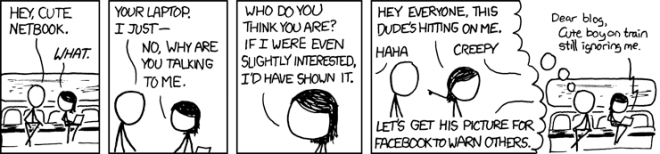
Another offers XKCD’s “great take on this”:
creepy

Another reader on the racial angle:

Instead of injecting my thoughts into this discussions, I thought I would direct your attention to a recent episode of Black-ish.  It’s a very funny show and I highly recommend it.  (In fact, a recent episode chronicled the parents struggle with whether to spank your child, and I think it addresses many of the issues raised by your readers.) In the third episode, available here, the father struggles with his son, who is growing up in an affluent white neighborhood and not understanding black culture, including the face that a black guy makes when he sees a woman with a nice butt.  The episode ends (go to about the 20 minute mark) with father and grandfather high-fiving after the son makes the face and says “damn” after looking at a woman’s behind. I was a little shocked by the scene myself and I don’t know whether it is really reflective of black culture.  However, I was surprised when the episode aired and there was little if any backlash.

Another turns the tables:

As a straight woman, I am constantly objectifying men I see on the street and on the college campus where I work. I am admiring their bodies (sometimes specific parts of their bodies), mentally unclothing them, imagining touching them, imagining having sex with them. I do not stop myself from doing this, and I do not feel shame or guilt about it – because it’s natural.

Yet I also recognize that these are my private thoughts, and that the men I am objectifying may be offended or feel sexually violated by me were I to tell these men that they are beautiful, hot, have a nice ass, etc. I also want to respect their personhood. For that reason, I stay as discrete as possible (though I am sure I’ve been noticed at least a few times). In my opinion, we shouldn’t pathologize the sexualization and objectification of other bodies; we should recognize that to do so is human instinct, for both men and women. We should instead seek to bring more civility into our culture – to recognize that it is the voicing the objectification, not the mental act of objectification itself, that is problematic and dehumanizing.

Another circles back to class:

I just want to respond to your reader on the updated Catcalling post, who wanted to point out this behavior doesn’t happen on their upper-middle-class streets. I’m sure it does happen there, if more rarely than in a heavily populated city; they just aren’t aware. Teenage boys will always find ways to let their female peers know if they like what they see – and I say that as having grown up in areas that sound very similar to this reader’s neighborhood, where once my friends and I were old enough to drive ourselves, rolling down car windows to shout “compliments” at girls and young women became frequent enough. It seemed like harmless fun then, but I’ve known for years that it really wasn’t. I carry no small amount of shame for having participated, even if I can chalk it up to being a hormone-fueled idiot. The phenomenon really shouldn’t astonish me, then, but it still does today when I see or hear of grown men behaving this way.

I work in the very white collar industry of financial products and services, and I hear from my women friends and co-workers that they get sexually harassed on some level on a near-daily basis while at work, in the same office I share with them. I don’t see it because these men have learned that behaving openly like that will get them fired post-haste, but it happens. Married managers, single interns, executives with grandkids. I’ve heard about them all, though never with any names attached to the stories, because these women are afraid of rocking the boat and would rather “deal with it” in relative silence than cost anyone their livelihood (including, especially, themselves).

No, it definitely isn’t all men, or even most men. Not even according to the harassed I’ve spoken to. But when it happens to them, or they witness it, every day, the unwanted attention becomes unbearable. How could it not? Videos like Hollaback are clearly striking that same nerve.

So your aforementioned reader wants to make this a class issue, but he’s using the word incorrectly. It’s not about economic class structure; it’s about a person’s, a heterosexual man’s, level of maturity. It’s about showing decorum, to know that catcalling or trying to get a woman’s attention through disrespectful means is wrong. Always. Period. It doesn’t matter where you grew up or where you live now. Or how you raise your kids. My father certainly didn’t teach me to catcall, but I did it anyway through some combination of peer pressure, cultural osmosis, and those damn hormones.

Catcalling” can happen anywhere, whether it’s yelled on the street or whispered in the halls of corporations. Your net worth has nothing to do with it.

Another would agree:

I’m the cliche long-time reader, first-time writer.  This catcalling business finally struck a deep nerve with me, so after hundreds of started-but-never-completed e-mails, I’m finally mad enough for the “SEND” button.

I’m a 29 year-old woman working in a heavily male dominated industry.  My clients and business partners are primarily white, in their late 40s, and making anywhere from $300-500k annually.  Some, quite a bit more than that.

These upper-middle-class white men are just as bad (I would say, worse) at this catcalling business … they just do it differently.  Your self-proclaimed upper middle class white guy isn’t out on the street all day whistling at girls who walk past. Instead, he’s sitting behind a mahogany desk with all sorts of trumped-up self importance thanks to his six-figure salary dishing out unwanted comments to the occasional woman he comes across under the guise of being complimentary.  Frankly, I prefer comments from strangers to what I deal with on a daily basis at work.

The most insulting “compliment” that I receive on the regular is the classic “you know, there’s more to you than meets the eye” – as if I, walking into his office on my initial visit, received low marks just for the fact that I’m a size-six twenty-something.  I straighten my hair, wear limited amounts of make-up with almost exclusively black suits and almost no jewelry. I’m a straightforward, aggressive, business-focused woman, desperate to hide the three biggest hurdles in gaining their respect: my age, gender, and shape.

A sampling of the repeated “compliments” I get fall along these lines: “It’s so nice that young women today don’t look like the butch girls in the industry when I was young.”  … “I bet if you had a boyfriend or husband he wouldn’t be letting you do this job with so many men.” (I have one, actually) …”You came with such a great recommendation – I was surprised when you walked in the door!” … “A pretty girl like you couldn’t find someone to take care of you so you could stay home and stop traveling so much?” … And, one of my personal favorites: “I bet a ton of the other guys out there hit on you, don’t they?”

These men appear to be committed family men when they’re back in their white, middle-class neighborhoods, but in the office, they feel entitled to comment on (and touch) young professional women’s bodies and general appearances just as much as the men in the video. So please inform your middle-aged white reader that his group is boorish, too.

Another woman complicates matters a little:

I’m 66 years old.  I remember the catcalls of the 1960s – girls walking down the street were often called broads and cunts and asked if we wanted to fuck. (Compare that with the overall good-natured and respectful language on the video!)

However, to muddy the waters; here’s one thing I miss about the catcalls of my youth. I was only average looking, but I had nice long legs.  In the days of short skirts, it was common for guys to whistle when I got out of the car. I loved that!

Another older woman with mixed feelings:

I’ve listened and watched all the comments people have about that woman walking the streets of New York and subjected to catcalls and whatever.  Takes me back to the last century – it really does.  Much has not changed.

The same stuff was going on in the streets my city back in the ’60s and ’70s and all the decades since.  I remember it well.  I hated it when it happened back then; the comments and whistles and gross come-ons made me feel cheap and diminished somehow.  I was a 20-year old from the farm country, new to the city, trying to get on with my career.  I’d steel myself to the shouts and keep on walking.  Some of those comments were the reason I became a “feminist”, way back then – still am, truth to tell.  Fighting for equal wages, equal rights, they called us “bra burners”.  Yeah, sure.

Back then, I got special prices at the butchers, extra bits of meat thrown in at no cost but with a sly comment that sounded much like “wanna meet me out back? I got some short ribs that are really meaty”.  I took the short ribs, but never went “out back”.  I got extra oranges and apples in the bag from the fruit market because I looked good. There were little extras at every turn.  Bartenders would say “we just got this nice white in, thought you might like to try it – this one’s on the house.”

I took it all and said thanks very much!  I knew it was just because of how I looked – young and attractive.

Now, at the age of 70, I can walk the sidewalks and markets downtown with no comments from anyone at all.  I don’t recall when I actually noticed that I’d become one of the “invisible women” on the street, probably around the time I hit between 50 and 55.  That’s about the time I noticed a few other things.

I don’t get deals at the butcher’s anymore – I’m still slender but a bit thicker through the middle, my hair is graying and I have a few wrinkles, I‘m still “good looking” according to my men friends, still dress stylishly, still have good legs but high heels have been traded in for boxy heels for comfort – it’s just that nobody ever whistles anymore or invites me “out back”. Or offers me deals on short ribs. Or offers me a nice white on the house.  I don’t miss it – I just note the absence.

Part of that absence makes me feel a little sad – yes, I’m old now.  The juiciness of life has passed me by.  Still, part of being “older” makes me feel a real sense of freedom; I’m accepted as just another human being, female by birth.  Nobody notices us older gals.  But we pay our way.

I kind of envy that gorgeous woman in her black slacks and black t-shirt. Part of me wants to say you’ll only have to put up with this for so long, and then it’ll be done.  Guys are guys, the cat-callers are mostly just dumb jerks being led by their hormones, and they’ll be old and fat and gone in no time.  And soon you’ll be older and heavier and nobody will notice you ever again.  You just might miss it when that time comes.  Not that I miss it all that much – but I DO have memories.  :-)

Will The GOP Block Obama’s Judges?

[T]he most intriguing potential fight will come if either Justice Ruth Bader Ginsburg (age 81) or Justice Stephen Breyer (76) decide that they don’t want to risk Democrats giving up the White House in 2016. It is precisely here that the logic of our timid democratic politics suddenly reverses. When major policy authority is given up by Congress or the president and is de facto thrown to the court, judicial nominations become almost as grave for the future of the nation as palace intrigue once was to the royal houses of Europe. While few expect Obama and the Democrats to fight for someone as progressive as Ginsburg, it would be seen as a total legacy-damaging failure in the party if Obama settled for a swing-voting moderate.

Chait also keeps focused on the judiciary:

Obama can fill the judiciary and staff his administration because he has a majority of votes in the Senate. But if Republicans win the Senate, then they can block his appointments. Sahil Kapur has one of the few detailed reports I’ve seen explaining the Republican strategy to leverage their majority. The parties have no incentive to cooperate on judicial nominations — Republicans would be better off leaving a seat empty than allowing it to be filled with an even moderately liberal judge. They say they want to force Obama to appoint “more acceptable” judges — “Obama would have to present nominees that are much much more acceptable to Republicans, or they won’t even schedule hearings,” explains Randy Barnett, a powerful Republican legal strategist — but the only kind of judge they have any reason to accept is one likely to side with conservatives more often than liberals. And Obama has no incentive to appoint a judge like that.

The difference between 50 Democratic senators (plus a tie-breaking vote by Joe Biden) and 49 Democratic Senators is the difference between two full years of filling the judiciary and two years of likely gridlock. What’s more, if a Supreme Court justice becomes incapacitated or dies, the judicial gridlock could become a Constitutional struggle — a possibility I explored last spring, but which has gathered little attention. News reports have wildly overstated the legislative importance of Republican Senate control. At the same time, they have understated its importance to the judiciary.

The Most Important Elections Tomorrow

John Oliver expects them to be at the local level:

Betsy Woodruff also spotlights the state races:

If there’s one truth of divided government, it’s that the most significant legislative action often happens on the state level instead of in gridlocked Washington. While the U.S. Congress has been bogged down in a morass, state legislatures with single-party rule have been hopping. In the last few years, for instance, the Republicans who control Texas’ legislature and governorship have passed bills banning abortion after 20 weeks, tightening regulations on abortion clinics, reducing the number of required standardized tests for students, running the table on tort reform, and requiring photo ID to vote.

And just like Republicans running for federal office are expecting a wave or wavelet of sorts next week, their state-level counterparts are aiming to take control of a few more legislative chambers—potentially with substantial policy consequences.

Carl Klarner’s forecasts that “Democrats will lose majorities in five state Senates and nine state Houses”:

Those state Senates are Colorado, Iowa, Maine, New York and Washington, while the state Houses are Colorado, Kentucky, Maine, Minnesota, Nevada, New Hampshire, New Mexico, Washington and West Virginia. … Forty-five states will have elections to their state legislatures this coming Tuesday, although four of those states do not have elections to their state Senates (not including special elections). Democrats are likely to lose seats in most states. The only gains are forecast to come in the Oregon, North Dakota, and Rhode Island State Senates, as well as the North Dakota House. West Virginia is forecast to see especially large losses for the Democrats in both of its chambers. Other states will see losses for the Democrats of over 10 percent, including the California Senate, the Nevada House, and both chambers of the Maine legislature.

Yglesias Award Nominee

“Back in 2012 I published a book about the Obama administration’s efforts to heal the economy. The book was largely a narrative, reconstructing events and internal debates as they unfolded. But it delivered a judgment on Obama’s economic team, and the judgment wasn’t favorable. Right there in the book’s subtitle it says that “Obama’s team fumbled the recovery.” This probably sounds right to anyone who’s unemployed, particularly anyone who’s been among the painfully large number of long-term unemployed

[But] my verdict on the administration was overly harsh. Job growth has been very steady the last three years. GDP growth has exceeded two percent in each of the last two years, and will almost certainly do so again in 2014 … And the same goes for historical comparisons. As Paul Krugman recently observed in Rolling Stone, the United States did a better job limiting the fallout from its financial crisis than the typical advanced economy has over the years. We also crawled our way out of the hole a little faster,” – Noam Scheiber.  (Awards glossary here.)