Our Syrian Allies Are Dropping Like Flies

Our proxy war in Syria suffered a setback over the weekend when two of the main “moderate” rebel groups receiving arms from the West surrendered to the al-Qaeda linked Jabhat al-Nusra following an assault on their strongholds in Idlib province:

The US and its allies were relying on Harakat Hazm and the Syrian Revolutionary Front to become part of a ground force that would attack the Islamic State of Iraq and the Levant (Isil). For the last six months the Hazm movement, and the SRF through them, had been receiving heavy weapons from the US-led coalition, including GRAD rockets and TOW anti-tank missiles. But on Saturday night Harakat Hazm surrendered military bases and weapons supplies to Jabhat al-Nusra, when the al-Qaeda affiliate in Syria stormed villages they controlled in northern Idlib province. The development came a day after Jabhat al-Nusra dealt a final blow to the SRF, storming and capturing Deir Sinbal, home town of the group’s leader Jamal Marouf.

On top of the American weapons now in the hands of the radical Islamist militia, the defeat of these two groups means that the Free Syrian Army has been almost completely driven out of northern Syria:

Idlib was the last of the northern Syrian provinces where the Free Syrian Army maintained a significant presence, and groups there had banded together in January to eject the Islamic State in the first instance in which Syrians had turned against the extremist radicals. Most of the rest of northern Syria is controlled by the Islamic State, apart from a small strip of territory around the city of Aleppo. There the rebels are fighting to hold at bay both the Islamic State and the forces of the Assad government, and the defeat in Idlib will further isolate those fighters.

Juan Cole responds to the news that some members of Marouf’s group defected to Jabhat al-Nusra:

The incident is disturbing because the Obama administration plans to train and arm fighters of the Syria Revolutionaries Front sort, on the theory that they are “moderates.” But a present Syrian moderate is all too often a future al-Qaeda member; many of these affiliations are not particularly ideological, but have to do with who is winning and who has more money. Last July, the Daoud Brigade of the Free Syrian Army joined ISIL.

Jamal Marouf’s group in any case had sometimes fought alongside Syria’s al-Qaeda and last April said al-Qaeda was the West’s problem, not his. (Ouch!) He complained that aside from a one time payment some time ago of $250,000, he hadn’t received any appreciable aid from the West. The loyalties of fighters may also have to do with which group is seen as more indigenous and which as foreign agents.

Larison knew this would happen:

In a saner political culture, this would be extremely bad news for the members of Congress that voted in favor of the administration’s plan to arm and train “moderate” and “vetted” rebels. The loss of weapons to an Al Qaeda affiliate is exactly the worst-case scenario that opponents of arming the “moderate” Syrian opposition imagined could happen, and now it has. Following the large loss of weapons and equipment to ISIS in Iraq, it was inexcusable to approve sending more weapons into Syria where they could be and now have been seized by jihadists, but the measure overwhelmingly passed both houses. A failure of this magnitude would normally be an indictment of the terrible judgment of the policy’s supporters, but we can expect that interventionists will quickly tell us that this would never have happened if only we had listened to them sooner.

Totten shrugs:

They were bad proxies anyway. The Syrian Revolutionary Front was an Islamist organization. Less deranged than Al Qaeda and the Islamic State, sure, but it was still an Islamist organization. Harakat Hazm is more secular, but it consists of a measly 5,000 fighters while the Islamic State has as many as 100,000.

Syria is gone. The only portions of that former country that may still be salvageable are the Kurdish scraps in the north. The Kurds are good fighters and they may be able to hold on with our help, but there is no chance they will ever destroy the Assad regime or the Islamic State. They don’t have the strength or the numbers. So unless the United States decides to invade outright with ground forces—and fat chance of that happening any time soon—we’re going to have to accept that the geographic abstraction once known as Syria will be a terrorist factory for the foreseeable future.

Jabhat al-Nusra’s gains in northern Syria weren’t the only bad news this weekend. In Iraq, ISIS militants perpetrated a massacre against a Sunni tribe in Anbar province that had attempted to resist them, murdering more than 300 people:

 The Albu Nimr, also Sunni, had put up fierce resistance against Islamic State for weeks but finally ran low on ammunition, food and fuel last week as Islamic State fighters closed in on their village Zauiyat Albu Nimr. “The number of people killed by Islamic State from Albu Nimr tribe is 322. The bodies of 50 women and children have also been discovered dumped in a well,” the country’s Human Rights Ministry said on Sunday. One of the leaders of the tribe, Sheik Naeem al-Ga’oud, told Reuters that he had repeatedly asked the central government and army to provide his men with arms but no action was taken.

Iraqi security forces are now planning a spring offensive to recapture the territory lost to ISIS, with American assistance, but the plan requires the training of three new army divisions and doesn’t foresee retaking the captured areas until the end of next year.

The Emotions Behind This Election

There are a few last-minute unknowables in what still looks like a GOP victory on Tuesday. But perhaps the biggest unknowable is still what this election is about. I made my own stab at an answer last week, and I recommend Ross Douthat’s musings on the same subject. But one thing that is hard to measure is the shift in political atmosphere this summer and fall. The news that has penetrated most deeply has all been Cole-Ebola-ISIS-2-690 (1) 2about threats from the outside, threats that make anyone want to pull up the drawbridge against an invasive world. This is an emotional environment tailor-made for conservative success.

The Fox Media Industrial Complex has worked these stories with its usual assiduity, and combined, they pack a big punch. You have the flood of illegal immigrants – aka, desperate children seeking refuge from mass violence – at the border. You have Putin posturing around his near-abroad, reminding us of past dangers. You have the rise of the Islamic State in Iraq – an almost text-book case of images and memes likely to trigger atavism and paranoia. And then, like some last sign of the apocalypse, you have the Ebola virus – seeping onto our shores, and turning even the most mild-mannered folks into quarantine enthusiasts. That all of these threats seem temporarily checked or calmed or over-rated hasn’t penetrated the national frontal cortex. What’s still there is fear. Or rather, a series of issues that prompt disgust and revulsion at the other – which is an extremely potent weapon in an election season.

And I’m not just blah blah blahing about this, while we all quietly scan the electoral polling data for the actual news. In a newly published study, neuroscientists found that they could predict people’s political leanings with surprising accuracy based on how their brains reacted to repulsive images:

In the experiment, subjects sat in a brain scanner while being shown a mix of images. Some of them were downright nasty, Ebola Virusshowing filth, rot, and decay. Others were neutral or pleasant — like landscape shots, or pictures of babies. The researchers noted the neural response to each. Afterward, the study subjects took a political survey that asked them about their thoughts on issues, such as having prayer in public schools and same-sex marriage legalization.

The researchers, led by Virginia Tech professor Read Montague, found that patterns of brain activity after viewing the gross images could be grouped together based on political leanings. In other words, conservatives reacted one way to the images (at least on a neurological level) and liberals reacted another way. When asked to rate the disgusting pictures, one group wasn’t more grossed out than the other. But the subconscious reactions varied enough for the researchers to tell conservatives and liberals apart.

Rick Nauert discusses the study with Montague in more detail:

Responses to disgusting images could predict, with 95 percent to 98 percent accuracy, how a person would answer questions on the political survey.

“The results suggest political ideologies are mapped onto established neural responses that may have served to protect our ancestors against environmental threats,” Montague said. Those neural responses could be passed down family lines — it’s likely that disgust reactions are inherited.

“We pursued this research because previous work in a twin registry showed that political ideology — literally the degree to which someone is liberal or conservative — was highly heritable, almost as heritable as height,” said Montague. “Conservatives tend to have more magnified responses to disgusting images, but scientists don’t know exactly why,” Montague said. Investigators believe the responses could be a callback to the deep, adverse reactions primitive ancestors needed to avoid contamination and disease.

Judis is skeptical of this sort of research:

Academics in the social sciences are always on the look out for ways in which they can ground their squishy subjective speculations in the hard terrain of science. The more mathematical symbols and complicated flow-charts or arcane graphs a journal article contains the better. Even literature professors have looked toward obscurantist continental philosophers to turn novels and poems into “texts” that can be analyzed and charted. Twentieth century philosophy is littered with attempts to reduce language to mathematic formulations. The drive to reduce human behavior to neurons and genes is only the latest expression of this drive to turn social scientists into real scientists.

Jon Green pushes back on Judis:

Long story short, research into how political attitudes and behaviors are affected by our biology — especially our genes — is very new and very clunky, but that doesn’t mean we should ignore it. Judis is right to be skeptical, but it isn’t fair for him to be as dismissive as he is.

I too see the new knowledge of our genetics an important addition to our understanding of the world, including politics. They cannot replace all the other tools of analysis we have – history, ideology, demography, and human agency. But they can supplement them, and tell us, as in this election, a little more about what we already kind of know.

It’s Getting Hot In Here

That’s one unsurprising finding from the latest UN report on climate change (pdf). Brad Plumer digs deeper:

It notes that some amount of “irreversible” climate disruption is already locked in, but things can also get much, much worse. Additional global warming could wreak havoc across the globe, potentially leading to food shortages, the flooding of major cities, and mass extinctions.

Perhaps the most relevant sections are about how to avoid this fate, something the world’s nations will be discussing over the next year of UN climate talks. To avoid the worst outcomes, the world would need to act immediately and drastically, reducing emissions 41 to 72 percent below 2010 levels by mid-century. We’d then need to keep cutting and possibly be taking carbon-dioxide back out of the atmosphere by 2100. That won’t be easy. And the task gets all the harder if countries delay action or if they rule out certain controversial technologies, like nuclear power or carbon capture for coal plants.

He makes a grim observation:

[Y]early greenhouse-gas emissions have kept rising fast in recent decades. If this keeps up, we’re likely on pace for between 3.7°C and 4.8°C rise in average temperatures by the end of the century. The World Bank, for one, thinks that would be a disaster – because “there is no certainty that adaptation to a 4°C world is possible.”

And let us remember that “adaptation” refers to the human race. Our fellow species on planet earth are already dying out in vast numbers. But Allen McDuffee finds a nugget of hope in the analysis:

We already have technology, the report points out, that could play a major role in helping to end our dependence on fossil fuels. “It is technically feasible to transition to a low-carbon economy,” Youba Sokona, co-chair of one of the IPCC’s working groups, says. “But what is lacking are appropriate policies and institutions. The longer we wait to take action, the more it will cost to adapt and mitigate climate change.”

And Elizabeth Shogren suggests the international political climate is gradually improving:

In six weeks, the negotiators will gather in Peru. That meeting is supposed to prepare the way for the conference in Paris in December 2015, which aims to reach an agreement to replace the Kyoto Protocol. Kyoto required developed countries to reduce greenhouse gas emissions by specific amounts. It was a legally binding treaty—except that it never bound the United States, then the largest emitter, which never ratified it. And it never bound China, now the largest emitter, because all developing countries were exempt.

The argument between developed and developing countries—about who should do how much to “mitigate” climate change through reduced emissions—has always been one of the main obstacles to an agreement that actually makes a difference. But the chasm is less deep than it used to be, said Laurence Tubiana, the French diplomat charged with organizing the Paris conference. “All countries, including less developed countries, are saying their contribution will have a mitigation part,” Tubiana said on a visit to Washington last month. “Even Mali will have emissions reductions. That’s really unprecedented.”

Meanwhile, Constantine Samaras wishes the report emphasized the need for greater investment in energy R&D:

Governments define their near-term and long-term priorities line item by line item on every fiscal year budget. In 2000, the U.S. Federal R&D budget for “activities to develop technologies to deter, prevent, or mitigate terrorist acts” was $511 million. In the aftermath of the terrorist attacks of September 11, 2001, the R&D budget for counterterrorism grew to almost $2.7 billion in 2003. …

The impacts from climate change also pose risks to the United States, but policymakers are responding to these risks with much less seriousness than the response to terrorism. … U.S. energy technology and global change research R&D budgets have been relatively flat and completely unrepresentative of the challenge. We correctly reacted to counterterrorism with enhanced R&D after 2001, yet on energy and climate change we’re effectively just muddling through.

And Chris Mooney contends that global warming may be even worse than the IPCC makes it out to be:

According to a number of scientific critics, the scientific consensus represented by the IPCC is a very conservative consensus. IPCC’s reports, they say, often underestimate the severity of global warming, in a way that may actually confuse policymakers (or worse). The IPCC, one scientific group charged last year, has a tendency to “err on the side of least drama.” And now, in a new study just out in the Bulletin of the American Meteorological Society, another group of researchers echoes that point. In scientific parlance, they charge that the IPCC is focused on avoiding what are called “type 1” errors – claiming something is happening when it really is not (a “false positive”) – rather than on avoiding “type 2” errors – not claiming something is happening when it really is (a “false negative”). The consequence is that we do not always hear directly from the IPCC about how bad things could be.

Just as well that we had a thorough airing of these issues in the current Congressional campaign, isn’t it?

A Mild Republican Wave

political tide

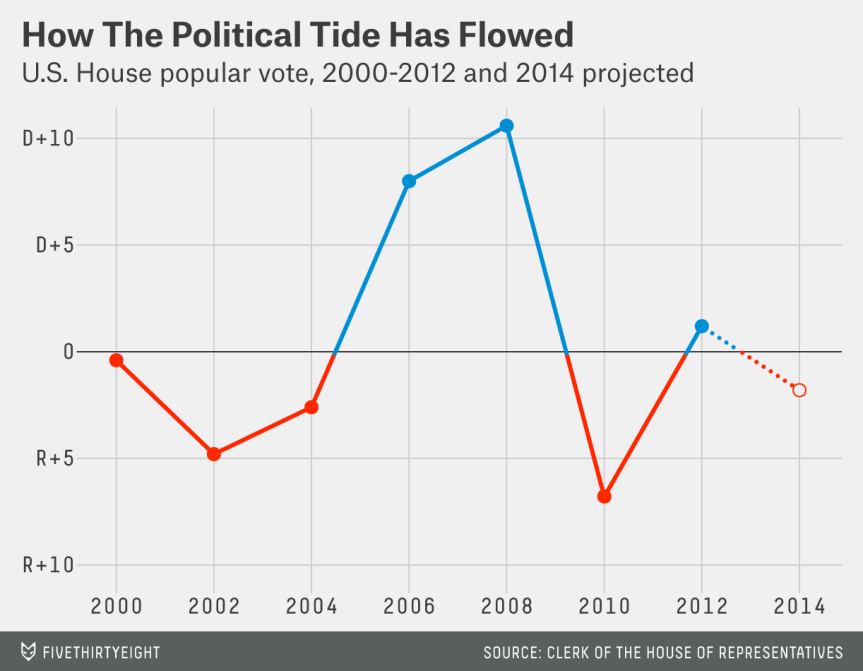
Silver compares 2014 to past elections:

The data point for 2014 reflects this year’s generic congressional ballot, a poll-based projection of the national House vote. There’s been huge variation from survey to survey on the generic ballot, but the average currently favors Republicans by about 2 percentage points. If the average is about right, it would tell us the same thing we inferred a few paragraphs ago: 2014 is a better year for Republicans than 2012 and a much better year than 2008 but not as good as 2010.

So maybe this isn’t so complicated, after all. The polling data we have tells a pretty consistent story. The challenge is in the different interpretations it will enable, all of which will feature prominently in the post-election spin.

Sam Wang largely blames the gains Republicans are likely to make in the House on gerrymandering:

The House is, in many ways, a predictable game: a modest gain in the popular vote will very likely lead to even further seat gains. Roughly speaking, gaining one percentage point in a popular-vote victory should translate to approximately three more seats. A popular-vote tie would lead to a gain of four seats, and a two-percentage-point win would lead to a gain of ten seats. If the G.O.P. gains eight seats—well within the realm of possibility—they will make up all their losses of the 2012 election. This would put the House back to where it was after the election of 2010, a so-called wave year, when voter opinion swung strongly to the right. Using the tool of redistricting, they have successfully tilted the political playing field to secure a large majority for at least the next two years without the same popular appeal.

The governor’s races are a different story. Wang checks in on them:

At this point, races fall into the following categories:

Incumbents headed for probable defeat (>3 percentage point margin): Brownback (R-KS), Corbett (R-PA).

Incumbents under threat (<3 percentage points): Parnell (R-AK), Deal (R-GA), Snyder (R-MI), Walker (R-WI), LePage (R-ME), Scott (R-FL), Quinn (D-IL), Malloy (D-CT), Hickenlooper (D-CO).

Open governorships, clear lead (>3 percentage points): Raimondo (D-RI), Baker (R-MA), Hutchinson (R-AR).

The expected net range of outcomes (1 sigma, about 68% of possibilities) is D+0.4 ± 1.3 governorships, which translates to between 1 net gain by Republicans to 2 net gains by Democrats.

A Defense Of Occasional Voters

 Sendhil Mullainathan mounts one. He discovered that voting increases polarization, that it “effectively committed people to a candidate or party”:

A combination of neutrality and persistent voting would be ideal. But our psychologies are complicated. If they override our narrow self-interest and lead us to vote instead of free-riding, the very act of voting may make us more partisan. Sporadic voters can provide an antidote: Their previous lack of engagement may serve as a counter to partisanship.

There is a line between apathy and neutrality. People who sit out all elections provide little value to a democracy. People who sit out some elections, jumping in at crucial times, serve an important role as a reserve army of the uncommitted.

Where There’s A Will (And There Is)

Stains

You have more willpower than you think, according to Jason Hreha:

Recent studies have failed to replicate the finding that willpower is, indeed, a limited resource. Other research, done in 2013 by Carol Dweck and colleagues, has shown that one’s beliefs about willpower affect how much willpower one has. Far from being a limiting factor, willpower seems to be a reflection of one’s beliefs and biology. Beliefs are things, and they can change how we survive and thrive within the world. If you see yourself as containing a limited amount of self control, it’s unlikely that you’ll make the extra effort to forgo dessert, or hit the gym, since you’ll “burn out anyways.”

Even though a substantial amount of research has challenged the idea of limited willpower, millions of people throughout the world have incorporated this spurious idea into their mental models of themselves and people in general. … There is no greater shackle than a false idea and, as the willpower field shows, ideas once “true” can become questionable, even false, in due time.

Malkin Award Nominee

“I’m sure Pius XII would have denied that signing a Concordat with Hitler’s Germany meant he approved of Nazism. But it conferred legitimacy and dramatically undercut any basis within the Church for resistance. The same goes for the concordat many Catholic institutions are signing with gay marriage. It confers legitimacy on the sexual revolution and undercuts resistance.

I can understand why Pius XII sought the Concordat with Hitler. He hoped to secure a stable basis for the Church’s ministry in Germany. I can also understand why many Catholics (including, perhaps, Pope Francis) want to make their peace with the sexual revolution, putting “divisive” culture-war issues behind them so that they can go on with the work of the Gospel and so forth. Moreover, Hitler in 1933 didn’t look so bad—and respectable gay couples don’t seem a threat to marriage or anything else,” – R.R. Reno, First Things.

(Hat tip: Alan Jacobs)

A GOP Senate Gets More Likely

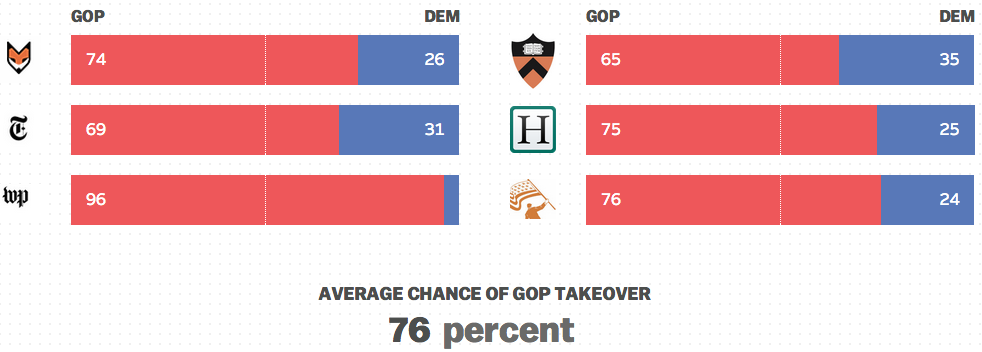
The forecasts increasingly favor Republicans:

GOP Chances

At this point, Democrats hoping for an upset are largely banking on the polls being wrong. Nate Silver explains:

The FiveThirtyEight model accounts for the possibility that the polls could be systematically biased — in either direction. If I instead tell the model to assume the polls have no overall bias — even though they might be off in particular states — the Democrats’ chances of keeping the Senate would be just 17 percent. Democrats are becoming increasingly dependent on the possibility that the polls will prove to be “skewed.”

But Silver notes that the polls “could be biased against Republicans, too”:

Historically, that’s been the case often than not in red states like the ones where some of the most crucial Senate races are being held.

Enten thinks “the more pressing question now may be the size of the Republican majority come next Congress”:

New polls out this weekend suggest that Republicans may not just win the six seats they need for control, but quite possibly eight seats — Republicans now have a 41.4 percent chance of doing just that. … If we add up all the states where Republicans lead, they will win eight seats for 53 seats in the next Senate. Sure, Democrats still have chances in Alaska, Colorado, Georgia and Iowa. But the Republican position is holding steady, if not improving, in all the states they need for a majority.

Chris Cillizza examines the toss-up Senate races:

* Alaska (Democratic controlled): Election Lab 79 percent Republican, LEO 67 percent Republican, FiveThirtyEight 71 percent Republican

* Georgia (Republican controlled): Election Lab 67 percent Republican, LEO 58 percent Republican, FiveThirtyEight 68 percent Republican

* Iowa (D): Election Lab 89 percent Republican, LEO 68 percent Republican, FiveThirtyEight 71 percent Republican

* Kansas (R): Election Lab 97 percent Republican, LEO 51 percent Independent, FiveThirtyEight 54 percent Independent


What 2014 Means For 2016

Not much, according to Sean Trende:

Any outcome we’ll see is likely to be roughly consistent with the underlying electoral fundamentals — a Democratic president’s low job approval rating, a tepid economy, a bad playing field for Democrats in the Senate and a good one in the House.  Back in the winter, when “fundamentals”-based models were being produced, people were predicting Republican gains in the Senate in the range of six-to-eight seats, with error margins putting us in something of the four-to-10 seat range.  This seems to be where we are headed.

But the upshot of this is that we can’t make grand predictions about 2016 and beyond.  If 2014 was well-predicted by fundamentals (as were 2008 and 2012), we should continue to expect that elections will be well-predicted by fundamentals; we should prefer a parsimonious explanation to a more complex one.  It is Republicans substantially over-performing or under-performing that might be meaningful, not Republicans getting what we’d expect, given the circumstances.

But, in Nate Cohn’s estimation, if Tuesday “night ends with tight races in Iowa, North Carolina, Colorado and Georgia, as the polls suggest, then the results will not be as great for Republicans as many analysts will surely proclaim”:

If there were a time when the Republicans ought to be making inroads into the Obama coalition, this should be it. The economy remains mediocre in many respects; there is turmoil in much of the world; and the American public is decidedly downbeat about the state of the country under Mr. Obama. His approval ratings have sagged into the low 40s. A significant proportion of Democratic-leaning voters say they disapprove of his performance.

Historically, presidential ratings like these have permitted the party that does not hold the White House to make substantial gains. This year, however, Democratic Senate candidates in the battleground states have largely reassembled the coalition that supported Mr. Obama two years ago. Democratic candidates would probably win Colorado, North Carolina, Iowa and Georgia — along with control of the Senate — if those who vote were as young, diverse and Democratic as they were in 2012 or will be in 2016.

A Major Setback For Space Tourism

Virgin Galactic SpaceShipTwo Crashes During Test Flight In Mojave Desert

Kenneth Chang brings us the latest on the Virgin Galactic tragedy:

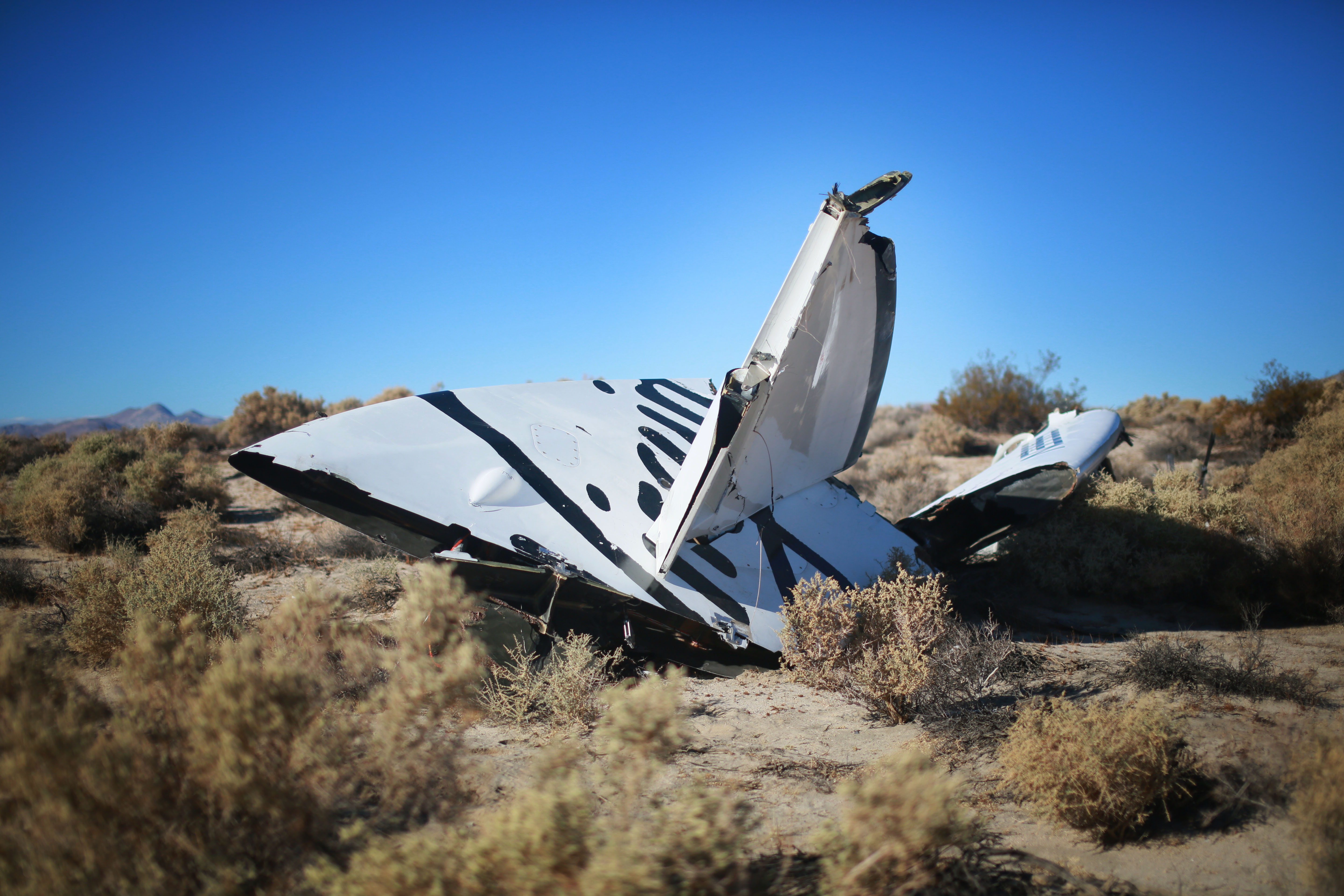
The Virgin Galactic space plane that broke apart over the Mojave Desert on Friday shifted early into a high-drag configuration that was designed to slow it down, federal accident investigators have said. The accident killed the co-pilot, Michael Alsbury; the pilot, Peter Siebold survived after parachuting out of the plane.

Clive Irving puts the disaster in perspective:

From the beginning in 2004 there has always been a credibility gap between the fairground hyperbole of [Virgin Group founder Richard] Branson’s formidable publicity machine and the scientific reality of the enterprise. Somehow, probably because he is such a consummate showman, Branson has been able, year after year, to override the story of continual delays, flagrant over-promises and a voracious, seemingly open-ended budget. This time it’s different. A National Transportation Safety Board investigation will deliver a forensic rigor that has been so far lacking. It will strip away the vocabulary of the promoter. And it will reveal the world as lived daily by the engineers and test pilots who knew how much was left to be understood among the hazards of the dream.

Adam Rogers predicts that, following this crash, “we’re going to hear a lot about exploration, about pioneers and frontiers. People are going to talk about Giant Leaps for Mankind and Boldly Going Where No One Has Gone Before.” He recommends we “call bullshit on that”:

SpaceShipTwo—at least, the version that has the Virgin Galactic livery painted on its tail—is not a Federation starship. It’s not a vehicle for the exploration of frontiers. This would be true even if Virgin Galactic did more than barely brush up against the bottom of space. Virgin Galactic is building the world’s most expensive roller coaster, the aerospace version of Beluga caviar. It’s a thing for rich people to do: pay $250,000 to not feel the weight of the world.

Jazz Shaw focuses on the financing of such projects:

The problem I’m wondering about here is that there are really only two target customer markets for these ventures. The government is the only viable buyer for services to ferry materials and astronauts to the space station. And while the government is a very regular customer, one change in administration or shift of a few decimal places in a budget committee report can dry up your sales overnight. The only other customers for an entity like Virgin Galactic are very high end, wealthy tourists. Initial ticket sales – even at a quarter million a seat – have been brisk, but one or two explosions can dampen the enthusiasm of your target audience. And even if everything had gone perfectly, there is surely a limit to the number of buyers for a service like this once the novelty has worn off.

Mataconis calls Virgin Galactic “little more than a Richard Branson vanity project that was unlikely to lead to a viable business in the near future.” But he is more optimistic about “the side of commercial space travel represented by companies like SpaceX, Boeing, and Orbital Sciences”:

For the time being, there’s obviously not going to be the kind of free market in space that some evangelists for commercial uses of space have talked about in the past. One imagines, for example, that Branson’s “space tourism” idea is pretty much dead for at least the next decade in much the same way the civilians in space program was put on hold after the Challenger disaster, but the involvement of private companies in the space program is likely to increase. Don’t be surprised, for example, to see things like SpaceX, Boeing, and other companies contracting directly with private companies for launches rather than going through the Federal Government. In other words, there is a future for the commercialization of space to some degree, but much of most of our efforts to “slip the surly bonds of Earth,” it is still at the point where we are moving slowly.

Wilson da Silva, who pre-purchased a Virgin Galactic ticket, is still excited about going into space. He compares the histories of space and air travel:

The pioneers of powered flight, brothers Wilbur and Orville Wright – who gave birth of the modern age of flying – experienced a fatality in September 1908, on their third demonstration flight for the US Army before a crowd of 2,000 people in Fort Myer, Virginia. Orville took up one passenger with him, and the third of these – 26-year-old Lieutenant Thomas Selfridge – became the first passenger to die in an aircraft accident: the propeller came off, and the plane nosedived 23 meters; Selfridge died from a fractured skull, and Orville suffered a broken leg and ribs.

Aviation become important in World War I, but despite some advances in the 1920s, it was still dangerous and fatal accidents were routine. Pilots flew 100m above ground, navigating by roads, railways and compasses. It took years of flying and experimentation before air travel became safe. Between 1920 and 1926, one in every four pilots was killed annually; in the 1930s, one in 50. By 1966, it was one in 1,600.

Alex Tabarrok remarks that “the safety of rockets continues to be far too low to support significant tourism”:

Virgin Galactic’s VSS Enterprise, which crashed [Friday], was just on its 23rd powered flight suggesting a failure rate of perhaps 5%, in line with expected values. An earlier tragedy involving tests of the rocket motor killed 3 people. As I said ten years ago, even a failure rate of 1 in 10,000 is far too high to support space tourism of the “fat guys with camera” variety and we are not yet close to a failure rate of 1 in 10,000.

Dish’s coverage of last week’s other aerospace accident, the Antares rocket explosion, is here.

(Photo: Debris from Virgin Galactic SpaceShip 2 sits in a desert field north of Mojave, California on November 2, 2014. By Sandy Huffaker/Getty Images)