Peak Islamism?

Screen Shot 2014-10-30 at 3.16.29 PM

Looking over Arab Barometer data from the past decade, Michael Robbins and Mark Tessler find that throughout the Arab world, “support for democracy remains high but support for political Islam has decreased” while “Islamic democrats – those who support both democracy and political Islam – are becoming scarcer across the region”:

Arab publics continue overwhelmingly to support democracy. In all but one country surveyed, three-quarters or more of respondents in the third wave of surveys (late 2012-2014) agree or strongly agree with the statement “A democratic system may have problems, yet it is better than other political systems.” …

Support for political Islam is substantially lower. In no country do more than half of respondents say religious leaders should have influence over government decisions.

It is often far less support, including just 34 percent in Algeria, 27 percent in Tunisia, 20 percent in Egypt and 9 percent in Lebanon. Moreover, support for political Islam declined over the past decade. Algeria has witnessed the most dramatic decline, with support for political Islam falling from 60 percent in 2006 to just 34 percent in 2013. A similar decline has occurred in Egypt, where 37 percent supported political Islam in June 2011 compared to 18 percent in April 2013, a 19-point decrease. Most other countries witnessed a similar decline, including Palestine (-15 points), Iraq (-11), Lebanon (-9) and Yemen (-7).

In Saudi Arabia, Caryle Murphy profiles the “post-Islamist generation” of young people who are fed up with religious politics:

Young Saudis “are looking for individual freedom and rights, not for religion,” said Mohammed al-Abdulkareem, an assistant professor of Islamic jurisprudence at Al-Imam Muhammad Ibn Saud Islamic University, a conservative religious university in Riyadh. This “big change” began after the Arab revolutions, he said. “It’s clear to me that from the Arab Spring, people discovered the ideas of human rights and individual freedom and that these ideas were more effective and more successful to get a change in their governments,” he said. “Why would you expect that people would return to religious trends when … these trends and religious institutions didn’t pay attention to human rights and the freedom of the people?” …

The trend is encapsulated in a 27-year-old Saudi woman I met in Riyadh. Raised in a traditionally religious family, she wears the Islamic headscarf and is religiously devout — but she dislikes how her government has used her faith for its own ends. “Islam came to free people. Islam didn’t come to put them in jail,” she said. “And the government uses it to put people in jail and under their control. So they control us by Islam…. That makes a lot of people not even want Islam.”
The Exploring Never Ends

Reviewing Matthew Lee Anderson’s The End of Our Exploring: A Book about Questioning and the Confidence of Faith, Timothy King criticizes his understanding of doubt’s place in the Christian life, asserting that faith “is grown not by the removal of doubt but by acting in its presence”:

If we do not experience a deep sense of uncertainty as to how the question we are asking may or may not be answered, then we are not, I would argue, in full exploration of the question. Anderson argues that our questions should occur “within the borders of faith” and that when we question “we do not weigh Christianity in the balances.” These sorts of presuppositions can not only make the questions we ask anemic, they also leave us open to the great danger of assuming that what we believe today as a “border of faith” should actually be a “border of faith.” A growing faith quite likely means that what we think it means to “weigh Christianity in the balances” at one point in our life, will not mean the same thing later. And that’s a good thing.

Anderson and I would agree that good questions have a role in the growth of our faith throughout the life of a believer. We always live with the knowledge that we might one day discover that a belief we have held is wrong, insufficient, or able to be improved upon. But Anderson believes this ongoing pursuit of better questions and answers can continue without doubt. I disagree. Without truly doubting and opening yourself to the possibility that even many of your most deeply held tenets of faith could be wrong or inadequate, questioning will remain a mental exercise that does not reach its potential for personal transformation. Doubt, I would argue, is that state of change that allows for the questions to continue and faith to grow. And as the husks of beliefs that were wrong, too small, or in other ways insufficient fall aside, they join in the process of fertilizing a more perfect faith through their own decomposition.

Quote For The Day II

“To those who know a little of Christian history probably the most moving of all the reflections it brings is not the thought of the great events and the well-remembered saints, but of those innumerable millions of entirely obscure faithful men and women, every one with his or her own individual hopes and fears and joys and sorrows and loves — and sins and temptations and prayers — once every whit as vivid and alive as mine are now. They have left no slightest trace in this world, not even a name, but have passed to God utterly forgotten by men. Yet each one of them once believed and prayed as I believe and pray, and found it hard and grew slack and sinned and repented and fell again. Each of them worshipped at the eucharist, and found their thoughts wandering and tried again, and felt heavy and unresponsive and yet knew — just as really and pathetically as I do these things. There is a little ill-spelled ill-carved rustic epitaph of the fourth century from Asia Minor: — ‘Here sleeps the blessed Chione, who has found Jerusalem for she prayed much’. Not another word is known of Chione, some peasant woman who lived in that vanished world of christian Anatolia. But how lovely if all that should survive after sixteen centuries were that one had prayed much, so that the neighbours who saw all one’s life were sure one must have found Jerusalem! What did the Sunday eucharist in her village church every week for a life-time mean to the blessed Chione — and to the millions like her then, and every year since then? The sheer stupendous quantity of the love of God which this ever-repeated action has drawn from the obscure Christian multitudes through the centuries is in itself an overwhelming thought,” – Dom Gregory Dix, The Shape of the Liturgy.

(Hat tip: Wesley Hill)

Face Of The Day

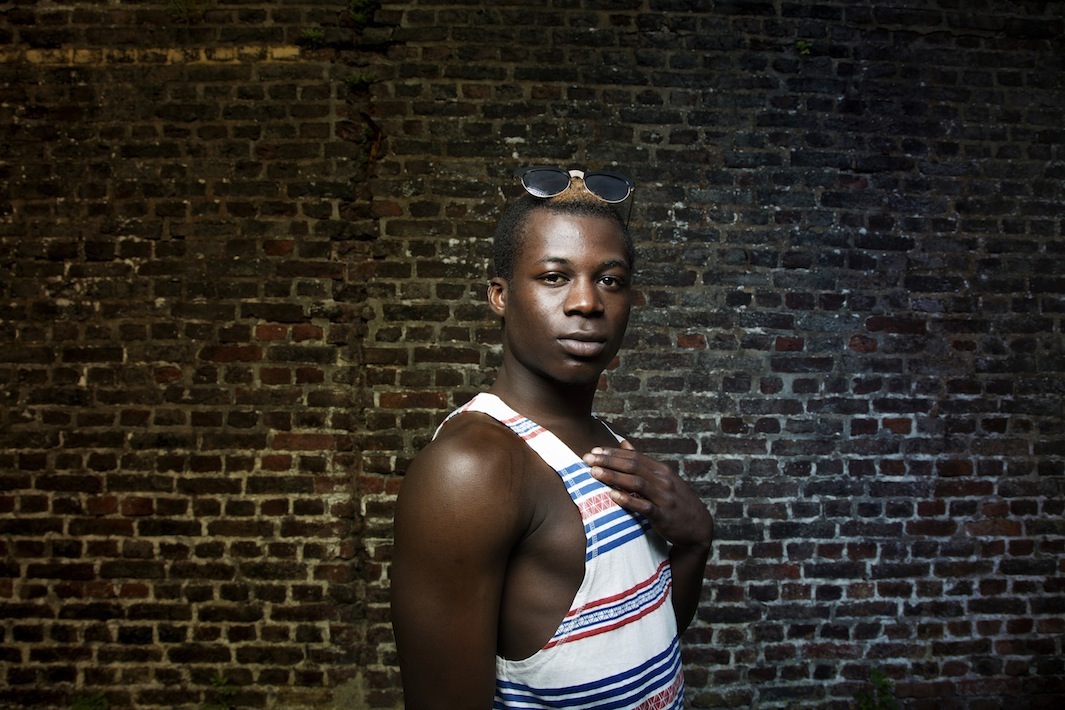
Leroy, Brussels, Belgium, 2013.

American photographer M. Sharkey captured images of young gay Belgians, including Leroy, above, for his 2013 series “Brussels Is Burning.” According to Jordan G. Teicher:

[Sharkey] found a “totally different youth culture” where queer youths were “not as open about their sexuality at such a young age as Americans are.” “Western Europe is an incredibly modern and connected culture, but the young people—the 14-, 15-, 16-year-old kids—still don’t have a community the way that American kids have,” he said.

See more of Sharkey’s work here, or catch his exhibit “Queer Kids” at the Stonewall National Museum and Archives through January 4.

Worshipping With Warhol

Mark Judge reminds us that the artist was a serious Catholic:

Andy Warhol’s family was Byzantine-Ruthenian, and in the early 20th century they came to America, settling in a Catholic section of Pittsburgh. Warhol’s mother Julia was deeply pious, attending St. John Chrysostom Byzantine Catholic Church. She took her children to Mass, and encouraged Andy, who was sick a lot as a child, to learn how to draw. Warhol drew pictures, went to church, and cut out magazine pictures of movie stars. In those three elements we find his entire life’s work.

Warhol moved to New York in 1949. He then went on to become the most famous artists of the latter 20th century. Warhol is associated with irony, disco, Pop Art paintings of everyday objects like Campbell’s soup cans, and cool. But he never lost the faith. Even during his high-flying Studio-54 days, Warhol would appear at Mass at St. Vincent Ferrer several mornings a week — and as a volunteer at soup kitchens. When his mother moved to New York to live with him, Warhol would warn visiting guests not to curse. Warhol also paid for his nephew to go through seminary and become a priest.

A good, if rare, overview of Warhol’s faith is Jane Daggett Dillenberger’s book The Religious Art of Andy Warhol. There is an entire section dedicated to the over one hundred drawings Warhol made of the Last Supper. When Warhol died in 1987, his eulogist John Richardson said that there were “two Andy Warhols” — the whimsical Pop Art celebrity and the shy and pious Christian.

Previous Dish on the subject here.

(Video: Warhol biographer Bob Colacello discusses the reissue of his Factory memoir, Holy Terror: Andy Warhol Close Up)

The Force Is With Them

In the UK’s 2001 Census, 390,127 people, or just under 1% of the population, identified their religion as “Jedi” – though it’s fair to assume not everyone who replied that way was serious. Tom de Castella updates us on the trend, claiming that what began “as an intellectual exercise by fans adding to the movies and filling in the gaps, has become an attempt to build a coherent religious code”:

Beth Singler, a researcher in the Divinity Faculty of Cambridge University, estimates that there are about 2,000 people in the UK who are “very genuine” about being Jedi. That’s roughly the same number as the Church of Scientology, she says. Jediism is not a joke for them but an inspiration. They don’t believe in “A long time ago in a galaxy far, far away…”, says Singler quoting the opening text that fills the screen of Star Wars. “It’s somewhere between metaphor and literal truth.”

“Feel the force” has become a rather tired cliche. But behind it is a New Age mysticism similar to many of the “holistic” ideas that emerged in the 1960s and 70s. “The Force is what gives a Jedi his power,” says Obi-Wan Kenobi, played by Alec Guinness, who initiates young men into Jedi tradition. “It’s an energy field created by all living things. It surrounds us and penetrates us. It binds the galaxy together.”

The Jedi belief system is a patchwork quilt of Taoism, Buddhism, Catholicism and Samurai, says Singler. Often the ideas offer a simple dualism of good and evil, light and dark. “Fear is the path to the dark side,” Yoda tells Anakin Skywalker. “Fear leads to anger. Anger leads to hate. Hate leads to suffering. I sense much fear in you.”

Stalling For Time

Stacey D’Erasmo waxes nostalgic for the days before the Internet ushered in a sort of “virtual eternity”:

I feel weird—sometimes giddy, sometimes nauseous—about time these days. Like many people, I stood in line for hours to become immersed in Christian Marclay’s 2010 art installation, “The Clock,” a twenty-four-hour montage of film clips that synchronized onscreen time—conveyed via images of various timepieces—with actual time. Oddly, vertiginously, although the time onscreen was identical to the time on the street, no matter if one watched for an hour or five one left the theatre feeling as if time had come unsprung, as if one had been plunged into another dimension, a great vertical depth, that made real time seem mysteriously thin and weightless. Lines snaked around blocks to see “The Clock”; some people camped out in sleeping bags overnight outside venues where it was to be shown in order to be first on line. It was a brilliant work of art, but the overwhelming hunger for it suggests that there is a widespread nostalgia for the dominance of clock time, akin to the rise of the nature special as species were disappearing at a rapid rate from the planet. There are more clocks than ever—clocks on computers, on cell phones, on televisions, on any screen available, telling time to the digital second—but they all seem to matter less. Sometimes, the time looks like one more graphic element on a buzzing surface crammed with them, a vestigial bit of design, like watch pockets on jeans.

(Video: Excerpt from Christian Marclay’s “The Clock”)

Darwin And The Divine

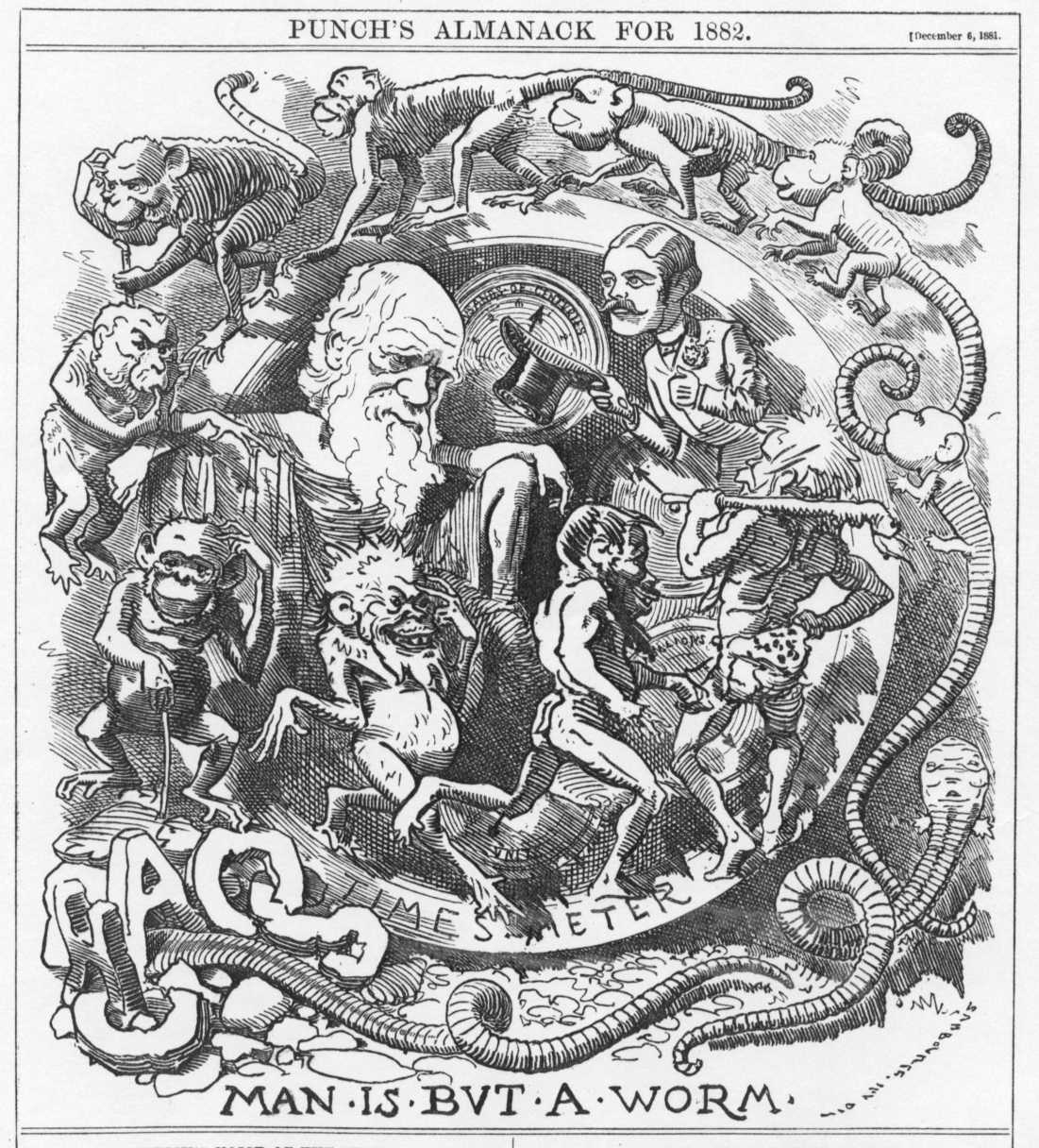
Man_is_But_a_Worm

Drawing from his new book, Darwin’s Dice: The Idea of Chance in the Thought of Charles Darwin, Curtis Johnson pushes back against an understanding of Darwin’s thinking about God that holds “he gradually shifted from ‘early orthodoxy’ to a ‘liberal form of theism,’ and then in later years ‘into an agnosticism tending at times toward atheism'”:

It seems probable that his departure from Christian faith was earlier, more abrupt, and more complete than this view indicates. The reason for thinking so stems from the same source that so many of Darwin’s contemporaries rejected a role for chance in nature’s workings: a chance-governed world seems tantamount to a godless world. Einstein made this very connection himself 75 years later when he famously said, “God does not play dice with the universe.” Darwin undoubtedly understood this implication of his theory, but rather than conclude that chance plays no role in nature he appears to have concluded instead that God does not have much to do with nature at all.

He goes on to excerpt a telling letter Darwin wrote to the Harvard botanist Asa Gray in May 1860, just a few months after the publication of The Origin of Species:

With respect to the theological view of the question; this is always painful to me.—I am bewildered.—I had no intention to write atheistically. But I own that I cannot see, as plainly as others do, & as I shd. wish to do, evidence of design and beneficence on all sides of us. There seems to me too much misery in the world. I cannot persuade myself that a beneficent & omnipotent God would have designedly created the Ichneumonidae with the express intention of their feeding within the living bodies of caterpillars, or that a cat should play with mice. Not believing this, I see no necessity in the belief that the eye was expressly designed. On the other hand, I cannot be contented to view this wonderful universe, and especially the nature of man, & to conclude that everything is the result of brute force. I am inclined to look at everything as resulting from designed laws, with the details, whether good or bad, left to the working out of what we may call chance. Not that this notion at all satisfies me. I feel most deeply that the whole subject is too profound for the human intellect. A dog might as well speculate on the mind of Newton.—Let each man hope and believe what he can.

(Image: Punch’s almanac for 1882, published shortly before Darwin’s death, depicts him amidst evolution from chaos to Victorian gentleman with the title “Man Is But A Worm,” via Wikimedia Commons)

Not With A Bang, But A Bubble

3876072412_405e4a7cc3_b

That’s how cosmologist Alex Vilenkin explains the way the universe will end:

All of a sudden a tiny little bubble will appear. It can appear anywhere—under your chair, or somewhere in Andromeda, very far away—and this little tiny thing starts growing at a speed that’s pretty close to the speed of light. And as it expands, all things that it engulfs turn into an alien form of matter. It may be approaching us right now. Say it nucleated at Andromeda some millions of years ago, it may be expanding toward us at the speed of light. But we don’t get much of a warning. So the good thing about it is you don’t really have to worry about it.

So what would happen to the Earth? It would just go, “FLOOP!” and not exist anymore?

Yeah. Inside of this bubble, ordinary matter as we know it does not exist. It’s made up of different kinds of particles. So everything will be turned into some other stuff that we just don’t know about. But aside from the fact that the end will come very quickly, the other piece of good news is that the probability of the universe ending at any given moment is extremely low.

Like how low?

We can’t really tell. It depends on particle physics at very high energy, so we can’t reliably calculate it. But back-of-the-envelope estimates give you extremely low numbers, like trillions and trillions of years from now. The probably of it occurring while our sun is still active and burning is almost nil. So most likely it will happen when the sun is already gone and, you know, we might not be around.

(Photo by Jim Trodel)