How Do We End Child Labor?

BANGLADESH-SOCIETY-ECONOMY

Laws against it can do more harm than good:

The complex economics of family finances show why simply passing laws against child labor can backfire. The impact of India’s 1986 landmark legislation against child labor in factories is one example. Economists Prashant Bharadwaj and Leah Lakdawala studied child labor rates and payments before and after the ban was implemented across different industries. They found the result of the law was to drive wages for children down and the number of hours they worked up.

Paying families who send their children to school has had more success:

A number of countries have introduced cash transfer schemes that pay families with kids in school. Mexico’s Opportunidades program gives mothers as much for keeping the girl in the ninth grade as two-thirds the amount a girl would earn in the labor force. The program has reduced child labor rates by as much as a quarter. And because sending kids to work is a choice of desperation for most parents, even unconditional cash transfers—simply giving poor people money with no strings attached—has reduced child labor rates in Malawi and South Africa. Providing free school meals is another approach (pdf) to increase enrollment and improve learning.

(Photo: Bangladeshi child labourers wash their hands before lunch at an aluminium pot factory in Dhaka on October 21, 2014. More than 6.3 million children under the age of 14 are working in Bangladesh, according to a UNICEF report on child labour. By Munir Uz Zaman/AFP/Getty Images)

Hillary Clinton’s Unforced Error

She is taking some heat for this comment:

Don’t let anybody tell you that, you know, it’s corporations and businesses that create jobs.

It’s a useful indicator of what may well happen in a future presidential campaign: the gaffe-prone politicking, the Republican noise machine, the re-calibration of position, the charge of being fake … oh God, please stop it now! Philip Klein characterizes the remark as feeling pressure from Warren:

She had made the statement campaigning on Friday for Martha Coakley, who is seeking a Senate seat in the state of liberal populist Elizabeth Warren, D-Mass. But Clinton now claims she meant to make a point about corporations that outsource their jobs overseas and just “short-handed” the point.

Just to put things in perspective, the latest ABC News/Washington Post poll gives Clinton a 53-point lead over Warren nationally in a hypothetical Democratic nomination battle. A University of New Hampshire poll has Clinton ahead by 40 points in Warren’s backyard. The 2014 midterms aren’t even over yet and there’s no indication Warren intends to run. And yet merely hearing the footsteps was enough for Clinton to attempt co-opt Warren’s populist message in an embarrassingly clumsy way.

Tobin chalks up the gaffe to Hillary’s inauthenticity problem:

Clinton understands that although Warren has wisely decided to decline to attempt to challenge her for her party’s presidential nomination, her left-wing populism makes her the darling of Democrats. Though she can’t be too worried about a gadfly like Senator Bernie Sanders providing competition in the 2016 primaries, Clinton needs the enthusiasm as well as the support of her party’s liberal core. So when placed alongside Warren, her instincts tell her to not merely echo the Massachusetts senator’s attack on the market economy but to go even further down the ideological road to a place that must surely baffle the Clinton enterprise’s big money Wall Street donors. …

Democrats are laboring under the delusion that Clinton is a political colossus who will follow in Barack Obama’s footsteps and sweep aside any GOP opposition in another historic campaign. But this misstep is a reminder that she has never (as Obama knows all too well) beaten a tough opponent in an election and is capable of blowing elections that seem impossible to lose. Even if this doesn’t tempt Warren to try and steal the party out from under Clinton’s nose, it should encourage Republicans who may believe that changing demographics and other problems doom their party to inevitable defeat. Americans can smell a phony from a mile away and this week Hillary proved again that this is her glaring and perhaps fatal weakness.

Ezra, for one, continues to dream of a Warren run:

If Warren were, say, the chair of the Senate Banking Committee, and if Democrats controlled the House and the Senate and the presidency, then there would be a good argument that Warren could do more as a legislator than as a candidate. But Warren is, in real life, the second-most junior senator on the Banking Committee. And she’s likely to be serving in a Senate controlled by Republicans, at a time when the White House is controlled by a Democrat, and absolutely nothing is getting done.

So it’s not just that running for president could do an enormous amount to push Warren’s issues forward. It’s that hanging around the Senate isn’t going to do anything for Warren’s issues at all. It’s hard to imagine two better years to spend away from the Senate than 2015 and 2016.

Weigel says it’s not gonna happen. Back to the gaffe at hand, Chait wryly remarks that “now we know that all the players are fully prepared to reprise their assigned roles as the 2016 campaign begins following next week’s election”:

The context of her remarks, in which she proceeded to denounce the Republican plan to reduce taxes and regulations for business, made it fairly clear that Clinton actually meant to disagree with the idea that its policies designed to benefit corporation and businesses that create jobs, not that jobs are actually formed mostly by private businesses.

Nonetheless, it was good enough to crank up the gaffe machine. Conservatives used the gaffe as a hook for unhinged paranoid claims that Clinton has revealed her secret hate for capitalism. (Forbes argues that Clinton has exposed herself as one of “certain deeply committed progressives do not support large-scale private free enterprise and do want the government to manage, control and oversee sector after sector of the economy.”) Likewise, the mainstream media dutifully conveyed the controversy. (Bloomberg reported that Clinton has “flip-flopped on whether companies create jobs,” citing three passages in her recent book that assume companies and businesses can create jobs. Almost as Clinton somehow … believes that companies create jobs.)

Beutler expects attempts to politicize the remarks to backfire:

Republicans are no less obsessed with gaffes today than they were in October 2012. Just last week, Republicans were riding high on President Obama’s gaffetastic observation that Democrats in the Senate vote with him most of the time, and before that, his admission that the policies he supports are on the ballot in November. But what makes their obsession with this gaffe particularly revealing is that it’s substantively identical to a gaffe they seized upon two years ago, weeks before they went on to lose the electionto their great astonishmentby a pretty wide margin.

In 2012, Republicans made “you didn’t build that”a decontextualized comment Obama made about the fact that the wealthy depend on and must contribute to the public spacethe unifying theme of their party convention in Tampa, Florida. They were certain that it would cause, or at least contribute, to Obama’s demise. But in hindsight, many conservatives acknowledged that the GOP’s obsession with that gaffe revealed more damaging truths about the Republican Party than the gaffe itself revealed about Obama.

So When Should We Start To Panic?

Poniewozik characterizes cable news coverage of the Ebola outbreak as a struggle between the “story” and the facts:

Thursday night, the facts were: Someone in New York City had Ebola. Dr. Craig Spencer, who had been volunteering with Doctors Without Borders treating patients in Guinea, had come back to Manhattan. He’d followed the accepted guidelines for self-monitoring, checking his temperature twice daily, and watching, per the medical organization’s guidelines, for “relevant symptoms including fever.” When he detected a fever that morning–before which, he would not have been infectious–he went to the hospital.

But then there’s the story! The story was that the day before Spencer went to the hospital, he went bowling! He rode in an Uber vehicle! He went jogging and ate at a restaurant and walked in a park. He rode the subway–the crowded subway! None of this, according to medical science on Ebola, presented a danger from a nonsymptomatic person. But it felt wrong in people’s guts. And that makes a better story.

But using data on the focus and tone of media coverage from the GDELT project, Kalev Leetaru calculates that the MSM has actually handled this story more responsibly than we think:

Only when the disease literally landed on American soil did it suddenly become news.  Yet, Ebola Viruscoverage of the disease has remarkably become less negative over the past seven months, transitioning from graphic descriptions of the disease’s symptoms to the “miraculous” interventions of modern medicine and stories of survival. As William Randolph Hearst famously noted, conflict sells newspapers; yet in the case of Ebola it seems that coverage has trended towards emphasizing recovery than end-of-the-world panic. Even the level of anxiety, while trending higher in news reports, has not spiraled out of control.

A reader feels that much of the media commentary has actually been too blasé:

More people have died so far this year from Ebola than the entire history of the Ebola (first known human case is 1976). Prior to last year, 1,590 people died from Ebola. So over the last 40 years and 24 outbreaks, we have had 1,590 deaths. We are already past 5,000 this year.

Ebola is extremely infectious (it takes a very small amount of the virus to infect you, as little as a single virus) but only moderately contagious. Because only poor people in Africa have previously died of Ebola, and in very small numbers when compared to other illnesses, Ebola hasn’t been studied at the level that rich person illnesses have.  This is why I’m less than fully convinced that researchers have enough information to be 99% sure about how contagious Ebola is at any stage of illness. There just are not that many data points, and those they have (with regards to humans anyway) are under less than ideal conditions.

So, is there some middle ground between full quarantine and partying like it’s 1999?  Maybe not locked in their house, but also not allowed to go to restaurants or bowling alleys or mass gatherings of people or use mass transportation systems?

For more on the devastating nature of the disease, and how it could spiral out of control, check out Richard Preston’s disquieting piece in The New Yorker. On the “extremely infectious” nature of Ebola:

Experiments suggest that if one particle of Ebola enters a person’s bloodstream it can cause a fatal infection. This may explain why many of the medical workers who came down with Ebola couldn’t remember making any mistakes that might have exposed them. One common route of entry is thought to be the wet membrane on the inner surface of the eyelid, which a person might touch with a contaminated fingertip. … In a fatal case, a droplet of blood the size of the “o” in this text could easily contain a hundred million particles of Ebola virus.

On its ability to travel through the air:

Khan worked long hours in the Ebola wards, trying to reassure patients. Then one of the nurses got sick with Ebola and died. She hadn’t even been working in the Ebola ward. The virus particles were invisible, and there were astronomical numbers of them in the wards; they were all over the floor and all over the patients.

There are two distinct ways a virus can travel in the air. In what’s known as droplet infection, the virus can travel inside droplets of fluid released into the air when, for example, a person coughs. The droplets travel only a few feet and soon fall to the ground. The other way a virus can go into the air is through what is called airborne transmission. In this mode, the virus is carried aloft in tiny droplets that dry out, leaving dust motes, which can float long distances, can remain infective for hours or days, and can be inhaled into the lungs. Particles of measles virus can do this, and have been observed to travel half the length of an enclosed football stadium.

Ebola may well be able to infect people through droplets, but there’s no evidence that it infects people by drying out or getting into the lungs on dust particles. In 1989, a virus known today as Reston, which is a filovirus related to Ebola, erupted in a building full of monkeys in Reston, Virginia, and travelled from cage to cage. One possible way, never proved, is that the virus particles hitched rides in mist driven into the air by high-pressure spray hoses used to clean the cages, and then circulated in the building’s air system. A rule of thumb among Ebola experts is that, if you are not wearing biohazard gear, you should stand at least six feet away from an Ebola patient, as a precaution against flying droplets.

And finally, on the volatility of the virus:

A sample of the Ebola now raging in West Africa has, by recent count, 18,959 letters of code in its genome; this is a small genome, by the measure of living things. Viruses like Ebola, which use RNA for their genetic code, are prone to making errors in the code as they multiply; these are called mutations. Right now, the virus’s code is changing. As Ebola enters a deepening relationship with the human species, the question of how it is mutating has significance for every person on earth.

Read the whole riveting piece here. (Preston wrote the 1994 bestselling book, The Hot Zone: The Terrifying True Story of the Origins of the Ebola Virus.) One more reader:

If you want to read the scary stuff about where Ebola could be headed, here it is (and the primary source for the article is here). If we can’t find the strength to help Africa contain this, it could get much, much worse for the rest of the world. We shouldn’t be worried about isolated cases showing up in NYC or Chicago or Dallas. We should be worried about Mumbai and Karachi and similar places with similar slum populations.

Follow all of our Ebola coverage here.

(Photo via Getty)

A Professional Peck On The Cheek

Bill Ridgers considers the complexities of greeting colleagues with a kiss:

In Britain, as with most of my compatriots, I am solidly in the one-kiss camp. But for a day or two after returning to London from France, I find myself instinctively puckering up for more, which can be awkward. (Although it does not present quite the same peril as trying to remember which way to drive around a roundabout, another thing it sometimes takes me a couple of days to relearn.) To complicate matters further, the way that Brits greet one another is evolving; we are slowly moving from a one-kiss society to two. When people with incompatible greeting strategies meet, the result can sometimes be a never-ending dance of thrust and withdraw.

Still, it is in business circles that offering a cheek becomes most fraught with danger. Some rules of engagement are obvious: one would never peck on first introduction, for example, no matter where in the world you were. But it is also best not to appear too stuffy or aloof. So with continental contacts, you can probably relax into the informal greeting pretty quickly. On the other hand, Americans, as far as I can tell, would much prefer to go unkissed. Brits, as ever, straddle the awkward transatlantic space.

The Caliphate’s Babes In Arms

Polly Mosendz highlights ISIS’s use of child soldiers:

As more and more children roam away from schools that are no longer operational, or not safe to attend, fighters offer increasing responsibility to young boys under the guise of a new educational system. In the past, fighters frowned upon to give a boy under 15 a rifle, but now, boys much younger than this carry automatic weapons. One fighter in Aleppo explained in the UN report that, “Often young boys are braver and cleverer than adult fighters.” The boys are trained to use the weapons in makeshift educational programs: recruitment masquerading as a replacement for their schools-turned-military bases.

The kids, some under the age of 8, but most commonly 14 to 15 years old, are sent to training camps where recruitment officers offer religious education alongside weapons training. The children, in turn, are paid for attending. However, when class is over and the camp ends, the children are not allowed to return home. Instead, they are sent into active combat zones and in some cases, on suicide bombing missions.

Kate Brannen takes a closer look at what these children experience:

On the front lines of Iraq and Syria, the boys who join or are abducted by the Islamic State are sent to various religious and military training camps, depending on their age. At the camps, they are taught everything from the Islamic State’s interpretation of sharia law to how to handle a gun. They are even trained in how to behead another human and given dolls on which to practice, Syria Deeply, a website devoted to covering the Syrian civil war, reported in September.

Children are also sent into battle, where they are used as human shields on the front lines and to provide blood transfusions for Islamic State soldiers, according to Shelly Whitman, the executive director of the Roméo Dallaire Child Soldiers Initiative, an organization devoted to the eradication of the use of child soldiers. Eyewitnesses from the Iraqi towns of Mosul and Tal Afar told United Nations investigators they have seen young children, armed with weapons they could barely carry and dressed in Islamic State uniforms, conducting street patrols and arresting locals.

The Never-Ending Midterms

Last week, Harry Enten calculated a 47 percent chance that “we won’t know who controls the next Senate when the sun rises on Nov. 5.” Cassidy explains why:

All things considered, the Republicans remain favored to pick up the six seats they need for a majority. That’s what the polls are indicating, and so are the most of the mathematical forecasting models, which extrapolate from survey data. At this stage, however, it is perfectly possible that neither side will emerge from next Tuesday with victory sealed. Runoffs are likely in Georgia and Louisiana. We could have to wait until early January to find out who controls the upper chamber.

Enten examines the Georgia Senate race, which he estimates has a 70 percent chance of going to a runoff: 

We don’t have much polling evidence on which candidate might have the advantage in January. Besides how the campaign might evolve, we don’t really know who will vote in a runoff. No pollster, even those who have asked about the runoff, have tried to model the electorate in January. As I noted last week, there’s no really good precedent for a January runoff in a midterm election.

Alex Rodgers, on the other hand, figures that a Georgia runoff favors Republicans:

Republicans have won the past five statewide runoff contests by doing a better job turning out their base in the conservative-leaning state. In 2008—the last Senate runoff in the state—Republican Saxby Chambliss won the first ballot by three percent of the vote, and then a month later trounced his Democratic opponent Jim Martin in the runoff by 15 points. Republicans were boosted in part by the lower turnout, which was around 57 percent of the number of voters who cast ballots in the same Senate race a month earlier.

Aaron Blake imagines how these races will play out if they determine control of the Senate:

If that’s the case, these two states will be inundated with money from all over the country, and nobody will be able to escape the importance of their state’s runoff. And conversely, if the Senate majority isn’t at stake, these could turn into pretty sleepy contests.

The State Of The Race In Texas, Ctd

A reader flags the awful ad seen above:

After reading my fellow Texan’s rundown of this year’s elections, I thought you might be interested to know that Republican candidate for Lieutenant Governor, Dan Patrick, has been using ISIS as a weapon against his Democratic opponent, Leticia Van de Putte, in an attack ad this month. If I hadn’t already voted for Wendy Davis and Van de Putte, this ad, which I first saw this morning, would have surely energized me to vote AGAINST Dan Patrick. It’s almost comical how ridiculous the fear mongering is here. Almost. The Republicans in this state have zero shits to give anymore and, thanks to SCOTUS’s lack of a ruling on our new voter ID laws, that will likely continue through 2016.

Another Texan looks at the horizon:

There is some possible good news in this article.

What the rest of the country doesn’t understand is that a history of low voter turnout and a pathetic Texas Democratic Party organization has been as responsible for recent election results as the fact that, in some parts of the state, there are indeed voters who will elect Neanderthals like Louie Gohmert.  But 1/3 of the state’s population lives in six counties – Bexar (San Antonio), Dallas and Harris (Houston), El Paso and Tarrant (Fort Worth), and Travis (Austin).  Dallas, El Paso, and Travis are solidly “blue”.  Every county-wide elected official in Dallas is a Democrat.  Harris and Bexar are now purple, but turning bluer. The very popular, recently re-elected mayor of Houston is a lesbian.  Tarrant is the only reliably red county on this list.

There are 254 counties in the state.  I can think of 15-20 off the top of my head that have fewer people in them than my office building in downtown Dallas has in it on a typical day.  ALL THOSE PEOPLE VOTE, and they vote in primaries.  Increased turnout in the big cities and the Rio Grande Valley could make a huge difference.   Maybe Battleground Texas (which has been very active for over  a year) is having an impact.  And there is a genuine lack of enthusiasm for the GOP ticket.  Only the most partisan voters have bumper stickers and yard signs this year.

People I know back east are flabbergasted that Dallas, Texas is a reliably blue island in a sea of red suburban and rural counties, but it’s true.  Change is coming, slowly, but inevitably.

The Profile Of A White House Fence Jumper

Aaron Labaree sketches it out:

In a 1943 study of White House cases, Dr. Jay Hoffman noted, “It is the rule that these patients are, with certain notable exceptions, quiet, pleasant, congenial, cooperative and well-behaved. They accept their enforced hospitalization with a remarkable degree of passivity and frequently without even verbal complaint.” Typical cases have remained strikingly similar over the years. “People usually go to the White House to tell the president what God is telling them or to warn of some impending disaster,” says psychiatrist David Shore, who worked at St. Elizabeth’s in the 1970s and 80s. “In some cases, they think that they have come up with a great invention or performed some great deed and expect to be rewarded.”

Most are schizophrenic. Some are experiencing a temporary psychotic episode. A few are on drugs. The basic motivation—to accomplish great things or avert great danger by going right to the top—seems to have remained the same throughout the decades, although over the years, specific concerns have shifted. Case studies by a number of researchers provide snapshots both of the historical period in which they occurred, and of the delusions associated with them. Many of [Dr. Jay] Hoffman’s patients came to Washington to complain about pensions owed them from service in the First World War, to advise the president on how to steer the country out of the Depression, or to warn him about Nazi plots. …

Kevin Carr, the New Jersey teenager, told police that he had an appointment with the president to discuss the conflict in the Ukraine. And Omar Gonzalez, expressing a fear that may be inspired by global warming, said he’d come to warn the president that “the atmosphere was collapsing.” As Dr. Hoffman wrote back in 1943, “It is only the content of the delusion that changes during the years; the patient otherwise is essentially the same.”

The Best Of The Dish Today

IRAQ-CONFLICT

Here’s Rod Dreher accusing me of being unhinged. He then pivots to news about Pope Francis:

He warned against the common view in society that “you can call everything family, right?”

“What is being proposed is not marriage, it’s an association. But it’s not marriage! It’s necessary to say these things very clearly and we have to say it!” Pope Francis stressed.

He lamented that there are so many “new forms” of unions which are “totally destructive and limiting the greatness of the love of marriage.”

From the context, it does not appear he was referring to gay unions. But surely these statements only reinforce my point. Francis is not changing doctrine of any kind. He has no intention of altering the Church’s understanding of the sacrament of marriage. I have never uttered a word suggesting that either. Francis is merely trying to reach the wounded in the field hospital of the church, which means finding ways to reach and evangelize the divorced or the re-married or the gay or lesbian Catholic and not act like the Pharisees and spurn their faith or be callous toward them. What Francis is talking about is a pastoral, not a theological, revolution. He is arguing that these truths be told with mercy and humility. Here’s the passage from the mid-week Relatio that prompts Ross’s and Rod’s alarm:

Homosexuals have gifts and qualities to offer to the Christian community: are we capable of welcoming these people, guaranteeing to them a fraternal space in our communities? Often they wish to encounter a Church that offers them a welcoming home. Are our communities capable of providing that, accepting and valuing their sexual orientation, without compromising Catholic doctrine on the family and matrimony?

It is perfectly clear that this is not about changing doctrine:

It is necessary to accept people in their concrete being, to know how to support their search, to encourage the wish for God and the will to feel fully part of the Church, also on the part of those who have experienced failure or find themselves in the most diverse situations.

I honestly cannot see how this is incompatible with any formal or informal teaching of the church. That it is objectionable to so many seems to me remarkable. Ross thinks it’s wrong to value and accept homosexual orientation? It’s wrong to offer us a fraternal space in the church? So wrong, in fact, that it could force the church to a precipice or eventual schism? A reader offers his view:

The whole tenor of Douthat’s column – which aptly summarizes the criticisms of the synod by churchmen such as Cardinal Burke and Archbishops Chaput and Mueller – is so much that of the prodigal son’s older brother.  The orthodox and traditionalists are going to leave because the Church welcomes in more people (those people)?  This variety of envy is part of human nature.  But who on earth holds up the older brother as a role model?

Today, I asked if the Cheneyite right believes that the American captives of ISIS were tortured. We wondered how big the legal cannabis market could become; whether Kobani is a distraction in the Syrian civil war; and if we face a lone wolf Jihadist problem in the US. Plus: roads that actually consider our fellow animals; and Rand Paul’s encouraging foreign policy realism; and another fall Window View to take your breath away. What is it about windows and autumn?

The most popular post of the day was A Declaration of War On Francis; followed by The End of Gamer Culture?

Many of today’s posts were updated with your emails – read them all here.  You can always leave your unfiltered comments at our Facebook page and @sullydish. 20 more readers became subscribers today. You can join them here – and get access to all the readons and Deep Dish – for a little as $1.99 month. Gift subscriptions are available here. Dish t-shirts are for sale here, including the new “Know Dope” shirts, which are detailed here. A subscriber writes:

That Chicago Sun Times story is chilling. Thank you all for providing a diving board into topics of which I was unaware I even had any interest! Every single day I find something on the blog that sends me down a rabbit hole of links and thoughts which in turn allow me to open another window in my own way of viewing the world. Honestly, who wouldn’t want to be a subscriber?

One more reader for the day finally “surrenders” over the Book Club discussion:

Okay, okay: I finally caved, and bought Sam Harris’s book.

See you in the morning.

(Photo: Arabic graffiti on the wall reads “Death to Islamic State (IS)” in the Jurf al-Sakhr area, north of the Shiite shrine city of Karbala on October 26, 2014. Iraqi officials said that government forces backed by Shiite militias retook Jurf al-Sakhr, southwest of Baghdad, from Islamic State (IS) group militants on October 25. By Haidar Hamdani/AFP/Getty Images.)

Where Not Voting Is A Crime

Mandatory Voting

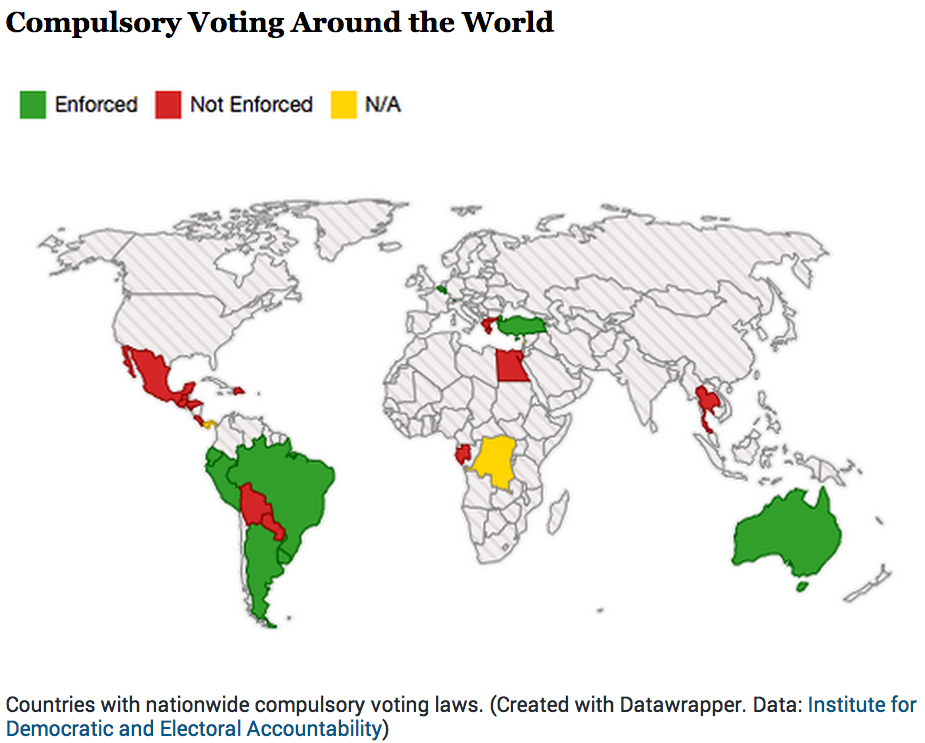
Both Uruguay and Brazil voted over the weekend. Kathy Gilsinan focuses on the fact that those “countries have compulsory voting, under which failure to vote is punishable by a fine.” She looks at why these laws came about:

In a 2010 paper, Gretchen Helmke and Bonnie Meguid of the University of Rochester investigated the origins of compulsory voting laws and the factors that could motivate a ruling party to adopt them. Comparing countries that instituted mandatory voting laws with a random sample of countries that didn’t, they found support for the theory that “the more incumbents fear that they are losing the ability to get their own voters to the polls, the more appealing an antidote compulsory voting will be. In essence, the decision to adopt [compulsory voting] is based on the incumbent’s wager that abstaining voters are the equivalent of untapped supporters.”

Ruling parties in Western European and Latin American countries, the authors write, faced the rise of unions and workers’ parties as their countries industrialized during the late 1800s and early 1900s, when many of them implemented their compulsory voting laws. “During this period, the Left’s organizational ability to mobilize—and, in particular, turn out—its potential voters was increasingly perceived as being unmatched by other parties,” they write. Ruling parties, according to this theory, were essentially trying to get out the vote for a silent majority of what one Argentine official called “the rich and content” to protect their incumbency from the growing power of the leftist opposition.