Why Networking Makes You Feel Icky

Jordan Gaines Lewis explains:

Describing ourselves on paper, while blindly attempting to live up to the expectations of others, makes it all feel like a giant lie, doesn’t it? Of course, personal statements and cover letters add a particularly thorny dimension – we have to brag about ourselves.

An amusing study in an upcoming issue of Administrative Science Quarterly suggests that putting ourselves out there professionally actually makes us feel dirty. Literally.

In the study, 306 adults were asked to imagine one of two scenarios. One group recalled a time when they needed to create a relationship with someone who would benefit them professionally. The other group thought about an instance where they socialized casually, like at a party. The participants then filled in the blanks to word fragments such as W _ _ H, S H _ _ E R, and S _ _ P.

Those who had relived situations of professional networking were roughly twice as likely to fill in the blanks with words related to physical cleanliness, such as “wash”, “shower,” and “soap,” while the other group tended to come up with more neutral words, such as “wish,” “shaker,” and “step.” The conclusion drawn by the study’s authors was that “networking in pursuit of professional goals can impinge on an individual’s moral purity.”

What The Market Is Thinking

Last week was a volatile one for the S&P 500, starting with the worst three-day decline since 2011. Robert Shiller contends that “fundamentally, stock markets are driven by popular narratives, which don’t need basis in solid fact. True or not, such stories may be described as ‘thought viruses.'” He focuses on secular stagnation, “the idea that there is disturbing evidence that the world economy may languish for a very long time, even for generations”:

I did a LexisNexis count of newspaper and magazine mentions, by month, of the phrase “secular stagnation,” and I found that they have exploded since November 2013. And a Google Trends search shows a similar pattern for web searches for the phrase since that time.

Why? It’s probably because Lawrence H. Summers, the former Treasury secretary and Harvard president, used the phrase in a talk he gave on Nov. 8 at the International Monetary Fund in Washington. Paul Krugman wrote approvingly about the talk in The New York Times nine days later. Mr. Summers presented his secular-stagnation idea with uncharacteristic diffidence: “This may all be madness and I may not have this right at all.” But his talk seemed to release a thought virus.

And changing the mindset of investors isn’t easy. Clive Crook points out an irony:

The more widely these psychological channels are understood, the harder it is for central banks and other policy-makers to exploit them.

If investors believe that policymakers are doing nothing but attempting to influence their mood, their mood will be more resistant to influence. Quite possibly, that resistance could increase to the point where even consequential changes in policy no longer have consequences. In central banking, as in most things, the secret of success is sincerity: If you can fake that, you’ve got it made.

Ben Casselman, however, recommends ignoring the day to day fluctuations in the market:

Wednesday was the 26th time this year that the Dow rose or fell by at least 1 percent. It happened 24 times in 2013 and 39 times in 2012. In other words, big swings in the market happen dozens of times a year — and usually mean absolutely nothing. Economist Eugene Fama won a Nobel Prize for demonstrating that the stock market is a “random walk” — its short-term moves don’t reveal anything about the long-term trend.

David Leonhardt provides a historical perspective on the stock market. He warns that stocks are currently expensive:

Since 1881, when the Standard & Poor’s 500-stock index has had a price-earnings ratio of at least 24 — just a bit below where it is now — the average return over the next 10 years is negative 3 percent.

By comparison, the average 10-year return over that entire period, regardless of P/E ratio, is 36.3 percent.

There have been times — like the last few years — when stocks are expensive and they continue rising rapidly regardless. So it is not out of the question that stocks will rebound from their recent decline and rise over the next few months or years. More often than not, though, high-priced stocks lead to mediocre returns, at best, over the ensuing decade.

Finally, Danielle Kurtzleben argues that the media pays too much attention to the stock market:

[F]or all the fearful questions about whether a market correction is coming, it’s important to take some perspective: the stock market’s latest oscillations and whatever crashes might be on the way will only directly affect around half of Americans, and their biggest effects will be on the richest people.

Federal Reserve data compiled by CNBC shows that the share of Americans who own stocks has hovered at around 50 percent for 15 years. And of course, not all of those people own the same amount of stock. As with incomes and wealth in general, stock ownership is highly concentrated at the top (and has been for a while), as this chart from the Economic Policy Institute shows. The bottom 80 percent of Americans by wealth only own just over 8 percent of all stock owned by US households.


Legalization Crosses The Border

Cannabis Supporters Hope For Legalization

Christopher Ingraham maintains that “the news coming out of Colorado and Washington is overwhelmingly positive.” And that other nations are paying attention:

Countries, particularly in Latin America, are starting to apply these lessons in order to craft smarter policies that reduce violence and other societal harms brought about by the drug war. Uruguay, for instance, has moved toward full national legalization of marijuana, with an eye toward reducing the thriving black market there. Mexico’s president has given signs he’s open to changes in that country’s marijuana laws to help combat cartel violence. The Organization of American States recently issued a statement in favor of dealing with drug use as a public health issue, rather than a criminal justice one.

Regardless the eventual direction of marijuana legalization in the U.S., steps toward reform here are already prompting other countries to seek out more pragmatic solutions to their drug problems. In short, they’re making the world a better place.

However, Ed Krayewski is underwhelmed by Uruguay’s experiment:

Just 378 people registered as of last month, and why would there be more? Uruguay’s president, Jose Mujica, who supported legalization even while warning of the illness marijuana use can lead to, is nevertheless term-limited. The front runner to succeed him, cancer doctor Tabare Vazquez, also his predecessor, is excited about using the registry to “better know who uses drugs and be able to intervene earlier to rehabilitate that person.” Meanwhile, the other candidate, center-right Luis Lacalle Pou, is opposed to legalization. Uruguay’s marijuana legalization experiment may not last much longer than Mujica’s term.

Update from a reader:

Of course legalization is going to spread across the world.  After all, the main reason that draconian drug policies are in place, and have not changed already, is that the US government demanded them.  And had the power to make the rest of the world go along, however reluctantly.

As soon as that driver fades, everybody gets to return to their own preferences.  Which, for a lot of countries (although doubtless not all) means legalization of some drugs, and milder penalties for most.  They are especially motivated, since illegal drugs are what fuels the gangs which make law and order a distant dream in so many places.  Most of Latin America would probably legalize tomorrow if US policy didn’t demand that they enlist in the War on Drugs, and be grateful to be able to devote their resources to the real problems that their countries face.

(Photo: A sticker calling for the legalization of marijuana lies on the street at the annual Hemp Parade (Hanfparade) on August 9, 2014 in Berlin, Germany. Supporters of cannabis legalization are hoping legalized sale in parts of the USA will increase the likelihood of legalization in Germany. The city of Berlin is considering allowing the sale of cannabis in one city district. By Sean Gallup/Getty Images)

“Inflation Is Dead. Done. Whipped.”

Inflation

That’s what Matt O’Brien declares:

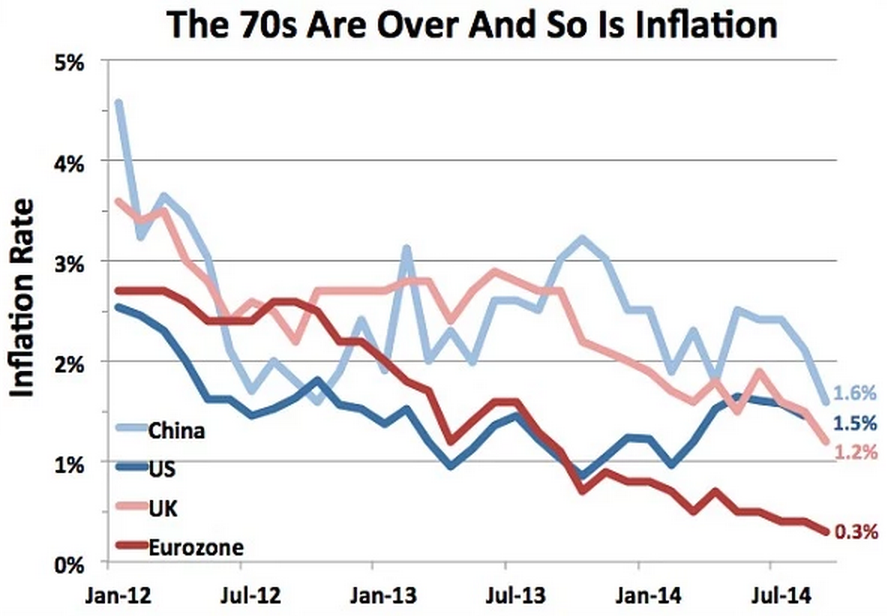
You can see that above. Inflation is just 1.6 percent in China, 1.5 percent in the U.S., 1.2 percent in the U.K., and a minuscule 0.3 percent in the Eurozone. Then there’s Japan, which is harder to compare since its sales tax hike just bumped up prices, but would only have 1.1 percent inflation, if not for that. And it’s probably even lower than that there and everywhere else. That’s because, as Jessie Handbury, Tsutomo Watanabe, and David Weinstein show, measured inflation tends to overestimate actual inflation by about 0.6 percentage points. So inflation might really be about 1 percent in all of the world’s biggest economies.

Drum’s bottom line:

Nobody knows what will happen in the long term, but for now we simply shouldn’t be worrying about inflation. We should be worrying about growth and unemployment. Inflation just isn’t a problem.

But Amity Shlaes doesn’t regret her inflation fear-mongering:

[S]omeone in the world ought always to warn about the possibility of inflation. Even if what the Fed is doing is not inflationary, the arbitrary fashion in which our central bank responds to markets betrays a lack of concern about inflation. And that behavior by monetary authorities is enough to make markets expect inflation in future

Chait pounces:

The inflationistas got the balance of risk totally wrong — unemployment, while falling, has remained above target, while inflation has stayed below it. Shlaes’s defense is not just factually wrong, it’s conceptually bizarre. Somebody has to worry about bear attacks, yes. But if you demand that all children be kept home from school for the year to protect them against bear mauling, it’s not enough to point out that bears exist. You need to somehow engage with the idea of a tradeoff.

Krugman quips:

The ability of inflation derp to persist, even flourish, in an age of disinflation remains remarkable.

You Can’t Hurry The Supremes

Dahlia Lithwick puzzles over the recent spate of high-impact SCOTUS decisions that came in the form of injunctions and cert denials. She looks to explain why “unsigned, unexplained reasoning is the new black”:

Between the state legislatures getting way out in front [o]f the court’s doctrine on voting rights and abortion, and the court’s decision to hang back and wait for conflicting decisions from different circuit courts in the marriage equality cases, what we seem to be witnessing is a Supreme Court that is dealing with events moving at lightening speeds. It may be attempting to impose what [former acting solicitor general Walter] Dellinger describes as “procedural dignity” upon the process. Even when the court issues late-night stays and unsigned orders, the court is clarifying that it gets the last word, even when the last word is haughty silence.

Thus, in the voting rights context, the court is merely ensuring that states do not put new systems in place immediately prior to the midterm elections. In the marriage equality context, the court is simply affording the states the opportunity to arrive at the correct conclusions on their own schedules.

And in the Texas abortion context, the court is reacting to a set of Texas regulations that appear to completely reinterpret (if not blatantly disregard) the rule announced by the court itself in its 1992 decision in Planned Parenthood v. Casey. As Greenhouse notes, the 5th U.S. Circuit Court of Appeals more or less ignored Casey when it ruled on the Texas abortion regulations: “In holding that the forced closing of every abortion clinic south and west of San Antonio, requiring women to travel hundreds of miles to exercise their constitutional right, was not an undue burden in purpose or effect, the Fifth Circuit ruled in blatant disregard of the Casey standard.” Really, was the court going to permit that to happen? When the court bats these issues away, it’s merely saying that nobody rushes the highest court in the land. Not even Texas.

A Declaration Of Independents

Surveying the independent politicians on today’s scene, from Michael Bloomberg to current South Dakota Senate candidate Larry Pressler, Michael Kazin waxes nostalgic for when the term meant more than press-pleasing moderation:

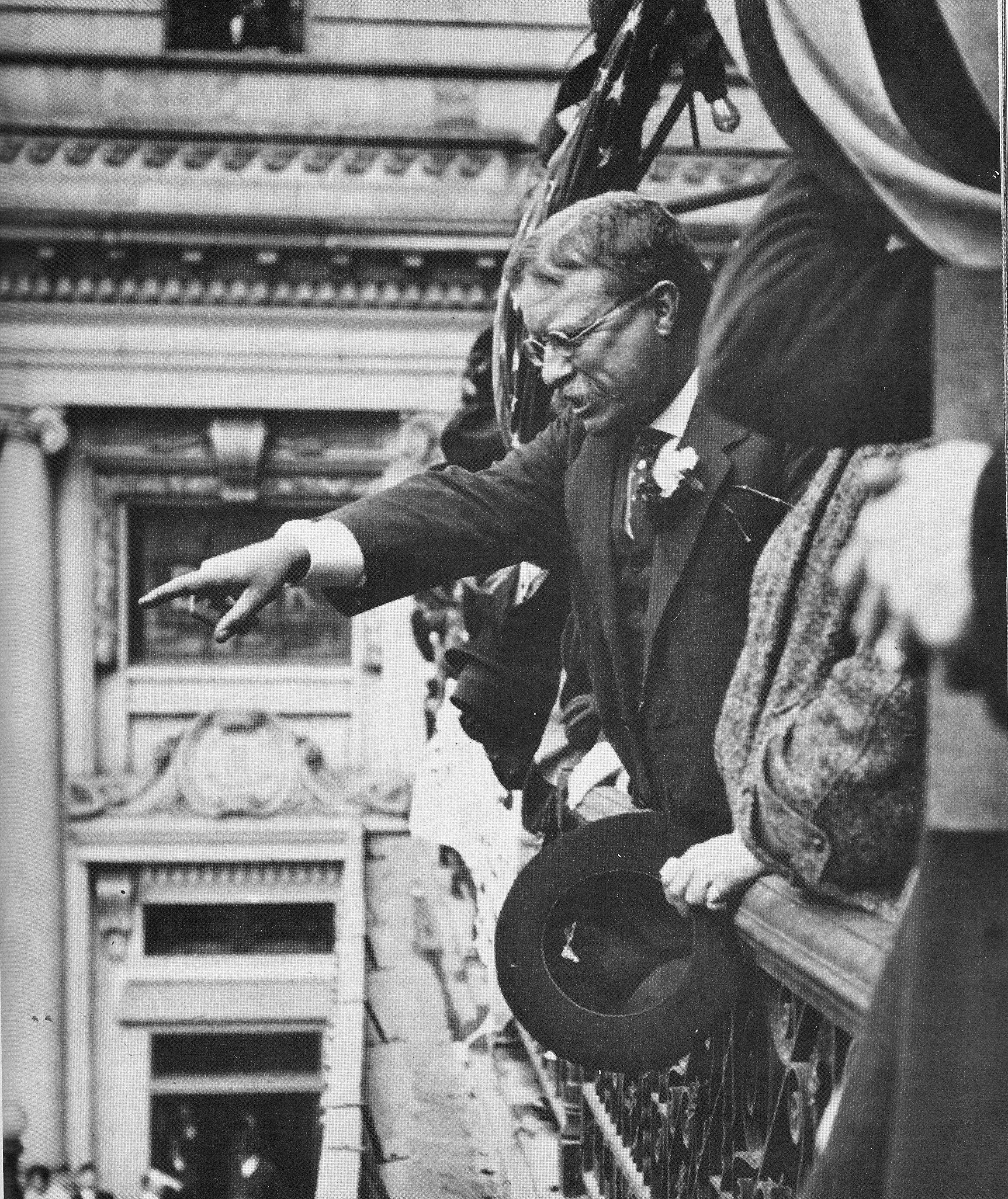
“Independent” wasn’t always a synonym for vapid. In the early decades of the last century, independent politicians played a far more serious and largely Theodore_Roosevelt_Hotel_Allen_1914 beneficial role. Stalwart “progressives,” they advocated open primaries instead of closed party caucuses, non-partisan elections for city government, replacing partisan hacks in the federal bureaucracy with dedicated civil servants, banning corporate spending on campaigns, and giving voters a chance to initiate their own laws or turn down ones passed by often corrupt state legislatures. Figures like Theodore Roosevelt, Robert La Follette, and Fiorello La Guardia left their party, temporarily or for good, to speak out for ideas that were later converted into policy. “There once was a time in history when the limitation of governmental power meant increasing liberty for the people,” TR told his followers in the independent new Progressive Party in 1912. “In the present day, the limitation … of governmental action, means the enslavement of the people by the great corporations, who can only be held in check through the extension of governmental power.”

Not everything such bygone independents did or tried to do lived up to their ambitions.

Big businesses and other “special interests” learned how to hijack the making of ballot initiatives, spending millions on measures designed to boost their profits and power. “Good government” mayors sometimes governed in a bloodless fashion, emphasizing tax-cutting and efficient administration instead of the better housing and health protection which city dwellers badly needed. And, of course, the major parties adapted and enduredand passed laws on the state level that made it difficult for third parties to gain a foothold or to fuse, for any given election, with the Democrats or Republicans.

But the pressure of principled independents and the friendly journalists who covered them did help create a more effective and more professional national state, which legitimated the idea that social programs should serve “the public interest” rather than just the followers of one big party or the other.

(Image: “Theodore Roosevelt Hotel Allen 1914” by Unknown Photographer, Lehigh County Historical Society, via Wikimedia Commons)

Egg-Freezing On The Company Dime, Ctd

Last week, we covered announcements from Facebook and Apple about covering the cost of female employees freezing their eggs. Megan McArdle raises an unaddressed concern:

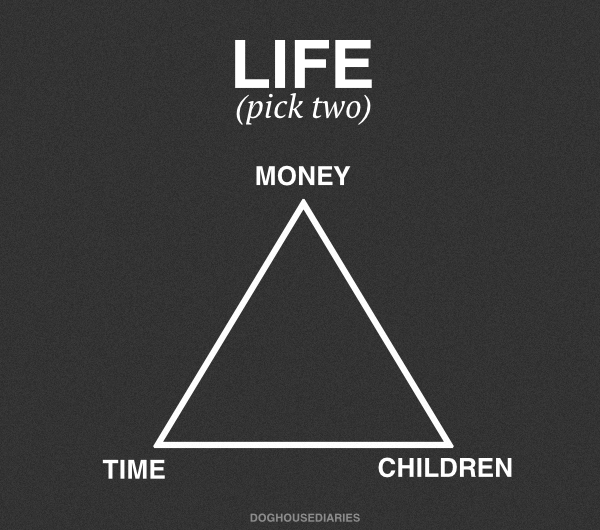
What I haven’t seen anyone explain is when, exactly, you’ll be ready. For most people, your 40s and early 50s are your peak earning years — is that really going to be a good time to meet that special someone, or finally step back to invest some time in having kids? I don’t know about the rest of you, but I’m already noticing that I have a lot less energy than I used to. It’s not that I can’t get my work done or anything like that. But it used to be that if I had to travel for six days straight and then deliver a 2,500-word essay on the 7th, I could dial up my reserves and power through it — miserable and cranky, to be sure, but functioning. Then one day, around the time I turned 40, I dialed down for more power and there just … wasn’t any. My body informed me that it was tired, and my brain would not be doing any more work today, and we were going to sleep whether I liked it or not.

Along similar lines, Rebecca Mead reflects:

[E]ven with this tantalizing suggestion of reproductive liberty, it’s hard to figure out exactly how long to postpone. A woman might skip having children in her twenties or thirties in order to focus on her career, only to discover by her forties that its demands—not to mention the encroachment of middle age—make motherhood even less manageable than it appeared at twenty-five or thirty.

And it seems overly optimistic to hope that, with nature’s deadlines subverted, a woman’s decision about whether or when to bear children might become an entirely autonomous choice—hers alone to make, independent of cultural and professional pressures as well as biological ones. Might Apple and Facebook’s offers of egg freezing be, in fact, the kind of employee benefit whose principal beneficiary is the company? What if, rather than being a means of empowerment—whereby a young woman is no longer subject to anything so quaintly analog as the ticking of a biological clock—freezing one’s eggs is understood as a surrender to the larger, more invisibly pervasive force of corporate control?

But Chavi Eve Karkowsky stands up for egg-freezing. She insists that it allows women to wait “until they can find a way to have the family they really want, with the partner they really want”:

When asked about delayed child-bearing in many studies, the two factors that come up again and again are financial stability and the availability of an appropriate partner. We really like to talk about that first factor, and tie reproductive lateness to hard-charging women who have their own career-centered, family-unfriendly priorities. But for a moment, let’s talk about that second factor: the appropriate partner. This is the one that I think creates the egg-freezing push. At some point, while dating, and waiting, and having hearts broken (or yes, breaking hearts), many women want to start working with what they have, and not waiting for the right XY chromosome carrier to come around. They want him to come around, they believe he’ll come around, but they don’t want to lose their chance at healthy, genetically related children while they wait for the father of those children.

Katie Benner also defends the corporations:

I know what informs some of the worries that got around after the Apple announcement: Big, technocratic companies might be using these perks to suck the best working years out of their female employees. Evil vampire geniuses at corporate HR ply us with fertility and adoption coverage, thus securing greater access to our young, alert minds.

What happens next? We become 40-something husks (because lord knows, women teeter on the verge of uselessness in every conceivable way at 40) and then and only then do our corporate masters allow us to finally procreate. As our weary 50-something bodies drag toddlers and teenagers from day care to soccer practice, somewhere a corporate overlord will smile with glee: “We got their best years. They never knew what hit ’em. Heh, heh, heh.”

But you know what? That’s not what I think is happening here. For starters, it’s an insane scenario. And it’s also ageist and sexist.

The Best Of The Dish This Weekend

lifedecisionscomic

I spent the weekend awaiting the final statement from the Synod in Rome (while catching up on Doctor Who). My take on the ongoing debate is here. I don’t have much to add tonight, except to say again that the most significant shift is merely that there is finally an open, unafraid dialogue and at the same time no consensus on the most contentious issues, i.e. how to handle divorced, re-married and gay Catholics and their families. That means that Francis has succeeded in a core early task: the beginning of a real conversation about gay people and other less-than-ideal families in search of the truth about us.

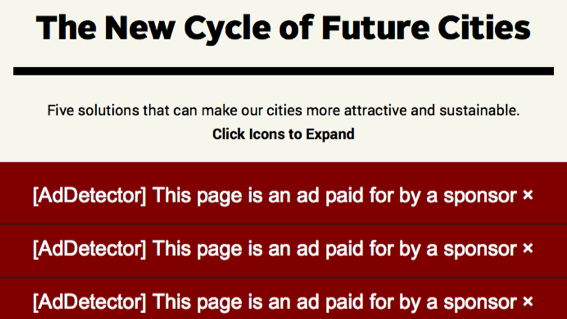
Meanwhile, another moonbeam of hope, this time in journalism. There’s a new browser addon you can add to Firefox or Google Chrome which makes sure you don’t mistake a “sponsored content” fake article for the real thing. It’s called AdDetector. Instead of searching for the deliberately subtle fig-leaf of a disclosure, it will add a big, bright red banner to any ad posing as an article. I downloaded it and tested it a bit. Here’s what a page on Slate now looks like:

Screen Shot 2014-10-19 at 4.21.38 PM

Pretty cool, huh? Sometimes, it can get very intrusive, like this AdDetector version of a fake article at the Atlantic:

Screen Shot 2014-10-19 at 7.21.26 PM

Hard to miss. Download AdDetector and force “sponsored content” to be transparent. And the more often you come up against these big red banners, the more you know you shouldn’t trust the site/magazine/blog you’re reading. So far, the add-on is only for a handful of major sites – from the New York Times to Buzzfeed – but the add-on creator’s Reddit page says he’s happy to add others. Get in touch with him and get some of the worst sites on the list.

Some gems from the weekend (curated and edited primarily by Jessie Roberts and Matt Sitman): a fantastically witty cartoon with two rather plucky octopi; rave reviews of a new Rembrandt exhibit in London; the peculiar poetry of James Laughlin; a splendid defense of shitty beer;  the case for hope in Israel; and a Quote For The Day from Francis Spufford that will knock your secular socks off.

Plus: the unforgettable faces of an English cock and a pissed-off Siamese fish.

The one post that made me laugh the loudest: this Tumblr of drunk J-Crew models. Priceless.

The most popular post of the weekend was this post on meditation: Compassion Is A Muscle. Next up: The Trouble With Religion which has already promoted a reader explosion (almost entirely in revulsion).

Dish t-shirts are for sale here, including the new “Know Dope” shirts, which are detailed here. I’ve been wearing mine this weekend and just remembered to take it off before Mass. 19 more readers became subscribers this weekend. You can join them here – and get access to all the readons and Deep Dish – for a little as $1.99 month. Gift subscriptions are available here.

See you in the morning.

(Chart via Rollin Bishop)