[Re-posted from earlier today]
The inevitable media headline from the final Relatio of the Synod on the Family will be: “Bishops scrap welcome to gays.” And this is literally true. The astonishing mid-term Relatio’s language of outreach, inclusion and welcome shrank last night into much more arid, cold and unsparing prose.
We don’t yet have an official English translation of the critical paragraphs, but the gist is clear. Gone are the paragraphs that extol the “gifts and qualities” of gay people; gays are no longer to be “welcomed” in a “fraternal space” but merely “accepted with respect and sensitivity”; the church should no longer “value” homosexual orientation; it should merely accept people with “homosexual tendencies.” Of the three paragraphs in the mid-term report, the two with the most positive language have been excised completely; and the remaining one reaffirms the tone and language of Benedict XVI and John Paul II. Here it is – in my unofficial Google-enabled version:
55. Some families live with members with homosexual orientation. In this regard, our view of the pastoral care appropriate to this situation refers to what the Church teaches: There is no foundation whatsoever to assimilate or to establish same-sex unions as even remotely analogous to the plan of God for marriage and the family. “Nevertheless, men and women with homosexual tendencies must be accepted with respect and sensitivity. In their regard should be avoided every sign of unjust discrimination” (Congregation for the Doctrine of the Faith, Considerations Regarding Proposals to Give Legal Recognition to Unions Between Homosexual Persons, 4).
Notice the very Ratzingerian foot-stamping:
There is no foundation whatsoever to assimilate or to establish same-sex unions as even remotely analogous to the plan of God for marriage and the family.
It’s not exactly subtle. My marriage, according to this version of the text, is light years away from the marriage of my own sister. There isn’t even a remote analogy between her family and mine. In fact, there is no foundation whatsoever to compare the two relationships in any way. Let me simply respond by saying what most Catholics who have encountered these relationships in our own lives would say: it is indeed hard to read this and believe it. This is not because I differ one iota from the church’s view that the life-long, procreative marriage between a man and a woman is a precious, beautiful and unique thing. Two men or two women cannot replicate it, if only because of basic biology. The sacrament of matrimony is a celebration of this unique institution – and cannot be re-fashioned into something else without diluting its central truth.
But where I differ from the old guard is in their refusal to see anything good or precious in the mutual love, responsibility and sacrifice that are as integral to same-sex unions as they are to heterosexual ones. To see nothing worthwhile there, nothing to value, nothing to affirm seems, well, untrue to the reality more and more of us live. As Cardinal Marx of Germany said earlier this week:
“Take the case of two homosexuals who have been living together for 35 years and taking care of each other, even in the last phases of their lives. How can I say that this has no value?”
He cannot, which is why this paragraph – along with two others on the pastoral care of divorced or re-married people – failed to win the 2/3 majority vote for it to be part of the official text.
But it was included anyway – with the vote tallies appended. And there you see why it is not wishful thinking to believe that something profound has indeed occurred so far in this Synod. Neither of the two previous popes would ever have allowed the original language to even see the light of day – Ratzinger as arbiter of church doctrine for decades could sniff heterodoxy on this like a beagle with a distant potato chip – and stamp it out with relentless assiduity. Both John Paul II and Benedict XVI would have excised the outreach to gay people altogether. And the idea of a transparent vote tally – revealing a vigorous internal division on these questions – would have been unthinkable.
The true headline of this past remarkable week is therefore: the Vatican hierarchy cannot find a consensus on the question of pastoral care for gays, the divorced and the re-married, and the Pope is happy for this fact to be very, very public. These remain open questions for a year of continued debate and discussion before the second stage of the Synod this time next year and the Pope’s subsequent summary. That these are open questions is the real result of this Synod.
I also think its worth reading Pope Francis’ concluding speech to the Synod, which was granted a four minute standing ovation. It is a beautiful text – certainly more so than the unavoidable consensus-speak of what might be called the interim communiqué. Here is Francis’ Obama-style weighing of two different temptations to avoid:
A temptation to hostile inflexibility, that is, wanting to close oneself within the written word, (the letter) and not allowing oneself to be surprised by God, by the God of surprises, (the spirit); within the law, within the certitude of what we know and not of what we still need to learn and to achieve. From the time of Christ, it is the temptation of the zealous, of the scrupulous, of the solicitous and of the so-called – today – “traditionalists” and also of the intellectuals.
The temptation to a destructive tendency to goodness [it. buonismo], that in the name of a deceptive mercy binds the wounds without first curing them and treating them; that treats the symptoms and not the causes and the roots. It is the temptation of the “do-gooders,” of the fearful, and also of the so-called “progressives and liberals.”
Avoiding both these temptations is the goal – which has to be accomplished pastorally and with prudential judgment. In his speech, Francis nods to the traditionalists by quoting Benedict XVI verbatim, but then says this:
We will speak a little bit about the Pope, now, in relation to the Bishops [laughing]. So, the duty of the Pope is that of guaranteeing the unity of the Church; it is that of reminding the faithful of their duty to faithfully follow the Gospel of Christ; it is that of reminding the pastors that their first duty is to nourish the flock – to nourish the flock – that the Lord has entrusted to them, and to seek to welcome – with fatherly care and mercy, and without false fears – the lost sheep. I made a mistake here. I said welcome: [rather] to go out and find them.
It’s hard not to see a little playfulness here. After all, the word “welcome” was one of the most contentious of the Synod, in so far as it was extended to gay people. And if the final Relatio turned that “welcome” into the more neutral “accept”, Francis turns it into something more radical still: to go out and find the lost sheep.
Just as vital in Francis’ vision is the open, tough and lively dialogue that this Synod represents. Nothing like this has been experienced since the Second Vatican Council. And in his concluding speech, Francis reveled in the turmoil:
It has been “a journey” – and like every journey there were moments of running fast, as if wanting to conquer time and reach the goal as soon as possible; other moments of fatigue, as if wanting to say “enough”; other moments of enthusiasm and ardor. There were moments of profound consolation listening to the testimony of true pastors, who wisely carry in their hearts the joys and the tears of their faithful people. Moments of consolation and grace and comfort hearing the testimonies of the families who have participated in the Synod and have shared with us the beauty and the joy of their married life. A journey where the stronger feel compelled to help the less strong, where the more experienced are led to serve others, even through confrontations. And since it is a journey of human beings, with the consolations there were also moments of desolation, of tensions and temptations.
The church is not a political party, voting on a platform, and shifting from one convention to the next. Its core doctrine is unchanged and unchangeable. But it has evolved and grown and changed in the way it has encountered the world throughout history. It has absorbed and assimilated new ways of thinking and newly discovered truths about humankind and attempted over the centuries to integrate them into its internal dialogue. So you have to look at a Synod like this one and not get too caught up in developments from last Monday to Sunday. You have to look beneath that surface to the tectonic shifts beneath. And the real shift, I’d argue, has been the glasnost of Francis – which may or may not lead to perestroika. The intellectual life of the church was a dark and stifling and deadly silent place until very recently. There is now a crack in the window, where light has been let in, and words said that can be excised from the final text but not expunged from the collective consciousness. And at the end, no consensus on the most contentious questions at hand. And a year to debate them further.
Those knots? They keep unraveling.
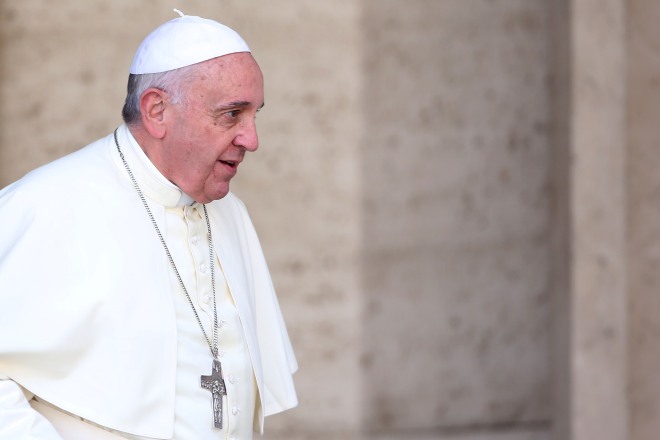
(Photo: Franco Origlia/AFP/Getty.)
 spectacle being at an end, I forgot about him. Then, looking up, my eye was caught by him. He was trying to resume his dancing, but seemed either so stiff or so awkward that he could only flutter to the bottom of the window-pane; and when he tried to fly across it he failed. Being intent on other matters I watched these futile attempts for a time without thinking, unconsciously waiting for him to resume his flight, as one waits for a machine, that has stopped momentarily, to start again without considering the reason of its failure. After perhaps a seventh attempt he slipped from the wooden ledge and fell, fluttering his wings, on to his back on the window sill. The helplessness of his attitude roused me. It flashed upon me that he was in difficulties; he could no longer raise himself; his legs struggled vainly. But, as I stretched out a pencil, meaning to help him to right himself, it came over me that the failure and awkwardness were the approach of death. I laid the pencil down again.
 The Dish