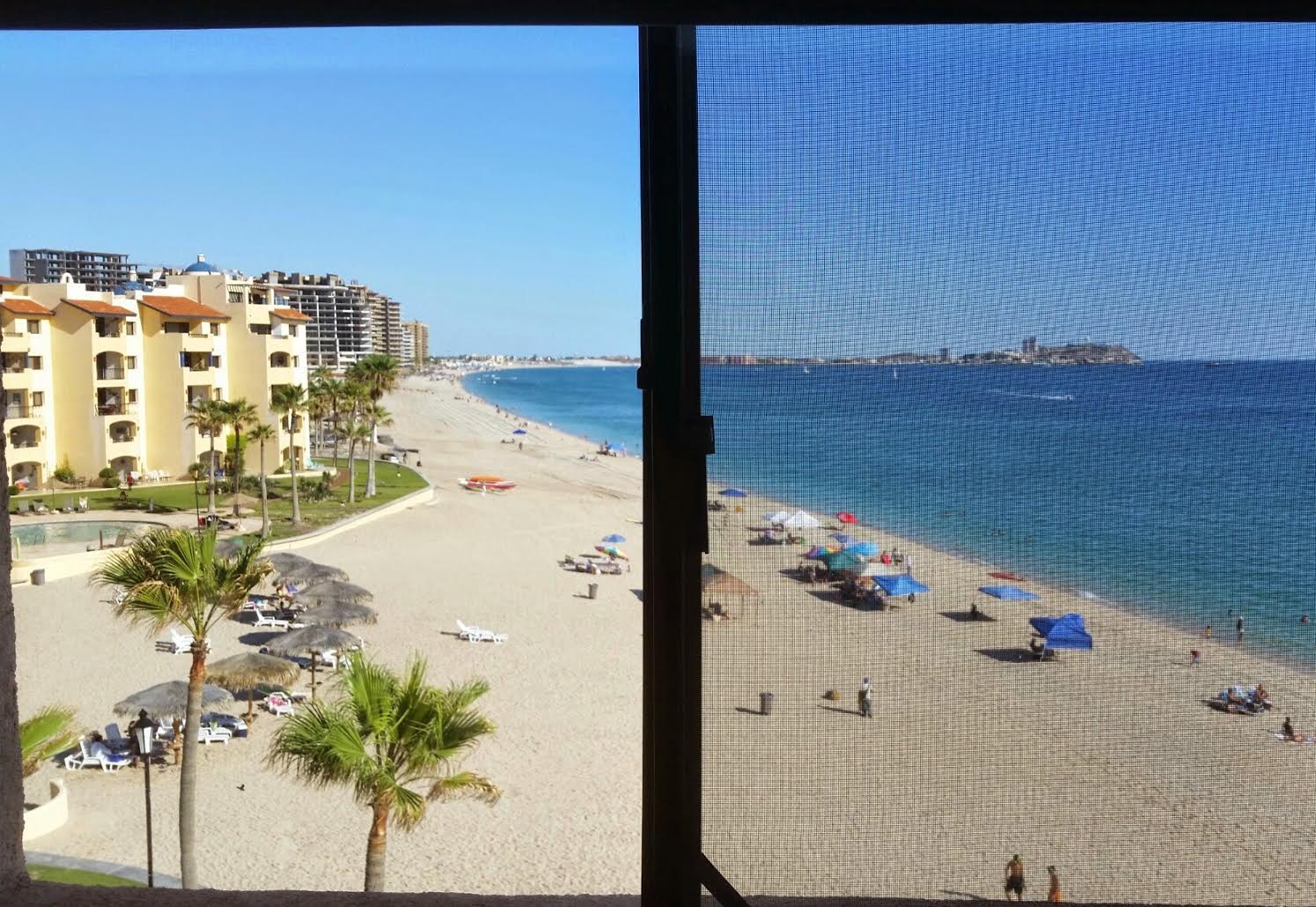
Puerto Peñasco, Mexico, 2.45 pm
Puerto Peñasco, Mexico, 2.45 pm
[T]he percentage of Americans who believe that state or local government should make the major decisions on drug policy has increased from 39% in 1973 to 61% in 2013. On health care, it has risen from 40% to 62%; on environmental protection, it has gone from 36% to 56%. On prison reform, the proportion supporting state and local primacy has increased from 43% to 68%.
In both 1973 and 2013, substantial majorities favored federal primacy on national defense, Social Security, and cancer research. But in the last two cases, the minority preferring state or local control has substantially increased. Similarly, in both 1973 and 2013, large majorities favored state or local control of education, transportation, housing, and welfare policy. But on all four issues, those anti-federal government majorities have grown substantially.
Todd VanDerWerff praises Jane The Virgin for sympathetically depicting characters who don’t spout Hollywood’s default “mushy progressivism”:
The central character, played by the remarkable Gina Rodriguez, is Latina. Much of the show’s dialogue is in Spanish. The family is by no means well-off. And, ultimately, the main character’s religious beliefs — and how they inform her personal politics — are deeply important to the show’s conception of her.
Put simply, this is a show about a virgin by choice (driven by only slightly masked religious beliefs) who is accidentally artificially inseminated, then chooses to keep the baby, because having an abortion is just the sort of thing she would never consider. The show doesn’t really make a big deal about this, but it all happens, all the same. Jane the Virgin is a show about people who are pro-life — written and produced by the much-demonized “Hollywood liberals,” no less — that doesn’t turn preachy or attempt to make much of Jane’s choice. It simply is.
Alyssa calls Jane The Virgin “the exceptionally rare television show to portray religious people not as rubes or bigots, but as smart, compassionate and conflicted.” Margaret Lyons loves the show:
Jane the Virgin is a shining example of how much a show can get away with as long as it takes its characters seriously. The show buys into the idea of Jane, of Jane’s concerns, Jane’s strengths, Jane’s sensibilities. This is the world Jane lives in, and this is the way she feels about it. It sounds so easy! But you don’t need to look at too many other shows to realize this isn’t easy, or at least isn’t common.
Jane is based on the Venezuelan telenovela Juana la Virgen, and it feels at times a little like Pushing Daisies: There’s a whimsical narrator; things feel very fated; we know exactly whom to root for and how much. The show credibly addresses Jane’s option to have an abortion and doesn’t rely only on religiosity to explain why she decides against it. Despite the show’s melodrama, everyone has a backstory, too; the inflated emotions of the show could just kind of float away were they not anchored by authentic, sometimes painful, true ideas. Jane’s grandma isn’t just some Bible-thumper — she’s speaking from experience when she talks about how hard it is to raise children. Jane’s mother didn’t stop having romantic fantasies and personal dreams when she became a mom; she just had to funnel that energy in a different direction. Even in soap-opera crazy-bananas pregnant-virgin world, characters can and ought to contain multitudes.
It’s refreshing to see an unabashedly good person at the center of an hour-long series. Jane is considerate, thoughtful, intelligent, and hard-working. She puts others before herself without a second thought, and yet it never feels like she’s a doormat. This should be a star-making turn for Rodriguez, who handles Jane’s broadly comedic moments as confidently as she does her quietly dramatic ones, and her performance in the role is enough of a reason to tune in by itself.
Hers isn’t the only strong performance. Navedo and Coll play off each other well and have an easy rapport with Rodriguez, giving the Villanueva family instant chemistry and a comfortable, lived-in quality that makes it easy to imagine their years together before the pilot’s instigating event.
Time caught up with the show’s star:
The actress says Jane the Virgin was love at first script. “To read a story about a young girl where her ethnicity wasn’t at the forefront, where her dual identity was so integrated in life that it didn’t feel like a separate conversation, was such a breath of fresh air,” Rodriguez says. The Chicago-born daughter of Puerto Rican parents says she has turned down high-profile roles when she needed the money because she thought the characters were too stereotypical. “I have fought so hard to not take roles,” Rodriguez says. “I had to fight [myself] like, ‘Gina, you can’t pay rent. Are you really going to say no?’”
Lizzie Stark, author of Pandora’s DNA: Tracing the Breast Cancer Genes Through History, Science, and One Family Tree, discusses the maddening ambiguity that comes with having a BRCA mutation:
As a woman positive for a BRCA mutation, I bear this uncertainty doubly, both because I am frequently screened for cancer and am therefore more likely to receive ambiguous results, but also because the BRCA test itself is a sort of screening for pre-cancer. I may not have any precancerous lesions inside me, but I have been told that I have a potentially life-threatening mutation inside every cell of my body. After my genetic results came back, I no longer felt like the physically healthy twenty-seven-year-old newlywed that I was. Instead I became someone who went to the doctor more than ten times a year, like a good patient, to make sure I wasn’t sick yet. I lived in a state of betweenness, in a no-man’s-land straddling the worlds of sick and healthy.
But it’s impossible to know which party will benefit. Silver explains:
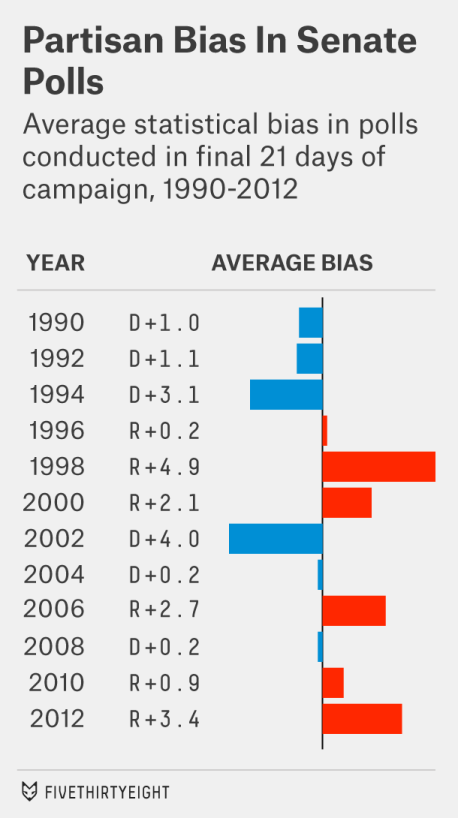
In a number of elections, including 2012’s, Senate polls had a systematic bias toward one party. But the direction of the bias has been inconsistent, favoring Democrats in some years and Republicans in others. The chart here depicts the average partisan bias in Senate polls of likely voters conducted in the final three weeks of campaigns since 1990. (For raw data from 1998 onward, see here; for 1990 through 1996, see here). A year indicated as having a Republican bias means the GOP underperformed its polls. A year shown as having a Democratic bias means the Democrats underperformed theirs instead.
In 2012, Senate polls had a Republican bias of about 3.5 percentage points. That means in a state where the polling average showed the Republican ahead by a point, the Democrat would be expected to prevail by 2.5 points instead. If there’s the same bias in the polls this year, Democrats would be very likely to keep the Senate.
But as I mentioned, this bias has flipped back and forth.
Waldman rejects the notion that Democrats are unskewing polls this election cycle:
What Democrats are doing is arguing that whatever the polls now say, they’ve got a great turnout operation this year, and that’ll make a big difference come election day. Or they’re expressing the hope that in a couple of key races, voters will eventually wise up and understand the radicalism of the Republican candidate. But that’s very different from arguing that the polls are systematically skewed against them. One is about expressing optimism and keeping your side motivated, while the other is a delusional denial of reality.
The NYT’s model now gives the GOP a 73 percent chance of taking the Senate. Leonhardt puts this percentage in context by listing situations that occur “between 25 and 30 percent of the time”:
■ The odds of rolling a 9, 10, 11 or 12 with two dice
■ The chances that a blackjack casino dealer busts
■ The percentage of calendar years since World War II that the Standard & Poor’s 500 has declined
■ The share of days in which it rains in Kansas City (as it did Monday, postponing a baseball playoff game)
■ The frequency with which a 25-year-old woman is shorter than 5 feet 3 inches
■ The frequency with which a 25-year-old man is 5-11 or taller
■ The odds that a National Football League defense prevents a first down on third-and-one.
He insists that, if the GOP’s odds stay roughly the same through election day, “it won’t be right if the Republicans win any more than it will be wrong if the Democrats keep control. “
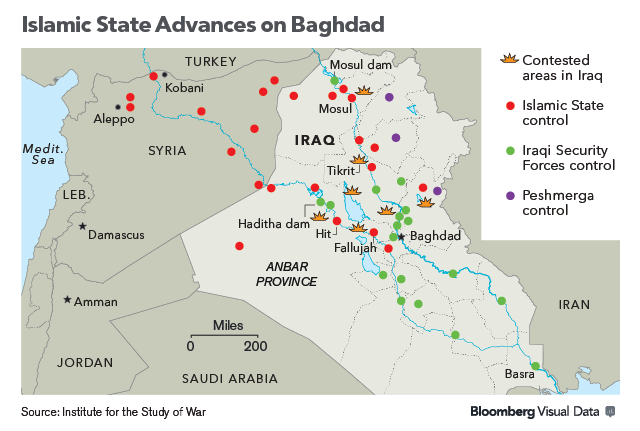
Recent gains by ISIS in western Iraq’s Anbar province, including the capture of a military base on Monday, are raising fears that the militants might soon attempt to move on Baghdad:
Militants seized the base, located near the town of Hit and a major highway from Baghdad to the Syrian border, after heavy fighting with soldiers, according to Ahmed al-Dulaimi, a Sunni tribal leader. Its capture increases the threat to Ramadi, Anbar’s capital, and to Iraq’s second-largest dam at Haditha. …
Islamic State captured the Anbar towns of Hit and Kubaisa last week, and its fighters are battling Iraqi forces in Abu Ghraib, 18 miles (29 kilometers) from Baghdad’s fortified Green Zone that houses embassies and government offices. The town of Haditha is “completely besieged” by Islamic State militants and will fall within days without U.S. action to prevent it, Faleh al-Issawi, the deputy head of Anbar provincial council, said by phone late yesterday. He said the jihadists control 80 percent of Anbar province.
Joel Wing attributes these advances primarily to the weakness of the Iraqi Security Forces:
The fact that the ISF still appear hapless in most areas does not bode well for the future. They have broken again and again in just a few days. Both Baghdad and the American led coalition need to intervene in a much more determined fashion to reverse the situation, because even if places like Ramadi and Haditha are able to hold on they are cut off from their supply lines and need to be supplied by air something the government forces are not good at. If not there could be more bad news coming out of western Iraq very soon.
In Walter Russell Mead’s view, there is “a lot to be nervous about”:
CBS News cites a figure of 60,000 Iraqi troops assigned to defend Baghdad, but given the rampant corruption in the Iraqi armed forces, the official numbers on paper are one of the least important facts about the defending forces. As Haaretz noted in June, a large portion of the Iraqi army is made up of “ghost soldiers” who appear in the official troop count but pay their commanders a portion of their salary in return for being excused from duty. Graft has always been rampant in the post-Ba’athi Iraqi military, with officers stealing not only money and equipment, but even reportedly food and water from their soldiers during ISIS’ June blitz. These factors, while perhaps attenuated, are still very much at play today. And the chances for turning things around look ever-more remote.
Even if the jihadists can’t take and hold the capital, Paul Shinkman argues that they can still do enough damage to seriously undermine the government’s authority:
Defense officials and analysts agree the Islamic State group likely could not seize and maintain control of Iraq’s capital city. Chiefly, militias within the Shiite Muslim neighborhoods in the east would resist the Sunni extremists’ onslaught and reject their attempts to recruit moderate citizens to their cause. There are, however, measures of extremist success other than all-out capture. It’s no coincidence that the Islamic State group has approached Baghdad from the west, taking control of most of Anbar province, including territory near the capital city that flows into western neighborhoods mostly populated by fellow Sunnis.
Any doubts among locals that their government would not be able to protect them feeds directly into the formula the Islamic State group has used with great success to seize control of large cities like Fallujah in Iraq or parts of towns like Kobani near the Turkish border in Syria. “For them, nothing succeeds like success. They’re on a roll and they’re not really being impeded,” says Bruce Hoffman, a former adviser to coalition forces during the Iraq War and counterterrorism scholar at the CIA. He now teaches at Georgetown University. “At this stage, it’s whoever can provide security.”
But Michael Knights interprets the push toward Baghdad as a Hail Mary pass of sorts:
In truth, the threat posed to Baghdad this autumn is emerging less because ISIL is winning the war in Iraq and more because it might be slowly but steadily losing it. All across north-central Iraq, ISIL is being challenged by joint forces comprised of Sunni tribes, Shia militias, Iraqi soldiers, Iranian advisors and U.S. airpower. ISIL is struggling to maintain its grip on this battlefield of strange bedfellows, and it could be moving on Baghdad now out of a desperate need for a big victory more than anything else. Even as ISIL appears to be making progress in marginal places like Kobane, the Syrian Kurdish border town, inside Iraq the group has been faltering and needs a new front to rejuvenate its campaign.
Among the less-noted victories against ISIL recently: In early October, Kurdish peshmerga forces and local Sunni tribesmen of the Shammar confederation – usually bitter rivals – cooperated in a three-day blitzkrieg that recaptured the vital Rabiya border crossing that links the ISIL territories in Iraq and Syria. In Dhuluiya, 45 miles north of Baghdad, Sunni tribesmen of the Jabouri confederation are pushing ISIL back from their lands in collaboration with both Iraqi Army forces and, stunningly, Iranian-backed Shia militiamen from the Kataib Hezbollah movement.
Don’t get too excited about any victories by the Shia militias, however. Justine Drennan flags an Amnesty International report that accuses these militias of carrying out revenge attacks on Sunni civilians:
The report, released on Tuesday, alleges that since the self-proclaimed Islamic State started grabbing territory in Iraq, Shiite militias supported by the Iraqi government have abducted and shot dozens of Sunni civilians, apparently in retaliation for the Sunni extremist group’s attacks on Shiites. Many of the Sunnis being killed have no apparent connection to the Islamic State, and just seem to have been in the wrong place at the wrong time, the report says.
“Scores of unidentified bodies have been discovered across the country handcuffed and with gunshot wounds to the head, indicating a pattern of deliberate execution-style killings,” the international human rights group stated on Tuesday. The group’s report is based on six weeks of interviews with victims, observers, and government officials in central and northern Iraq between August and September.
A ballin’ tour of the movies:
Megan Garber contemplates Facebook’s and Apple’s move to pay for female employees to freeze their eggs:
[W]hile the companies’ inclusion of egg-freezing as a health benefit may certainly be part of the Valley’s notorious perks arms race, you could also read it as a sign that egg-freezing has reached a kind of cultural normalcy. In 2008, the American Society of Reproductive Medicine called the technique “experimental,” warning, based on current evidence, that it “should only be offered in that context.” In 2012, however, citing sufficient evidence to “demonstrate acceptable success rates in young highly selected populations,” it lifted that designation.
Since then, according to NBC’s Danielle Friedman, doctors have seen a steady increase in the number of women who have sought out the procedure.
Amanda Hess doubts many other employers will follow Facebook’s lead unless they are forced to:
Despite ample evidence that covering assisted reproductive technology is generally good for business—a 2008 review found that 91 percent of companies that cover fertility treatments didn’t see a rise in costs to the employers—the vast majority of American employers still decline to provide the benefit, dismissing it as too expensive. Maybe other employers will heed Facebook’s example and cover $20,000 in egg freezing costs for their employees; maybe they’ll also take a cue from YouTube and install giant, three-lane indoor slides in their offices.
But Jessica Bennett thinks numerous companies would be wise to get onboard:
As the Lancet put it in a medical paper earlier this month, covering egg freezing as a preventative measure could save businesses from having to pay for more expensive infertility treatments down the line – a benefit that is already mandated in 15 states. As Dr. Elizabeth Fino, a fertility specialist at New York University, explains it: with all the money we spend on IVF each year, and multiple cycles of it, why wouldn’t healthcare companies jump on this as a way to save? And while success rates for IVF procedures vary significantly by individual, and are often low, using younger eggs can increase the chances of pregnancy.
Claire Cain Miller wonders whether free egg-freezing will allow companies to avoid implementing family-friendly policies “like paid family leave, child care and flexible work arrangements”:
[W]orkplaces could be seen as paying women to put off childbearing. Women who choose to have babies earlier could be stigmatized as uncommitted to their careers. Just as tech company benefits like free food and dry cleaning serve to keep employees at the office longer, so could egg freezing, by delaying maternity leave and child-care responsibilities.
And Nitasha Tiku compares the move to another recent corporate innovation:
Unlike unlimited vacation days, which go unused to the point where Mastercard built an ad campaign around it, I imagine most working women would exercise this option in a heartbeat because of the huge financial and personal cost of continuing to hustle, crush it, and shut up in their careers while biologically constrained. This subsidizes the cost of choosing when to prioritize having children. …
It’s too soon to tell whether female employees will feel pressured to freeze their eggs rather than take time out to have children, just like everyone feels pressured to always be on call to the office, always check email, always have a smartphone in hand. The choice is yours to decide whether or not to take those vacation days, except sometimes that choice feels like an illusion and this decision might be the hardest one working women have to make.
Aaron Carroll highly recommends getting a flu shot:
Pediatrician Russell Saunders recounts his attempts at convincing parents to pay closer attention to the flu than to Ebola:
Though at present flu activity is low in the United States, it’s only a matter of time before people start coming down with it in greater numbers. (This is as good at time as any to exhort you to get a flu shot if you haven’t done so already.) Thus far, the parents who have raised concern about Ebola have been relatively easy to reassure, as their children haven’t really had symptoms that looked like it. As more come down with the flu, I suspect the reassurance will become more challenging.
James Surowiecki reminds everyone that the flu will kill far more than Ebola:
At work here is the curiously divergent and inconsistent way most of us think about risk.
As a myriad of studies have shown, we tend to underestimate the risk of common perils and overestimate the risk of novel events. We fret about dying in a terrorist attack or a plane crash, but don’t spend much time worrying about dying in a car accident. We pay more attention to the danger of Ebola than to the far more relevant danger of flu, or of obesity or heart disease. It’s as if, in certain circumstances, the more frequently something kills, the less anxiety-producing we find it. We know that more than thirty thousand people are going to die on our roads this year, and we’ve accommodated ourselves to this number because it’s about the same every year. Control, too, matters: most of us think that whether we’re killed in a car accident or die of heart disease is under our control (as, to some degree, it is). As a result, we fear such outcomes less than those that can strike us out of the blue.
These attitudes toward risk are irrational, but they’re also understandable. The real problem is that irrational fears often shape public behavior and public policy. They lead us to over-invest in theatre (such as airport screenings for Ebola) and to neglect simple solutions (such as getting a flu shot). If Americans learned that we were facing the outbreak of a new disease that was going to do what the flu will do in the next few months, the press would be banging the drums about vaccination. Instead, it’s yesterday’s news.
A particularly great email from a reader:
Thanks for your post on anosmia, or loss of smell. This really hit home for me. I completely lost my sense of smell following a sinus infection a few years back. Mercifully, it was a temporary loss that lasted a couple of months. But I can honestly report that that was one of the darkest periods of my life, and it nearly drove me insane.
In this state, life becomes flat and inescapable in a profound way. I had no idea how central this sense is to our well being. Everything big and small loses its luster. My anosmia nightmare would begin every morning with my coffee tasting like nothing more than hot water and would continue to torture me throughout the day. Beer tasted like carbonated water. Food? Well, I was lucky if I could get a hint of cardboard out of any of it.
People whom I would confide in would casually respond, “yeah, I had a cold once and food tasted weird.” “No!” I would snarl. That didn’t begin to capture the experience. There was NO taste. Zero. There isn’t any flavor or any sense that you’re addressing your hunger. I actually gained weight, since the failure to get that emotional satiation drove me to stuff more food in my mouth.
Additionally, as your post highlighted, intimacy really suffered, as I couldn’t smell my girlfriend’s skin, perfume, or hair. And the simple pleasure of walking outside was considerably dulled by the fact that I couldn’t smell the fragrance of grass or leaves or flowers. Yes, I had the benefit of not smelling auto fumes, but they were killing me regardless.
The only consolation was that I didn’t have to smell my cat’s offerings in the kitty litter (nor my own in the toilet). But I’ll tell you this: the first time I noticed my sense of smell coming back was while taking a dump, and to paraphrase Hitchens, the odor was like a breath of fresh air. In all my life I had never imagined that I would be so excited to smell shit! I was ecstatic.
To this day, I relish scents no matter how foul – garbage, kitty litter, my kid’s diaper, rotting cheese in the back of my car (don’t ask) … it doesn’t matter. It reminds me that I am alive and that good smells and flavors are to be had just around the corner. I thank my lucky stars for the return of this sense and have no shortage of empathy for those who never regain it.
Again, thanks so much for this post and your blog!
 The Dish