
Florence, Italy, 7 pm
Florence, Italy, 7 pm
In an excerpt from Social: Why Our Brains Are Wired to Connect, Matthew D. Lieberman investigates it:
Perhaps the most dramatic positive sign that we can get from another person — short of a marriage proposal — is to read something that person has written to express their deep affection for us. In a recent study, researchers asked participants’ friends, family members and significant others to compose two letters: one that contained unemotional statements of fact (“You have brown hair”) and one that expressed their positive emotional feelings for the participant (“You are the only person who has ever cared for me more than for yourself”).
Subjects would then lie in an MRI scanner while reading these letters written about them by several of the people they cared about the most. Our intuitive theories suggest there is something radically different about the kind of pleasure that comes from people saying nice things about us and the pleasure that comes from eating a scoop of our favorite ice cream. The former is intangible, both literally and figuratively, while the latter floods our senses. Although there are surely differences between physical and verbal sweets, this study suggested that the brain’s reward system seems to treat these experiences more similarly than we might expect. Being the object of such touching statements activates the ventral striatum in the same way that the other basic rewards in life — like ice cream — do.
They may be on the verge of reality:
Victoria Turk heralds this breakthrough:
A real-life patient now has a fully-implanted “mind-controlled” robotic prosthetic for the first time. A Swedish truck driver who had his arm amputated over a decade ago became the first to properly get the arm, which is surgically implanted so as to be controlled by his biological nerves and muscles.
That means that he can control the arm in a pretty natural way, with the nerves and muscles sending signals to the prosthetic in order to move it. It’s like you’d move your own arm—you don’t have to really think about it. … The device is “osseointegrated,” which means it’s attached directly to the skeleton. The user doesn’t have to wear it all the time, however, as only a titanium implant is actually integrated with the bone, and the arm attaches to that.
Other researchers are working on prosthetics that feel like the real deal:
Restoring sensation has practical uses.
Modern prostheses are able, by reading electrical signals from muscles using electrodes attached to the skin of the missing limb’s stump, to perform tasks such as picking things up. Delicate tasks, however, can be tricky, since the user must rely on a combination of sight and experience to work out how much pressure to apply. For example, when Dr [Daniel] Tan blindfolded his volunteers and asked them to pluck the stalks from cherries without crushing the fruit, they succeeded only 43% of the time. But when he connected pressure sensors attached to the protheses’s fingers to the signal-generating machine, and gave them appropriate feedback, the success rate jumped to 92%.
Intriguingly, one unexpected benefit was that the device’s feedback banished the phenomenon of phantom limbs, in which an amputee perceives that his missing appendage is still present. Without the computer-generated sensations, both volunteers reported that their prosthetic hands felt like external tools (one described it as like an artificial hand that he was holding with his phantom hand). Switching the sensations on made the hand feel like an integral part of the body.
Watch the world go by with this space station timelapse:
In a review of Robert Howse’s Leo Strauss: Man of Peace, Benjamin Aldes Wurgaft remarks on how the author “defends Strauss against his caricature as a ‘cult figure of the right'”:
Howse’s “man of peace” discussion involves two central, intertwined claims: first, that Strauss was not a foe of liberalism, constitutionalism, or democracy, as he is commonly taken to be. Howse’s Strauss looks beyond the limiting polarization of liberalism and anti-liberalism, is willing to support constitutional democracy (just as the historical Strauss was, of course, happy to live within the constitutional democracy of the United States), and asks how philosophers might contribute to constitutional thought. …
Howse’s other claim is biographical: he argues that we should see Strauss’s development in terms of t’shuvah (Hebrew for “repentance”) performed for the youthful sin of illiberal and nihilistic thinking: he calls this “Strauss’s self-overcoming of anti-liberalism,” a form of surrogate repentance not through religious piety but by philosophical means. Strauss came to recognize, Howse argues, that his early attraction to the thought of Schmitt and Heidegger had been a youthful error, and all his subsequent projects must be understood as a slow arc of reorientation. Strauss’s persistent contemplation of non-liberal positions throughout his career — up to and including his study of Machiavelli, of which Howse is a very sensitive reader — was never an endorsement of those positions. It was driven by a need to tarry with the negative, to take critical distance from it, and then assume more moderate political and philosophical stances. For Howse’s Strauss, pre-modern political thought was not a source of authority but rather of “critical distance toward the present.”
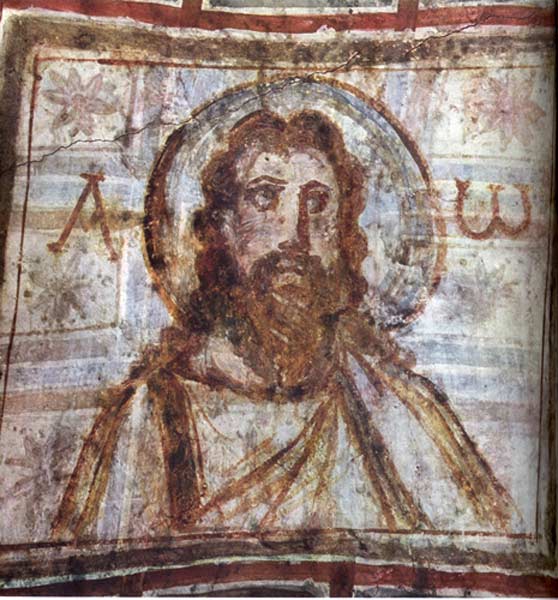
Kimberly Winston analyzes Christianity’s “on-again, off-again relationship with the beard”:
St. Augustine wrote: “The beard signifies the courageous; the beard distinguishes the grown men, the earnest, the active, the vigorous.” But around 1000 A.D., the Canons of Edgar forbade clerical beards, declaring “Let no man in holy orders conceal his tonsure, nor let himself be misshaven nor keep his beard for any time, if he will have God’s blessing and St. Peter’s and ours.” And as for cleanliness (of face) being next to godliness, the Franciscans equate the beard with manliness. “The Friars shall wear the beard, after the example of Christ most holy,” their constitution reads, “since it is something manly, natural, severe, despised and austere.”
Ditto for the Eastern Orthodox, where a clergyman’s beard is seen as a sign of his devotion to God.
Orthodox Christians frequently cite Numbers 6:5 for their beards: “a razor shall not come upon his head, until the days be fulfilled which he vowed to the Lord: he shall be holy, cherishing the long hair of the head all the days of his vow to the Lord.” Today, beards are super popular among Christian hipsters. Exhibit A:Bearded Gospel Men, a blog for Christian men with big beards. Last year, Christianity Today published a handy-dandy guide to parsing a Christian man’s theology, denomination and profession by the cut of his beard.
(Photo: This fourth-century mural painting from Rome’s catacombs of Commodilla is one of earliest known images of a bearded Christ. Earlier Christian art in Rome portrayed Jesus as the Good Shepherd disguised as Orpheus: young, beardless, and in a short tunic. During the fourth century, Jesus started to be depicted as a man of identifiably Jewish appearance, with a full beard and long hair, a style not usually worn by Romans. Via Wikimedia Commons.)
Merill Miller asks, “What would it mean for belief – or non-belief – if we discovered the existence of extraterrestrial life?”
This question is central to the premise of a new book, Religions and Extraterrestrial Life: How Will We Deal with It? by David Weintraub, an astronomy professor at Vanderbilt University. The book examines the stances, if any, of the world’s major religions in regards to the possibility of life beyond our own planet. Wintraub reports that one-fifth to one-third of Americans believe that alien life exists, and with the exponential increase in the discovery of new planets, finding one that would harbor living beings seems more and more likely.
However, not all Americans are quick to embrace the idea of extraterrestrials. While Weintraub found that 55 percent of atheists felt that the existence of aliens was possible, his book also states that evangelical and fundamentalist Christians are the least likely of any religious group in the United States to embrace the thought that life may exist beyond Earth. An article on Futurity examines this reticence of fundamentalists Christians to believe in aliens in terms of salvation – Christian concepts of original sin and the need for atonement through Christ’s sacrifice on the cross would be complicated by the existence of otherworldly beings who may or may not require the same redemption.
But as Megan Gannon notes, “some Christians who interpret the Bible quite literally might actually have an easier time incorporating the existence of aliens into their spiritual cosmology”:
Many Seventh-day Adventists, for example, are creationists who believe the Earth was literally created by God in six days some 6,000 years ago and that humans descended — and inherited original sin — from Adam and Eve. In that line of thinking, life could exist on other planets, but beings that didn’t descend from Adam and Eve on Earth wouldn’t be inherently sinful, and effectively, they wouldn’t need Christianity to be saved, Weintraub told Live Science.
Seventh-day Adventism’s flexibility with regard to aliens might be a product of the time in which the religion was founded (the 19th century). During the 1700s and 1800s, there was a strong popular belief in extraterrestrial life, Weintraub said. The telescope (a relatively recent invention) finally allowed astronomers to peek at other planets and moons in our solar system, but scientists didn’t yet fully understand that these celestial bodies were barren. And perhaps it’s no coincidence that the religions that began at that time — Mormonism, Seventh-day Adventism, Jehovah’s Witnesses, the Baha’i Faith — all have a strong belief in extraterrestrial life, Weintraub said. In contrast, the notion of extraterrestrial life was for the most part irrelevant to religions that began thousands of years ago.
But more ancient religious traditions might be coming around. Last month, the head of the Vatican Observatory Foundation, Guy Consolmagno, declared the discovery of alien life basically inevitable.
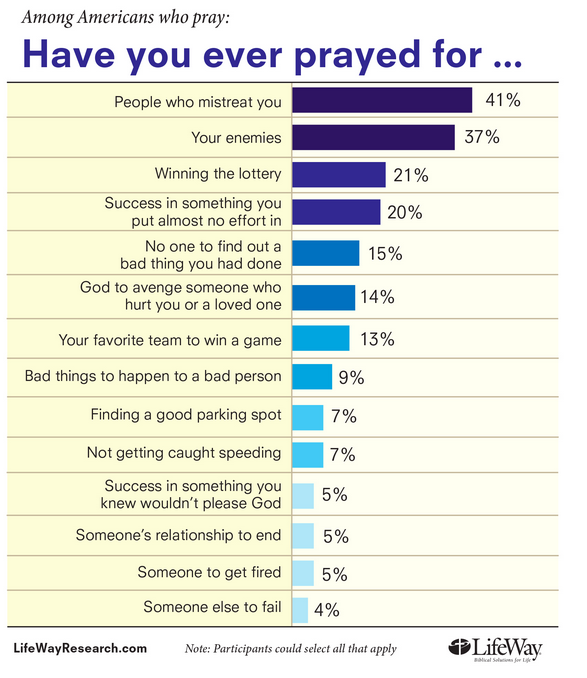
Brandon Ambrosino flags a new survey suggesting that “among praying adults [in the US], 1 in 4 say God answers all their prayers, and 37 percent say God answers some of them. Only 3 percent of those who pray think God answers none of them”:
Religious people aren’t the only ones praying. A Pew study from 2013 found that more than 1 in 5 religiously unaffiliated, or “nones,” said they pray daily. This trend is particularly evident among Millennials, as I recently reported. According to a study out earlier this year from Carnegie Mellon University’s Integrated Innovation Institute, while only 52 percent of Millennials look to religion for guidance, 62 percent of them say they talk privately to God. This suggests that Millennials aren’t giving up on God — more of them are just cutting out the middleman and going straight to God with their prayers.
As for what Americans are praying for, LifeWay reports that 74 percent pray for their own needs and difficulties, and 42 percent pray for “my own sin.” The study also found that Americans are generous with their prayers: 82 percent pray for friends and family, and 38 percent pray for those who’ve experienced natural disasters. People who pray seem less concerned with praying for politicians (12 percent) and celebrities (5 percent).
Morgan Lee has more:
One-third of Americans said they pray several times a day, and 17 percent pray once per day. Less than one in five say they never pray. Among Protestants, 61 percent pray at least daily, and 43% several times a day.
Who prays? Men are less likely to talk to God than women: one in five say they never pray (22 percent), vs. 1 in 10 women (11 percent). Roughly 20 percent of whites (19 percent) and Hispanics (20 percent) say they never pray; in contrast, only five percent of African Americans say the same.
Drum snickers that his favorite result “is the 5 percent of respondents who prayed for success in something they knew wouldn’t please God”:
This is great. Apparently these folks are more willing to be honest with a telephone pollster than with God despite the fact that God already knows. If it displeases Him, then that’s that. You aren’t going to fool Him into making it happen anyway. I’m also intrigued by the 20 percent who prayed for success in something they “put almost no effort in.” That’s fabulous! Not that they did it, mind you. That’s just human nature. But that they were willing to fess up to this to a telephone pollster. Is there anything people aren’t willing to confide to telephone pollsters?
“The world – whatever we might think when terrified by its vastness and our own impotence, or embittered by its indifference to individual suffering, of people, animals, and perhaps even plants, for why are we so sure that plants feel no pain; whatever we might think of its expanses pierced by the rays of stars surrounded by planets we’ve just begun to discover, planets already dead? still dead? we just don’t know; whatever we might think of this measureless theater to which we’ve got reserved tickets, but tickets whose lifespan is laughably short, bounded as it is by two arbitrary dates; whatever else we might think of this world – it is astonishing.
But ‘astonishing’ is an epithet concealing a logical trap. We’re astonished, after all, by things that deviate from some well-known and universally acknowledged norm, from an obviousness we’ve grown accustomed to. Now the point is, there is no such obvious world. Our astonishment exists per se and isn’t based on comparison with something else.
Granted, in daily speech, where we don’t stop to consider every word, we all use phrases like ‘the ordinary world,’ ‘ordinary life,’ ‘the ordinary course of events’ … But in the language of poetry, where every word is weighed, nothing is usual or normal. Not a single stone and not a single cloud above it. Not a single day and not a single night after it. And above all, not a single existence, not anyone’s existence in this world,” – Wislawa Szymborska, in her 1996 Nobel Lecture.
John Gray heralds Karen Armstrong “one of our most perceptive and thoughtful writers on religion” in a review of her book Fields of Blood:
Armstrong performs an invaluable service by showing that religion is not the uniquely violent force demonized by secular thinkers. Yet neither is religion intrinsically peaceful—a benign spiritual quest compromised and perverted by its involvement with power. The potential for violence exists in faith-based movements of all kinds, secular as well as religious. Evangelical atheists splutter with fury when reminded that a war on religion was an integral part of some of the 20th century’s worst regimes. How can anyone accuse a movement devoted to reason and free inquiry of being implicated in totalitarian oppression? It is a feeble-minded and thoroughly silly response, reminiscent of that of witless believers who ask how a religion of love could possibly be held to account for the horrors of the Inquisition.
Conventional distinctions between religious and secular belief pass over the role that belief itself plays in our lives.
“We are meaning-seeking creatures,” Karen Armstrong writes wisely, “and, unlike other animals, fall very easily into despair if we fail to make sense of our lives.” We are unlike our animal kin in another way. Only human beings kill and die for the sake of beliefs about themselves and the nature of the world. Looking for sense in their lives, they attack others who find meaning in beliefs different from their own. The violence of faith cannot be exorcised by demonizing religion. It goes with being human.
In another positive review, David Shariatmadari draws on Armstrong’s writing to interpret the current conflict with ISIS:
Armstrong begins and ends her book with reflections on the scapegoat – the animal burdened with the sins of the community and sent out into the desert. She argues that we, in the secular, rational west, have become incapable of properly acknowledging our own ferocious violence. The madmen are the ones who believe in a man in the sky, who strap on suicide belts imagining that they will be rewarded with virgins in heaven – not we, who debate and legislate and only then slam hellfire missiles into wedding parties.
But what of Islamic State? Theology motivates its actions; that theology derives from the Qur’an. Surely this is religious violence. In a narrow sense, yes. However, it represents a grossly mutated version of a doctrine that survives in much of the world in its original form as a stabilising, communitarian practice. To extend the analogy of the virus: we know that environmental stress accelerates mutation in the natural world. The faith communities subjected to the most stress over the past two centuries are those of Middle Eastern and subcontinental Islam; as Armstrong sets out in grim detail, its members have endured colonisation, the expropriation of land, authoritarian rule and military occupation. Could these stressors come to be seen as the greater cause?
None of which is to excuse the revolting acts of Islamic State fanatics. In this arena, the tendency for attempts to explain and understand to be taken as acts of apology is deeply frustrating. But we must not turn our backs on history, which is the only way the arguments set out by the likes of Sam Harris and Tony Blair make sense. The urge to blame others is strong, and old, as the ritual of the scapegoat shows. The first step towards extirpating it is to acknowledge it. In her efforts to bring this about, Armstrong is doing us a great service.
Previous Dish on Armstrong’s book here and here.
(Video: Tom Sutcliffe interviews Armstrong)
 The Dish
