
Face Of The Day

dish_fotdsun12

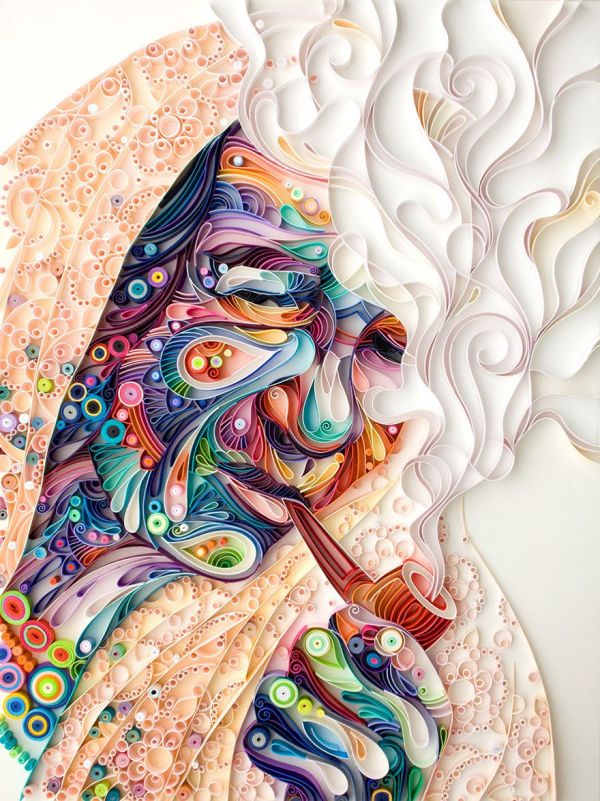
Russian-born illustrator Yulia Brodskaya crafts her art from paper. She described her process in an interview last year:

Could you please explain what paper quilling is and tell us a little about the work process? 

Quilling is a paper craft that involves the use of paper strips that are rolled, shaped, and glued together to create decorative designs. The name is believed to be derived from the feather quill on which the strips of paper were rolled.The technique itself is really simple; this is something anyone can do; there are quilling tools available in craft shops designed to help to learn quilling, there are also pre-cut paper strips and of course numerous video lessons on youtube.

Personally I use cocktail straw and little cocktail sticks for rolling the paper strips (I didn’t know that there are specially designed tools available when I taught myself to shape the paper strips, I started to use the cocktail straw and I still use it now).

The most challenging thing is that this paper craft is very time-consuming and requires lot of patience. In general I prefer the projects where I get the most creative freedom, so probably I mostly enjoy my personal self-initiated works (e.g. portraits), they take the longest, but I believe the result is worth the effort, this helps me to keep rolling.

Watch Brodskaya demonstrate her craft in this video, and see more of her work here and here.

(Hat tip: Lisa Marcus)


Selfies In Mecca

SAUDI-RELIGION-ISLAM-HAJJ

Amena Bakr takes note of a new phenomenon on the hajj:

It’s one of the biggest trends taking over the social media world, and now during the annual Muslim hajj pilgrimage visitors to the holy sites can’t resist the urge to take a selfie. Between calls for forgiveness from God, the word “selfie” echoes through the white marble halls inside the Grand Mosque in Mecca where pilgrims walk around the Kaaba, the black-clad cube towards which the world’s 1.6 billion Muslims face to pray,

“I’m taking a selfie with Kaaba behind me to post on my Facebook so my family and friends can see me. That’s the way we communicate these days – no need to call,” said Mehmet Dawoud, a Turkish student. To many, selfies are just another way to preserve the memory of being in a holy site and also share the experience in the trendiest of ways with loved ones. “Selfies are just a way to make the memory last in the coolest possible way. Hajj is always seen as something very serious and for older people. Selfies make it cool again,” said Amir Marouf, a 30-year-old Egyptian architect.

Antoinette Lattouf ties the trend to to the Saudi government’s decision to allow cell phones at the Holy Mosque. But John Bowman raises an eyebrow, noting that the most widely read article about the “craze” was published before the Hajj even started :

Here’s now it happened. Saudi photographer Jameel Musleh posted [the above] selfie to Twitter in April. The pilgrims shown in the photo may have been on the lesser pilgrimage, the umrah, that can be performed at any time of year, says Fareed Amin, the president of the Islamic Institute of Toronto. This photo has been retweeted and reposted thousands of times.One Twitter user dubbed it the #selfieoftheyear. Another tried to get the photo more retweets than Ellen DeGeneres’s Oscar selfie. This may be where the hashtag and name #HajjSelfie originated.

The meme was persistent enough that last week, ArabNews.com wrote an article ahead of the hajj, quoting Islamic studies teachers and scholars who advised against “photography without a legitimate reason.” The story used the above umrah photo was illustration. “The Prophet (peace be upon him) when he went for Haj, he said: O Allah, I ask of you a pilgrimage that contains no boasting or showing of. Taking such selfies and videos defy the wish of our Prophet,” said scholar Sheikh Assim Al-Hakeem in that article. This led to a discussion among Muslims on social media. The Twitter account @MuslimMatters put the question to its followers.

When Buzzfeed got a hold of the story, it became Muslim Pilgrims Are Taking “Hajj Selfies” And Clerics Are Not Happy. “‘Selfie fever’ has taken over the hajj,” they wrote, proclaiming it a “craze” before it even occurred.

Meanwhile, Boer Deng looks into another way new media is engaging with ancient tradition:

The prototype for a new app, Mecca 3D, was released this summer, and lets users explore a true-to-scale digital rendition of the Mosque at Mecca. It has been downloaded about 80,000 times on Android and iOS, according to its creator, Bilal Chbib.* He hopes to add interactive lessons and to integrate the program with Oculus Rift, a virtual reality simulator. Going on a technologically mediated pilgrimage might resemble the experience of a flight simulator. “You can never substitute the place where the Prophet stood,” as Chbib says. But virtual participation in religious activities can still give people an authentic experience, though of a different sort. Krystina Derrickson, an Islamic scholar, writes of visiting Mecca in the virtual world program Second Life: “When my ‘avatar’ visits the Mosque, I feel compelled to take off my avatar’s shoes,” she says, “because, really, it’s me visiting that Mosque.” The Mosque is not real, but that does not mean it lacks “a rather noticeable social and cultural reality.” Derrickson thinks that this gives it and other digital religious spaces a kind of “ambiguous” sacredness.

(Photo: Muslim pilgrims pose for a selfie during the Jamarat ritual, the stoning of Satan, in Mina near the holy city of Mecca, on October 4, 2014. Pilgrims pelt pillars symbolizing the devil with pebbles to show their defiance on the third day of the hajj as Muslims worldwide mark the Eid al-Adha or the Feast of the Sacrifice, marking the end of the hajj pilgrimage to Mecca and commemorating Abraham’s willingness to sacrifice his son Ismail on God’s command in the holy city of Mecca. By Mohammed Al-Shaikh/AFP/Getty Images)
Robinson’s Revelatory Prose

Like previous critics, Michelle Orange emphasizes the role of grace in Marilynne Robinson’s new novel, Lila:

Robinson’s genius is for making indistinguishable the highest ends of faith and fiction, evoking in her characters and her readers the paradox by which an individual, enlarged by the grace of God, or art, acquires selfhood in acquiring a sense of the world beyond the self—the sublime apprehension that other people exist.

Which is to say that Robinson’s animating theme—grace—is also central to her genius. Described as “a sort of ecstatic fire that takes things down to essentials,” grace is evidenced in both the particular and the abstract: as laughter, a beloved face or voice, or as “playing catch in a hot street . . . leaping after a high throw and that wonderful collaboration of the whole body with itself”; but also in forgetting “all the tedious particulars,” in feeling the presence of a “mortal and immortal being.” “A character is really the sense of a character,” Robinson has written, and hers suggest, above the particulars, how the mysteries of grace persist in human beings, those wanting creatures who move Ames with their incandescence, the presence “shaped around ‘I’ like a flame on a wick, emanating itself in grief and guilt and joy and whatever else.”

Wyatt Mason focuses on how Robinson’s characters approach self-understanding:

She documents how Lila’s mind changes, not owing to the efforts of some external force but out of a righteous need of her own: to understand her husband, to speak his language, to forge a language of her own that will be spoken with, to, and for him and for them.

One of the book’s most telling passages involves watching Lila’s mind as she sits in her house, pregnant, reading the Book of Job, registering the lines and considering them. The act of reading the Bible as high drama may seem unlikely, but through it, Robinson has managed to portray how a mind with no religiosity might meet a book Robinson loves fiercely and, in its pages, find a road to a self that learns a new language: her own language. As it turns out, there is extraordinary drama in the story of how we learn to speak to ourselves.

In a recent interview, Robinson addressed this connection between faith and language:

As you write, do you draw on language found in your faith? What are the strengths of religious language, or what are the limitations of language when it comes to talking about faith and belief?

Language is limited in its nature. It’s like consciousness itself. It’s defective, and you can push at it. You can make it do things you wouldn’t have known it can do. One of the things that is a benefit to me is that, because I have been interested in a particular theology, it makes a coherent language. It’s internally self-referential, in a way. This could be true of anyone who is deeply acquainted with any tradition. This particular tradition was very verbal, so you have a very rich literature that pushes the articulation of certain basic ideas.

We have anxiety about differences. We are different, anyway, so we might as well calm down about it. But one of the things that we have to do is understand that within the system that is anyone’s difference is incredibly enabling. It means people before me have pondered the response to death. People before me have pondered the reality of time in different dialects. This is beautiful. This is not a thing to be anxious about. For my own Calvinistic purposes, I would like to see the tradition that I speak from re-animated, fleshed out. It’s human, it’s experience. Only religion fully realizes the arc of human life, and so much beautiful thought has gone into this over our eons of time.

Recent Dish on Lila here.

Face Of The Day

dish_burlesque2

For his series Burlesque, Sean Scheidt photographed performers before and after their transformations:

In his portraits, Scheidt captures the virtually nondescript everyday face of the performers. These are people who, aside from the occasional colored hair, look, well… normal. In Scheidt’s description of the work, he says that they tended to be quite reserved at first, which made the transformation into their characters all the more transfixing.

Scheidt described his inspiration in an interview earlier this year:

It was really a confluence of two separate things.  First, I was hired to do a shoot for DNA theater.  This allowed me to go backstage and get a glimpse of the transformation of the actors.  About this time, I was also reading Harpo Marx’s autobiography.  Marx talked a lot about Judy Garland, which sent me to search her out on YouTube.  I was amazed to see how, even in her declining years, Garland lit up, once she stepped onto the stage.  I guess it was then that I realized the stage has the power to transform a person into someone else.  The question I wanted to explore was finding the reality within that transformation.

He added:

Capturing those moments, I believe, helps to humanize these performers.  If you were just seeing the “after” shots alone, you might make certain pre-conceived judgements about the person behind the make-up.  I hope this series gets people to think about their reactions to these men and women.

See more of his work here and here.

Sex For Commies

Colin Marshall unearths Do Communists Have Better Sex?, a 2006 documentary (NSFW) that suggests East Germans did, indeed, best their West German counterparts in bed:

The documentary proposes that, for all its deficiencies, the German Democratic Republic actually put forth a remarkably progressive set of policies related to such things as birth control, divorce, abortion, and sex education — a precedent to which some non-communist countries still haven’t caught up. However forward-thinking you might find all this, it did have trouble meshing with other communist policies: the state’s rule of only issuing housing to families, for instance, meant that women would get pregnant by about age twenty in any case. We must admit that, ultimately, citizens of the showcase East Germany had a better time of it than did the citizens of Soviet Socialist Republics farther east. And if the Ossies had a better Cold War between the sheets than did the Wessies, well, maybe they just did it to escape their country’s pervasive atmosphere of “unerotic dreariness.”

A Hard Sell?

A new Viagra ad, which features a woman breathily imploring viewers to talk to their doctors about the drug, prompts Ian Crouch to consider a history of advertising for E.D. drugs:

[A]lthough the ad is essentially a come-on by a beautiful woman, it is refreshingly frank about sex, which means that it is markedly better than past ads that relied on silly or crass innuendo: Levitra’s football-through-the-tire-swing ad; Viagra’s “We Are the Champions” mass male celebration; Cialis’s adjacent his-and-her bathtubs. The rare exception  is the first television commercial Viagra ever ran, which turns out also to have been the brand’s best, featuring the former Senator and Republican Presidential candidate Bob Dole. That ad, which looks rather oddly like a campaign spot, became a punch line, mocked later by even Dole himself. But, watching it now, it seems far more forthright, honest, and even dignified than the ads that followed. Dole makes note of the ways in which the subject might make viewers uncomfortable, but he tells the audience, basically, to grow up: “You know, it’s a little embarrassing to talk about E.D., but it’s so important to millions of men and their partners, that I decided to talk about it publicly.” It was a little embarrassing; that was the point. In the intervening years, Viagra steered away from talking much about sex in its TV ads: its most recent campaign had showed ruggedly capable men at work, and alone.

The new ad, however, gets remarkably specific.

The problem under review is “not just getting an erection but keeping it”—the woman says this twice in less than a minute. The suggestion is that male sexual performance isn’t an all-or-nothing proposition but something that exists on a continuum—and it implies that men could be performing better. In another context, this plain talk about erections might have been the beginning of a more comprehensive, and truly honest, discussion about sex: it might have included the psychological and relational aspects of sexual experience; it could have suggested to men that sex wasn’t a sporting event, and that it need not be judged in terms of wins and losses; and it might have included the voices of real women. Here, the solution to a complicated issue remains simple: get yourself a prescription.

Recent Dish on Viagra here.

Dogs vs Cats: The Great Debate, Ctd

In a recent Guardian live chat, the frequently-entertaining pop philosopher Slavoj Zizek added his two cents:

What do you think we can learn from cats, if anything?

Nothing. I like to search for class struggle in strange domains. For example it is clear that in classical Hollywood, the couple of vampires and zombies designates class struggle. Vampires are rich, they live among us. Zombies are the poor, living dead, ugly, stupid, attacking from outside. And it’s the same with cats and dogs. Cats are lazy, evil, exploitative, dogs are faithful, they work hard, so if I were to be in government, I would tax having a cat, tax it really heavy.

Much, much more Dish discussion of dogs vs cats here.

The Language Of Creative Pairs

In an excerpt from his new book, Powers of Two: Finding the Essence of Creation in Creative Pairs, Joshua Wolf Shenk describes the ways individuals in creative partnerships communicate:

When the writer David Zax visited The Daily Show to profile Steve Bodow, Jon Stewart’s head writer (and now the show’s executive producer), Zax could understand only a small fraction of their exchanges, given the dominance of “workplace argot and quasi-telepathy.” “If you work with Jon for any length of time, you learn to interpret the shorthand,” Bodow said. For example, Stewart might say: “Cut the thing and bring the thing around and do the thing.” “ ‘Cut the thing’: You know what thing needs to be cut,” Bodow explained. “ ‘Bring the thing around’: There’s a thing that works, but it needs to move up in order to set up the ‘do the thing’ thing, which is probably the ‘blow,’ the big joke at the end. It takes time and repetition and patience and frustration, and suddenly you know how to bring the thing around and do the thing.”

I’ve interviewed many pairs and seen a variety of styles. Some talk over each other wildly, like seals flopping together on a pier, and some behave with an almost severe respect, like two monks side by side. (Watch a video of Merce Cunningham and John Cage for an illustration.) But regardless of a pair’s style, I usually came away feeling like I had just met two people who were, while inimitable and distinct, also a single organism.