Book Club: Waking Up, Ctd

unnamed (6)

Our latest Book Club selection is already shaping up to be our most popular, based on the reader response we’ve been getting so far:

I am an atheist, and until I read about Waking Up on the Dish, I had never heard of Sam Harris. I bought the book, read it, and because of it not only will I die happily, I will be happier for the rest of my life. I am 69, a retired engineer. For a long time I have wondered about, and struggled with questions such as, Where was I before I was born? What happens to me after I die? Sam Harris has convinced me that consciousness is self (I.) My perception of I is just my consciousness. Bingo! Now I am not worried about “I.” Thanks, Andrew, for paving my way to enlightenment.

Another atheist:

Count me as one excited for this pick! I had already requested it at the library in fact, before 51dolkylyou chose it. The timing of its release happened just as I have been reading more books on Buddhism and attempting to practice meditation myself. Despite being a long-time atheist, I have lately felt the need to find a different framework, a spiritual one, and Harris’s book offers me reassurance that I don’t need to feel I am betraying my convictions, or giving in to some soft-heartedness, by heeding the pull toward spirituality. At first I felt almost ashamed to be exploring meditation and Buddhism, as if I am failing to be rational or abandoning my intelligence. But in fact I think that my world when I only considered myself as an atheist and did not leave room for exploring other paths was too narrow and lacked room for any nurturing growth or exploration. I think it will be a great conversation.

The book has had a powerful impact on me, since I have long been drawn to many elements of Buddhism (Thomas Merton guided me there), but always stumbled at the problem of the self. The book helped me think about that problem more powerfully than anything I have ever read – including many Buddhist scriptures.

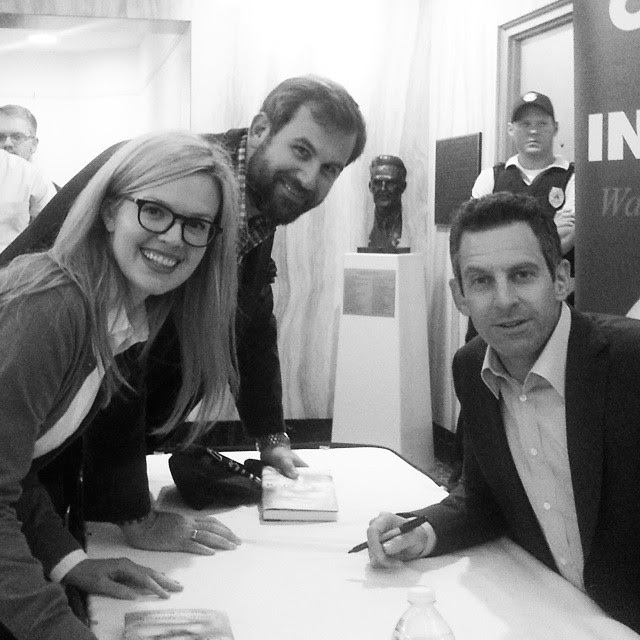
We’ll be starting the discussion next week, so there is still plenty of time to read the book – buy it here. And send your thoughts to bookclub@andrewsullivan.com. Sam has agreed to join the conversation in its final stages, so he might even respond to your writing. Another reader sends the black-and-white photo seen above:

Recently my wife and I went to hear Sam talk about his new book here in DC. Neither of us believe in the supernatural or an afterlife, etc, but we do believe there are numinous experiences to be had in life, and that those can be – and I’d argue can better be – had outside of religion.  So, we’re really stoked that you’re placing this topic on the table for discussion.

One more:

I’ve only been able to read the first half of the first chapter. I keep having to stop and process. bookclub-beagle-tr-2Is it true that all religions are similar but for the crazy fictions we place on them, or that you have to believe ridiculous, magical things before you can be a follower of all major religions (except Buddhism)? And that, honestly, all day long we’re just lurching between states of wanting and not wanting?

Many thanks for choosing this book. I am humbled, even after 21 pages, and grateful for the future time lost to the interesting conversations this reading provokes.


How To Explain The World

Funny or Die channels the post-college know-it-alls at Vox:

After spending the past few weeks reading these Wikipedia articles in all of my spare moments I feel dumber and more discouraged than I did before. Human societies are complicated and when assessing history it is all to easy to assign causation after the fact. But when it comes to really be able to draw any meaningful lessons about how to improve in the future, things are less certain. We seem to be doomed to repeat our mistakes for all time.

So, why is shit so fucked in the Middle East? Because humans live there and humans are really good at fucking shit up. Will shit be fucked forever? Probably. But maybe if we collectively take a breath and let the sins of our fathers and mothers be forgiven, we can change the eternal return of the same fucking shit [cue [Aimee Mann’s “Wise Up.”]]

Okay. Now time to go read some Wikipedia pages about something that doesn’t depress the fuck out of me. I think I’ll start with pallas’s cats.

Update from a reader:

I fear that search for a non-depressing subject by turning to Wikipedia’s article on Pallas’s cats will be undercut as soon as he reaches this sentence: “It is negatively affected by habitat degradation, prey base decline, and hunting, and has therefore been classified as Near Threatened by IUCN since 2002.”

The Next Big Ruling On Marriage Equality

Steve Friess introduces us to Judge Jeffrey Sutton “the inscrutable swing vote on the Federal Sixth Circuit Court of Appeals’ three-judge panel, which is due to rule any day now on six gay-marriage cases that span Michigan, Tennessee, Ohio, and Kentucky”:

In the complicated legal morass created by the Supreme Court’s refusal to hear appeals in several gay-marriage cases, the legal consensus is that SCOTUS decided it could keep ducking because every appellate court thus far has ruled the same way — that is, for marriage equality.

Sutton, flanked at oral arguments in August by one judge who was almost comically pro-marriage equality and another who seemed solidly on the other side, finds himself in a fascinatingly powerful position. If he concurs with the eight circuits that have already found a fundamental right to same-sex marriage, his vote will expand marriage equality to four more states. If he and the Sixth Circuit come down in support of the right of states to ban gay marriage, the Supreme Court, faced with conflicting rulings among the circuits, will almost certainly step in to take the case. If that happens, there is good reason to think that marriage equality will become the law of the land.

Which is all to say Sutton could be doing gay marriage a big favor whichever way he votes.

Dale Carpenter explains what happens if Sutton rules in favor of marriage equality:

If the Sixth Circuit does this, gay marriage would be legal in Kentucky and Tennessee, and the states of Ohio and Michigan would have to recognize same-sex marriages from out of state. One or more of the states might simply acquiesce to the decisions, as other states have done when further appeal became fruitless. If the states petitioned the Court, it would likely deny their petitions since there would still be no circuit split. It also seems likely that stays on the lower-court decisions would be immediately or very quickly lifted since the stays had functioned only to preserve a status quo that the Supreme Court has now let pass. …

The onus would then fall on the Fifth, Eighth, or Eleventh Circuits to reject same-sex marriage claims. Any of them would have to be considered more likely to uphold SSM bans than the circuits that have decided the matter thus far. But given that oral argument has not been scheduled in the Fifth Circuit, that briefs have not yet been filed in the Eleventh Circuit, and that there is not even a case before the Eighth Circuit, a decision from one of them would probably put the matter off for at least another Term.

But Damon Root points out that Sutton could “uphold the gay marriage bans as an act of judicial deference, the legal philosophy which says that the courts should give lawmakers the benefit of the doubt and therefore rarely strike down democratically enacted statutes”:

After all, the last time Sutton found himself at the center of a roiling national debate over the wisdom of a controversial piece of legislation, he voted to sustain the law in part on those very grounds.

What case was that? It was Sutton’s 2011 opinion in Thomas More Law Center v. Obama, in which the 6th Circuit upheld the constitutionality of the Patient Protection and Affordable Care Act, aka Obamacare. According to Sutton, the great legal battle over President Obamas health care law is “just as stirring, no less essential to the appropriate role of the National Government and no less capable of political resolution” than the debate over the constitutionality of the Second Bank of the United States at issue in McCulloch v. Maryland (1819). And in that foundational case, Sutton observed, “the Supreme Court erred on the side of allowing the political branches to resolve the conflict.” Similarly, he declared, the fate of Obamacare should be decided by “the peoples’ political representatives, rather than their judges.”

The Moral Intimacy Of Drone Warfare

AFGHANISTAN-FRANCE-ARMY-FILES

In a feature on the drone era and its ramifications, Ben Wallace-Wells touches on how military drone operators engage with their targets much more intimately than bomber pilots on manned missions do, despite working from thousands of miles away:

Pilots typically benefit from what psychologists call “the morality of altitude” — separated from their victims by thousands of feet of airspace, they tend to suffer far less post-traumatic stress than do their counterparts on the ground. But drones have collapsed that moral distance, bringing their operators into far greater intimacy with their targets. The details of how drone pilots work have, like the missions themselves, been largely classified, but by combing through unclassified medical studies of drone-operator stress, Peter Asaro of the New School has been able to pinpoint some of the changes. Asaro found that tasks that had been distributed through the military and intelligence bureaucracies (gathering intelligence on a target, conducting surveillance, weighing the risks of a targeted killing, navigating a plane, firing a missile, assessing what happened afterward) have now been concentrated, so that they are all performed by tiny teams often scattered at bases around the peacetime United States, working at night, monitoring targets halfway across the globe for whose survival or death they are responsible.

“A pilot traditionally might have to fly to a coordinate and drop a bomb, and that was it,” Asaro says. “Now a drone operator has much more intimacy. Often he has to track a subject for weeks beforehand. The access to the intelligence is much greater. Sometimes they have to do damage assessment in the aftermath of an attack — to count the bodies pulled from the rubble.”

Yochi Dreazen calls attention to the psychological toll the job takes on these soldiers:

The results of the growing number of studies examining what long-distance war does to those who fight it are stark and striking. An Air Force survey in 2011 found that 41% of the Air Force personnel operating the unmanned aircrafts’ advanced surveillance systems reported “high operational stress,” along with 46% of those actually piloting the robotic planes. … Last year, a study by the Armed Forces Health Surveillance Center found that drone operators were at “similar risk” for mental health issues like PTSD, depression, and anxiety as the pilots of the manned warplanes and other aircraft flying over Iraq and Afghanistan from bases in the two war zones because they were experiencing — even from the safety of their trailers thousands of miles away — “witnessing traumatic experiences” like the deaths of U.S. troops or the militants they had just killed by pulling a trigger on what looks like a video game joystick.

Recent Dish on drone pilots here and here.

(Photo: A US ‘Predator’ drone passing overhead at a forward operating base near Kandahar, Afghanistan. By Joel Saget/AFP/Getty Images)

Marriage Equality Update

Marriage Equality Population

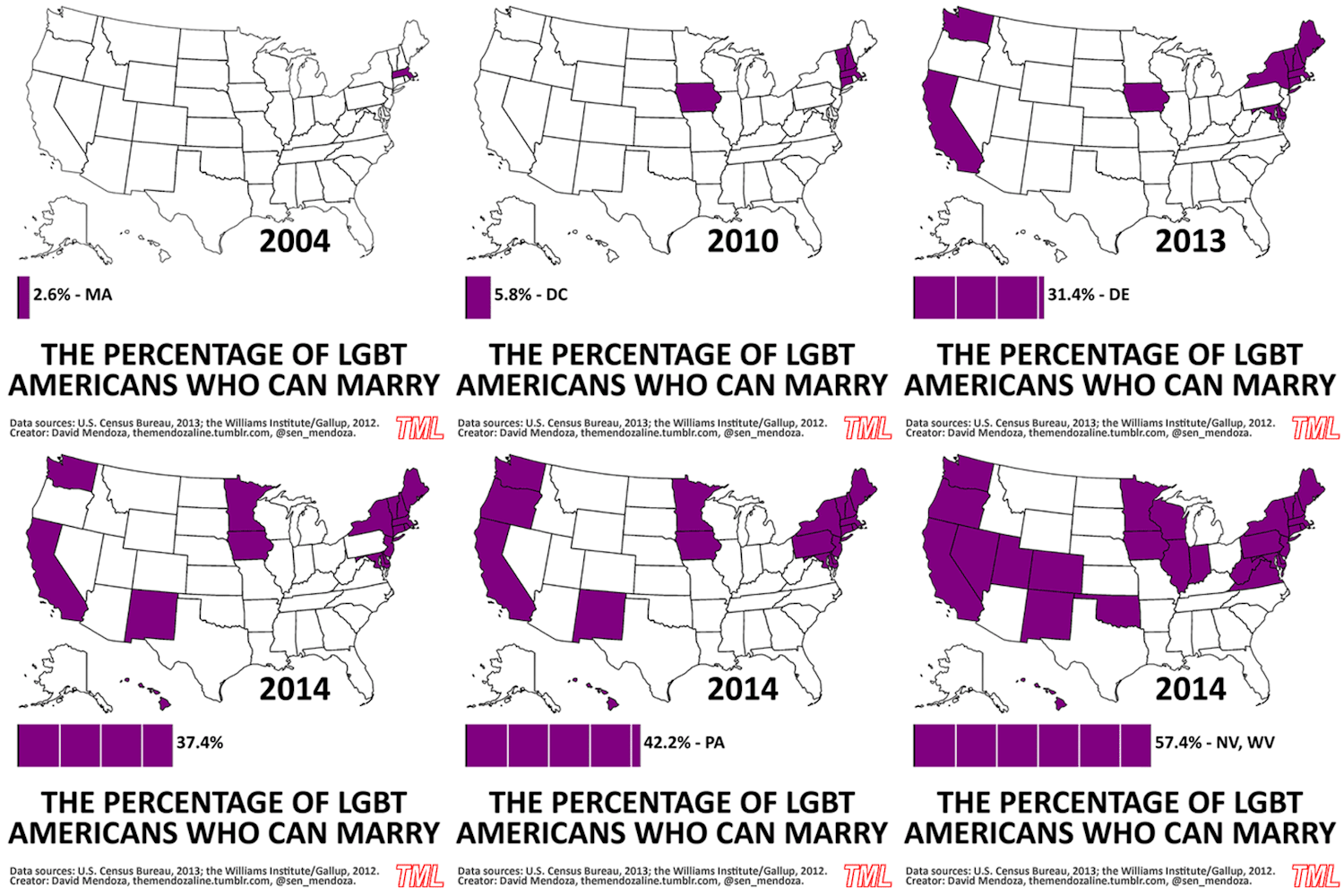
Equality has come to Nevada and West Virginia. Joe Jervis quips:

When you get to post a new Wikipedia map twice in a few hours, that was a very good day for our people. When you get to post a new Wikipedia map eight times in four days, that was one of the best weeks in our history.

Lyle Denniston checks in on those states without marriage equality:

A decision by the Ninth Circuit on Tuesday to nullify a ban in Idaho (along with the ban in Nevada) created the likelihood that prohibitions would soon be set aside also in Alaska, Arizona, and Montana.  However, Idaho has a challenge pending with Supreme Court Justice Anthony M. Kennedy; the same-sex couples involved in that case filed their response late Thursday afternoon, arguing that state officials “point to nothing that would justify” postponement of the Ninth Circuit decision “only days after the Court denied every other petition presenting the same claim.”

A decision by the Tenth Circuit against bans in Oklahoma and Utah (and left intact by the Supreme Court on Monday) suggested that similar prohibitions would be ended in Kansas and Wyoming.  In Wyoming, a federal trial judge on Thursday scheduled a hearing for October 16 on whether to allow same-sex couples to begin marrying in that state.  In Kansas, state officials have said they were studying the situation, but a state judge in a district in the Kansas City metropolitan area on Wednesday ordered clerks in that district to begin issuing marriage licenses to same-sex couples.

A case in Alaska begins today. Zack Ford examines the situation on North Carolina:

North Carolina is another state where a change could come quite soon. The state stopped defending the ban back in July, but several GOP lawmakers, led by House Speaker and U.S. Senate candidate Thom Tillis (R), are trying to take up the fight. To advise them,they’ve even hired National Organization for Marriage Chairman John Eastman. While their motion to intervene in the case has not yet been considered, a federal judge ruled Thursday night that they will not be granted the eight-day extension they requested. They have until noon Friday to file their finalized motion to intervene, and the case could advance — or be resolved — quite quickly after that.

Dahlia Lithwick and Sonja West take a closer look at Kansas and South Carolina:

The state is presumably under the jurisdiction of the 10th Circuit, which also covers Utah, whose appeal was batted away by the Supreme Court on Monday. The 10th Circuit ruling that same-sex marriage bans are unconstitutional should therefore be the law in Kansas. Moreover, state law provides that a clerk who issues a license to “unqualified” people could be found guilty of a misdemeanor. So on Wednesday, Chief District Judge Kevin Moriarty of Johnson County issued an order directing the district court clerk to issue licenses to same-sex couples without fear of prosecution, reasoning that state laws—statutory or constitutional—are void if they contradict federal law, and that after Monday Kansas is bound by the 10th Circuit decision. But other judges in the same county disagree. And a judge in a different county has already denied a couple seeking a license because, in her view, Kansas’ ban on same sex marriage has not been explicitly struck down.

Meanwhile, Kansas Attorney General Derek Schmidt and Gov. Sam Brownback declined to accept the Johnson County ruling. Brownback issued a statement Wednesday night indicating that “An overwhelming majority of Kansas voters amended the constitution to include a definition of marriage as one man and one woman.” The statement asserted, “Activist judges should not overrule the people of Kansas.” Is Judge Moriarty an “activist Judge”? Or is he merely aware of the existence of the Supremacy Clause? Who knows?

Over in South Carolina? Same deal. Depending on which courthouse you visit, you can procure either a marriage license or a refusal.

(GIF by David Mendoza)

Make Orwell Proud, Ctd

We bleg, you respond – this time by emailing “examples of jargon that is is designed explicitly as a euphemism to disguise the core reality.” One reader writes:

The use of the words “Collateral Damage” has always made me cringe. The US Dept of Defense Dictionary of Military and Associated Terms defines collateral damage as the “unintentional or incidental injury or damage to persons or objects that would not be lawful military targets in the circumstances ruling at the time.”

Really? Killing someone is “damage”. Collateral Death is more like it.

Another points to “‘disposition matrix’, to refer to the CIA’s kill list.” Another:

While the titles of most legislation coming out of Congress usually makes me cringe , I’m going to have to go with USA PATRIOT Act as perhaps the most Orwellian, in that it contains some of the most anti-Bill-of-Rights (if not anti-Constitutional) legislation ever enacted in this country. Basically, it’s little more than “be patriotic and give up a good chunk of your rights because terrorism!” I count the Patriot Act and its reauthorizations as perhaps Osama Bin Laden’s greatest accomplishment …

Another reader:

“Ethnic cleansing” always struck me as a gross Orwellian term.  Sounds like something is being made better and more clean. I was very surprised when the U.S. used the term regarding Bosnia (although using “genocide” has legal implications for a nation). Still, there has to be a better term.

Shifting to employment:

When my mother was laid off from her job as a bank teller at the age of 60, she was told that she was “non-selected”.

Another has three more: “rightsize, early retirement option, workforce imbalance correction.” Another writes:

When large companies outsource a division to a cheaper labor location, say India or even Iowa, the term used to describe the new lower cost department is “Center Of Excellence”.  The original name of New York’s deservedly world famous “Hospital for Special Surgery” was “Hospital For The Relief Of The Ruptured And Crippled”.

Another:

One of my personal favorites is “knowledge transfer” as in “China actively promotes “knowledge transfer,” a euphemism for stealing your technology.”

And another:

I used to work in the mortgage industry, and the company I worked for was in the process of merging with very similar organization. However, there was a problem that was making everyone nervous. Many of the employees from the other company did the exact same job that we did. There was significant overlap. But don’t worry! None of us were going to get fired! No firings here. That would have been bad for morale. Instead, we were told that management was looking into “eliminating unnecessary redundancies”. This cold and technical language struck me as perverse. These were fathers, mothers, husbands, and wives who were about to lose their jobs, not “redundancies” – as if they were unfeeling machines that could just be disposed of.

Another quick one. During my time with this company, we were under investigation for fraud by federal prosecutors. In the end, we agreed to pay a fine in exchange for an end to the investigation. This was reported to all employees in a positively spun email that stated we had “met all of our legal obligations”. It seems to me that when you have broken the law that’s the exact opposite of meeting your legal obligations. All we did was pay a fine to get the feds off our backs. This use of language irritates the hell out of me.

Another turns to parenting:

This might be more innocuous than most, but I’ve always gotten a kick out of the language of the Ferber Method, where parents teach babies how to “self-soothe”. This is of course, a polite way of saying let the baby cry.

This one’s a doozy:

You know the little safety talks the flight attendants always give at the beginning of flights? I was once privileged to hear one that included the phrase, “In the event of an unscheduled water landing …” Which of course begs the question, how many scheduled water landings does that airline make?

Our Pharmacist Glut, Ctd

Dish alum Katie Zavadski recently reported on the bursting of the pharmacist bubble. Freddie sympathizes with students with “practical” degrees who end up unemployed:

This country graduates 350,000 business majors a year. The metrics for those degrees are generally awful. But nobody ever includes them in their arguments about impractical majors, despite those bad numbers. And if you’re some 19 year old, out to choose a career path, business sure sounds practical. So they graduate with those degrees and flood the market with identical resumes and nobody will hire them. Meanwhile, they lost the opportunity to explore fields that they might have enjoyed, that might have deepened the information acquisition and evaluation skills that would allow them to adapt to a whole host of jobs, and that might have provided a civic and moral education. All to satisfy a vision of practicality that has no connection to replicable, reliable economic advantage. …

Chasing a particular employment market, for an individual, can be a good or a bad bet. But treating skill chasing as a long-term economic solution on the societal level is insane. We’ve responded to unprecedented labor market swings, and to our incredible exposure to risk through our financial system, by dramatically narrowing our notion of what skills are valuable and who gets to be considered a practically educated person. That makes zero sense, particularly in a time when automation threatens to cut the legs out from more and more workers as we move forward. We are manically pursuing a far narrower vision of what human beings can call a vocation, treating any endeavor that does not involve numbers or digital technology as useless and old-fashioned, with nothing resembling a sound evidentiary basis for believing that this will deliver better labor outcomes. (The numbers-based fields are the ones that computers will be best equipped to take over!)