How Do We Get On The Same Page?

Tim Parks considers how the social function of novels has changed with the times:

How often have we been involved in conversations, at a party maybe, where four or five people ask what others think of this or that novel, only to find that no one else has read it? Even, or perhaps especially, among people who read a lot it is often difficult to find a single recently published book that we have all read. The conversation founders, literature fails to bring us together, no debate is provoked. Or to find a book to talk about we have turn to one of the blockbusters or media-hyped works of the day, something one almost feels authorized to talk about whether one has read it or not: Underworld, The Girl with the Dragon Tattoo, Interview with a Vampire, My Struggle. Regardless of quality, regardless even of sales, since [Karl Ove] Knausgaard’s are nowhere near on a level with the others, these are books that have been as it were chosen for the conversation, perhaps precisely because it’s often embarrassingly difficult to find a book we’ve all read to settle on.

He goes on to speculate why people gravitate toward some titles over others:

The serialized novel has been replaced by serialized television fiction that has become so successful at generating discussion that those of us who didn’t follow The Sopranos or The Wire were often made to feel left out. Meantime, in the bookshops, readers choose from literally thousands of recently published titles. In the countries of western Europe a good 50 percent of those books will come from abroad; so people’s reading is not focused on the society they live in and the stories read are often set elsewhere.

In 2011 when I ran a little survey in a Dutch bookshop on the kind of novels people were reading, younger readers in particular said they often chose to read popular foreign, particularly American or English, authors—Dan Brown or Ian McEwan or Philip Roth or Zadie Smith—so that they would have a common subject of conversation when meeting other young people during their summer travels. Their choices seemed random and were taken regardless of quality. Rather than a situation where people are naturally finding themselves reading the same thing and then talking about it, some readers are responding to celebrity in the hope that what they read will enable them to join an international conversation.

The Best Of The Dish Today

Sydney Locals Create Bondi's Largest Fluro Wave

A reader writes:

I have had to correct this misstatement numerous times with friends, and now I’m disappointed to see you parroting Kristof, who is parroting Allah-knows who else. The data from the Pew Report [pdf] showing majorities in many Muslim countries in favor of the death penalty for apostasy come only from those Muslims who believe Sharia law should be the law of the land.

So not all Muslims, by any means. What percentage of Muslims across the diverse Muslim world favor Sharia law? The key graph from Pew on executing apostates is below. And when you do the math (and yes, fair warning that I usually do it wrong), you find that 63 percent of Egypt’s Muslims, 58 percent of Jordanian Muslims, 78 percent of Pakistani Muslims, and 53 percent of Malaysian Muslims believe that if you decide you don’t believe in Islam any more, you should be executed. Think about that for a minute.

Screen Shot 2014-10-09 at 6.57.21 PMCentral Asian and South-Eastern European Muslims are very different, as are Indonesians. You’ll notice also that in one of the least devout of the Muslim countries in the Middle East and North Africa, Tunisia, only 16 percent favor the death penalty for non-belief. It does not shock me that Tunisia’s democratic revolution is the only one that has survived.

The more devout you are, the more you tend to favor the state enforcing religious doctrine, Pew also finds. Not how poor you are, how devout you are.

But variety and diversity exists as well. And nowhere has Islam come closer to a reconciliation with modernity than in America. American Muslims are far more like American non-Muslims than Muslims in any other country. On the core question of religious liberty, 56% of American Muslims “believe that many religions can lead to eternal life … Across the world, a median of just 18% of Muslims worldwide think religions other than Islam can lead to eternal life.” Here’s another big difference between Islam in America, and Islam elsewhere:

About half of U.S. Muslims say that all (7%) or most (41%) of their close friends are followers of Islam, and half say that some (36%) or hardly any (14%) of their close friends are Muslim. By contrast, Muslims in other countries nearly universally report that all or most of their close friends are Muslim (global median of 95%). Even Muslims who also are religious minorities in their countries are less likely than U.S. Muslims to have friendships with non-Muslims. For example, 78% of Russian Muslims and 96% of Thai Muslims say most or all of their close friends are Muslim.

I think it’s essential that this is better known in America, and that dumb conflations of Islam here and around the world – leading to foul prejudice and discrimination and fear – be challenged at every point. At the same time, I just don’t think the extreme and barbaric views of so many Muslims around the world can be denied. They are dangerous for their own societies and for ours. No one should not be intimidated into silence about it.

Today, the debate about Islam continued – see the thread here. We have updates on the Senate races where the GOP is in some trouble – in South Dakota and Kansas. I pushed back against the Beltway bullshit that the Obama presidency is suddenly a failure – au contraire! The intervention in Syria is another almighty clusterfuck that the US should have avoided at all costs; and our experiment in new media is chugging along.

The most popular post of the day was my defense of Sam Harris and Bill Maher against Ben Affleck and Nick Kristof; followed by my defense of religious freedom in Gordon College.

Many of today’s posts were updated with your emails – read them all here.  You can always leave your unfiltered comments at our Facebook page and @sullydish. 29 more readers became subscribers today. You can join them here – and get access to all the readons and Deep Dish – for a little as $1.99 month. And drop us an email; we love hearing from new subscribers.

(Photo: Sydney locals line up along the waters edge dressed in fluro costumes in an attempt to create Bondi’s largest fluro wave stretching from South Bondi to North Bondi at Bondi Beach on October 10, 2014 in Sydney, Australia.  The event is to raise awareness on World Mental Day and show support for everyone who has ever suffered, or knows someone who has suffered with depression and other disorders including bi-polar and anxiety. By Ryan Pierse/Getty Images.)

Will “Tightening The Borders” Keep Ebola Out?

New York's Bellevue Hospital Prepares For Possible Ebola Cases

Thomas Eric Duncan, the first Ebola patient diagnosed in the US, succumbed to the virus yesterday, as the Centers for Disease Control announced that five key airports would begin screening passengers arriving from Guinea, Liberia, and Sierra Leone for signs of illness. Amanda Taub outlines the new screening protocols:

According to the CDC, over 94 percent of travelers from those three affected countries enter the US through one of the five airports that will implement the screening measures: JFK in New York City, Newark, Washington-Dulles, Chicago-O’Hare, and Atlanta. JFK, which receives more than half of those passengers, will begin screening on Saturday, October 11. Travelers will be screened at the border, immediately after they go through passport control, in a special area of the airport. Customs and Border Protection officers will take passengers’ temperatures and ask them a series of questions about their health and possible Ebola exposure.

Passengers who do not have fevers or any history of exposure to Ebola will be given information about the virus and asked to complete a temperature monitoring chart at home. Those who do have fevers or who give answers that raise concerns about possible Ebola exposure will be referred to a CDC officer in the airport, and then to public health authorities if it is determined that further monitoring is necessary.

Jonathan Cohn expects that the main benefit of these screenings will be psychological:

Experts have generally been skeptical that increased screening would make a difference, in part because the new precautions rely on candor from foreign visitors. Remember, similar screenings already take place at the points of departure in West Africa. Duncan got out of Liberia by lying and stating that he’d had no contact with an Ebola patient.

But a secondary goal of the new steps is to calm the American psyche and there’s a case for that. If it takes some extra vigilance and a quick temperature check to make the American people feel safe, and if it doesn’t divert precious resources, it’s probably a price worth payingin much the same way that security theater in the airports, following September 11, made it possible for the flying public and eventually the rest of the public to return to some form of normalcy.

And Maryn McKenna argues that emergency rooms, not airports, are the spaces we should be worrying about:

Screening passengers for fever makes it look like someone is doing something. (It’s also a surprisingly active area of engineering research; check these post-SARS papers from 2005, 2006, 2009, 2013 and this year.) But as Duncan’s case demonstrated, the critical point for “border control” of Ebola may be not the airport, but the emergency room. We already know — have known for years, in fact — that our emergency-care system is underfunded, overstressed, and asked to bear a larger burden for the health of the mass public than either hospital or outpatient care do. It is very disappointing that Duncan’s travel history was ignored in his first encounter with Texas Presbyterian — but as Texas health journalist Laura Beil pointed out on Twitter yesterday, not even slightly surprising given the churn of uninsured patients through the state’s big ERs.

Jason Millman checks in with some ER doctors:

One ER doctor in Denver, Eric Lavonas, said there was no Ebola panic yet, while another in the Bronx, Dan Murphy, said several patients came in on Tuesday fearing they were infected. Sudip Bose, an ER physician working in Chicago and Texas, said he’s seen an increase in visits after an inbound flight scare in Dallas this week. Hamad Husainy, an ER physician in Alabama, said two people who were recently hired as “scribes” to document patient visits quit those jobs because they feared being exposed to Ebola.

New York-based physician Bob Glatter said he thinks people are still being reasonable about the extremely low risk of contracting the disease in the United States. However, he thinks Ebola fears may start to pick up after Duncan’s death on Wednesday and with flu season rapidly approaching.

Pointing to a series of polls suggesting that a significant number of Americans are worried that they or their loved ones might get the disease, Waldman comments on the hysteria:

We’ve had only one case in America, and while there may be a few more like him—people who went to a place where the disease was spreading and returned before becoming symptomatic, all while evading the precautions that were in place—it won’t be more than a few. You aren’t going to get it. But fear always wins. Fear sure wins on TV, where they’re actually asking questions like “Could the virus mutate and become airborne?” And we’re all hard-wired for fear, because fear is highly adaptive from an evolutionary standpoint. The australopithecine who’s terrified of every bump in the night is the one who survives to pass on his genes.

Meanwhile, the totally-not-a-race-baiter Rush Limbaugh is telling his listeners that Barack Obama wants to let white Americans get Ebola as revenge for slavery. So of course we can all stay rational.

Meanwhile, Spanish ebola patient Teresa Romero Ramos’s dog Excalibur was put down yesterday. Barbie Latza Nadeau reports:

Despite an online petition that garnered more than 400,000 signatures and half a million tweets to try to save the dog’s life, a campaign launched by Romero’s husband Javier Limón from his quarantined quarters in the Carlos III hospital, the dog was euthanized on Wednesday evening in the couple’s apartment in suburban Madrid. Armed guards kept animal rights activists shouting “assassins” at bay.  The dog, which was never tested for the Ebola virus, was put to sleep before being removed from the locked-down apartment.  The body will be incinerated at a medical waste plant in Madrid. According to Spanish press reports, the dog’s corpse will not be tested for the virus, so no one will ever know whether or not Excalibur had the lethal disease.

Marc Champion puzzles over the outcry to save Excalibur:

I don’t remember people clashing with police to persuade their governments to do more to help stop the spread of Ebola in Africa, where more than 3,400 human beings have died from the disease. Indeed, an online petition to persuade the U.S. government to fast-track research for an Ebola drug has so far received 152,534 signatures. By that measure, we care half as much about finding a cure for Ebola as saving a dog.

Either way, Amy Davidson points out, neither mercy for Excalibur nor security theater at airports addresses the actual problem:

If it takes a dog to remind people to not be senselessly fearful in the face of a disease—not to just smother everything that’s frightening—Excalibur will have a real legacy. But that’s only true if the perspective he opens is broad: we can’t just deal with Ebola by looking at dog pictures while trying to close airports and banish images of Africa. There’s another set of scenes, the ones that we have been looking away from for months, in West Africa, where children orphaned by Ebola are fending for themselves. In Sierra Leone, gravediggers have gone on strike; it’s dangerous work, and they say that they haven’t been paid.

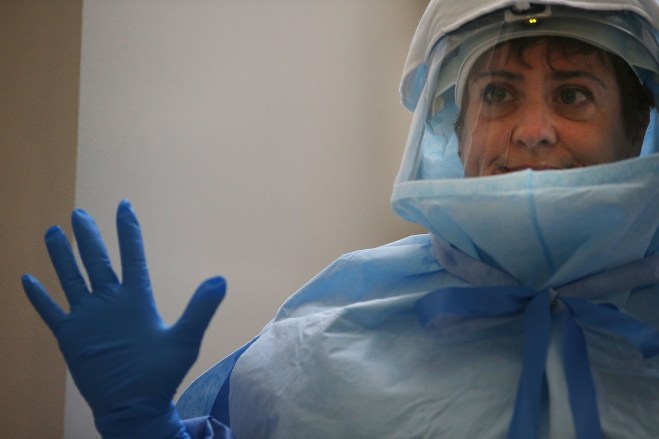
(Photo: A member of Bellevue’s Hospital staff wears protective clothing during a demonstration on how they would receive a suspected Ebola patient on October 8, 2014 in New York City. By Spencer Platt/Getty Images)

Face Of The Day

Liberia Races To Expand Ebola Treatment Facilities, As U.S. Troops Arrive

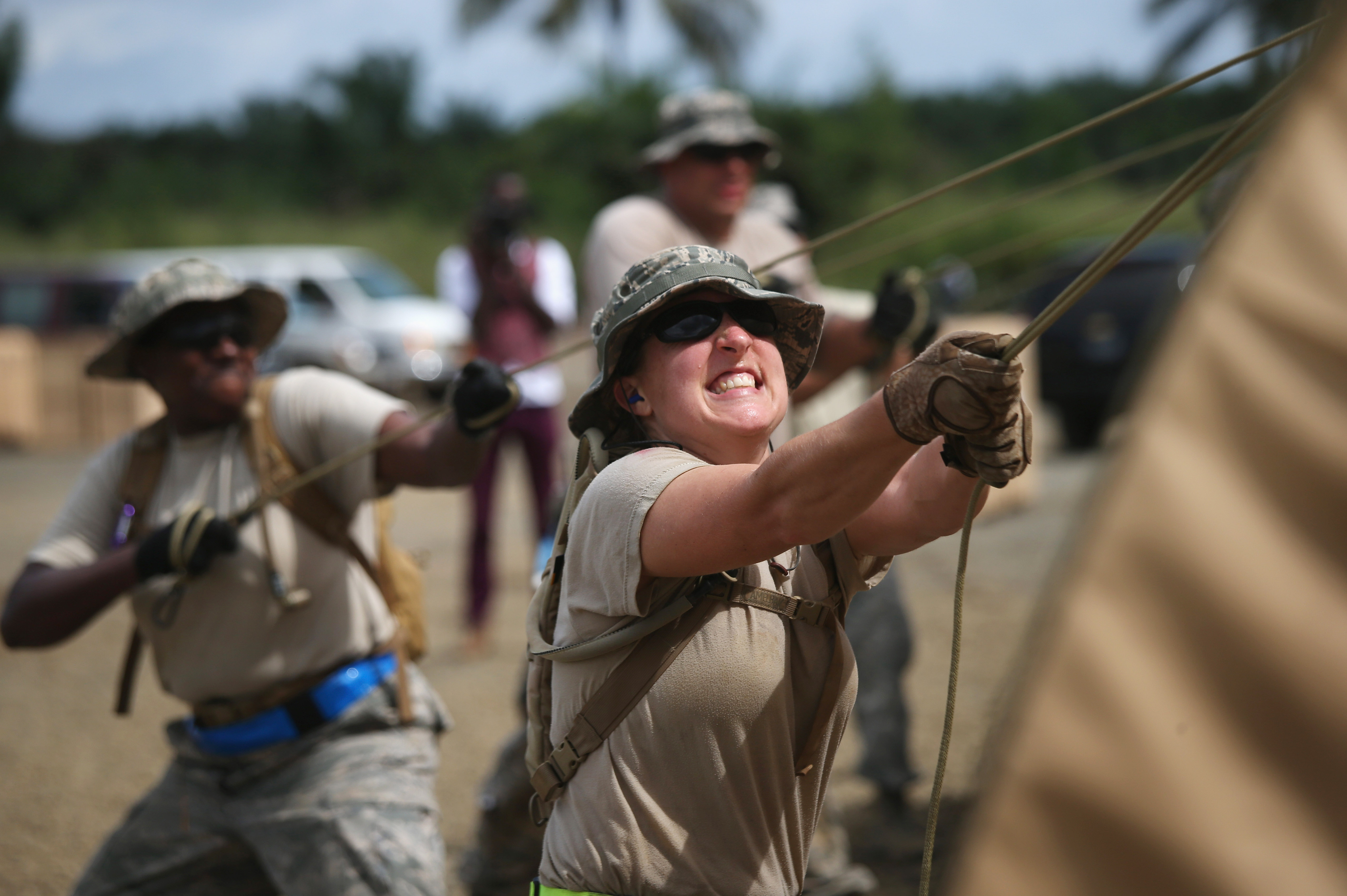
U.S. Air Force personnel put up tents to house a 25-bed hospital for sick Liberian health workers as part of Operation United Assistance in Monrovia, Liberia on October 9, 2014. U.S. President Barack Obama has committed up to 4,000 troops in West Africa to combat the Ebola epidemic, which has killed at least 3,400 people. By John Moore/Getty Images.

A Short Life Remembered

Ta-Nehisi interviews Lucia McBath, mother of Jordan Davis:

It’s been almost two years since her son was murdered by a man who took offense to his music. The murderer was Michael Dunn. After shooting the boy, Dunn drove to a motel with his girlfriend. He ordered pizza. He mixed a few cocktails. Then, the next day, he turned himself in and claimed that he was defending himself against a shotgun-wielding Davis. No shotgun was ever found. In his first trial, Dunn was convicted of attempted murder, for shooting—unjustifiably—at Davis’s friends. He was not convicted of murdering Jordan Davis after the jury deadlocked. The state of Florida retried the case, and this time convicted Dunn of first-degree murder. …

Davis hailed from the striving class of America.

He grew up with all the comforts and possibilities that black people associate with Atlanta, where he was raised, and which Americans at large associate with middle-class life. And yet African Americans raised in such circumstances understand that in so many ways they are not that far removed from the block. Many of them are just a generation away, and they still have cousins, brothers, and uncles struggling. Their country cannot see this complexity, and thinks of the entire mass as the undeserving poor—which is to say, in the language of our country, criminal.

“For these people, The Cosby Show was just amusement,” McBath said. “They don’t know that in the black community the Cosbys exist. They don’t know that we educate our children, we train up our children, we have fathers, nurturing, and supporting. We have that. But that’s the America that a lot of people don’t know exists, and they don’t know because they don’t want to see it.”

Kansas Is Key

Earlier this week, Andrew Prokop observed that “Kansas independent Senate candidate Greg Orman is the sole candidate who’s actually risen in the estimate of his state’s voters in recent weeks”:

Orman

Sean Trende calls Orman’s opponent, Senator Pat Roberts, “the most vulnerable Republican incumbent”:

Orman does have real problems as a candidate, which, over the course of a full campaign, would probably drag him down. In particular, refusing to declare which party you will caucus with eventually invites people to fill in the blanks in their own minds as they focus in on the race. Given that most things in Orman’s past point toward him at least sympathizing with Democrats, it seems unlikely that people would conclude that he is a Republican. But in a short campaign, anything can happen.

Nate Cohn explains why the race is so important:

If Mr. Orman wins, it could deal a big blow to the G.O.P.’s overall chances. Think about it this way:

Well into August, most assumed that the Republicans had a 100 percent chance of winning Kansas. If the state were secure for the G.O.P., Leo, The Upshot’s Senate model, would give the Republicans a 78 percent chance of retaking the chamber. (Leo currently gives the Republicans a 61 percent chance of winning the Senate.)

Without Kansas, the Republicans would probably need to win both Alaska and Iowa. That’s certainly possible because the Republicans appear to lead in both states. Leo gives the Republicans only a 54 percent chance of taking the Senate if they lose Kansas, not much better than a coin flip.

But Harry Enten warns that Kansas voters are still making up their minds:

With Orman’s lead, why doesn’t the FiveThirtyEight model give him an even better chance of winning? The electorate in Kansas is unusually fluid for such a competitive race. We’re only a month into this campaign, and the race is still developing. We can see this by looking at the Marist poll. Only 43 percent of Kansas voters strongly supported their preferred candidate in Kansas. In Kansas’s gubernatorial race, it’s 55 percent. In Iowa’s Senate race, which Marist polled at the same time as the Kansas election, 57 percent of voters strongly supported their choice. In North Carolina’s Senate race, it’s 50 percent of voters.

The FiveThirtyEight model shows something similar. There are more voters unattached to major candidates in Kansas than in the average competitive race.

Cassidy provides background on Orman:

Orman, a private-equity investor with a net worth of somewhere between twenty million and eighty-six million dollars, according to campaign disclosures, looks, in some ways, like a moderate Republican along the lines of Bob Dole, the longtime senior senator from Kansas. Orman is a deficit hawk, he wants tax reform, and he’s very pro-business.

In other ways, though, he tilts towards the Democrats. He supports campaign-finance reform, abortion rights, (somewhat) stricter gun laws, and a pathway to citizenship for undocumented aliens. In 2008, he briefly entered the Kansas senate race as a Democrat, withdrawing before the party primary. “Let’s be honest—he’s a Democrat,” Senator John McCain said last month. “He walks like a duck and he quacks like a duck and he is a duck.”

Whether that’s true or not, Harry Reid and his colleagues would much prefer to deal with Orman rather than have McConnell running things.

A Long, Ugly Primary

The GOP is hoping to avoid one:

The message from Republican officials has been crystal clear for two years: The 2016 Republican primary cannot be another prolonged pummeling of the eventual nominee. Only one person ultimately benefited from that last time — Barack Obama — and Republicans know they can’t afford to send a hobbled nominee up against Hillary Clinton.

Jonathan Bernstein tells Republicans not to fret:

Republicans who worry that Clinton will lock up the Democratic nomination easily while Republicans continue fighting among themselves should remember what happened to Vice President Al Gore. He was nominated practically by acclamation and then proceeded to fall short of projections by a greater degree than any modern candidate. By contrast, his Republican opponent, George W. Bush, fought an extended battle against John McCain.

Philip Klein deems it “silly for RNC officials to think they can orchestrate a process that will protect the eventual nominee from serious scrutiny during the primary season, and to the extent that they’re able to do so, to think that a reduced level of scrutiny is automatically a good thing”:

The RNC has also decided to make its 2016 convention earlier — as early as June — so the nominee can begin to spend general election funds earlier than in 2012, when the convention took place in late August. But again, there is no reason to think this will improve matters. In 2004, John Kerry effectively clinched the Democratic nomination in early March, when his main rival, John Edwards, dropped out. The Democratic National Convention that nominated Kerry was held in July, while the GOP convention that year extended into September. After Kerry lost, the popular conclusion was that the early convention hurt Kerry because the Swift Boat story dominated news in August and fed right into the Republican convention, and the Kerry campaign never was able to adequately respond.

Larison is in favor of a long primary:

Despite a lot of what was said and written at the time, the 2008 contest on the Democratic side was generally very beneficial to their party. What matters is that the party in question has a large number of high quality candidates with which it can start the winnowing process. That is where the GOP may have more concerns.

It has often been taken for granted that the 2012 Republican field was exceptionally weak and the 2016 field will be much stronger, but it has never been clear that the likely 2016 candidates will be that impressive as a group once they are actually declared and running their campaigns. The more that they are scrutinized and their competence as candidates (or lack thereof) becomes better-known, the more that we’ll start to hear how overrated this field was all along. People are able to claim the higher quality of the 2016 field for the same reasons that many people assumed that the fantasy candidates of 2012 would have been much better than the ones that declared: it easy to claim that the non-candidates would be more appealing/competent/interesting because no one is thinking about their weaknesses yet, and there is no way to prove the assertion wrong until they declare. Once the 2016 field starts to take shape, we can expect another round of the same complaints about the “strong” candidates that stayed on the sidelines.

Ukraine Is Still A Mess

Adam Chandler highlights a UN report revealing that at least 331 people have been killed in the Ukrainian conflict since the signing of a ceasefire on September 5:

“There is a total breakdown of law and order,” said Gianni Magazzeni, the United Nations human rights official who announced the release of the report in Geneva. Over the past month, grim developments have included the shelling of schools and city buses, the gutting of villages, the fierce battles for control of Donetsk’s Sergei Prokofiev Airport, and startling lists of locals who are believed to either be missing or held captive by pro-Russian rebels. An early October report estimated that nearly 400,000 Ukrainians are internally displaced, part of a seven-figure estimate for the total number of Ukrainians who have been displaced.

While the latest violence has largely been limited to the exchange of small-arms fire—a shift from this summer’s large-scale military offensives, which drove up death tolls and ultimately forced the warring sides to negotiate—there’s been little letup in fighting over the past month.

With a battle raging between Ukrainian and rebel forces over the Donetsk airport, the ceasefire appears to be going off the rails entirely, threatening to take the upcoming parliamentary elections with it:

As the shaky cease-fire has failed to quell the most intensive fighting in and around Donetsk, government officials fear the separatists are regrouping for a fresh offensive to take Mariupol and the rest of the seaside corridor that would connect mainland Russia with the Crimean peninsula that the Kremlin seized and annexed seven months ago.

Ukraine has scheduled parliamentary elections for Oct. 26, and the Moscow-backed separatists are suspected of aiming to control enough Ukrainian territory by then to prevent voting in the areas they hold in order to undermine the legitimacy of the election. Although hundreds of thousands of eastern Ukraine residents have fled the fighting, the Crimea, Donetsk and Luhansk regions were home to 8.5 million before the conflict, representing about 18% of the country’s population.

The Interpreter underscores a series of unsettling surveys showing that 70 percent of Ukrainians believe they are at war with Russia, while nearly 50 percent want the country to become a nuclear power again. At the same time, western Ukrainians are getting tired of supporting the hundreds of thousands of people displaced by the fighting:

Attitudes toward IDPs in Ukraine appear to have shifted since the onset of the conflict pitting government forces against pro-Russian separatists in the country’s east. As displaced families continue to stream westward, the initial outpouring of solidarity — which once saw residents extend free accommodation to IDPs — is slowly giving way to impatience and distrust. “You can often see ads that say ‘Flat for rent, people from Donetsk, Luhansk, and Africa please abstain,'” says Ivan Kudoyar, a real estate lawyer in Kyiv.

Things like this aren’t just happening in Kyiv. Anastasia, a young woman who fled Donetsk two weeks ago, says she’s losing hope of finding a flat to rent in the western city of Lviv. “The main obstacle I’ve encountered during my search is my Donetsk registration,” she says. “I meet with the landlord, we agree on the rent, then he looks into my passport and says ‘Sorry, this is a matter of principle.”

Robots As Whistleblowers

Adam Waytz floats the idea:

What if every organization, particularly those in highly regulated industries, explicitly created a whistle-blower position? The job seems essential, yet applicants might be scant and coworkers might view them similarly to the childhood schoolmate who reminds the teacher about the homework assignment.

The position’s social, reputational, and emotional risks thus make whistle-blower the perfect job for a robot. Robots—and algorithms—largely lack the “hot” social and emotional attributes that commonly (and, often, unfairly) litter portrayals of many whistle-blowers—self-interest, revenge, spite, disloyalty, betrayal, and resentment. At the same time, robots are proficient at “cold” skills necessary for diligent evaluation and inspection of organizational errors—calculation, routinization, automation, and consistency.