Josh Voorhees believes it’s “too early to predict” and that “it’s a mistake to judge either [state experiment] based on the speed at which each hits subjective checkpoints along the way”:
Washington’s slow and steady march could still pay dividends when it comes to the business of weed. While Colorado allows for—and in part requires—vertical integration between growers, processors, and sellers, Washington forbids it. That’s been an early burden for shops that need to spend their time searching for pot to sell, but regulators maintain that it will prevent the market from eventually being dominated by big businesses. As an added bonus for the state, it also provides three distinct points to impose a tax: between grower and processor, processor and store, and store and consumer.
And while the lack of medical marijuana regulations has caused Washington a string of headaches in the early days of retail pot, officials are optimistic that an eventual crackdown on the semi-illegal medical market will push many consumers into retail stores, where the pot is both taxed (good for the state) and tested for safety (good for the consumer). In Colorado, meanwhile, medical marijuana—cheaper than retail weed, and still legal—will remain relatively easy to buy for any resident who takes the trouble to secure a state-issued red card. So closing the gap between the medical and retail markets there will likely take longer and prove more difficult. Of course, given that the market is already regulated, harmonizing the two is also less urgent.
May the best state win. And if you missed new revelations from previously unpublished Carl Sagan letters on drug policy and cannabis, check them out here.
Today, the French writer Patrick Modiano was awarded this year’s Nobel Prize in Literature. The Guardian notes that “Modiano is well known in France but something of an unknown quantity for even the most widely read people in other countries”:
[The Nobel Academy’s permanent secretary Peter] Englund said: “Patrick Modiano is a well-known name in France but not anywhere else. He writes children’s books, movie scripts but mainly novels. His themes are memory, identity and time. His best known work is called Missing Person. It’s the story about a detective who has lost his memory and his final case is finding out who he really is; he is tracing his own steps through history to find out who he is.”
He added: “They are small books, 130, 150 pages, which are always variations of the same theme – memory, loss, identity, seeking. Those are his important themes: memory, identity, and time.”
Modiano spoke to Julien Bisson in a rare interview in 2011:
“Actually, I never thought of doing anything else,” he says of his literary career. “I had no diploma, no definite goal to achieve. But it is tough for a young writer to begin so early. Really, I prefer not to read my early books. Not that I don’t like them, but I don’t recognize myself anymore, like an old actor watching himself as a young leading man.”
Modiano’s novels all delve into the puzzle of identity:
How can I track evidence of my existence through the traces of the past? Obsessed with the troubled and shameful period of the Occupation—during which his father had engaged in some shady dealings—Modiano returns to this theme in all of his novels, book after book building a remarkably homogeneous work. “After each novel, I have the impression that I have cleared it all away,” he says between two silences. “But I know I’ll come back over and over again to tiny details, little things that are part of what I am. In the end, we are all determined by the place and the time in which we were born.” The place, for him, is Paris, the city he writes about constantly, describing the evolution of its streets, its habits and its people. In fact, Modiano might very well be to Paris what Woody Allen is to New York: a memory and a conscience.
In a 2010 piece for The Millions, J.P. Smith wrote about reading Modiano in French:
His theme is unchanging; his style, “la petite musique,” as the French say, is virtually the same from book to book. There is nothing “big” about his work, and readers have grown accustomed to considering each succeeding volume as an added chapter to an ongoing literary project. His twenty-five published novels rarely are longer than 200 pages, and in them his characters, who seem to drift, under different names, into first this novel, then another, wander the streets of Paris looking for a familiar place, a remembered face, some link to their elusive past, some ghost from a half-remembered encounter that might shed some light on one’s history. Phone numbers and addresses are dredged up from the past, only to bring more cryptic clues and, if not dead ends, then the kind of silence that hides a deeper and more painful truth.
In a review ofMissing Person, Ted Gioia emphasized that “Modiano doesn’t hesitate in shaking up the conventions of the mystery genre”:
The missing person in the title … is the detective himself. Guy Roland suffers from amnesia, the period of his life before launching his career as a private investigator is almost a complete blank. Even his name and nationality are a mystery to him. Now after a career of solving other people’s problems, he turns to his own. …
Those who like the mystery genre for its neat resolutions and the comforting sense of closure from a crime solved, justice up-held, and a perpetrator punished, will only get a queasy sensation from Missing Person. In this quest for identity, the very notion of self begins to fade under close scrutiny. “Do not our lives dissolve into the evening?” our narrator concludes, as he accepts the possibility that the person he is seeking will never be found, his identity as ephemeral as “the sand holds the traces of our footsteps but a few moments.”
Meanwhile, Emma Brockes uses Modiano’s win to explore the politics of the Nobel awards, remarking that “the real scandal of Patrick Modiano’s Nobel win is that Philip Roth is a huge loser – again”:
There are lots of theories about Nobel “bias”, few of them involving the possibility that writers from non-English speaking countries, many of whom readers in the west have neither read nor heard of, might actually be quite good. The Royal Swedish Academy’s appointed judges themselves say they don’t like the effects of the creative writing school battery farms on the New York publishing scene. More widely, the Nobel is seen as the perfect platform from which to counter US cultural hegemony; and there’s a notion that the snobbish Nobel judges don’t like to reward authors who actually sell. …
Anyway, Modiano won. Good for him and his many fans around the world. Now on to the more important question: Who becomes the next Philip Roth, champion novelist whose once-a-year loss we can all get behind?
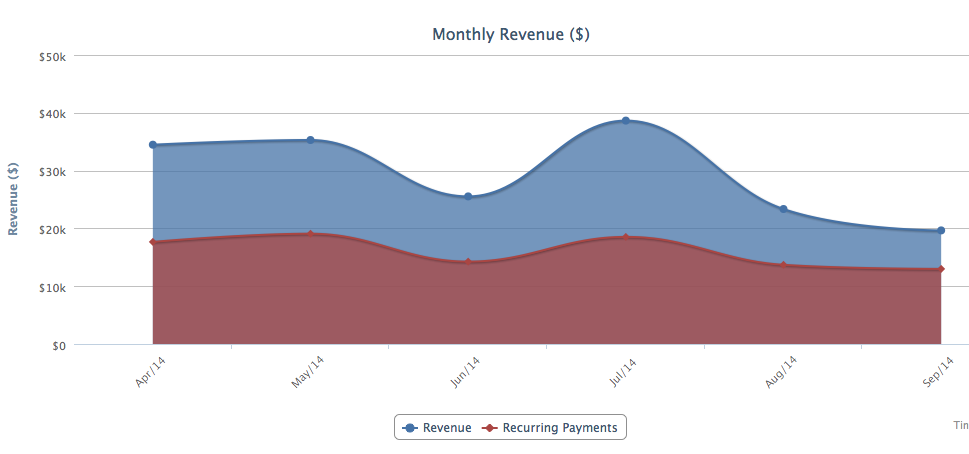
It’s been two months since my last post on this, because, well, I was still recovering from Burning Man this time last month. So here’s our revenue flow since April, including September:
You can see we are in a cyclical decline, especially with new subscriptions (the blue part of the graph). But we are above the total number of subscribers since my last report – marginally. At the beginning of August, we were just below 30,000 subscribers; right now, we’re slightly above – 30,164. Effectively, we’ve reached a plateau of 30,000 – losing about as many old subscribers to expired credit cards or non-renewals each day as we win new ones. Total revenue in September 2014 – at just under $20K – compares with $12K last September. Our renewal rate for subscriptions is 83 percent.
Our year-on-year revenue is now at $964K – compared with $879K for all of 2013. When you add in affiliate and merchandise revenue (we’re projecting about $50K from the two for all of this year), we’re bumping up against $1 million.
As for traffic, the last three months have been up and down: July was great with 900,000 unique visitors (compared with 673,000 and 681,000 the previous two months respectively), but August and September declined to 780,000 and 690,000 respectively. For a site with a pay-meter, that’s still solid, but we could do better. The silver lining to these ups and downs in traffic is that they do not really have an impact on our finances – because, unlike almost everyone else in online journalism, we’re completely subscription based. That guides us away from the sirens of clickbait, and allows us to provide content that we think matters – even though we know it won’t rack up pageviews.
If you believe in supporting that kind of journalism, please subscribe, if you haven’t. There are 31,000 of you who have reached the meter’s free-content limit – which means you’re dedicated but still reluctant to jump in. A subscription is just $1.99 a month or $19.99 a year. So subscribe here if you really want to support a rare journalism model that is not reliant on sponsored content and clickbait. If you have already subscribed and want to help some more, you can always add a little to your subscription here; or purchase a gift subscription here; or simply share a post with a friend and encourage them to join the conversation.
The good news is: we have survived into our second year and have no debt, which is quite something for an independent site in this day and age. But with your help, we can also thrive. And we hope to.
Gerald Seib imagines that “full GOP control of Congress might well shift Republicans’ focus from stopping him to making things happen.” Chait doesn’t buy it:
Washington already has divided control. Now, to be sure, Republicans control just one chamber of Congress at the moment. Seib argues that the calculus might change if they win control of the other chamber as well.
For this to be true, you would have to imagine that there are deals that could be struck between the Republican House and President Obama that the Democratic Senate would block but that a Republican Senate would agree to. What reason is there to think that any such deal exists? Has Harry Reid actually blocked an agreement between John Boehner and Obama?
A better way to think about the difference between a Democratic and GOP Senate is to look at where along the political spectrum the center of negotiations will lie. Right now, because Democrats control the Senate, it lies further to the left than it would under GOP control, which makes all tentative agreements much harder to sell to the Republican House.
Move things to the right a bit, and the question becomes whether Obama would be willing to cut more conservative deals that aren’t currently in the offing. I don’t know what the answer is, but it isn’t crazy to think a lame-duck president might sign off on legislation that would, under the current arrangement, be tantamount to surrender. And when you look at it that way, it’s reasonable to imagine that Obama-Boehner-McConnell might cut more deals than Obama-Boehner-Reid. They’d just be worse deals.
Yigal Schleifer spotlights how a new memorial to the victims of the Nazi occupation reflects the revisionist nationalism of Prime Minister Viktor Orbán and his Fidesz party, and hints at the creeping resurgence of Hungarian anti-Semitism:
The government is erecting the monument to honor the victims of Nazi Germany’s March 1944 occupation of Hungary—including 565,000 Jews. But the country’s opposition parties and Jewish groups are unhappy: They believe the monument—a historically and artistically challenged creation that will feature an eagle (Germany) swooping down on the archangel Gabriel (Hungary)—whitewashes the extensive and troubling role Hungary’s Nazi-sympathizing government played in the massive deportation of Jews to Auschwitz.
The Fidesz ex-party official I’m with explains that the monument is a powerful example of how Orban has reached back into Hungary’s history for inspiration. “It isn’t modern right-wing politics, but a 19th-century conservatism that plays well with the Hungarian sense of the past. That’s what he’s doing here,” he says, pointing toward the monument site.
The official approach to the memory of the Holocaust fits uncomfortably into all of this. On the one hand, Fidesz has been credited with taking positive steps, such as setting aside 2014 as a year to commemorate the Holocaust and dispensing government funds for memorial projects and events. On the other hand, as with the monument in Szabadsag Square, Fidesz is being accused of rewriting history by offering up a narrative in which Hungarian responsibility for the systematic deportation of nearly 440,000 Jews—the majority to Auschwitz-Birkenau—is diminished: The monument portrays all Hungarians, by linking it to the 45-year Soviet occupation and the continuum of Hungarian suffering. During my stay in Hungary, it was the construction of the monument that almost every government critic I spoke to—Jewish or not—considered the defining symbol of the Orban government’s efforts to toy with the past in order to bolster its political future.
Chait defends football against its critics. He draws a distinction between pro and amateur players:
More than a million boys play high-school football every year. If the effects of those games remotely approached those afflicting former professionals, there would be millions of American men walking around with brain damage and a national epidemic of male suicide. The tragic cases of brain-damaged NFL veterans that have filled the news — the Junior Seaus, the Dave Duersons — would be replicated on a scale a thousand times as large. That something like this has escaped attention until now defies plausibility.
It is true that the improvements of weight-training methods have made high-school football players, at least at the highest levels of competition, bigger and stronger than those of a generation ago, which may produce as-yet-unrealized hazards. And we do know that it may be a series of minor concussions that ultimately poses the biggest threat to the brains of football players. Thankfully, we also have data about how common concussions are in other sports, and that data gives us no reason to consider high-school football a dramatically riskier activity.
He calls football “the most exciting thing that has ever happened to me”:
This is not because my life is a failure, and it is not because football stole my youth. Football’s enemies have an accurate sociological observation, but their conclusion is backward. Nothing else pumped so much adrenaline through me that I couldn’t feel my feet underneath me as I ran and could barely remember my name, or made me weep or scream uncontrollably. It is the adventure of your life, a chance to prove yourself as a man before other boy-men who, even if you never see them again, you will always regard as brothers-in-arms.
This is an increasingly antiquated conception of male socialization. George Orwell, the old socialist, was well ahead of his time when he scribbled out an angry rant against the sporting ethic, which, he wrote, “is bound up with hatred, jealousy, boastfulness, disregard of all rules and sadistic pleasure in witnessing violence: in other words it is war minus the shooting.” That is all more or less true. But shooting is precisely the problem with war. War minus the shooting is actually pretty great.
Relatedly, Ian McGugan looks at how football fans are made:
[Sports economist Stefan] Szymanski told me that when he moved his family from Britain to Michigan three years ago, his two teenage sons were already N.F.L. fanatics — not because of television, but because of PlayStation. “A new generation is consuming games in new ways,” he says. “The gap between the virtual and the real is narrowing, and the N.F.L. is in an excellent position to capitalize on that.” A virtual N.F.L. could offer fans the opportunity to play along with real games and compare their play calls with real ones. It might also allow fans a way to indulge their appetite for violence in a virtual world while allowing the real game to become safer.
Research also suggests that early exposure makes all the difference. Lorenz Kueng, an assistant professor of finance at Northwestern University, co-wrote a recent study of Russian drinking habits, in which he found that men’s preference for vodka or beer varied widely by generation and depended on the beverage’s availability around when a person turned 18. “The research suggests,” Kueng told me, “that your first exposure to a product could shape your long-term preference to a large degree.” It’s not a huge stretch to suggest that consumption habits for sports are just as persistent.
The Dish’s thread from a couple years back on the dangers of professional football is here.
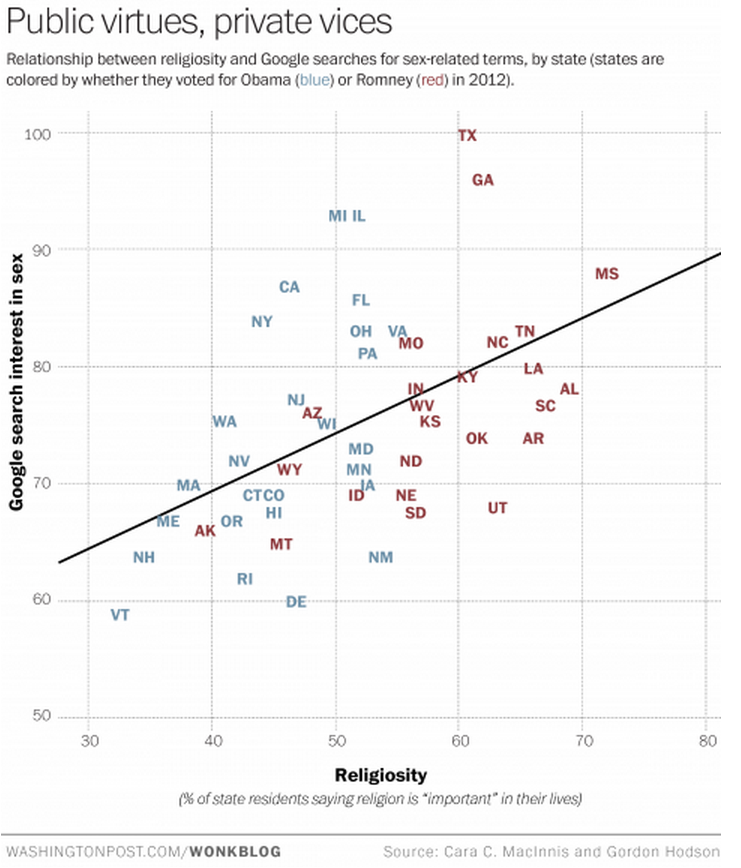
Ingraham presents a study finding that porn-related Google searches are more common in conservative states:
Cara C. MacInnis and Gordon Hodson of Brock University found that residents of more religious and more politically conservative states — often in the South — are more likely to Google things like ‘‘sex,’’ ‘‘gay sex,’’ ‘‘porn,’’ ‘‘xxx’’, ‘‘free porn,’’ and ‘‘gay porn” than their peers in more secular states. The study, published this month in the journal Archives of Sexual Behavior, analyzed state-level Google Trends data for 2011 and 2012, and combined it with measures of religiosity and political conservatism from Gallup surveys. “Overall,” the authors say, “a reliable positive association of moderate-to-large association size exists between state-level religiosity and searches for the term ‘sex.’” They observed similar patterns for Google image searches for sex with political conservatism.
The abstract proposes, “These findings were interpreted in terms of the paradoxical hypothesis that a greater preponderance of right-leaning ideologies is associated with greater preoccupation with sexual content in private internet activity.” Except that the researchers didn’t do the hard work of actually identifying and studying those specific populations of “right-leaning ideologies”;
that would require time and effort in crafting a study of several populations, along with control groups, and then perhaps reaching some conclusions that actually show real correlation and perhaps causation.
Instead, they based their studies on entire states’ Google trends without any control over which populations did the searching. There’s nothing in the abstract or the Post’s recap, for instance, that even posits that religious and/or political conservatives use the Internet overall at the same rate as other populations, or more or less so. There is no data presented at all that assigns that traffic to specific subgroups; the authors just assumed that the controlling factor had to be “right-leaning ideologies” without ever establishing that as a fact, or even a data-supported hypothesis.
James Hamblin details how “an abundance of psychology research has shown that experiences bring people more happiness than do possessions”:
The idea that experiential purchases are more satisfying than material purchases has long been the domain of Cornell psychology professor Thomas Gilovich. Since 2003, he has been trying to figure out exactly how and why experiential purchases are so much better than material purchases. In the journal Psychological Sciencelast month, Gilovich and [Matthew] Killingsworth, along with Cornell doctoral candidate Amit Kumar, expanded on the current understanding that spending money on experiences “provide[s] more enduring happiness.” They looked specifically at anticipation as a driver of that happiness; whether the benefit of spending money on an experience accrues before the purchase has been made, in addition to after. And, yes, it does.
Essentially, when you can’t live in a moment, they say, it’s best to live in anticipation of an experience. Experiential purchases like trips, concerts, movies, et cetera, tend to trump material purchases because the utility of buying anything really starts accruing before you buy it.
Some further thoughts on the problem with contemporary Islam. What troubles it – utter certainty, abhorrence of heresy, the use of violence to buttress orthodoxy, the disdain for infidels – is not unique to it by any means. In history, some of these deviations from the humility of true faith have been worse in other religions. Christianity bears far more responsibility for the Holocaust, for example, than anything in Islam.
But the eighteenth and nineteenth centuries forced a reckoning between those coercive, reactionary forces in Christianity, and in the twentieth century, Catholicism finally, formally left behind its anti-Semitism, its contempt for other faiths, its discomfort with religious freedom, and its disdain for a distinction between church and state. Part of this was the work of reason, part the work of history, but altogether the work of faith beyond fundamentalism. Islam has achieved this too – in many parts of the world. But in the Middle East, history is propelling mankind to different paths – in part because of the unmediated nature of Islam, compared with the resources of other faiths, and also because that region is almost hermetically sealed from free ideas and open debate and civil society.
Let me put it this way: when the Koran can be publicly examined, its historical texts subjected to scholarly inquiry and a discussion of Muhammed become as free and as open in the Middle East as that of Jesus in the West, then we will know that Islam is not what its more unsparing critics allege. When people are able to dissent, to leave the faith, and to question it openly without fearing for their lives, then we will know that Islam is not, in fact, ridden with pathologies that are simply incompatible with modern civilization. It seems to me that until that opening happens, there will be no political progress in the Middle East. That is why we have either autocracy or theocracy in that region, why the Arab Spring turned so quickly into winter, and why the rest of the world has to fear for our lives as a result.
Western democracy was only made possible by the taming of religion. But Islam, in a very modern world, with very modern technologies of destruction and communication, remains, in a central part of the world, untamed, dangerous, and violent. No one outside Islam can tame it. And so we wait … and hope that the worst won’t happen.
About which: However down I am about Obama’s new war in Iraq and Syria, the knowledge that Panetta and Clinton and Petraeus all opposed him in core respects in foreign policy makes me feel better. All three of them are vested in the way things always were, in the twentieth century, and in the smug, conventional Washington consensus that led this country down the cul de sac of the Iraq War and all it represented. If you want to know how much Obama has really represented change these past six years, just check out his critics. They tell you a lot about what he has tried to do – and the immense forces arrayed against him. For a great take-down, see Michael Cohen.
Many of today’s posts were updated with your emails – read them all here. You can always leave your unfiltered comments at our Facebook page and @sullydish. 24 more readers became subscribers today. You can join them here – and get access to all the readons and Deep Dish – for a little as $1.99 month. A long-time holdout finally gets on board:
For years I have been following you on the Dish – I can’t even remember when this madness started, probably just before I left the States in 2006. Anyway, I finally subscribed. Even though I don’t always agree with you, your contribution to the in-depth conversation of matters from around the world is extremely important and I would like to thank you and your team for that. And thanks for keeping it real!
Tom Angell has been spending some time at the Library of Congress reading through newly available papers from the estate of Carl Sagan, the scientist who might just have had more impact on the popular culture than any other in his time. What’s truly fascinating is how Sagan’s employment by NASA made it all but impossible for him to publicly say what he privately believed: that cannabis is a positive good for individuals and for society as a whole. But mainly, they also reveal a true scientist’s frustration with prejudice over data, and with easy answers to conventional questions.
After the jump is the full text of a letter Sagan wrote to the president of the Drug policy Foundation, responding to the idea of a televised debate on drug laws. It is largely a series of questions – and they remain as relevant today as ever:
Know dope.
(Photo: Pots of cannabis inside a medical cannabis cultivation facility in Denver, Colorado, U.S., on Monday, March 4, 2013. This is inside a warehouse in Denver, and is one of the facilities that Kristi Kelly, Co-Founder of Good Meds Network, operates. By Matthew Staver/For The Washington Post via Getty Images.)



 The Dish