Leo Strauss, Man Of Peace?

That’s the argument of Robert Howse’s recent book, which portrays the controversial philosopher as something of a liberal internationalist rather than the progenitor of warmongering neoconservatism. Samuel Goldman isn’t so sure; he claims Howse should have included “a detailed consideration of the role of Zionism in Strauss’s thought about violence”:

In his intellectual autobiography, Strauss describes his earliest political decision as a commitment to “simple, straightforward political Zionism” at the age of 17.

Throughout the 1920s, he was active in the Revisionist movement led by Vladimir Jabotinsky. In the 1930s, Strauss endorsed the “the principles of the Right, fascist, authoritarian, imperialist principles…” as the only basis for defense of Germany’s Jews. In the 1940s, he offered a moral defense of the British Empire partly because of the mercy it offered to the vanquished—including the Jews settled in Palestine. In the 1950s and 1960s, Strauss lectured and wrote extensively on Jewish themes, rarely failing to voice his admiration and gratitude for the foundation of the State of Israel.

These facts are barely mentioned in Leo Strauss: Man of Peace. In fact, the only explicit reference to the State of Israel that I have found comes in the conclusion, when Howse mentions Strauss’s 1957 letter to National Review defending Israel from accusations of racism. As part of his polemic against the neoconservative appropriation of Strauss, Howse assures readers that, “This was an act of loyalty to the Jewish people, not to the political right.”

Howse may be correct about Strauss’s intentions. But Strauss’s personal relationship to the American conservative movement is not the most important issue. Strauss’s lifelong commitment to Zionism tells us something important about his views on political violence. In this decisive case, he endorsed the politics of national self-assertion that Howse contends he had rejected by end of his career.

The Beagle Up For A Vote

dustygate

Will the feisty little hunters and sniffers become the state dog of Vermont? They just might:

Sen. John Rodgers, D-Essex/Orleans, has introduced S.25, which would establish that “The State Dog shall be the beagle,” effective July 1. If passed, the bill would put Vermont into a league of nearly a dozen other states that already have canine bragging rights: Maryland was the first to name a state dog, the Chesapeake Bay retriever, in 1964. The bill was read Tuesday morning and introduced before the Senate, Rodgers said in a telephone interview later in the day.

The Dish endorses the whole pack.

The Returns On Low Capital Gains Taxes

Chris Edwards insists that “low capital gains tax rates are not some sort of unjustified loophole”:

We’ve had reduced rates virtually the entire time we have had an income tax, and for very good reasons. Low capital gains tax rates are crucially important for spurring entrepreneurship, investment, and growth.

Mike Konczal disagrees. He cites a recent paper by economist Danny Yagan on Bush’s massive capital gains tax cut. Yagan’s research compares S-corporations, which “don’t pay a dividend tax and thus didn’t benefit from the big 2003 dividend tax cut” to C-corporations, which “do pay them and did benefit”:

So that allows Yagan to set up S-corporations as a control group and see what the effect of the massive dividend tax cut on C-corporations has been. Here’s what he finds:

yagan

The blue line is the C-corporations, which should diverge from the red-line if the dividend tax cut caused a real change. But there’s no statistical difference between the two paths at all. (Note how their paths are the same before the cut, so it’s a real trend in the business cycle.) There’s no difference in either investment or adjusted net investment. There’s also no difference when it comes to employee compensation. The firms that got a massive capital tax cut did not make any different choices about things that boost the real economy. This is true across a crazy-robust number of controls, measures, and coding of outliers.

The one thing that does increase for C-corporations, of course, is the disgorgement of cash to shareholders. Cutting dividend taxes leads to an increase in dividends and share buybacks. This shows that these corporations are in fact making decisions in response to the tax cut; they just happen to be decisions that benefit, well, probably not you. If right now you are worried that too much cash is leaving firms to benefit a handful of investors while the real economy stagnates, suddenly Clinton-era levels of dividend taxation don’t look so bad.

Yglesias admits that Yagan’s study has its limits:

Any empirical study can be nitpicked in a variety of ways. But the big thing Yagan’s research methodology doesn’t cover is venture capital and startups.

Most business investment is undertaken by established businesses, and established businesses don’t rely on the stock market to fund their investments. But some firms do. Brand-new companies — and especially brand-new companies built around unproven technologies or business models — usually have their early investments financed by venture capitalists. These VCs are hoping to earn a long-term return after the company goes public, and the size of that return depends, in part, on the tax treatment of dividends and capital gains.

Consequently, higher taxes on investment income might depress VCs’ willingness to finance startups.

Who Really Cares About Keystone?

Keystone

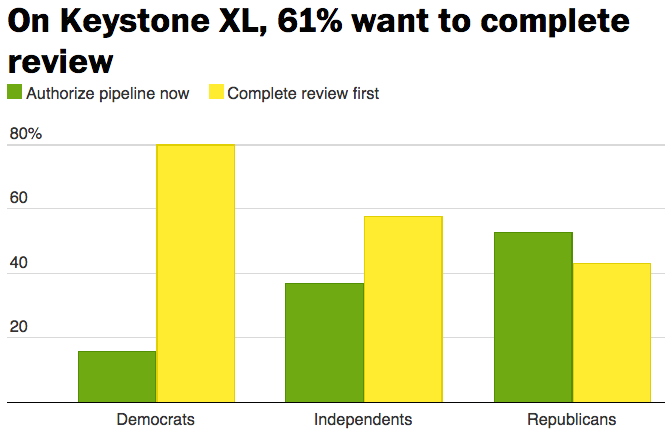
After looking at a new poll, Aaron Blake concludes that “support for Keystone is softer – and less urgent – than previously thought”:

 The survey asks people whether they think the pipeline should be authorized now, or whether they think a review should be completed to determine that the project is in the nation’s interest. Just 34 percent of Americans say, ‘Build it now.’ An additional 61 percent are happy to allow the review process to play out. Even among Republicans, 43 percent want the review to run its course. Just more than half – 53 percent – insist it’s time to move forward.

David Roberts is unsurprised by these numbers. He argues that “that vast swathe of people who have busy lives and no time or particular incentive to study up on matters of policy, will generally gravitate to things that sound good“:

How many Americans know what kind of oil the Keystone pipeline will carry, who will build it or profit from it, where it will carry the oil, what the economic or environmental effects will be? I’d wager on the order of 2 percent, optimistically. Never mind long and hard — I doubt most Americans have thought about Keystone at all. Here’s a telling contrast. Most polls show that a roughly 60 percent majority of Americans favor building Keystone. But in the Hart poll, they asked an open-ended question: “What would you most like the president and Congress to do related to this issue?” When “this issue” was energy, just 7 percent offered up Keystone voluntarily. It is engaged partisans, and engaged partisans only, for whom this is a salient issue.

Tidal Warming, Ctd

A reader provides a much different take on oceans heating up:

I’ve been long bothered about how climate scientists and pundits have been stretching the truth a bit on the effects of global warming, and in trying to “win” the news cycle. The latest is the narrative about 2014 being the warmest on record. Now, I’m not going to harp about whether statistically speaking it’s the warmest or not, because to be honest, I think it’s somewhat irrelevant. Let me be clear: the Earth is warming. It is going to be a problem someday. We have good reasons to decarbonize our economy even if that weren’t the case.

However, some of the things being said just drive me nuts. First off, I should mention that I’m a meteorologist. I’m a weather forecaster. I’m not a climate scientist, so I’m not an expert on this. But I have been interested in the subject for over 15 years.

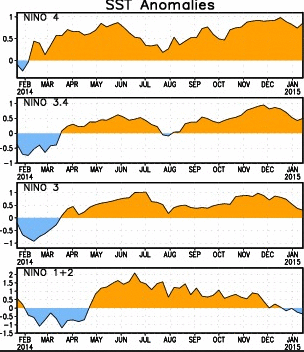
First, regarding that this is an El Niño neutral year. This is true. By a technicality. For NOAA to call an El Niño, it requires the temperature in a certain section (the Niño 3.4 region) of the tropical Pacific to be greater than 0.5 degrees Celsius more than average, for a period of 5 months. Here’s what we’ve had:

unnamed (9)

You can see that the Niño 3.4 region was warm … nearly El Niño criteria for much of the first half of the year, and near or above the criteria over the last several months. But not quite breaking it. Further west, in the Niño 4 region, it was quite a bit warmer. So yes, technically not an El Nino year, but almost.

In addition, that assumes that we’re looking at classical El Niño. Recently there’s been research on a 2nd flavor of El Niño, called El Niño Modoki, which has the warm water focused on the central Pacific, rather than the “classical” eastern Pacific. The interesting thing is that El Niño Modoki has actually been the dominant type of El Niño since the early ’90s, and there’s research that indicates that global warming may be the reason for that. I don’t have access to a current El Niño Modoki index, but eyeballing it, plus given that the weather patterns we’re experiencing are typical of an El Niño Modoki, make me thing that we could be seeing one.

But my point here is that the narrative that the record-breaking temperature was not enhanced by an El Niño is wrong. It’s only because it just barely missed the criteria. Several people, including Phil Plait, have used this record to state that there is no pause in global warming. They’re wrong. But just because there is a pause doesn’t mean that global warming has stopped.

Now, many people like to use 1998 as the start of the pause. I don’t. Because it’s cherry picking, as has been pointed out before. It’s taking an unusual spike in temperatures and using that as a start point. If you pretend that 1998 didn’t happen, you can see that temperatures continued to rise for several years afterwards.

unnamed (31)

However, “warmists” are completely discounting that there are natural variations in climate. The IPCC acknowledges the existence of the pause. There are climate patterns that have periods on the order of 30-60 years. One is called the Pacific Decadal Oscillation (PDO), which is a pattern of sea surface temperature anomalies in the North Pacific. Recent shifts in this oscillation occurred in 1946, 1977, and 2006.

unnamed (32)

A second is the Atlantic Multidecadal Oscillation (AMO), which is something similar but for the Atlantic Ocean:

unnamed (10)

The interesting thing is how these patterns correspond to changes in global average temperature.

unnamed (33)

Global average temperature has periods where there is rapid rise, and then a plateau. We have the first rise, from roughly 1910 to the mid 1940s. This corresponds to the time where the PDO was neutral for a good chunk of time, but it then turned to the “warm” phase near the end. The AMO bottomed out in the early 1910s and then rose until peaking around 1950.

Then we have a bit of a drop and then a plateau in temperatures in the mid ’40s until the late ’70s. During this period the PDO had flipped to the “cold” phase, and the AMO was dropping.

Then in the late ’70s we get the rapid rise until the mid 2000s. The PDO had flipped to the “warm” phase, and the AMO was rising.

Finally we get to the start of our pause. The PDO flipped to the “cold” phase in 2006, and the AMO hit a plateau. Some people are denying that we’re in a pause. All I can say to them is look at that graph above. Would you be happy if your 401K had a chart that looked like that if you started in 2000?

It’s as if the contributions to global average temperature are roughly half and half between long natural cycles and man-made global warming, such that during periods when the natural cycles are warming, we get quick, alarming warming. But then during periods when those natural cycles are cooling, it’s enough to pretty much balance out the warming from CO2.

Now, yes, it’s only been 10 years for my definition of the pause. But my definition is based on actual physical processes, and not by cherry-picking a year. It is completely consistent with previous pauses and sudden rises. And even if we’re going to continue warming, the warming isn’t going to be anywhere near what it was like in the 1977-2006 period.

So what does this mean going ahead? Here’s what I think is going to happen.

The AMO will start to decrease in the next five years, and will probably bottom out in about 20 years. The PDO isn’t expected to switch until sometime in the 2030s. So I think that the pause (which still may result in slight warming) will continue until then. This prediction will be considered falsified if the increase in global average temperature over the next 5 years is greater than 0.10 C per decade.

I also think we’ve seen the bottoming out of the Arctic ice loss. We’ve started to see a recovery and I think it will continue. I’m not completely sure on that because the AMO hasn’t started to drop yet though. So I will consider this prediction falsified if we have two or more new minimums in Arctic ice in the next five years.

And then watch out, because our temps are going to start to spike and I suspect at a greater rate than the 1977-2006 period.

The bottom line is this: just because some of us think that a pause is in place doesn’t mean we’re deniers. It doesn’t mean that we don’t think it’s a problem. I do think we need better climate models that can handle these natural variations, but I think that’s coming. The longer the pause goes, the more scientists are going to realize the need for taking these natural variations into account.

Regarding the reader’s claim that “we’ve started to see a recovery” in Arctic ice, here’s his foil, Phil Plait, last September:

This time, in Sunday’s Mail Online, [David Rose] writes that Arctic sea ice, which hit a major record low in 2012, “has expanded for the second year in succession.” This claim is a humdinger, and typical denial double-speak. It’s technically true, but also really wrong. It’s like examining someone who has a 106° fever and saying it’s really made their skin glow. But what do you expect from an article that has this breathless headline:

Myth of arctic meltdown: Stunning satellite images show summer ice cap is thicker and covers 1.7million square kilometres MORE than 2 years ago…despite Al Gore’s prediction it would be ICE-FREE by now

“Myth of arctic meltdown” is enough to tell you just how slanted and wrong the conclusions of this article will be … and the inclusion of Al Gore’s name brings it home. Mentioning Gore is at best a distraction, red meat to the deniers. Gore isn’t a climate scientist, and as we well know actual climate scientists overwhelmingly agree that the world is warming. One of the outcomes of this is the decline of Arctic sea ice.

Briefly: Arctic sea ice reaches a minimum in late September every year. The overall trend for the amount of ice at that time is decreasing; in other words, there is less ice all the time. Some years there is more than others, some less. But the trend is down, down, down.

In 2012, a mix of unusual causes created conditions where the minimum reached a record low, far below normal. The next year, in 2013, the ice didn’t reach quite so low a minimum extent, and this year looks very much the same as 2013. But saying the ice is “recovering” is, to put it delicately, what comes out the south end of a north-facing bull. You can’t compare two years with a record low the year before that was due to unusual circumstances; you have to look at the average over time.

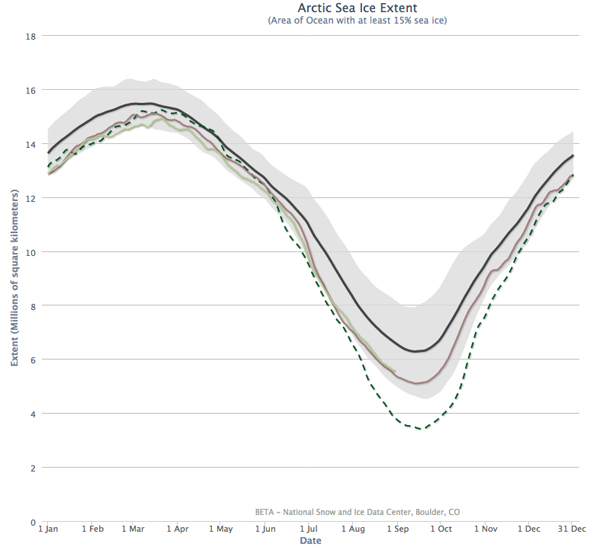
Of course, if you do, your claims that global warming isn’t real melt away. I’m happy to provide that information. Here’s the Arctic ice extent graphed by the National Snow and Ice Data Center:
arcticice_aug2014.jpg.CROP.original-original

The black line is the average for 1981–2010. The gray region shows the ±2 standard deviation extent for that average; statistically speaking it’s an expected range of extent (it’s actually more subtle than that, but that’s enough to understand what’s going on here). The dashed line shows the 2012 ice extent, and is clearly very low, well outside the expected range. The brown line is 2013, and the light green line is this year, 2014, up to late August. Notice 2014 follows the year before pretty closely.

Note also they are well below average, near the bottom of the expected range. If you look at any recent year’s ice it’s below average; you have to go back to 2001 to find an ice extent near the average.

So the claim that the ice is “recovering” is made based on the wrong comparison. Compare the past two years to the overall trend and they fit in pretty well with overall decline.

Can A Netflix For Magazines Catch On?

Derek Thompson is one of many considering the question:

Next Issue Media was born in 2011, with some of the largest magazine publishers onboard. Charging $15 per month for access to about 140 magazines via phone or tablet, it’s built an audience of a couple hundred thousand subscribers, Joshua Brustein reports in Bloomberg Businessweek. Brustein notes that this week Magzter, another newsstand of digital apps, is launching a similar service with access to “2,000 magazines—including Maxim, ESPN the Magazine, and Fast Company—although not to any of the 25 most popular magazines at U.S. newsstands.” But as Brustein writes, a Netflix for magazines remains the impossible dream of the industry.

What Next Issue and Magzter are principally offering is a Netflix for something far less popular than magazines: magazine apps.

Many magazines still have print circulations well into the millions—National Geographic, Sports Illustrated, Cosmopolitan, and Time all top 3 million—with monthly online audiences in the tens of millions. But far fewer people are paying extra for the apps. Take out Game Informer Magazine, which offers discounts along with its digital subscription, and there is no magazine in the country with more than 300,000 app subscribers.  The print-magazine industry is struggling, and yet the magazine-app industry is, to a title, between 10 and 100 times smaller. There is not much here to re-bundle.

Derek adds, “and the Internet is already Netflix enough for most news and entertainment consumers.” Matthew Ingram also mehs over Magzter and its competitors:

I don’t share this enthusiasm [for] a number of reasons: One of them is the user interface that is offered by most of these services — which tends to employ a somewhat tired “bookshelf” or “newsstand” metaphor that can be difficult to navigate. Meanwhile, the magazines themselves tend to be bloated PDF-style formats that are effectively giant photographs of existing print pages. They take forever to download they are cumbersome to navigate through.

magzter-bookshelf

But the biggest problem with such services is the problem of discovery: One of the main reasons why people like to use Spotify and Rdio and Netflix and similar services is that they make it easy to find new content, whether it’s by sharing playlists or by using algorithm-driven recommendation engines. Netflix, in fact, has what is probably one of the most powerful recommendation algorithms on the web today, and it has spent hundreds of millions of dollars developing it and fine-tuning it so that it works for people. There is nothing similar in most of the NextIssue-style services, and so they essentially force you back into old-fashioned behavior — namely, browsing through magazines, flipping virtual pages.

Magzter is trying to master that “discovery problem” with its own algorithm, but Ingram isn’t impressed. Joshua Brustein notes that the newcomer is also trying the competitive edge of “offering a larger selection of more obscure titles and by selling subscriptions internationally.” But he joins the skeptics:

Netflix-like subscriptions for reading material are still in their early days. In addition to the magazine experiments, there are several similar services for books run by Amazon.com and startups Oyster and Scribd. In all these cases, it’s not clear that anyone but the most voracious readers will save money by signing up for an unlimited multimagazine subscription. For about three-quarters of Next Issue’s $180 annual fee, a reader could get separate digital subscriptions to The New Yorker ($60), Bloomberg Businessweek ($30), Rolling Stone ($20), and National Geographic ($20). The average Next Issue user spends about two hours per week engaged with the app, so it’s fair to ask whether people need much more than that.

Especially if you read the Dish a lot. If so, subscribe here for as little as $19.99 a year!

Judging The Beards Of Believers

The SCOTUS just ruled in Holt v. Hobbs. Amy Howe sums up the unanimous ruling:

The Court easily agreed with inmate Gregory Holt that the Arkansas policy prevents him from exercising his 20150124_usp505religion. Put simply, the prison will not allow him to follow the tenets of his religion and grow a beard. And it didn’t matter, the Court explained, that he could practice his religion in other ways, such as by observing Muslim holidays and having a prayer rug.

The Court was also unconvinced by the state’s justifications for the ban. For example, the Court did not agree that the ban was necessary to prevent inmates from hiding things like razor blades, needles, drugs, or cellphone SIM cards (which could be used to run drug rings from prison) in their beards. That particular argument, the Court suggested, was “hard to take seriously” because most things would be too big to hide in the half-inch beard that Holt is seeking permission to grow, and anything that was small enough to hide would probably fall out anyway. But in any event, if this were actually a problem, it could easily be eliminated simply by making an inmate run a comb through his beard.

Michael Bobelian goes into more detail:

The similarity between the [Religious Land Use and Institutionalized Persons Act] and “its sister statute” enacted the same year, the Religious Freedom Restoration Act, made this a straightforward case for the Court.

“Congress enacted RFRA in order to provide greater protection for religious exercise than is available under the First Amendment,” Justice Samuel Alito wrote, citing Hobby Lobby. “RLUIPA thus allows prisoners ‘to seek religious accommodations pursuant to the same standard as set forth in RFRA,’” Alito explained, in explaining the close relationship between the two statutes. Both acts rely on a balancing test to determine whether a government action potentially infringing on a person’s religious exercise is valid. Any restriction on an individual’s religious exercise must both further a “compelling governmental interest” and be “the least restrictive means of furthering that compelling governmental interest.”

Carrie Severino has more on the degree of burden allowed on a person’s religious practice:

[This ruling] emphasizes that it is the religiously-motivated view of an action, not the unbelieving bystander’s judgment of its importance, that determines whether a burden is substantial.  That is particularly important where, as here, courts are dealing with a minority or unpopular religion.

The Court also clarified some key points respecting substantial burdens.  First, it noted that permission to engage in many other aspects of religions exercise – here, praying daily, keeping a prayer rug, corresponding with religious advisors, keeping a halal diet, and observing religious holidays – does not cancel out the effect of denying Holt the ability to carry out his simultaneous religious obligation to grow a beard.  Additionally, the Court corrected a misunderstanding below that only “compelled” religious practices could be substantially burdened or that disagreements within the Muslim community about the necessity of growing a beard meant curtailing that ability was not a substantial burden.  After all, courts have no business making a judgment call about the fundamentally theological questions of how much religious practice is “enough” or which view of a certain religion is correct.

Justice Ginsberg sought to differentiate her vote from her dissent against the Hobby Lobby ruling, writing that “accommodating petitioner’s religious belief in this case would not detrimentally affect others who do not share petitioner’s belief.” Steven Mazie unpacks her words:

The distinction Justice Ginsburg wishes to push, then, is this: part of the court’s investigation in considering whether to grant religious exemptions from generally applicable laws, as in Hobby Lobby, or from prison grooming regulations, as in Holt, is whether and in what way the accommodation will impact the lives of third parties. No one suffers when Mr Holt lets his stubble grow a bit. But when a corporation with 23,000 employees refuses to provide a benefit available under federal law, thousands of women are directly impacted. They have to buy their own birth control pills, for example, or shell out $1,000 for their own IUDs.

But he wades into some complexity:

While there are clear cases like Hobby Lobby and Holt where an accommodation either does or doesn’t entail harm on third parties, there are other cases that are more difficult to classify. You could say, for example, that no one is harmed when a Seventh Day Adventist gets her unemployment check after being fired for refusing to work on Saturday. But taxpayers foot that bill; they are an impacted third party. And you could say that when an Amish family gets to keep its children on the farm rather than sending them to high school, nobody outside the Amish world is negatively affected. But what about the children who are denied an education that could give them choices and expose them to possibilities outside the Old Order Amish Church?

Looking ahead, Eugene Volokh believes there will be more decisions like Holt‘s:

Now that the Court has a trio of recent cases accepting religious exemption claims, and no cases rejecting such claims, I think this will lead judges to take such claims much more seriously — and will embolden litigators to bring such claims. (It should also help the Becket Fund for Religious Liberty, which won both this case and Hobby Lobby, raise funds for such litigation.) And while RFRA only affects federal laws, RLUIPA affects state prisons and state zoning decisions, and over half the states have either state RFRA-like statutes or state constitutional regimes that are similar to RFRA.

So I think Holt, together with the other two cases, will create ripples far outside prison cases. And that’s especially so given its analysis [of] how a statute’s underinclusiveness can show that exemptions should be granted, how a statute’s unusualness can do the same, and how demanding the “least restrictive means” test is.

Indeed, an anxious Noah Feldman sees a creep in the conservative Court:

Step by step, the justices are expanding the logic of religious exemptions from otherwise neutral laws. Over time, this is leading to a de facto reversal of the Supreme Court’s doctrine that ordinarily denies religious exemptions under the Constitution. This is a good thing when there’s no counteracting compelling interest in applying the law. But it can also go too far, as it did in June’s Burwell v. Hobby Lobby decision.

But in another post, Volokh points to history:

Historically, statute-by-statute religious exemptions have been common in American history. Liberal Justices and advocacy groups pushed, especially starting with the 1960s, for a broader regime of presumptive exemptions for religious objectors, and they got it. Conservative Justices pushed back, and eventually overturned this regime.

Then the movement became bipartisan, as Congress tried to re-enact a broad presumptive exemption regime with RFRA and RLUIPA. And only in recent years has the opposition to religious exemptions — not just individual exemptions in individual cases, but to having RFRA-like regimes altogether — become somewhat more a liberal matter than a conservative one.

Obama’s Tax On College Savings

Ryan Ellis is alarmed by the president’s proposal to make 529 plans, which are basically IRAs for college savings, much less attractive:

Already, it’s difficult for middle class families to find discretionary after tax income for college savings plans. Besides paying the bills and staying out of high interest debt, there are better uses of savings for most families–notably retirement and a down payment for a home. Raising taxes on 529 plans would probably deal a death blow to their widespread use, a kind of anti-savings tipping point.

Karen Weise isn’t so worried:

Obama pairs these reductions with expanding the remaining education incentive, the American Opportunity Tax Credit, which is set to expire in 2017.

Obama signed the AOTC into law in 2009 as part of the federal stimulus program, and it gives up to $2,500 in credits to families with incomes as high as $180,000. The AOTC does share some of the regressive nature of the tax programs—about a quarter of familiesthat claim the credit make more than $100,000—so Obama’s new proposal would make the AOTC permanent and take steps to boost how the AOTC helps lower-income families.

Jordan Weissmann supports Obama’s plan:

Obama wants to tax college savers. But, by and large, they’re wealthy college savers. When the Government Accountability Office looked at 529 plans and their less popular cousins, Coverdell accounts, it found that 47 percent of families that had them earned more than $150,000 per year. (Depending on who’s measuring, that puts them in at least the top 10 percent of U.S. households.) By comparison, it noted, the median income of families with a student in college is $47,747. I don’t know about you, but I generally don’t think that our higher education policy should be geared toward helping families that earned $150,000 or more send their kid to the most expensive possible school.

Reihan is open to the idea for different reasons:

I’m all for helping families, including well-off families, save and build wealth. The reason I’m sympathetic to paring back the benefits associated with 529 plans is that tuition tax breaks appear to be an extremely ineffective way of making higher education more affordable — indeed, one scholar I trust, Andrew Gillen of Education Sector, has actually suggested that they might contribute to tuition increases.

How, you ask? All kinds of financial aid, from direct grants to low-income students to tuition tax credits that benefit all students, including high-income students, increase demand for higher education. It is important, however, that while direct grants to low-income students only increase demand for low-income students, who are less likely to go to college than more affluent students in the first place, tuition tax credits increase demand for all students, including those who are already willing and able to spend large sums on higher education. Colleges can respond to increased demand by increasing supply (e.g., admitting more students), by becoming more selective, or by charging higher prices to capture more of the aid.