The Battle For Kobani, Ctd

US-led coalition strikes ISIL in Kobane

Stepped-up air strikes have apparently begun to drive back ISIS fighters from the Syrian Kurdish border town, which they had all but captured as of yesterday, though it’s not clear whether this will be enough to turn the tide in the battle:

“They are now outside the entrances of the city of Kobani. The shelling and bombardment was very effective and as a result of it, IS have been pushed from many positions,” Idris Nassan, deputy foreign minister of Kobani district, told Reuters by phone. “This is their biggest retreat since their entry into the city and we can consider this as the beginning of the countdown of their retreat from the area.” Islamic State had been advancing on the strategically important town from three sides and pounding it with artillery despite fierce resistance from heavily outgunned Kurdish forces. Defense experts said it was unlikely that the advance could be halted by air power alone.

The Obama administration, meanwhile, is getting fed up with Turkey:

“There’s growing angst about Turkey dragging its feet to act to prevent a massacre less than a mile from its border,” a senior administration official said. “After all the fulminating about Syria’s humanitarian catastrophe, they’re inventing reasons not to act to avoid another catastrophe. “This isn’t how a NATO ally acts while hell is unfolding a stone’s throw from their border,” said the official, who spoke anonymously to avoid publicly criticizing an ally.

Steven Cook turns a critical eye on Ankara’s reasoning here:

The Turkish analysis of the situation is different from that of the United States and the Europeans. Ankara believes that IS emerged as a result of the Syrian civil war, which in turn is the result of Syrian President Bashar al-Assad’s intransigence and brutality. The Turks thus insist that getting rid of Assad is the only way to get rid of IS. This is both simplistic and self-serving: Given that Ankara has been vocal in its support for regime change in Syria, anything less would be a profound embarrassment to Erdogan and Davutoglu. Inasmuch as Erdogan does not believe that the United States is going to do in Assad and may even sometime down the road tacitly agree to some sort of deal that leaves the Syrian dictator in place, the Turks remain cool to taking part in the anti-IS coalition.

Finally, though it may be hard to believe, there are elements of the AKP’s constituency that regard IS as a legitimate group seeking to protect Sunni interests in Syria and Iraq amid ongoing sectarian bloodshed.

Semih Idiz solicits some expert views, which all coalesce around the notion that Erdogan wants the coalition war to be against Assad rather than ISIS:

“Davutoglu is saying in effect that IS is the product of rage and if the source of that rage, namely the Syrian regime, goes, then such groups will also go. I don’t know if he believes this himself, though,” [lecturer on international politics at Istanbul’s Kadir Has University, Soli] Ozel told Al-Monitor. Ozel also wonders if there is an ulterior motive to Ankara’s insistence on a no-fly zone and buffer zone in Syria even though there is no international support for them. “If IS engages in a massacre in northern Syria this will provide an excuse for Ankara doing little to prevent it. It can say, ‘I warned the international community, but it refused to act.'”

Nihat Ali Ozcan, a security expert at the Ankara-based Economic Policy Research Foundation of Turkey and a columnist for Milliyet, believes the real problem for the Turkish military in Syria is that it cannot decide who the enemy is. “If the target is Assad, the answer to this question is simple,” Ozcan argued in his Oct. 7 column. “Otherwise it is not clear who and where the enemy is. It wears no uniform and is a part of the civilian population.”

Larison reminds us, again, of how dangerous it would be for the US to start a two-front war in Syria:

If “destroying” ISIS is already an unrealistic goal, and it is, setting out to defeat both ISIS and the Assad regime at the same time is even more fanciful. Destroying the latter would probably be relatively easier, and we know that the U.S. is capable of overthrowing established foreign governments by force, but in doing so the U.S. would plunge all of Syria into even greater chaos. If the war against ISIS also requires the U.S. to go to war with the Syrian government now or later, there is no way that the outcome will be worth the costs to the U.S., and those costs continue to grow with each new goal that hawks want to tack on to the ever-expanding war.

Kurds in southeast Turkey are protesting the government’s inaction. Some of the protests have turned violent:

Nineteen people have been killed in fighting between supporters of the Kurdish PKK party and police and local Islamist groups, according to media reports. Turkey’s Agriculture Minister Mehdi Eker said ten were killed and 45 injured in Diyarbakir, the main city in Turkey’s mostly Kurdish southeast. The city of Diyarbakir is “calm” as citizens “generally abide by the curfew,” imposed last night, Eker said today at a televised press conference.

Jamie Dettmer channels more outrage from the Kurdish refugees and fighters amassed on the Turkish side of the border:

“There will be consequences for this,” an activist with Turkey’s outlawed Kurdistan Workers’ Party, or PKK, tells me. “We aren’t going to forget,” the curly-haired woman, who declines to give a name, says sitting cross-legged on a blanket pulled up under Pistachio trees. PKK activists and defenders in Kobani claim the course of battle could have been changed with just some modest assistance: if they could have gotten anti-tank missiles the Americans have been handing out to rebel battalions in Aleppo and Idlib provinces, and if Turkey had allowed Kurdish reinforcements to cross the border.

Cale Salih examines how the US has dealt with the Kurds differently in Syria and Iraq, which she argues “is reflective of Washington’s general mistaken tendency to presume distinctions between the two countries that do not actually exist”:

In Iraq, the US not only carried out air strikes but also armed the Iraqi Kurdish peshmerga and sent military “advisors”. As a result, the peshmerga were able to provide ground intelligence to guide US air strikes, and, in conjunction with Kurdish fighters from Turkey and Syria, they followed up on the ground to retake important territories lost to Isis.

In Syria, the US has been more hesitant to develop such a bold Kurdish partnership. At first glance, the Kurdish fighting force in Syria – the People’s Defence Units (YPG), linked to the Kurdistan Worker’s Party (PKK), which the US designates as a terrorist group due to its decades-long war with Turkey – is a less natural partner than the widely recognized Kurdistan Regional Government (KRG) in Iraq. Yet it was YPG and PKK forces that provided the decisive support on the ground to the Iraqi Kurds, allowing KRG peshmerga to regain territory lost to Isis in Iraq. The US in great part owes the limited success of its airstrikes in north Iraq to the PKK and YPG.

But Jake Hess reveals that Washington has held back-channel talks with the Syrian Kurds:

The United States has rejected formal relations with the Democratic Union Party (PYD), the party that is essentially the political wing of the YPG. The PYD, which has ruled Kobani and other Kurdish enclaves inside Syria since President Bashar al-Assad’s forces withdrew in July 2012, is affiliated with the Kurdistan Workers Party (PKK), a militant organization that has fought Turkey since 1984 — and has consequently been listed as a terrorist organization by both Turkey and the United States. But interviews with American and Kurdish diplomats show that Washington opened indirect talks with the PYD years ago, even as it tried to empower the group’s Kurdish rivals and reconcile them with the Free Syrian Army (FSA).

Though Washington has declined PYD requests for formal talks, the United States opened indirect talks with the group in 2012, former U.S. Ambassador to Syria Robert Ford told Foreign Policy.

Meanwhile, Canada will be launching its own airstrikes soon, and another report suggests coalition ground troops are being discussed:

Military chiefs from more than 20 countries — many already involved in the fight against the Islamic State and some who are considering joining the group — will meet in Washington early next week to discuss progress on airstrikes in Iraq and Syria as well as plans to create a ground force to consolidate gains against the group.

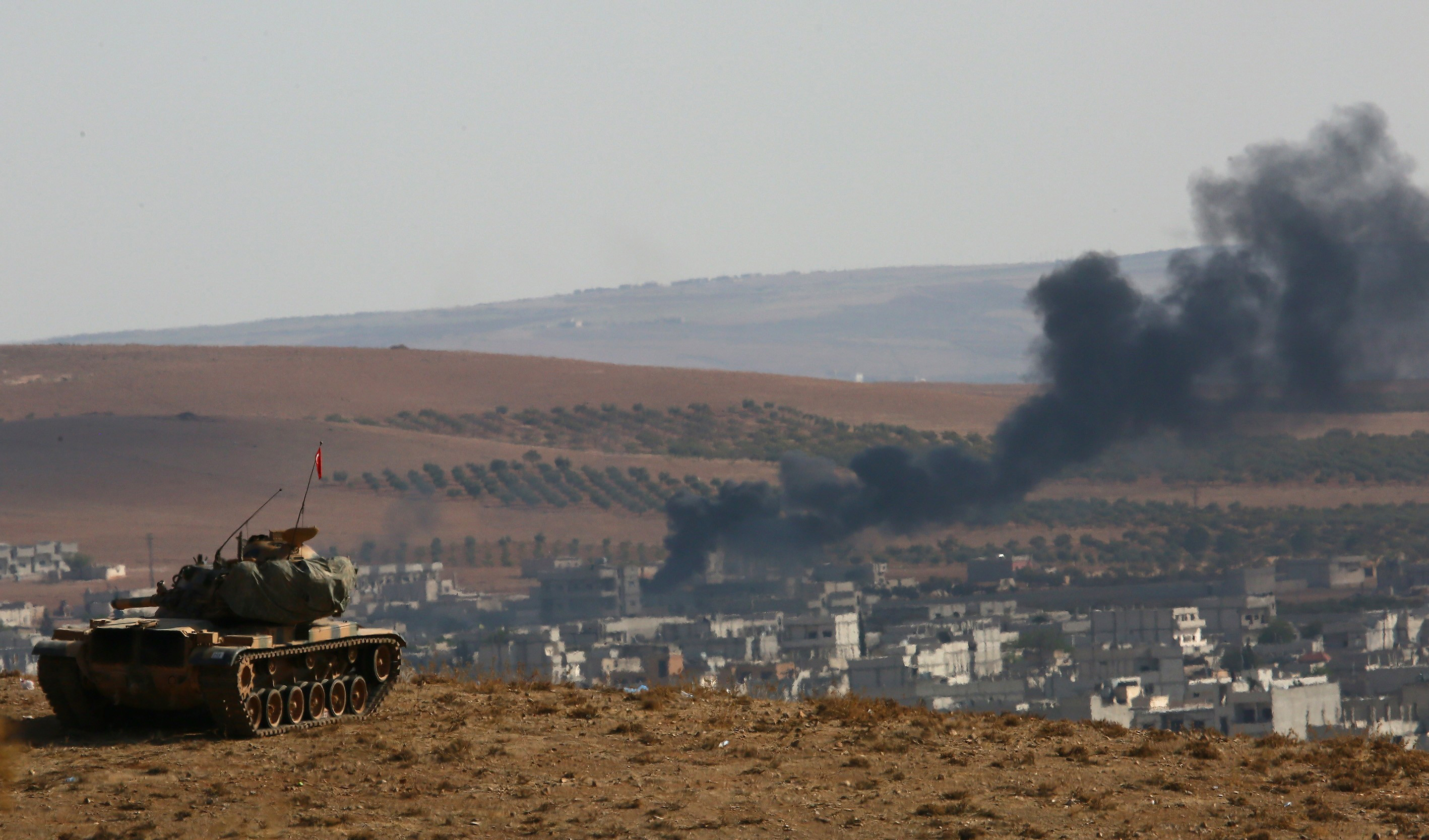
(Photo: A photograph taken from Suruc district of Sanliurfa, Turkey, shows that Turkish army forces patrol while smoke rising from the Syrian border town of Kobani (Ayn al-Arab) after US-led coalition airstrikes against the Islamic State of Iraq and the Levant (ISIL) on October 8, 2014. By Emin Menguarslan/Anadolu Agency/Getty Images)

In Defense Of Gordon College

Here’s a possibly troubling story out of Massachusetts:

The regional body that accredits colleges and universities has given Gordon College a year to report back about a campus policy on homosexuality, one that may be in violation of accreditation standards. The higher education commission of the New England Association of Schools and Colleges met last week and “considered whether Gordon College’s traditional inclusion of ‘homosexual practice’ as a forbidden activity” runs afoul of the commission’s standards for accreditation, according to a joint statement from NEASC and Gordon College.

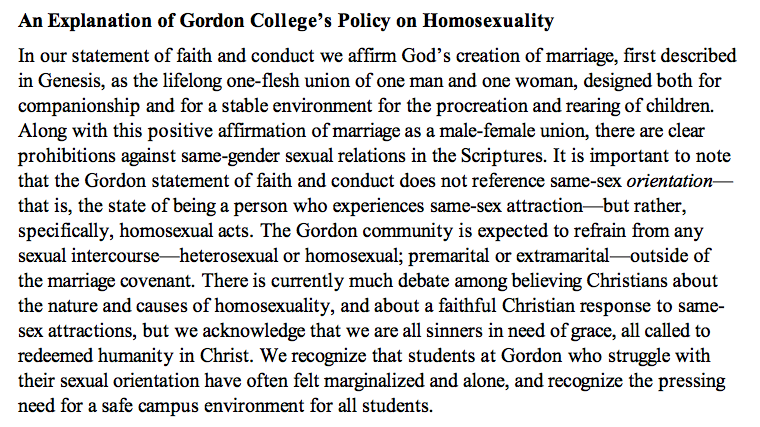
Here is that college’s public statement about its policy on homosexuality:

Screen Shot 2014-10-08 at 10.58.37 AM

They key issue here, it seems to me, is whether the college’s orthodox views about sex are being fairly implemented. If the prohibition against non-marital sex is enforced only on gay students, we have a problem. But there is no evidence that it is. And the college – which implemented its own review of this policy – seems attuned (see the last sentence) to the problems for gay students in such a setting.

In a liberal society, a college should not be denied accreditation because of its religious teachings, as long as they do not endorse double standards for different individuals who are enrolled.

I’ve spent most of my adult life challenging the notion that the distinction between a homosexual person and “homosexual acts” makes sense – but I am not omniscient, and I respect those who sincerely disagree with me. I certainly don’t want them penalized for such religious convictions. This is something called “liberalism” – the toleration of different faiths in a civil society, and the conviction that the best long-term way to discern the truth is not to suppress such faiths but to allow them to flourish (or not) in the free marketplace of ideas and beliefs. You don’t have to agree with Rod Dreher that this is about “hatred” of Christianity, just as you don’t have to agree that all difference of opinion on homosexuality is about “hatred” of gays. But Damon Linker is onto something:

Contemporary liberals increasingly think and talk like a class of self-satisfied commissars enforcing a comprehensive, uniformly secular vision of the human good. The idea that someone, somewhere might devote her life to an alternative vision of the good — one that clashes in some respects with liberalism’s moral creed — is increasingly intolerable. That is a betrayal of what’s best in the liberal tradition.

Our Eight-Armed Friend?

Silvia Killingsworth, after running through all the wondrous traits of the octopus, questions the ethics of eating one:

After all this research, I find myself suffering from what Michael Pollan, in his book “The Omnivore’s Dilemma,” calls “ethical heartburn.” Is an animal’s marked intelligence really reason enough not to eat it? Many arguments have been made against eating pigs on the same grounds. But, unlike domesticated animals, octopuses don’t have what Pollan calls a “bargain with humanity,” wherein they are dependent on us rearing them as either food or pets. (Though I do wonder what’s become of Tracy Morgan’s pet octopus.) Candace Croney, an associate professor of animal sciences at Purdue University, told Modern Farmer earlier this year, “If we’ve decided to eat pigs despite the fact that they are smart, should we not at least use the information that we have to make their lives as positive as possible up until the point when we decide, ‘Well now they’ve become food?’”

Previous Dish threads on the question of eating pigs vs dogs here and horses here.

Make Orwell Proud

A reader has a great idea:

Between Meredith Kopit Levien’s “form factor” and the Obama administration’s “long-term non-religious fasting“, you should begin compiling a list of Orwellian jargon.

While visiting a friend in a mental hospital, I witnessed a grieving husband ask a doctor about the long-term prognosis for his suffering wife. All the doctor could do was prattle on about the different “medicinal modalities” (i.e. drugs) they were utilizing to try to stabilize her. As the husband looked on helpless and dumbfounded, I wanted to punch the doctor.

Let’s make sure we’re focused. Email us examples of jargon that is is designed explicitly as a euphemism to disguise the core reality. “Enhanced interrogation techniques” remains the industry standard of abusing the English language to defend the indefensible. But there must be countless others out there – bubbles of deception and blather waiting to be popped.

Aiming Our Nukes At The Sky

Tim Fernholz explains what the government is doing to protect us from killer asteroids:

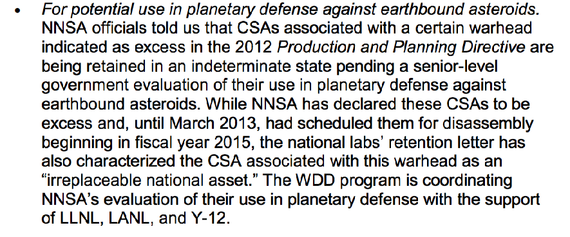
Why is the U.S. falling behind on its promises to destroy old nuclear weapons? Here’s one reason given to government auditors (pdf):

c2ce66b2f

That’s right, the U.S. isn’t dismantling its old nuclear weapons, because we might need them to destroy an asteroid hurtling toward earth. To clarify some of the bureaucratic language above, NNSA is the “National Nuclear Security Administration”; CSAs are “canned subassemblies” that contain highly enriched uranium for use in nuclear weapons. And senior-level government evaluation means that somewhere in government, there is contingency planning going on around what to do in the event of an asteroid heading toward earth.

But Fernholz notes that the planners aren’t necessarily as concerned about a “planetary-extinction level asteroid” as they are about a smaller object like the near-earth asteroid seen above, which lit up the skies over Chelyabinsk, Russia, in 2013.

More Good News For Marriage Equality

As noted last night, the Ninth Circuit Court of Appeals ruled in favor of marriage equality yesterday. This map shows which states each circuit court covers:

Judicial Circuits

Lyle Denniston breaks down the ruling:

Striking down bans on same-sex marriage in two states, and setting the stage for the same outcome in three others, a federal appeals court in San Francisco on Tuesday nullified laws in Idaho and Nevada. The ruling by the U.S. Court of Appeals for the Ninth Circuit is expected to control pending challenges to bans in Alaska, Arizona, and Montana.

With developments since Monday’s refusal by the Supreme Court to get involved in the constitutional controversy at this point, it now seems clear that the same-sex marriage campaign has succeeded — or very soon will — in thirty-five of the fifty states, plus Washington, D.C.

Ari Ezra Waldman wonders “whether we will need the Supreme Court at all.” He lists “several reasons why all applicable circuits may agree and create, piece by piece, a nationwide right to marry”:

First, three circuits are already in the fold through a combination of litigation, legislative vote, and plebiscites. Marriage equality exists in all jurisdictions covered by the First, Second, and Third Circuits.

Second, we have won at the appellate court level in the Fourth, Seventh, and Tenth Circuits. And, at the Ninth Circuit, which is the largest circuit in the country, the appellate court has affirmed that any discrimination against gays merits heightened scrutiny. That means that any marriage equality ban in the Ninth Circuit will be nearly impossible to maintain. That’s seven circuits out of eleven, leaving the Fifth, Sixth, Eighth, and Eleventh.

One reason he doubts those courts will rule against equality:

[J]udges who have yet to hear marriage equality appeals do not exist in a vacuum. They see a rising tide of proequality rulings below them — at the district court level — and above them — at the Supreme Court (Windsor). They also see state court rulings and growing majorities of Americans supporting marriage equality. They also have the lessons of history. The Governor George Wallaces who literally stood in the way of racial equality do not get positive historical treatment. Judges know that marriage equality opponents are going to be forgotten, at best, and ridiculed or despised, at worst.

William Eskridge expects there “will be as many as thirty-five marriage equality states very soon – even if the Fifth and Sixth Circuits reject marriage equality claims in pending appeals”:

For example, if the Sixth Circuit were to uphold Michigan’s exclusion of lesbian and gay unions from civil marriage, the Supreme Court would very probably take the Michigan marriage equality case (or another case from the Sixth Circuit, where several are pending). That would be more good news for the marriage equality movement, because the Michigan case comes loaded with detailed findings of fact not only documenting the value of lesbian and gay families, but also soundly refuting stereotype-laced arguments supporting their exclusion.

Imagine this scenario. The Sixth Circuit upholds Michigan’s (or another state’s) exclusion in the next several months, and the Supreme Court takes review.   During the briefing process, one state after another recognizes marriage equality – often through a deliberative process where elected officials support or acquiesce in lower court judgments requiring marriage equality for lesbian and gay couples. Amicus briefs fall into line behind marriage equality, with support from businesses, many religious groups, public officials from both parties and from most of the states.

As tens of thousands new marriage licenses are issued to lesbian and gay couples all over the country, it strikes me as highly unlikely that the Supreme Court would affirm Michigan’s pervasive discrimination against committed lesbian and gay couples and their families.

Was Napoleon Truly Great?

Jeremy Jennings reads Andrew Roberts as answering with an emphatic “yes” in his forthcoming biography, Napoleon: A Life:

As Roberts concedes, the Revolutionary and Napoleonic wars cost a total of around three million 448px-Napoleon_a_Cherbourg_bordercroppedmilitary and one million civilian deaths. Of these, 1.4 million were French. For this Napoleon must share much of the responsibility. Roberts also accepts that naval warfare was an almost total blind spot for Napoleon. Even after Trafalgar, he remained convinced that he could build a fleet capable of invading Britain, wasting men, money and material on a doomed enterprise. To this we might add Napoleon’s abandonment of his army in Egypt, the abduction and execution of the Duc d’Enghien, the reintroduction of slavery in French colonies in 1802, catastrophic defeat in Russia, and other similar blemishes to his reputation. And, of course, Napoleon ultimately brought France to her knees.

Roberts however is in no doubt that the epithet [“Napoleon the Great”] is deserved.

A general at 24, Napoleon lost only seven of 60 battles fought. In 1814 he won four separate battles in five days. His capacity for decision-making and daring on the battlefield was extraordinary. If he did not invent new military strategies, he perfected them, using new formations and artillery to maximum effect. Like Napoleon himself, his superbly trained and disciplined armies moved fast, in one case covering 400 miles in 20 marching days. None of this would have been possible without the creation of a new military culture based on honour, patriotism and devotion to Napoleon’s person.

Napoleon’s military achievements, Roberts further contends, were matched and have been outlasted by his civil achievements. Having put an end to the violence of the Terror and the disorder of the Directory, Napoleon built upon and protected the best achievements of the 1789 Revolution: meritocracy, equality before the law, property rights, religious toleration, secular education, sound finances, and efficient administration. Napoleon, Roberts writes, was no totalitarian dictator but rather “the Enlightenment on horseback”.

(Photo of a statue of Napoleon in Cherbourg-Octeville, France, by Eric Pouhier)

On The Clock

Bourree Lam flags new findings on the impact of clocks in the workplace:

The research of Tamar Avnet and Anne-Laure Sellier focuses on the differences between organizing one’s time by “clock time” vs. “task time.” Clock-timers organize their day by blocks of minutes and hours. For example: a meeting from 9 a.m. to 10 a.m., research from 10 a.m. to noon, etc. On the other hand, task-timers have a list of things they want the accomplish. They work down the list, each task starts when the previous task is completed. The researchers say that all of us employ a mix of both these types of planning.

They wanted to know, what are the effects of thinking about time in these different ways? Does one make us more productive? Better at the tasks at hand? Happier?

In their experiments, they had participants organize different activities—from project planning, holiday shopping, to yoga—by time or to-do list to measure how they performed under “clock time” vs “task time.” They found clock timers to be more efficient but less happy because they felt little control over their lives. Task timers are happier and more creative, but less productive. They tend to savor the moment when something good is happening, and seize opportunities that come up.

On a somewhat related note, Megan McArdle analyzes a Supreme Court case whose plaintiffs are employees of an Amazon contractor “who say they had to wait in line as long as 25 minutes — unpaid — to clear end-of-shift security screenings”:

Should they be paid for that time? The intuitive answer is obvious: of course. Their employer requires the security screenings to guard against theft; it is part of their employment. How can your employer make you spend significant time doing something, while declining to pay you for it? Labor activists call this “wage theft,” and I can’t say that’s an unfair word for it. If you want to pay your workers by the hour, you should pay for all of them.

But the law is never simple and intuitive, in large part because case law is made by the difficulty of hard corner cases. The briefs run through some of this history. For example: Does your employer have to pay you for your commuting time? That doesn’t seem reasonable; employees could relocate to the far exurbs and get themselves time and a half for hours spent driving and singing along to “Free Fallin’.” …

The workers’ brief tries to distinguish those cases from the Amazon case. The TSA case seems pretty easy: The security screening is not there for the benefit of the employer; it’s there because it’s required by law. You can’t demand that your employer pay you for commuting just because they’re located in the middle of an extended 15-mph zone. The security checks at the Amazon warehouse, on the other hand, are exclusively for the benefit of the employer, who is trying to prevent theft.

The Danger Of Not Smelling

183750606_68fe81565f_o

The Economist digs into a bizarre new medical finding:

You are more likely to die within five years if you cannot recognise common smells than if you have ever been diagnosed with one of those more obviously deadly illnesses. That, at least, is the conclusion of a sobering study just published in PLOS ONE, by Martha McClintock and Jayant Pinto of the University of Chicago.

Dr McClintock and Dr Pinto were prompted to conduct their investigation because they knew olfactory problems can forewarn of neurodegenerative diseases such as Alzheimer’s and Parkinson’s. They are also associated with abnormally shortened telomeres (the caps on the ends of chromosomes), and that shortening is, in turn, implicated in the process of ageing. Moreover, a good sense of smell helps keep people healthy by detecting pathogens and toxins in the air, stimulating appetite, and aiding memory, emotions and intimacy. The researchers therefore had good reason to wonder if measuring smell loss might predict mortality.

James Hamblin digs deeper:

“Obviously, people don’t die just because their olfactory system is damaged,” McClintock said in a Wednesday press statement. Obviously. Unless they do.

Australian musician Michael Hutchence, the lead singer of INXS, famously lost his sense of smell in a mysterious accident in a Copenhagen night club in 1992. He developed depression shortly thereafter and died of asphyxiation five years later in what seemed to be suicide, the culmination of what friends called a slow decline in his mental well-being that began with the accident.

In another angle on just how devastating anosmia can be, Elizabeth Zierah wrote in an essay on Slate about dealing with the aftermath of a stroke at age 30. It left her with deficits including a limp and only partial control of her left hand─but it paled in comparison to the misery of losing her sense of smell after a complicated sinus infection. “Without hesitation,” she wrote, “I can say that losing my sense of smell has been more traumatic than adapting to the disabling effects of the stroke. As the scentless and flavorless days passed, I felt trapped inside my own head, a kind of bodily claustrophobia, disassociated. It was as though I were watching a movie of my own life.”

(Photo by Craige Moore)