Steven Pinker is interviewed about his new book, The Sense of Style: The Thinking Person’s Guide to Writing in the 21st Century:
Many purists have remarkably little curiosity about the history of the language or the scholarly tradition of examining issues and usage. So a stickler insists that we never let a participle dangle, that you can’t say, “Turning the corner, a beautiful view awaited me,” for example. They never stopped to ask, “Where did that rule come from and what is its basis?” It was simply taught to them and so they reiterate it.
But if you look either at the history of great writing and language as it’s been used by its exemplary stylists, you find that they use dangling modifiers all the time. And if you look at the grammar of English you find that there is no rule that prohibits a dangling modifier. If you look at the history of scholars who have examined the dangling modifier rule, you find that it was pretty much pulled out of thin air by one usage guide a century ago and copied into every one since, And you also find that lots of sentences read much better if you leave the modifier dangling.
Meanwhile, Cass Sunstein flags some findings about another irritating behavior:
New research by social scientists Irene Scopelliti, George Loewenstein and Joachim Vosgerau offers a powerful explanation for why people undermine their own goals, and create a seriously negative impression, by bragging. In a nutshell, braggarts project their own emotions onto the person they’re talking to.
The researchers tested this hypothesis by asking about 50 people to describe a situation in which they had bragged. They asked these “self-promoters” to say whether they felt positive or negative emotions while they were bragging, and also to say whether they thought those who heard them felt positive or negative emotions. At the same time, the researchers asked about 50 other people to describe a situation in which someone had bragged to them. They asked these “recipients” to say whether they felt good or bad while they listened.
The self-promoters greatly underestimated the recipients’ negative feelings. They figured that slightly more than a quarter of people reacted negatively to their bragging when, in fact, almost three-quarters of recipients said they did so. These differences mirror another finding — that most self-promoters felt positive emotions while they were bragging. Only a small minority of recipients of bragging said they felt good during the experience.
I would love your perspective on the debate Bill Maher, Ben Affleck and Sam Harris attempted to have on Friday’s Real Time. I’m sure many other Dishheads would too. Can you please weigh in? It really is a fascinating topic that is drawing a lot of attention.
There’s been so much going on I let this one pass. But since you ask, I think it’s pretty indisputable that any religion that can manifest itself in the form of something like ISIS in any period in history is in a very bad way. I know they’re outliers – even with respect to al Qaeda. But, leaving these mass murderers and sadists to one side, any religion that still cannot allow its own texts to be subject to scholarly and historical inquiry, any religion that denies in so many parts of the world any true opportunities for women, and any religion whose followers believe apostasy should be punished with death is in a terrible, terrible way. There is so much more to Islam than this – but this tendency is so widespread, and its fundamentalism so hard to budge, and the destruction wrought by its violent extremists so appalling that I find Affleck’s and Aslan’s defenses to be missing the forest for the trees.
Yes, there are Jewish extremists on the West Bank, pursuing unforgivable religious war. There are murderous Buddhist extremists in Burma. There are violent Christian extremists in Nigeria, and in Russia. All religions have a propensity to banish doubt, to suppress humility and to victimize outsiders. But today, in too many parts of the world, no other religion comes close to the menace and violence of Islam.
Christianity has a bloody past and a deeply flawed present. Islam has a glorious past in many respects, and manifests itself in many countries today, including the US, humbly, peacefully, beautifully. But far too much of contemporary Islam – from Pakistan through Iran and Iraq to Saudi Arabia – is more than usually fucked up. Some Muslims are threatening non-believers with mass murder, subjecting free societies to shameless terrorism, engaging in foul anti-Semitism, and beheading the sinful in Saudi Arabia just as much as in the Islamic State. And if liberals – in the broadest sense – cannot stand up for freedom of speech and assembly and religion, and for toleration as a core value, then what are liberals for?
Does this make me a bigot? Of course it doesn’t. Criticizing a current manifestation of a religion is a duty – not a sin. And it’s not as if I have spared my own church from brutal criticism. And it’s not as if I do not respect – because I do – those countless Muslims and Muslim-Americans whose faith is real and deep and admirable. But it’s precisely because of those true representatives of the best of their faith that we should not hesitate to point out the evil and intolerance and violence of too many others. Some things really are right in front of our nose – and contemporary Islam’s all-too-frequent extremism and fanaticism is one of them.
As for Sam Harris, we are never fully in agreement, but on this issue – the unique threat that Jihadism represents in our world and the disgrace it represents for Islam as a whole – we are as one. I do not believe that all religion is poisonous delusion – au contraire – but I do believe that this particular religion at this particular moment in time is specifically dangerous and violent, and to argue that this has nothing to do with the religion that these fanatics profess is simply denial. We’ll also very shortly be starting our discussion of Sam’s new book, Waking Up: A Guide To Spirituality Without Religion. So we can perhaps address this in that bigger discussion. Stay tuned.
Today, I tried to think through what “containment” can mean in terms of confronting Jihadist terror (I think it counsels minimalism and a defensive posture, rather than our current military gestures in Iraq and Syria). I screwed up in a post comparing Obama’s and Reagan’s record in private sector job growth – although it remains indisputable that the Obama recovery would be far stronger if it had not been strangled by willful GOP austerity in the public sector. We noticed that chickens have grown in size over the last few decades almost as much as football players; and we pondered the meaning of a sudden explosion at an Iranian nuclear research facility.
The entries for today’s window contest were particularly impressive. But one reader is left pulling out her hair:
It finally happened to me today, as it has happened to so many others. I looked at the View From Your Window pic on Saturday and said “It looks like Lake Chelan” – I grew up on the lake so I should know. Then I asked myself, “Yeah, but what are the odds?” and closed the window without sending in a guess.
I love you guys, but I kind of hate myself right now.
Many of today’s posts were updated with your emails – read them all here. You can always leave your unfiltered comments at our Facebook page and @sullydish. 19 more readers became subscribers today. You can join them here – and get access to all the readons and Deep Dish – for a little as $1.99 month. Gift subscriptions are available here. Dish t-shirts here.
From the Ninth Circuit, referring to governor “Butch” Otter of Idaho:
He also states, in conclusory fashion, that allowing same-sex marriage will lead opposite-sex couples to abuse alcohol and drugs, engage in extramarital affairs, take on demanding work schedules, and participate in time-consuming hobbies. We seriously doubt that allowing committed same-sex couples to settle down in legally recognized marriages will drive opposite-sex couples to sex, drugs, and rock-and-roll.
It’s Footnote 12 on page 21, as several Dishheads have discovered.
That’s how Geoff Manaugh describes the opening chapters of Deep Down Dark, Héctor Tobar’s account of the 2010 Chilean mine disaster. Really riveting stuff:
Tobar builds and builds to the actual moment of collapse, like an orchestra tuning itself to some inevitable and apocalyptic note that only gets more terrifying as its implications becomes clear. There are dust clouds and claps of thunder; changes in air pressure and growing suspicions; then an event unlike anything I’d ever read about before—the complete internal cleaving of a so-called “mega-block” inside the mine. Here, Tobar explains that a single block of diorite two times heavier than the Empire State Building has suddenly broken free inside the mountain.
It immediately free-falls straight downward like a cork plunging into a bottle of wine, breaking through the spiraling ramp on hundreds of underground levels and completely—seemingly fatally—trapping the miners nearly at the very bottom of the entire complex.
After hours—days, weeks—of audible strain and the popping of unseen faults, “the essential structure of the mountain must have failed.” It’s as if the entire mountain is “pancaking” from within, Tobar writes: “the vast and haphazard architecture of the mine, improvised over the course of a century of entrepreneurial ambition is finally giving way.”
For the trapped miners, the inhuman scale of this “mega-block” makes it into an almost totemic object, an otherworldly and supernatural mass. It is impossible for the miners to comprehend, let alone to see, in its entirety, and crawling around or—given their now drastically limited tools and virtually non-existent food supply—digging through. As Tobar points out, “Only later will the men learn the awesome size of the obstacle before them, to be known in a Chilean government report as a ‘megabloque.’ …
And, terrifyingly, it is not done falling.
(Photo: A view on October 13, 2011 of the tunnel that collapsed trapping 33 miners at San Jose mine, in Copiapo, Chile, 850 km north of Santiago, during the first anniversary of the rescue. By Ariel Marinkovic/AFP/Getty Images)
Sometimes staying in an abusive relationship means enduring more than beatings. Alex Campbell reports on the horrifying case of Arlena Lindley, a domestic violence victim who was sentenced to 45 years in prison after her child, Titches, was killed by her abusive boyfriend, Alonzo Turner, for failing to prevent the child’s death:
Lindley’s case exposes what many battered women’s advocates say is a grotesque injustice. As is common in families terrorized by a violent man, there were two victims in the Lindley-Turner home: mother and child. Both Lindley and Titches had suffered beatingsfor months. But in all but a handful of states, laws allow for one of the victims — the battered mother — to be treated as a perpetrator, guilty not of committing abuse herself but of failing to protect her children from her violent partner. Said Stephanie Avalon, resource specialist for the federally funded Battered Women’s Justice Project, “It’s the ultimate blaming of the victim.”
Lindley’s not the only woman to suffer this injustice, either:
No one knows how many women have suffered a fate like Lindley’s, but looking back over the past decade, BuzzFeed News identified 28 mothers in 11 states sentenced to at least 10 years in prison for failing to prevent their partners from harming their children. In every one of these cases, there was evidence the mother herself had been battered by the man.
Campbell’s story demonstrates how the criminal justice system is scapegoating domestic violence victims in order to cover for its failures to properly investigate and prosecute instances of child and intimate partner abuse. Shortly before he began dating Lindley, Turner was charged on two separate occasions, first with burglary and later “unlawful restraint,” after he broke into an ex-girlfriend’s home, pushed her, and stole her belongings, then returned three weeks later, grabbed her by the neck, covered her mouth, and forced her outside. The woman escaped after a neighbor stabbed Turner in the leg; months later, Turner was out on probation from the burglary charge and was still awaiting trial on the restraint charge when he murdered the boy. On the day of Titches’ murder, another neighbor called police after she witnessed Turner kicking Titches on the floor, but when police arrived and couldn’t locate Turner or the toddler, they failed to pursue the report. It is outrageous that the justice system in this case only took a hard line against domestic violence after a child was killed.
New satellite images from NASA show that the Aral Sea, a once-vast lake on the border of Kazakhstan and Uzbekistan, has almost completely dried up. At first glance, the sea looks like another victim of climate change, but in fact its depletion originated in ill-considered Soviet agricultural policies:
Actually a freshwater lake, the Aral Sea once had a surface area of 26,000 square miles (67,300 square kilometers). It had long been been ringed with prosperous towns and supported a lucrative muskrat pelt industry and thriving fishery, providing 40,000 jobs and supplying the Soviet Union with a sixth of its fish catch. The Aral Sea was fed by two of Central Asia’s mightiest rivers, the Amu Darya and the Syr Darya.
But in the 1960s, Soviet engineers decided to make the vast steppes bloom. They built an enormous irrigation network, including 20,000 miles of canals, 45 dams, and more than 80 reservoirs, all to irrigate sprawling fields of cotton and wheat in Kazakhstan and Uzbekistan. But the system was leaky and inefficient, and the rivers drained to a trickle. In the decades that followed, the Aral Sea was reduced to a handful of small lakes, with a combined volume that was one-tenth the original lake’s size and that had much higher salinity, due to all the evaporation.
Anna Nemtsova explains how the events of the past decade finished it off:
The final chapter began in 2005, when the World Bank gave Kazakhstan the first $68 million credit to build a 13-kilometer-long dam to split the Aral Sea into halves: the Northern Aral Sea in Kazakhstan and the Southern Aral Sea in Uzbekistan. The dam prevented water from Kazakhstan’s Syr Darya from flowing into Uzbekistan’s half of the sea.
By 2008, Kazakhstan had managed to complete take control over the Syr Darya water, reviving 68 percent of the northern sea, reducing the salinity by half, and once again developing the fishing industry. On the southern, Uzbek side, however, the sea dried up that much faster. Uzbekistan, largely dependent on cotton, the industry of white gold, could not afford to re-channel water to its half. Also, with the water vanishing, the Russian oil company Lukoil found a silver lining in the disaster, setting out in 2006 to explore for oil and gas on the bottom of the Aral Sea in the Uzbek sector.
While climate change is not primarily responsible for the shrinking sea, it’s making the problem worse:
Recent studies suggest only 14% of the shrinking of the Aral Sea since the 1960s was caused by climate change, with irrigation by far the biggest culprit. Researchers looking at what will happen to Aral Sea levels with global warming over the next few decades have combined several model predictions together and expect net water loss to increase as more evaporation leads to less river inflow. However, if irrigation of the rivers continues, then net water loss will be even greater as river flow into the Aral Sea will essentially cease.
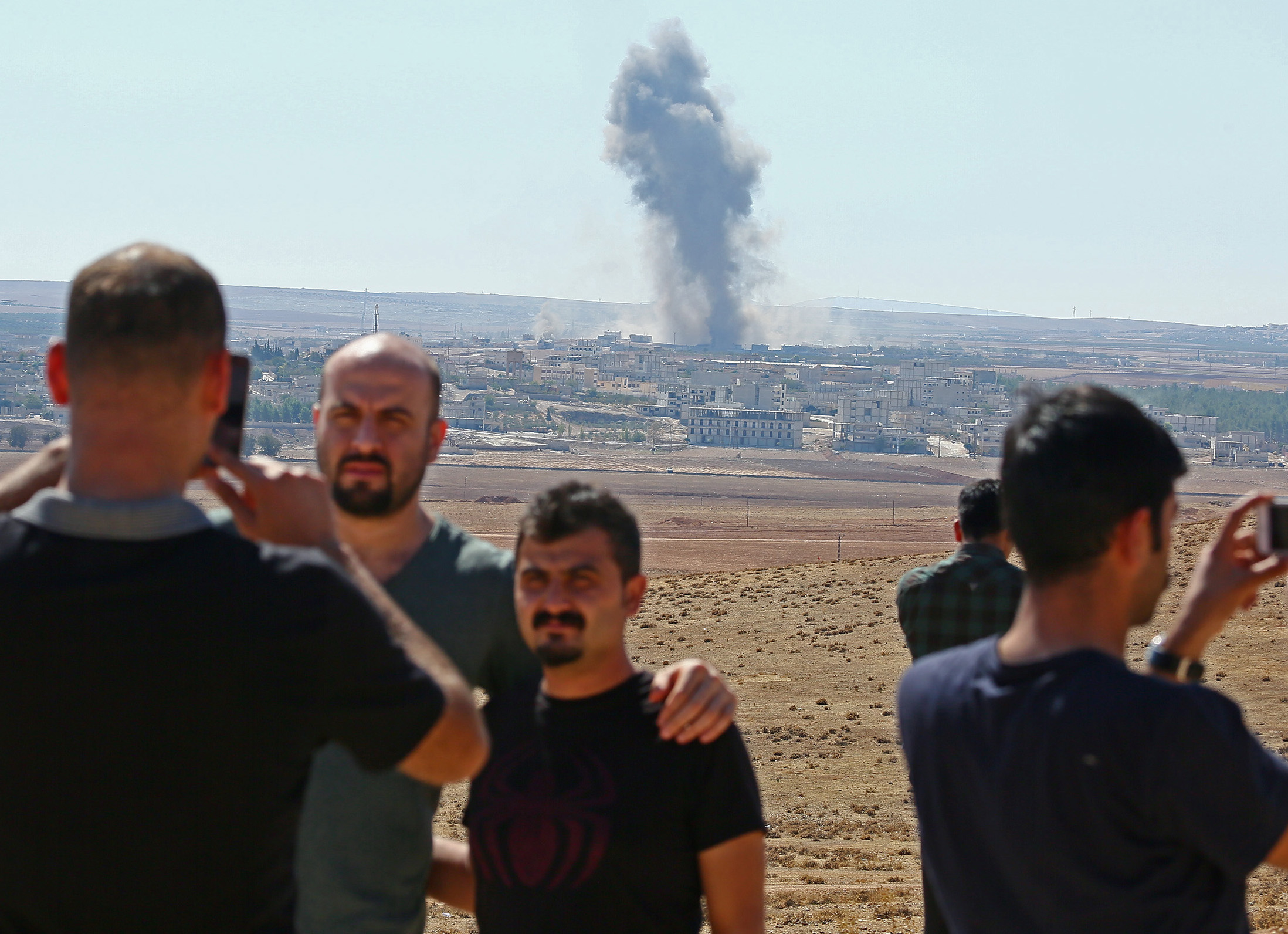
People pose for a photo in Suruc district of Sanliurfa as the smoke rises from Ayn al-Arab city (Kobani) of Syria after the US-led coalition bombed the targets of the Islamic State of Iraq and the Levant (ISIL) in Ayn al-Arab, on October 7, 2014. By Emin Menguarslan/Anadolu Agency/Getty Images.
Jennifer Fredette is troubled by the depiction of French Muslims:
It is true that we need to consider immigration when talking about the Muslim experience in France. That said, it is inaccurate to conflate “Muslims” with “immigrants.” Exact numbers are difficult to obtain because the French government refuses to collect or store statistics based on religion (or race or ethnicity). Nevertheless, we do know that many Muslims in France today are the children of immigrants, or even the grandchildren of immigrants; additionally, some have only one immigrant parent. And increasingly, French people are converting to Islam. Recognizing that immigration has directly or indirectly affected the lives of many Muslims in France is not the same as assuming (fallaciously) that all Muslims are foreigners.
But the real answer to our question about “permanent foreignness” does not lie in sloppy demography. French Muslims continue to appear foreign largely because today’s political debates are premised on an assumption of Muslim “different-ness,” and structured in a way that emphasizes this difference. For all of the discrimination, educational inequality, violence, and hostility that Muslims experience in France, political discourse concerning Muslims in the country overwhelmingly focuses on narrow religious issues it attributes to all Muslims: the hijab, the niqab, halal meat, the construction of mosques and the oppression of women.
She regrets how this creates “a flattened, homogenous view of Muslims in France” and “sidelines other political concerns that French Muslims have.” Meanwhile, Sara Wallace Goodman considers Muslim integration in the UK:
Muslim youth are born into British society and socialized in British schools, or naturalized after years of residence and integration, but endure frustrating barriers to socioeconomic mobility and face discrimination as members of an ethnic minority. And though a majority identify as British, a 2006 Pew survey shows how British Muslims maintain attitudes of disaffection and alienation more than Muslims in other European countries. Opportunistic imams can then mobilize a minority of impressionable youth toward a fundamental practice of religion. In fact, former Foreign Office Minister Kim Howells directly attributes the threat from British-born Islamic State militants in Syria and Iraq to not dealing with their radicalization in the U.K.
Yet blame is ascribed not merely for the absence of tough responses to radicalization at home, but also in providing weak tropes of belonging in the first place. As David Cameron stated in a speech criticizing state multiculturalism, “We have failed to provide a vision of society to which they feel they want to belong.”
Ross Douthat wrote a recent column noticing how “the cult phenomenon feels increasingly antique, like lava lamps and bell bottoms.” Drawing on the thinking of religious historian Philip Jenkins and entrepreneur Peter Thiel, Douthat argues that the decline of cults “might actually be a worrying sign for Western culture, an indicator not only of religious stagnation but of declining creativity writ large”:
The implications of Jenkins’s argument are specific to religion. Cults can be dangerous, even murderous, but they can also be mistreated and misjudged (as Koresh’s followers were, with fatal consequences); moreover, spiritual experiments led by the charismatic and the zealous are essential to religious creativity and fruitful change. From the Franciscans to the Jesuits, groups that looked cultlike to their critics have repeatedly revitalized the Catholic Church, and a similar story can be told about the role of charismatic visionaries in the American experience. (The enduring influence of one of the 19th century’s most despised and feared religious movements, for instance, is the reason the state of Utah now leads the United States on many social indicators.)
Thiel’s argument is broader: Not only religious vitality but the entirety of human innovation, he argues, depends on the belief that there are major secrets left to be uncovered, insights that existing institutions have failed to unlock (or perhaps forgotten), better ways of living that a small group might successfully embrace.
Suderman argues that Douthat probably “understates the ways in which semi-cult-like behavior has come to infuse daily life and mainstream culture”:
Yes, there are probably fewer cults in the aliens-and-messiahs sense, but there are more subcultures, in a wider variety, than ever before, more regimented lifestyle trends and minority beliefs about how to improve personal productivity or fitness, about how to become a better person and live a purer, more interesting, more connected and compelling life. Some of these subcultures remain distinctly fringe (dumpster-diving freegans, gently quirky bronies, furry fans, Juggalos [seen in the above video), while others are embraced, to varying degrees, by the mainstream:
At its height, Occupy Wall Street was as much an alternative lifestyle and belief community as a political movement. What is Crossfit if not a ritualized system that offers its highly dedicated, tightly-knit cells of followers a better and more meaningful existence?
None of these are cults in the specific sense that Douthat describes, with gated compounds and secret songs, but they are all experiments in behavior, taste, and belief intended to help adherents find meaning and connection in their lives.
In response, Douthat wonders if these subcultures really can take the place of religion:
I’m only slightly exaggerating when I say that this raises the most important question facing Western culture and society right now. Suderman is right, I think, that these “individualized and custom-tailored” forms of association are where creative/questing/artistic/religious impulses are increasingly being channeled, thanks to the internet and various broader economic and social forces; what’s more uncertain, to my mind, is whether they really encourage the kind of intense, enveloping commitment that I tend to think that deep creativity (among other goods) requires.
To the extent that like-minded people finding one another in ways that weren’t previously possible are creating cultural experiments that are as immersive, if not more so, than anything in the human past, then Suderman’s case for optimism makes a lot of sense. But to the extent that these experiments are more, well, dilettantish than past cultural groupings, more like hobbies than real commitments, more of a temporary identity that can be shaken off the moment it no longer completely pleases, they seem more likely to skim the shallows of creativity (to borrow an image from one of online culture’s more persuasive critics) than plumbing the true depths, more likely to cycle through pastiches and remixes (often fun and entertaining ones!) without stirring up something fully-realized and new.
(Image from the cover of Leander Kahney’s book Cult of Mac)
“An earlier version of this article referred incorrectly to when Mr. Macron’s wife had been his teacher. It was in high school, not first grade,” – NYT.

 Thiel’s argument is broader: Not only religious vitality but the entirety of human innovation, he argues, depends on the belief that there are major secrets left to be uncovered, insights that existing institutions have failed to unlock (or perhaps forgotten), better ways of living that a small group might successfully embrace.
 The Dish