
Houston, Minnesota, 12.38 pm
Houston, Minnesota, 12.38 pm
Sabato contends that “the truly remarkable thing is that polling is as accurate as it is.” But he fully admits their predictive limits:
First, we can probably expect up to a baker’s dozen of Senate contests to remain highly competitive right up to Election Day. Second, polling averages are likely to mislead us about the eventual winner in one or two cases. And finally, if there should be multiple Senate contests where the pre-election polling average has the candidates separated by three percentage points or less, the polling leader in about a third of these cases may well lose.
Therefore, if we’re headed for an election that produces a Senate divided by only a seat or two, don’t expect polls to precisely predict the outcome. Even well-conducted, large-sample surveys are blunt instruments with a margin of error.
Enten keeps an eye on the Kentucky and Georgia Senate races:
FiveThirtyEight’s forecast still gives McConnell a little better than a 77 percent chance of winning. Most people aren’t looking at Kentucky as a place where the Senate will be decided. Nor are many people looking at Georgia, where Republican David Perdue is a 71 percent favorite to beat Democrat Michelle Nunn.
But consider the chances of a Republican victory in races more often placed in the middle of the 2014 board. FiveThirtyEight has the Republican candidates in Alaska, Arkansas and Louisiana holding between a 72 percent and 75 percent chance of winning — the same range as Georgia and Kentucky.
Georgia and Kentucky remaining on the table for Democrats significantly hurts Republicans’ overall chances of winning a Senate majority.
Bernstein examines the big picture:
[C]urrent polling averages are within four percentage points for Senate races in Alaska, Arkansas, Colorado, Georgia, Iowa, Kansas, Kentucky, New Hampshire and North Carolina. Some of those contests (such as Colorado, which is a dead heat) could go either way — even if the polling is correct. But if something is systematically wrong, then 4-point contests such as New Hampshire (where the Democrat leads) or Kentucky (where the Republican leads) could turn out very differently, even if the polls don’t change before Election Day. I wouldn’t bet on Republican Scott Brown in New Hampshire or Democrat Alison Lundergan Grimes in Kentucky based on the polling to date, but I also wouldn’t be surprised if the trailing candidate ended up winning in any of these closely contested races.
Bottom line? The polls are still likely to be correct. And the uncertainty makes relying on polling averages even more important. But I don’t expect to know which party will have a Senate majority — however large — until the votes are counted (or even later).
A clever exploration of concert fandom:
[vimeo https://vimeo.com/107575275 w=580]The was a mysterious explosion near Tehran on Sunday, allegedly at the Parchin military facility. Some observers are wondering whether it was an accident or an act of sabotage:
According to the BBC, one Iranian opposition site described the event as a massive explosion that lit up the sky and shattered windows over nine miles away. The semi-official Islamic Republic News Agency dubbed the episode a “fire [that] broke out in an explosives producing factory in eastern Tehran,” neglecting to include the name Parchin and adding that two people had died. Neither source mentioned or even speculated upon the cause of the incident.
It’s widely believed that the United States and Israel have engaged in a heavy regimen of sabotage against the suspected Iranian nuclear program including, but not limited to, crippling computer viruses, the assassination of nuclear scientists, and a series of mysterious explosions that have killed high-level targets and damaged facilities. This development comes just hours before Iran and the International Atomic Energy Agency (IAEA) were reportedly set to meet in Tehran. The Parchin complex, which has long been a site that the U.S. and Israel say might be part of an illicit Iranian nuclear program, has not been inspected by the IAEA since 2005. If the episode in Iran is some kind of sub-rosa attack, the timing couldn’t be better.
Jim White speculates:
Another possibility that I haven’t seen mentioned is the potential of a semi-intentional accident that would destroy the building that is at the heart of the negotiations.
It is only a matter of days before satellite imagery of the blast site become public, so we will know fairly soon whether the particular building with the blast chamber in question was destroyed. If the site is completely destroyed, that would be a convenient way for Iran to prove, without saying it, that no further work of this type will take place.
Allahpundit finds this story suspicious:
If Parchin really is a test site for atomic weapon technology, go figure that a test might occasionally go bad. Which raises the question of just what sort of explosion this was. If it broke windows miles away and emitted a bright glare, that could mean either a really large conventional blast (e.g., if the fire reached the base’s weapons depot) or a small atomic blast — and of course western governments who detected it would have an interest in hushing it up too, lest they’re forced to admit that they failed to stop Iran from getting the bomb. But if there really was a huge explosion, how come social media wasn’t instantly inundated with “whoa!” tweets from Iranians living in and around east Tehran and Parchin? Seems hard to believe Iran’s Internet censorship could be so thorough that no trace of a reaction like that was detected online by western media. Which means maybe there was no such reaction, and thus no explosion.
To Frum, the fact that the IAEA hasn’t inspected Parchin in nearly a decade “reminds us how limited and defeated U.S. inspection rights have been in Iran, through this year of negotiation”:
Here’s the key point: The rulers of Iran clearly want sanctions relief. They have got a considerable measure already, and will likely soon obtain more from the Obama administration. The rulers of Iran are not, however, looking “to come in from the cold.” They are not looking to rebuild a more normal relationship with the United States. They are looking for the maximum economic benefit consistent with not abandoning their pursuit of a nuclear weapon. Any inspection rights the U.S. may ultimately obtain will be inspection rights within the context of persistent and profound Iranian rejection of the goals of an inspection regime.
I’m a broken record, but here’s a new development in the surrender of journalism to public relations and pap: “Collectively.” It appears as a new news site that seeks to emphasize the positive in the world:
Today’s media is obsessed with fear-mongering tactics, and a pervasive pessimism that would have us all believing that “everything is f*cked, and it’s all our fault,” which has had the undesirable effect of making people feel alienated and ineffectual, unable to figure out what they can do to alter the current path we’re on. Collectively will break through that negativity and cynicism to help people learn how they can help. Take meaningful action. Choose to make a difference.
A sort of Upworthy with added Zoloft and a touch of Xanax – perfect for “sharing” on Facebook as an expression of your own personal virtue. And, of course, you keep waiting for the catch, the poll-tested euphemism that will tell you what this site is really about – because you can see no advertisements at all, and there are no subscribers … and … ah, yes … bend over, here it comes:
Collectively symbolizes a new synergy between industries, institutions, and people that moves beyond blame and fault to focus on positive change.
“A new synergy between industries, institutions, and people?” Has your bullshit detector gone off yet?
The founding partners – Unilever, The Coca-Cola Company, Marks and Spencer, BT Group and Carlsberg – wanted to help build a non-profit platform open to the voices and opinions of as many different organizations and individuals as possible. We’re ridiculously excited by the list of highly energized participants who are already on board, and this is just the beginning. VICE Media’s creative services division, VIRTUE, was selected by the founding group to create and curate Collectively with complete editorial independence.
So this is a site directly funded by major corporations to tout their own alleged virtues – and, as Gawker’s Hamilton Nolan notes, it’s a site “run with ‘complete editorial independence’—by an ad agency.” Which is to say Vice‘s. Nolan reports on all the corporations involved:
Vice, Diageo, Dow, Facebook, General Mills, Google, Havas, Johnson & Johnson, McDonald’s, Microsoft, Nestle, Nike, Omnicom, PepsiCo, Philips, SAB Miller, Twitter, and WPP, among others.
I’ve been warning for a while that when established journalistic outlets whore themselves out to corporate propaganda through “sponsored content”, they are playing a mug’s game. The only reason these companies are paying these media outlets to disguise their ads as editorial copy is because they can still trade on those outlets’ residual reputation. But as native advertising cumulatively undermines that reputation, magazines and newspapers will lose their luster. Instead, corporations will simply fund and create their own pseudo-journalism directly, and cut out the middleman altogether.
This isn’t some future specter; it’s already here.
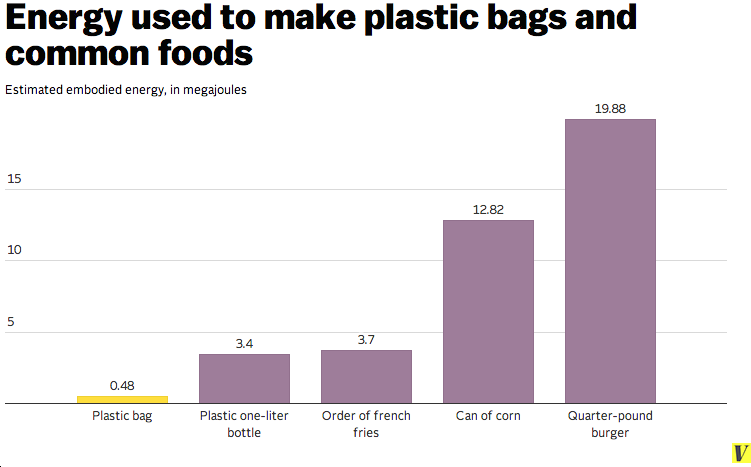
Joseph Stromberg thinks the importance of reducing plastic-bag use has been overstated:
In 500 to 1000 years, the primary concern for pretty much every ecosystem on earth will be global warming. The facts on this are pretty clear. If we don’t significantly cut back on greenhouse gas emissions very soon, the world will get hotter, sea levels will rise, and the oceans will turn more acidic, among other problems. If we let truly drastic levels of warming occur — and at this point, there’s no sign we’re doing anything to stop it — scientists warn that profound disruptions to both modern human society and the natural world are very likely.
What does all this have to do with plastic bags? When it comes to greenhouse gases, they’re once again dramatically less important than the products we buy and put inside them.
Vauhini Vara has a more favorable take on the issue:
I live in San Francisco, where a local plastic-bag ban and paper-bag charge went into effect in 2012.
At the time, I was working for the Wall Street Journal. While working on an article about the city ordinance, I called a grocery store in my neighborhood, Canyon Market, to see how its owners felt about the law. Janet Tarlov, who owns the store with her husband, didn’t like the idea of giving shoppers fewer options, and worried that the inconvenience would persuade some of them to drive to nearby cities without bans or fees. “On balance, I think it’s a bad idea,” she told me at the time.
On Thursday, I called Tarlov again to see how things had played out. She laughed, a bit abashedly: “I’ve changed my mind,” she said. Even though paper bags tend to cost more than plastic bags, Tarlov thinks that the amount she has spent over all on bags since the ban has grown by less than her revenue has. Tarlov’s store pays about twenty-five cents for each paper bag it uses, and the ten-cent charge covers only part of that. But, in the past, the store had to cover the entire cost of the paper bags. (Bigger grocery chains can pay much less for paper bags, as little as a couple cents apiece; the California law requires that if stores end up with proceeds from the paper-bag fees, after covering the cost of the bags, they have to spend the money on activities related to the law, like educating customers about bringing their own reusable bags.) Plus, the ten-cent paper-bag charge has had more of an impact than Tarlov expected; more people are bringing their own reusable bags. “Our consumption of bags has gone way down,” she said. “That’s good for the environment, and people adjusted to it very quickly.”
Joshua Keating thinks a certain peace prize needs a year off:
This year the [Nobel] prize committee could best serve its mission by giving the prize to the person who most deserves it: nobody. Such a move would highlight that this has been a particularly violent year around the world. More importantly, it would serve as an
acknowledgment that the most notable eruptions of violence have been so grimly predictable, the result of years of individual and collective failures by governments and international institutions. … [I]t’s hard to find anyone deserving of a Peace Prize in 2014. The original purpose of the Nobel Peace Prize was to reward the person who “shall have done the most or the best work for fraternity between nations, the abolition or reduction of standing armies and for the holding and promotion of peace congresses.” And on that score, there was not much to report this year. The committee should follow the example of the Mo Ibrahim Prize for Achievement in African Leadership, the world’s most generous prize given to individuals, with an outlay of $5 million over 10 years plus $200,000 per annum after that. The prize has simply not been granted in three of the six years it has existed because no suitable candidates were found.
Noah Smith argues that the entire Nobel system is seriously flawed:
In addition to giving too much credit to too few people, the Nobels have the disadvantage of not being given postmortem. This means that great scientists from ages past, who were probably prevented from receiving the prize only because of sexism or racism, will remain Nobel-less forever. Examples include nuclear physicist Lise Meitner, mathematician Emmy Noether (whose work was hugely important to theoretical physics), and nuclear physicist Chien-Shiung Wu. Speaking of discrimination, another problem with the Nobels is that they are awarded almost exclusively by Swedish and Norwegian people. Just look at the committee that selects the physics prize. In the era when Europe ruled the world, the neutral countries of Scandinavia might have seemed like the ultimate honest brokers, but in today’s globalized world there is no good justification for such provinciality.
But Emily Badger notes one of the awards that went to a project with noble applications:
The Nobel Prize for physiology or medicine was given Monday morning to three scientists who’ve uncovered the “inner GPS” in our brains that helps us find our way through the world around us, identifying where we are, where we’ve been and how to get back there again. … The answers have some direct implications for how we understand diseases like Alzheimer’s that rob people of their spatial memory. But they also have some fascinating implications for perfectly healthy people, too, and for the way we design spaces — from individual buildings to neighborhoods and whole transportation networks — that we move through daily. While the first story is clearly the province of scientists and doctors, the second is very much of interest to urban planners, architects and cartographers.
And as Rachel Feltman points out, the physics Nobel went “to researchers whose findings you probably rely on just about every day (or, if you’re like me, just about every minute). The blue light-emitting diodes they helped create are taking over lightbulbs as we know them, but already see universal use in smartphone flashlights and displays.” Update from a reader:
Perhaps this year would be a good year for the Nobel Committee to not just refuse to award a new prize but to rescind the Nobel Peace Prize awarded to Barak Obama in 2009. I understand that there are several online petitions circulating urging the Nobel Committee to do just that.
A reader writes:
I’m sure you saw this, but just in case. The interplay between the Virginia plaintiffs and the court clerk who opposed them is wonderful. Here’s the link to the story on the local TV station. Money quote:
Norfolk Clerk George Schaefer denied London and Bostic a marriage license a year ago. But on Monday, Schaefer was there congraulating them along with the couple’s attorneys and close friends.
“Thank you so much. It was a pleasure suing you,” said London. “I enjoyed being sued,” Schaefer replied. “I don’t think [Schaefer] ever took it personally,” said London.
“No, and neither did we. I mean everyone was doing their jobs. They were fulfilling the roles they were required to fulfill by the laws of the state. And that’s what they did. And no where along the line, and I try to be clear about this, has anyone been disrespectful. And even those that opposed us, they didn’t attack us, they attacked the issue,” said Bostic.
Those notes of grace have been sorely missing from the national opponents and some supporters. Just once it would be nice to read that Tony Perkins or Brian Brown said something like: “While we are disappointed in the ruling/vote of the legislature/election outcome, we wish the couples who will be getting marriage licenses well and hope they find as much joy in their unions as we have in ours.” Too much to ask, it would seem.
There has been bitterness and anger in this long debate. But what I’d highlight would be the grace of so many, the determination not to make this a battle between “perverts” and “bigots” on both sides, the conversations that did not end in shouting matches, and the peaceful interplay of public opinion, state legislatures and courts that have helped move us toward a different reality. Some will never give up – either in prosecuting and discriminating against those rightly and legitimately exercising their religious liberty or in continuing to demonize and stigmatize so many gay fellow-citizens and human beings. But they have not defined this battle; and they must not define its resolution.
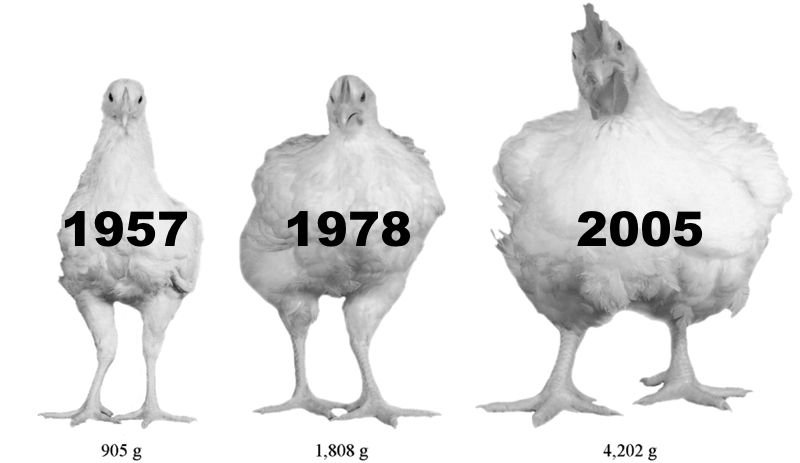
The delicious creatures have grown a lot in 50 years:
The one on the left is a breed from 1957. The middle one is a 1978 breed. And the one on the right is a commercial 2005 breed called the Ross 308 broiler. They’re all the same age. … The image above comes from a study done by researchers at the University of Alberta, Canada, who raised three breeds of chickens from different eras in the exact same way and measured how much they ate and how they grew. This allowed them to see the genetic differences between the breeds without influences from other factors like food or antibiotic use.
They remind me of how football players have grown in the same period. Meanwhile, Christopher Leonard examines the modern poultry industry from a different angle, focusing on “the tournament,” a “secretive system that companies like Tyson use to pay chicken farmers, which … pits farmers and communities against one another to earn a living”:
[C]ompanies like Tyson keep a tally of the farmers who deliver chickens to slaughter. Based on how well they fattened the birds on a given ration of feed, the farmers are ranked against each other. At the end of a given week, Tyson will mail out tournament results to all the farmers whose birds were processed. Farmers will learn how they ranked, how many players were in the tournament, and how much weight their birds gained on their feed rations. Those at the top receive premium payment, while those at the bottom are financially penalized. …
Critically, the tournament is a zero-sum game: the financial windfall of the winners is taken from the pay of the losers. This means the tournament systematically pits farmers against each other. The difference in pay between the winners and the losers can be the difference between making a profit on six weeks of work and taking a loss.
Poultry companies say the tournament incentivizes farmers to work hard, which might make sense if they had any control over their operations. But the success of a given flock of chickens rests on the quality of feed the birds eat, and the healthiness of the chicks when they’re delivered. A farmer can be a genius, can put in ten-hour days, seven days a week, but he will not raise a good batch if his feed is bad or he gets sickly chicks. His impact is on the margins: if he completely neglects his birds, they won’t gain as much weight. If he’s in the chicken houses constantly, they’ll gain a little more. Farmers pray for good birds and feed, and the tournament is laid bare as a lottery.
When you’re raising money for a political campaign:
[Todd Rogers of Harvard and Don A. Moore of the University of California, Berkeley] conducted experiments in which they showed that online survey participants are more supportive of hypothetical preferred candidates if they are just behind in the polls instead of just ahead. These differences matter in the real world of campaigns, as the two professors show using fund-raising experiments conducted by the Democratic Governors’ Association and Anne Lewis Strategies, Inc. Emails from the D.G.A. saying that Rick Scott, the Republican candidate for governor in Florida, was ahead of the Democrat Charlie Crist in the polls were almost 50 percent more likely to result in a donation and raised approximately 60 percent more than those saying Mr. Scott was behind.

 The Dish