An Actual War On Women, Ctd

Colum Lynch relays the nauseating findings of a new report on ISIS:

By the end of August, the U.N. documented the abduction of up to 2,500 civilians, mostly women and children, from the northern Iraqi towns and regions of Sinjar, Tal Afar, the Nineveh Plains, and Shirkhan. Once they were in captivity, fighters from the Islamic State sexually assaulted the teenage boys and girls, witnesses told the United Nations. Those who refused to convert to the groups ran the risk of execution. “[W]omen and children who refused to convert were being allotted to ISIL fighters or were being trafficked … in markets in Mosul and to Raqqa in Syria,” according to the report. “Married women who converted were told by ISIL that their previous marriages were not recognised in Islamic law and that they, as well as unmarried women who converted, would be given to ISIL fighters as wives.”

A market for the sale of abducted women was set up in the al-Quds neighborhood of Mosul. “Women and girls are brought with price tags for the buyers to choose and negotiate the sale,” according to the report. “The buyers were said to be mostly youth from the local communities. Apparently ISIL was ‘selling’ these Yezidi women to the youth as a means of inducing them to join their ranks.”

Previous Dish on ISIS’s use of rape and sexual slavery here.

The Geopolitics Of Slightly Cheaper Oil

Looking over Russia’s budget for the coming year, Callum Williams observes how many of its assumptions depend on oil prices remaining pretty high:

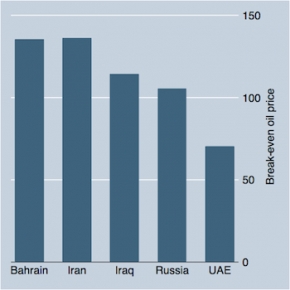
graph_3In 2015 Russia will need an oil price of about $105 a barrel to balance its budget (see chart). But crude is currently trading in the mid-$90s, down by about 10% since May. Weak demand from China and healthy supply from America help explain the drop.

Lower dollar-denominated oil prices are not so bad for Russia, given that the rouble has weakened so much. But over the past few years the budget’s reliance on oil revenues has increased. When excluding oil, there was a shortfall of 3.6% of GDP in 2007, but now it is more like 10%. Russia expects to run a small budget deficit (about 0.6% of GDP) this year. That prediction is optimistic—the Kremlin is banking on an oil price of $100. The latest predictions from Energy Aspects, a consultancy, show that the price of Brent is not expected to pass $100 for about nine months.

Steven Mufson details how the dip in demand and surge in US production is bad news not only for Russia, but Iran as well:

Crude oil and oil products made up 46 percent of Russia’s budget revenues in the first eight months of this year. At a time when the West is trying to sanction Russia for its incursions in Ukraine, a 10 to 20 percent drop in oil prices could prove powerful. Still, it’s still a far cry from the 1980s, when Saudi Arabia produced enough oil to flood the market and drive prices down so far that many experts say it sped up the fall of the Soviet Union. That’s not going to happen now, but Russia could be squeezed a bit.

Iran, whose oil exports are limited by sanctions related to its refusal to limit its nuclear program and open it up to greater international scrutiny, will also suffer a setback. Iran’s oil minister Bijan Namdar Zangeneh late last month called on the Organization of the Petroleum Exporting Countries to keep oil prices from falling any further. “Given the downward trend of the oil prices, the OPEC members should make efforts to offset their production to keep the prices from further instability,” Zangeneh said according to Shana, a news agency supported by Iran’s oil ministry.

But according to Keith Johnson, the other Gulf petrostates are much less vulnerable:

“In the short term, the Saudis are the last ones who need to worry. They can sit it out for a couple of years, even with oil below $90,” said Laura El-Katiri, a research fellow at the Oxford Institute for Energy Studies. Other Gulf states, such as Kuwait and the United Arab Emirates, can also resort to deficits or spending tweaks to weather a price storm, she said. That may partly explain the deaf ears turned by Saudi Arabia and other big OPEC members to Iran’s pleas. Of the big producers, Iran by far requires the highest prices to remain fiscally sound, by some estimates as much as $130 a barrel. Further, Iran has been hammered by Western sanctions that have cut its oil exports — and earnings — almost in half.

Yet Saudi Arabia, still the world’s swing oil producer and a visceral opponent of Shiite Iran, has little interest in slashing output. Quite the contrary: Saudi Arabia on Wednesday suddenly started offering discounts to maintain its market share, even if it undermines overall crude prices.

Cup O’ Quandaries

In his latest Ethicist column, Chuck Klosterman advises a camp counselor to let a Mormon teenager sample coffee, disregarding the parents’ wishes:

As an authority figure, you have an obligation to approach the camper and ask, “Are you aware that your parents requested that you not drink coffee?” You might follow that with a second question: “Do you understand why your parents don’t want you drinking coffee?” This seems like a prime opportunity to have a meaningful discussion that might affect the rest of his life.

But regardless of the teenager’s response, you should not physically stop him from consuming a beverage that is legally and ethically within his right to consume. It’s not as if you’re forcing him to drink coffee against his parents’ wishes or placing him in a position where there’s no alternative; he is choosing to do this, despite his spiritual upbringing. A 16-year-old has the intellectual ability to decide which aspects of a religion he will accept or ignore. He’s not an infant, and you’re not living in the town where “Footloose” happened. It’s the responsibility of a secular camp to respect the principles of any religion but not to enforce its esoteric dictates.

Coffee, of course, has also stirred secular objections over the years. Dan Piepenbring unearths the “rhetorically marvelous if scientifically unsound” advice of one J. M. Holaday, who strongly advocated against the beverage in his 1888 paper “Coffee-Drinking and Blindness“:

Children that are allowed to partake freely of coffee will become restless, fussy and noisy, half wild with mischief. They probably advance in their school studies with abnormal rapidity. But they hate work. At times they are indifferent about education. Their strength goes to the brain. They grow rapidly, but not aright. They develop into men and women three years too soon. Yet their eyes dance with angelic splendor, and their cheeks glow with vermilion, providing that they started in life with robust constitutions. If they began life with puny physiques, however, coffee will make them slim and ghostly, and their eyes and features flat. Coffee … gives a sentimental strength—the strength that pertains to runts. The best thing that can be said of coffee is, that it has a tendency, like opium, to make lawless persons tame.

The Best Of The Dish This Weekend

456639430
 

First up, a classic eggcorn from our friends at TPM:

The No. 2 official at the Israeli Embassy in Washington, D.C., is scheduled to speak Sunday at an event co-hosted by Concerned Women for America—a group with a long history of fermenting the “creeping Sharia” conspiracy theory.

And a quote from today:

The humble are they that move about the world with the love of the real in their hearts.

More gems from the weekend: Rembrandt’s genius with intimacy; Nabokov’s amazing love letters; Facebook as a Kafkaesque “accusation aggregator“; a butterfly chart that flutters; an unforgettable portrait painted with microbes; the desolation of those who lose their faith; and the surprising short lengths of most addictions. Plus: a pretty wonderful devastation of Richard Dawkins.

25 more readers became subscribers this weekend. You can join them here – and get access to all the readons and Deep Dish – for a little as $1.99 month. Gift subscriptions are available here. Dish t-shirts are for sale here. From a reader who saw me speak at Claremont McKenna College last week:

Thanks for all you are doing! Becca insists that you will like the pic attached – with our Dish Andrew sullivan picshirts prominent. You spoke about having 30,000+ subscribers, but little hope for growing that number significantly in the near term.  Here’s just an observation: we put this pic on Facebook on Tuesday night. The response from many of our friends has been “Who’s Andrew Sullivan?”

Most of those are people who should be seeing your work (and probably a few who would just think you’re another crackpot – yes, we know some of them too!) and, having seen it would subscribe. At the risk of committing the very sins you spoke about at CMC – monetizing every post a la Buzzfeed, etc – it seems that you need to find a way to market The Dish that goes beyond word-of-mouth from your dedicated fans.

All ideas are welcome. Another subscriber from Claremont:

I was the guy in the grey suit and white hair.  My daughter sat at your table.  I’ve been reading the Dish since 2001 and actually contributed to you for 2 or 3 years before you moved to a different platform.  (I subscribed for $40 just now.) She’s been reading your blog since high school. I spoke to many of the students in attendance.  None of them ever read your blog or knew very much about you.  However, they were intensely interested in the subject matter.  That’s why they chose to attend.  Very unusual to get a sell-out for one of these dinners unless it is a celebrity.

So, I just want to let you know that you are really on to something.  What you had to say last night really connected with that audience of young people.

These trips are always a mix of exhilaration and exhaustion. But one thing I always discover: the passion of Dishheads. It’s the elixir of a blogging life.

See you in the morning.

(Photo: Pope Francis leads a vigil prayer in preparation for the Synod on the Family on October 4, 2014 at St Peter’s square at the Vatican. By Gabriel Buoys/AFP/Getty.)

A Poem For Sunday

2428152539_0dd303d9da_o

“To the Reader: The Language of the Cloud” by Chase Twichell:

Come with me to a private room.
I have a secret to show you.
Sometimes I like to stand outside it

with a stranger because I haven’t
come at it from that vantage in so long—

see? There I am beside him, still joined,
still kissing. Isn’t it dreamlike,
the way the bed drifts in its dishevelment?

Bereft of their clothes, two humans
lie entangled in its cloud.

Their bodies are saying the after-grace,
still dreaming in the language of the cloud.
Look at them, neither two nor one.

I want them to tell me what they know
before the amnesia takes them.

(From Horses Where the Answers Should Have Been © 1998, 2010 by Chase Twichell. Used by permission of Copper Canyon Press. Photo by Suzanne LaGasa)

The Neocons vs Oakeshott

It’s long been a simmering intelllectual rift within the philosophy of conservatism – between the rigid disciples of Leo Strauss and the wayward offspring of Michael Oakeshott. My own choice of Oakeshott for my dissertation was one of the first moments when my “conservatism” was greeted with intense skepticism by the neocons I knew. The chill was palpable. He wasn’t interested in fostering the morals of others, which was, to many neocons, the only real purpose of religion at all. So it’s no surprise that in introducing a collection of essays, On Jews and Judaism, written by her late husband Irving Kristol, Gertrude Himmelfarb connects his attachment to religion to his brand of neoconservatism – and not to the bohemian Englishman’s conservatism:

Religion, he held, is not just for the good of society; it is good for the individual, and not just for the sake of leading an ethical life but for the sake of a meaningful and soulful life. … His neo-orthodoxy is firmly Jewish, rooted in history and community, in an oakeshottid.jpgancient faith and an enduring people. And so, too, his neoconservatism is firmly rooted in Judaism. In an essay on Michael Oakeshott written many years later, Kristol recalled the day in 1956 when, as an editor of Encounter in London, he found on his desk an unsolicited manuscript by Oakeshott entitled “On Being Conservative.” It was a great coup for the magazine to receive, over the transom, an essay by that eminent philosopher. Kristol read it “with great pleasure and appreciation”—and then politely rejected it. It was, he later explained (although not to Oakeshott at the time), “irredeemably secular, as I—being a Jewish conservative—am not.” Oakeshott’s “conservative disposition,” to enjoy and esteem the present rather than what was in the past or might be in the future, left little room for any religion, still less for Judaism:

Judaism especially, being a more this-worldly religion than Christianity, moves us to sanctify the present in our daily lives—but always reminding us that we are capable of doing so only through God’s grace to our distant forefathers. Similarly, it is incumbent upon us to link our children and grandchildren to this “great chain of being,” however suitable or unsuitable their present might be to our conservative disposition. And, of course, the whole purpose of sanctifying the present is to prepare humanity for a redemptive future.

Kristol’s inability to appreciate the deeper religious teaching of Oakeshott was not surprising. Few did for most of his life  – my own dissertation was the first to insist upon it, and has been supplanted by Elizabeth Corey’s elegant work on Oakeshott’s understanding of religion and aesthetics, and even more by the recently published Notebooks, where religion is an obsessive interest. The idea that Oakeshott is “irredeemably secular” is almost laughable once one has read these.

If I were to point to one core difference between Oakeshott’s understanding of faith and the neocons’, it would not simply be the difference between Judaism and Christianity, but more that the neocons see religion primarily as a political and social tool, rather than as an insight into a present eternity. And it is neoconservatism’s use of religion that makes them in fact, the irredeemably secular ones. And, to the extent that some, like Allan Bloom, were actually atheists, cynics.
Dawkins: No Modern-Day Darwin

John Gray pans Richard Dawkins’ memoir, An Appetite for Wonder, which takes us beyond Dawkins’ polemics on behalf of science to reveal a bit of the man himself. One point Gray makes? The famed New Atheist is nothing like his hero Charles Darwin:

No two minds could be less alike than those of the great nineteenth-century scientist and the latter-day evangelist for atheism. Hesitant, doubtful, and often painfully perplexed, Darwin understood science as an empirical investigation in which truth is never self-evident and theories are always provisional. If science, for Darwin, was a method of inquiry that enabled him to edge tentatively and humbly toward the truth, for Dawkins, science is an unquestioned view of the world. The Victorians are often mocked for their supposed certainties, when in fact many of them (Darwin not least) were beset by anxieties and uncertainties. Dawkins, by contrast, seems never to doubt for a moment the capacity of the human mind—his own, at any rate—to resolve questions that previous generations have found insoluble.

Dawkins may not be Victorian, but the figure who emerges from An Appetite for Wonder is in many ways decidedly old-fashioned. Before Dawkins’s own story begins, the reader is given a detailed account of the Dawkins family tree—perhaps a natural prelude for one involved so passionately with genes, but slightly eccentric in a twenty-first-century memoir. Dawkins’s description of growing up in British colonial Africa, going on to boarding school and then to Oxford, has a similarly archaic flavor and could easily have been written before World War II. The style in which he recounts his early years has a labored jocularity of a sort one associates with some of the stuffier products of that era, who—dimly aware that they lacked any sense of humor—were determined to show they appreciated the lighter side of life.

Eau De Eternity

dish_incense3

In a review of Mandy Aftel’s new book Fragrant: The Secret Life of Scent, Emily Gould reveals her affinity for perfume. The book, she suggests, “makes a person wearing perfume feel connected to every human in every era who has ever done so”:

A spritz of L’Artisan Parfumeur: Passage d’Enfer in the morning not only becomes a way of “decorating the day,” as perfume critic Tania Sanchez memorably wrote, it also gives you the sense that you have something in common with the ancient Egyptians, who packed frankincense inside the corpses they embalmed. Jars of unguents taken from these tombs, according to Aftel, have retained their fragrance. If you can still smell, three thousand years later, what Egyptians wanted to smell like in the afterlife, that’s a kind of afterlife in and of itself. Aftel also points to biblical descriptions of the uses of incense and the specific instructions for compounding it given to Moses by God. It’s easy to forget, as you light a stick of incense to mitigate the smell of a litter box, a bong, or a neighbor’s cooking, that smoke rising toward the skies once was used to communicate messages to heaven.

(Photo of incense and candles at Yangon’s ancient Shwedagon Pagoda by William)

Discourse And The Divine

Theo Hobson ponders Rowan Williams’ new book, The Edge of Words: God and the Habits of Language, emphasizing the way language is “made by bodies in time and space” – a view that “ought to make us utterly resistant to neat tidy systems, and final explanations”:

He therefore argues that there is a sort of wisdom in language, when carefully attended to: it teaches us to affirm our dependence and finitude, and it leads us towards acceptance of linguistic difficulty (or ‘mystery’), and silence. For these things are aspects of how complex meaning is made, rather than just deficiencies. One learns to be patiently attentive to such strange, challenging forms of communication when one grasps that ‘there is no level of representation to which all others can be reduced’.

You could say that attention to language-as-representation promotes a sort of slow humanism, an intense tolerance for how human beings actually make meaning (at one point he discusses the fraught communication of a severely autistic child as illustrative of how all language is rooted in finite bodily life). Furthermore, although one’s meaning-making is limited (by one’s embodied nature), one needs to trust other forms of language that are somewhat alien to one — perhaps this entails positing a general meaningfulness in which all particular, limited meaning shares. Is there an argument for God here?

Well, the atheist is unlikely to have broken into a nervous sweat. And Williams cheerfully admits it. But maybe this is what ‘natural theology’ should do, he ventures: not try to find evidence of the Christian God in the world (an erroneous aim, as it undermines the concept of revelation), but give an account of the world that is congruent with the religious view.