On The Health Hazards Of Heathens

Jon Fortenbury examines why leaving a religion can be a detriment to your health, touching on findings from psychologist Darrel Ray:

Ray has been a psychologist for more than 30 years and founded Recovering From Religion, an organization that connects nonbelievers with therapists and each other. According to Ray, it generally takes depressed deconverts two to three years for their health to bounce back. A few years after leaving their religion, they tend to reestablish a social community and rid themselves of guilt they may have felt over premarital sex, depression over losing God, and anxiety about death and hell.

Ray, author of The God Virus and Sex and God: How Religion Distorts Sexuality, said not all of his clients recover within the typical three years, though. Getting over a fear of death after believing in an afterlife for so long takes some of them five years or longer. And about five percent of his clients can take even more time to stop fearing hell. Ray often compares learning about hell to learning a language.

“When you were five years old and learning English, you never stopped to ask your parents why you weren’t learning German,” said Ray, who uses cognitive behavioral therapy to decatastrophize the concept of hell for clients. “You just learn it. The same is often true of religion. When you’re taught about hell and eternal damnation at ages four through seven, these strong concepts are not going to easily leave you. Just like it’s hard to unlearn English, it’s hard to unlearn the concept of hell.”
Mega-Churches And Mega-Bucks

At Guernica, Meara Sharma interviews Anthony Pinn, a scholar of African-American religion, about the role mega-churches play in the American black community:

Guernica: I think for many people, there’s something off-putting, or just unsettling, about a pastor like Creflo Dollar, who has a private jet, a Rolls Royce, and multiple million-dollar homes. There’s a dissonance between that kind of lavish lifestyle and being a spiritual figure.

Anthony Pinn: For believers, it would only be off-putting if Creflo Dollar said, Look, this stuff is only available to people like me. I’m special. You can’t get this. But to the extent that he provides this invitation—you live by my teachings, and you can have what I have—then it’s appealing.

It really depends upon how one views churches. If one views the black church as being primarily about the business of spiritual renewal, emotional, psychological, spiritual well-being, then it’s offensive. But, to the extent that folks recognize black churches as businesses, why shouldn’t they see their CEO have what the CEO of Pepsi has? The parishioners don’t see a contradiction between the church as an economic enterprise and a place for spiritual renewal. One leads to another. They flow together.

Guernica: So what happens when it doesn’t seem to be working for the parishioners? When they’re not getting more prosperous, even though they’re abiding by the teachings?

Anthony Pinn: This is the genius of the system. It’s not working because you’re not doing it right. There’s no flaw in the system! No flaw in the teachings! There’s a flaw in your practice of the teachings. How can the minister say this? Because the minister is still doing well! The minister is still driving that Rolls Royce, wearing ten-thousand-dollar suits, so clearly the teachings work! You are not practicing them properly.

And Jesus wept.

Faces Of The Day

dish_fotdsun5

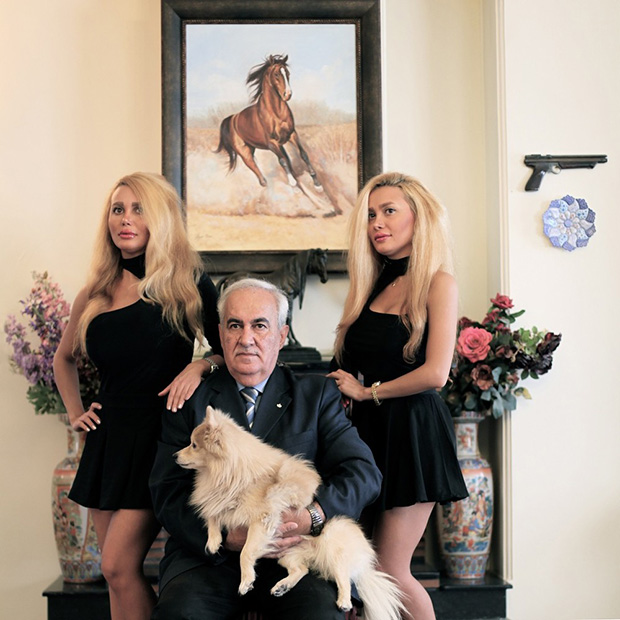
For her series Iranian Fathers & Daughters, Nafise Motlaq photographed families in their own homes:

Motlaq’s subjects encompass a wide range of economic and cultural backgrounds. Some families are religious, while others subscribe to a more secular lifestyle. Motlaq explains that Iranian Fathers & Daughters has allowed her to reevaluate some of the prejudices she herself held about her home. Since the government regulates national television and other media outlets, she found she had a limited view of those living outside of her community. Says the artist, “Putting these portraits together shows the reality of us; it shows how diverse we are.” She hopes to continue the project during her next trip home.

Motlaq, who currently works as a communications instructor at University Putra Malaysia, described her inspiration for the project in an interview:

I was driven to begin “Fathers and Daughters” after my father nearly passed away. His illness and then eventual recovery brought us much closer. When I visited Iran in 2014, after seven years away from the country, the idea sprang to mind. …

I strongly believe story-telling is important in photography. Photo-stories not only describe what’s in front of the camera but also who is behind it. The editing of a series of images reveals the photographer’s perspective and his or her views about the issue. For example, when I’m in Malaysia, I find it very easy to make street photographs—quick, slightly distant work, that’s done in public. But it is only in Iran where I can reach deeper levels of communication with my subjects. My familiarity with Iranians lets me know how to deal with them and allows me capture their real moments.

See more of her work here.

Quote For The Day

“The genuine artist is never ‘true to life.’ He sees what is real, but not as we are normally aware of it. We do not go storming through life like actors in a play. Art is never real life. The poet sees with a poignancy and penetration that is altogether unique. What matters is that the poet must be true to his art and not ‘true to life,’ whether his art is simple or complex, violent or subdued. Emotion is thought to lie at the center of aesthetic experience. That, however, is not how the matter appears to me. If I am right, the essence of art is insight of a special kind into reality. But such insight is bound to be accompanied by remarkable emotions. A poem would be nothing without some meaning. The truth is that meaning is an awareness and a communication. But it is no ordinary awareness, no ordinary communication.

Novelty must be inspired. But there must be novelty. This crisis is most evident in religion. The theologians whose thought is most astir today do make articulate a supreme need, and one that has now become also an imperative, as their urgency shows, the need to infuse into the ages of enlightenment an awareness of reality adequate to their achievements and such as will not be attenuated by them. There is one most welcome and authentic note; it is the insistence on a reality that forces itself upon our consciousness and refuses to be managed and mastered. It is here that the affinity of art and religion is most evident today. Both have to mediate for us a reality not ourselves. This is what the poet does. The supreme virtue here is humility, for the humble are they that move about the world with the love of the real in their hearts,” – Wallace Stevens, “On Poetic Truth,” in Opus Posthumous: Poems, Plays, Prose.

Two Sides To Their Story

1024px-MHS_Deesis_XVII_w_p

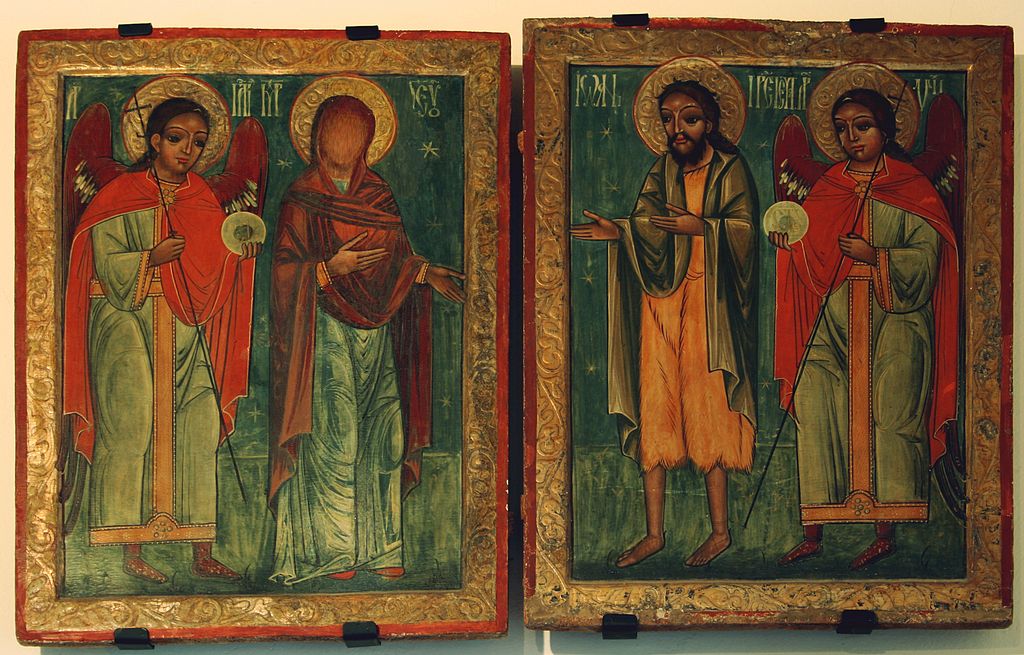
Eric Dean Wilson muses about the varied history and uses of diptychs, the art that consists of two panels, usually joined by a hinge. He notes that the diptych was, for the ancient Romans, often used as “a ceremonial notebook used to track and record consular appointments by year” – but that Christians made it their own, finding the form well-suited for expressing the nuances of their faith:

The rise of iconography in the Christian church evolved the diptych into a narrative form. A scene—most often the birth, crucifixion, or resurrection of Jesus—was painted on one panel and hinged to another. Larger diptychs could be slightly closed to stand on the altar of a side chapel; smaller diptychs could be shut and carried, the paintings inside protected by the decorative casing. Narrating complex stories from the New Testament to illiterate Christians, these diptychs worked much like stained glass windows would in later cathedrals.

The narratives of the New Testament are filled with paradox—Christ is both fully human and fully divine, both dead and alive—and the diptych offered reconciliation. Two stories, set parallel and given equal weight, merge into one, and the hinge offers a moment to chart similarities and differences. The iconic diptychs also became holy objects themselves, capable of healing and calming the mind. A meditation on the two panels could bring one closer to God.

(Image: A 17th-century diptych-style icon, featuring, from left to right: Archangel Michael, Theotokos, John the Baptist, and Archangel Gabriel, via Wikimedia Commons)

Leaving The Family Faith Behind

Laura Cok, whose mother is a minister in the Christian Reformed Church of America, describes how her own atheism is now a family taboo:

[O]f course she has not asked [if I am an atheist], because she does not want to know. Every week she prays, researches her commentaries, procrastinates on writing her sermon, colour codes it and prints it out in increasingly large font. She visits elderly women and eats their cookies and counsels young couples who want to get married. She baptizes babies and takes terrified women to shelters and sits in family court and sees the best and the worst of people, every day. Her whole life has been bringing her to this; it is all she wanted, and faith is all she wanted for me. When I rejected it, I rejected everything: her dreams for my life, all the hope and the grace that she sees.

When she was young, she wanted more than anything to be a minister in a world that would not let her in. And all I have wanted is to be let out. I no longer worry about going to hell, but the same is not true for everyone in this world that I hold dear. To them, I am a lost soul. They may pray for me but it will never help, and I cannot grant them the comfort of an afterlife. My grandparents, my cousins, my best friends: they all believe that I am damned. That is a terrible burden to lay at their feet. And so for so long I have pretended, and not spoken of this, and let my grandfather die believing that my soul was safe. But it goes on for so long, and I am a tired and faithless child, and they will have to let me go.

A Short Film For Sunday

The Missing Scarf, the above short film by Eoin Duffy, is “a virtuosic piece of motion design, character animation, and above all, storytelling”:

The Missing Scarf becomes an analytical examination of the aftermath of loss. How do we deal with fear of the unknown, of failure, and rejection? Moreover, how do we process? What’s the point of living if we’re all just molecules floating through the universe, slowly counting the clock ticks until our eventual demise? The existential concepts may not be new, but Eoin’s approach to the subject certainly is. Using the tone of a child’s storybook reading, the film lulls the viewer into a certain sense of complacency. So, when the more philosophical topics hit, the change in dynamic is a punch in the metaphorical nards. It’s cute, dark, and even a little bit cheeky.

As for the narration, well, if the voice sounds familiar that’s because it belongs to none other than George Takei. In his search for famous vocals, Duffy presented Takei with polished animatics of the film. The actor loved the look and story and agreed to take part in the project.

Kindness Without The Credit

Alva Noë recalls the time, driving in California, he went to pay a toll, only to discover the vehicle ahead of her had taken care of it – in his words, he was “the target of a random act of kindness.” What he learned about such acts when he tried to do the same:

Some weeks later, I was driving with my boys and we approached the toll plaza at the Bay Bridge. Cars changed lines repeatedly, cutting each other off, jockeying for position. I formed an intention: If that mini-van behind us — a man and woman up front, two kids in the back — stays put in my lane, I’ll pay their toll. I explained my plan to the kids. They were confused. Why would I do that? I explained what had happened to me. They were excited.

That’s when I realized I’d made a mistake sharing my plan with the kids. I’d given myself an audience and that made my intentions somehow less pure. As if I were doing it so that I could feel good, or we could feel good, or, even worse, so that I’d look good in the eyes of my kids. What’s more, now the kids couldn’t stop looking back. After we went through — I paid the mini-van’s toll as well as my own — my kids kept looking to the car to see their reaction to what we’d done.

So, now a toll was being exacted from the other vehicle after all. My kids and I were letting them know that we had done them a random act of kindness and we expected or hoped for or waited on their reaction. We took pleasure not in doing them a good turn but in, in effect, getting thanked for it. We intruded on their privacy.

Becoming Rembrandt

Rembrandt_Harmensz._van_Rijn_-_Portret_van_een_paar_als_Oud-Testamentische_figuren,_genaamd_'Het_Joodse_bruidje'_-_Google_Art_Project

Martin Gayford asserts the painter’s style “changed to one of profound originality” in the early 1650s – and holds up “The Jewish Bride” as an example of that mature brilliance:

There are two figures in the painting, a man and a woman; he is embracing her in the tenderest of ways. ‘What an intimate, what an infinitely sympathetic painting!’ as Vincent [van Gogh] wrote to his brother Theo in 1885. It scarcely mattered that he, like all his contemporaries, was under a misapprehension about the subject.

That familiar title, ‘The Jewish Bride’, was not Rembrandt’s; it first appeared in 1835, and with it a mistaken view that the scene was a contemporary one from the artist’s lifetime. In reality, as Jonathan Bikker, the research curator at the Rijksmuseum, pointed out to me as we stood in front of the picture, the story he was painting was a Biblical one, that of Isaac and Rebecca (or Rebekah). The two were married, but such was Rebecca’s beauty that Isaac — a refugee in Philistine lands — feared it would lead a Philistine to kill him, and marry her himself. Cautiously, he pretended that he was her brother. One day, however, ‘Abimelech, king of the Philistines, looked out at a window, and saw, and, behold, Isaac was sporting with Rebekah his wife.’ This is the incident that Rembrandt painted. But, characteristically, he omitted the figure of King Abimelech.

Consequently, we, rather than the Philistine king, become the witnesses of the couple, and what we see is the emotion between them. This is one of the most modern things about Rembrandt. ‘You don’t have to know all about the subject of the painting,’ Gregor Weber observed. ‘You feel straight away that it is about intimacy.’

(Rembrandt’s “The Jewish Bride,” circa 1667, via Wikimedia Commons)