In March, Scott – a former International Space Station commander and veteran of the space program – departs on a one-year mission to the ISS, alongside Russian cosmonaut Mikhail Kornienko. Meanwhile, Mark, who is now retired from NASA, will stay on the ground, at home in Arizona. A group of researchers will track Scott in space, and his genetic doppelgänger on Earth, to get a fuller picture of the myriad effects of long-term space travel – crucial information if we hope to send astronauts to Mars and beyond.
The twins study brings NASA into a new realm of science, what Craig Kundrot, at NASA’s human research program, calls “21st-century omics research.” This includes genomics (the study of the Kellys’ DNA), metabolomics (their metabolism), microbiomics (the bacteria in their guts), and more. “The twin study is really a baptism for us,” says Kundrot, who’s based at the Johnson Space Center in Houston. But there’s another reason NASA has largely avoided this type of research, until now. “NASA has never been in the genetics game for one simple reason,” says Fred Turek of Northwestern University, one of the investigators on the twin study. “Astronauts have only one fear in life: that some scientist is going to find something wrong with them.”
Samantha Allen takes stock of Viagra’s legacy. While its impact on older men’s sex lives hasn’t quite measured up to the hype, its impact on dick-related comedy has been outstanding:
According to The Wall Street Journal, it took Jay Leno only four years to make nearly 1,000 Viagra jokes on The Tonight Show. In 2008, too, TIME published a compilation of 10 years of Viagra jokes. Saturday Night Live, in particular, has a long history of constantly returning to the well of Viagra humor with parody commercials and a particularly memorable installment of the popular Ladies Man sketch. If you were in the business of telling jokes in the 2000s, Viagra and erectile dysfunction were the gifts that kept on giving. And 15 years later, comedians are still keeping it up. Just last week, for instance, Conan O’Brien compared the iPhone 6’s issues with bending to erectile dysfunction in a mock advertisement.
To an extent, Pfizer’s advertising has embraced the humor of Viagra throughout the drug’s history. While Pfizer tends to play it straight in the U.S. with straightforward advertisements that show men involved a variety of manly tasks like surfing, sailing, and commercial fishing, their international approach has been much more light-hearted. In South Africa, for example, Pfizer promoted the drug with a playfully suggestive image of a milkman re-buttoning his jacket as he leaves an estate. A Saudi Arabian television ad for Viagra shows a man struggling to push a straw through the lid of his beverage. And a Canadian spot promotes Viagra as a way for men to get out of tedious household responsibilities like helping out with the redecorating.
Christopher Orr sets up the story of David Fincher’s new movie, an adaptation of Gillian Flynn’s novel:
Like the book, the film tells its story, for a while at least, in the form of two interwoven strands of he-said/she-said: the narrative DNA of an unraveling marriage. We watch as Nick [Dunne (played by Ben Affleck)], on the morning of the couple’s fifth anniversary, goes to the bar he co-manages with his sister, Margo (Carrie Coon), for a far-too-early whiskey. When he returns to his home—a lifeless McMansion in depressed North Carthage, Missouri—his wife [Amy (Rosamund Pike)] is missing, and there are signs of a struggle. He calls the police, and two detectives (Kim Dickens and Patrick Fugit) arrive to conduct an investigation that leads, inevitably, to Nick himself. Does he seem insufficiently concerned about Amy’s disappearance? How can he be so clueless regarding her daily life? Why doesn’t he even know her blood type? And what’s with that shit-eating grin he seems incapable of suppressing?
Some people said that this was a film that only Mr Fincher, the director of “Seven” and “The Girl with The Dragon Tattoo”, could have done well. They were right. Mr Fincher has managed to pace this perfectly, showcasing snippets of scenes before ruthlessly cutting away and moving on to the next.
“Gone Girl” isn’t Mr Fincher’s best film. It suffers from too many of the same flaws as the novel: a tendency towards absurdity that undermines its granular observations about the reality of domestic life. And yet this could be Mr Fincher’s most exemplary film. He is known for his cold, clever precision, and “Gone Girl” is ever so cold, ever so precise. It is drowning in muted colours and a sense of inevitability. Like Ms Flynn’s novel, its cleverness lies in the fact that it is so raw and yet so empty at the same time. This may not be the perfect film—but it is a perfect adaptation.
In a review that merits a mild spoiler alert, Kevin Fallon goes wild over Affleck’s performance:
[W]hen Gone Girl’s famous mid-point twist arrives, Affleck’s performance zings with sudden energy as Nick transforms from douchebag to Erin Brockovich, diving into the case of Amy’s disappearance (of sorts) himself. Critics often describe the kind of barreling, madcap work Affleck does in the second and third acts of the film as a “wild ride,” and, truly, the one Affleck goes on could not be more entertaining to watch. By the time he lands the line reading of the year—“you fucking bitch”—at the film’s climax, you’re a fool not to erupt in applause: As it turns out, Ben Affleck, star of Gigli and survivor of Bennifer, is a fantastic actor.
Andrew O’Hehir finds Affleck’s “bland characterization … a weak spot,” but heaps praise on Pike’s acting:
Pike may well get an Oscar nomination for this performance, and I daresay she deserves it, but not because Amy resembles a human being. She resembles about six of them, as if Amy were a female archetype splintered into overlapping and competing personalities by the pressure of trying to live up to her beauty, her blondness, her wealth and her “love affair” with the “perfect guy.”
An unimpressed Ryan Gilbey, however, suggests that Fincher – who used to direct commercials and music videos – here “is falling back on his skills as an adman.” Meanwhile, David Thomson sneers that the film “is not just a stepping stone in Fincher’s absorption in misanthropy, but a willful plunging off its cliff”:
Fincher is fifty-two, and one longs to see him reaching out for more than cruelty. Yet, somehow character and intelligence have not emerged. You may know a film is Fincher from the snap of his film-making and its remorseless, depressive view of human situations, but there is no sense of these criminal melodramas amounting to a portrait of the world as a whole. Gone Girl promises to be an unnerving portrait of marriage as ruin, but then it opts for madness and implausibility. Can he find himself and keep working within the mainstream? I’m not sure, and I remain uncertain as to whether he is simply a glittering craftsman in compelling but sometimes self-satisfied pessimism.
Matt Zoller Seitz agrees that “the director is a misanthrope, no question,” but maintains that “misanthropes can be entertaining”:
The most intriguing thing about “Gone Girl” is how droll it is. For long stretches, Fincher’s gliding widescreen camerawork, immaculate compositions and sickly, desaturated colors fuse with Trent Reznor and Atticus Ross’s creepy-optimistic synthesized score to create a perverse big-screen version of one of those TV comedies built around a pathetically unobservant lump of a husband and his hypercontrolling, slightly shrewish wife. For most of its running time, “Gone Girl” is “Everybody Loves Accused Wife-Murderer Raymond,” sprinkled with colorful-verging-on-wacky supporting players (including Tyler Perry as a Johnnie Cochran-like defense attorney and Neil Patrick Harris as a former flame of Amy’s who’s still obsessed with her). Then it takes a right turn, and a left turn, and flips upside down.
Dana Stevens questions how the film handles gender roles:
There’s no way to wade into the stickier wickets of Fincher and Flynn’s gender politics without giving away large chunks of the mystery plot. But there are moments, several of them, in which Nick’s unsavory feelings about his complicated missing wife and about women in general—feelings that might be charitably summed up as “bitches be crazy”—seem indistinguishable from the filmmaker’s own vision of Amy as a black hole of ineffable female needs, moods, and desires. Does this make Gone Girl a sexist movie? A movie about sexism that isn’t fully in control of its tone? Or some unholy hybrid of the two?
David Edelstein also wonders about how the film represents women:
I can’t leave Gone Girl without going back to its depiction of women, though here I risk the dreaded “spoiler.” (Stop reading if you wish.) The timing for a film that features instances of trumped-up sexual assaults could hardly be worse, and while it’s nowhere near as extreme as Fatal Attraction—which discredited feminist shibboleths by putting them in the mouth of a psychopath—the movie, like the novel, plays to the stereotype of weak men entrapped by pretend-helpless women. The Spider Woman is, of course, a noir archetype, and I’m not prepared to renounce my affection for Double Indemnity and its ilk. But I can’t say those movies don’t have real-world consequences, and coming in the middle of mounting outrage over the pervasiveness of sexual abuse, I’d hate to see the likes of Rush Limbaugh buoyed by the film’s bloodcurdling specimen of a predatory slut. For the rest of us, it’s preferable to view Gone Girl as a profoundly cynical portrait of all sides of all relationships: First you’re blind to the truth of other people, then you see and wish you could go back to being blind. See it with your sweetie!
Alissa Wilkinson insists “this is not a movie about modern marriage at all”:
[I]t is about surfaces and images that we project to one another, but it’s a farce, a movie that takes our silliest ideas about what constitutes a marriage and slams them against the wall repeatedly till they go insane. There’s a lot that’s wrong with a lot of marriages, and plenty to criticize about how we approach marriage. But seriously: this movie does not take place in our universe, or at least, it stops being our universe when they walk through the door of their house. It is, if anything, about one truly messed-up marriage that is so messed up not because of ordinary human flaws, but something like psychosis, maybe.
“Gone Girl” is meant to inspire debates about whether Amy is victimized or vengeful, and whether Nick deserves everything he gets, but, really, who cares? All I could think of was the verdict of Samuel Butler on Thomas Carlyle: “It was very good of God to let Carlyle and Mrs. Carlyle marry one another, and so make only two people miserable and not four.” Or, in the words of Tanner Bolt (Tyler Perry), Nick’s unflappable attorney: “You two are the most fucked-up people I have ever met, and I specialize in fucked-up people.”
Peter Schjeldahl scoffs at New Portraits, the new Richard Prince exhibit that consists of Instagram pictures printed onto canvas:
Possible cogent responses to the show include naughty delight and sincere abhorrence. My own was something like a wish to be dead—which, say what you want about it, is the surest defense against assaults of postmodernist attitude. Come to think of it, death provides an apt metaphor for the pictures: memento mori of perishing vanity. Another is celestial: a meteor shower of privacies being burnt to cinders in the atmosphere of publicity. They fall into contemporary fame—a sea that is a millimetre deep and horizon-wide.
You needn’t visit the show to absorb its lessons about the contagion of social networks. But there’s a bonus to viewing the images as material stock in trade, destined for collections in which they will afford chic shocks amid somewhat subtler embodiments of the human spirit. They add a layer of commercial potency to the insatiable itch—to know oneself as known—that has made Instagram a stupefying success.
But Jerry Saltz defends Prince’s “genius trolling”:
With these new works, the protests against him center on three things. First, he’s making money from these things, a lot of money, and given how easy they seem to be to make, that seems like theft, or at least a con; second, he’s using other people’s Instagram feeds without their permission; and most prevalently, he’s a lech for looking at and making art with pictures of young girls. Never mind that all these images shadow us everywhere now and already exist in a public uncopyrighted digital realm. And yes, he’s making money. About $40,000 a pop, to the best of my knowledge. And even though the thought of an artist raking it in at such rates when so many other artists — many of them as well known as he is — can barely get by and sell next to nothing makes me hate our current bifurcated top-versus-everyone-else system even more, the guy is a famous artist in his mid 60s. If anyone deserves it, he does.
As for him “stealing other people’s pictures,” my view of an artist using other people’s Instagram pics is no different than an artist using any other material. By now, we have to agree that images — even digital ones — are materials, and artists use materials to do what they do. Period. In my way of thinking, too many artists are too wed to woefully outmoded copyright notions – laws that go against them in almost every case. … Prince’s new portraits number among the new art burning through the last layers that separate the digital and physical realms. They portend a merging more momentous than we know.
And Rhett Jones appreciates what Prince brings to the images through his comments:
These comments appear to be mostly tongue in cheek, like “I remember this so well (tent emoji) glad we had the tent” under Kate Moss posing with her legs spread. The frequent use of emoji adds an extra graphic layer. The comments themselves create another level of participation in the work. If nothing else, you can’t say Prince didn’t add anything this time. His name’s right there. He’s saying something. …
Your average Instagram comment isn’t, “ah yes post-modern redux meets Warhol celebrity-bacchanal meets Benjamin’s age of mechanical reproduction flipped back on itself.” You say “I’ve never seen a tat like that.” Then you click like, because you like it, and sometimes that’s enough.
The exhibition runs through October 25th in New York City.
A new paper suggests that Stanley Milgram’s 1963 “obedience” experiments – which, infamously, involved volunteers delivering what they believed to be painful electric shocks to strangers on the instructions of an authority figure – might not be as damning as previously thought. Josie Glausiusz runs down what was found when the paper’s authors revisited the Milgram archive at Yale, noting that the participants were not “passive conformists blindly following malevolent orders, but rather ‘engaged followers’ who identified with the noble goals of Milgram’s research”:
Forty-four percent of respondents were “very glad” to have participated in the study. Sixty-four percent indicated that, once the experiment was over, it had not bothered them at all. One volunteer wrote, “I am very delighted to be apart of this project. … I sure hope my efforts, and cooperation have been somewhat useful.” Another replied, “I did not like the idea of giving the shocks, but had complete confidence in the instructor and the nature of the experiment.” While the experiment had prompted depressing thoughts and nightmares in some, others expressed satisfaction that they had been “of some small help,” and a firm belief in “experiments that will help to understand people.”
[Alex] Haslam and colleagues’ statistical analysis of the responses revealed that participants were “highly engaged” in the science, seeing it as a social good to which they were pleased to contribute. Milgram himself had convinced them of this when he wrote to them, at the conclusion of his study, that “the experiments you took part in represent the first efforts to understand [obedience] in an objective, scientific manner.” Their investigation, the researchers say, “supports the view that people are able to inflict harm on others not because they are unaware that they are doing wrong, but rather because—as engaged followers—they know full well what they are doing and believe it to be right.”
The critic Dwight Garner recently contended that reading Donald Antrim’s books “is like driving 90 miles an hour while in third gear, in the back seat of a jalopy the author has stolen, while he disposes of his drugs by throwing them out the window.” That sounded like an endorsement to us, so this weekend’s short story is Antrim’s “The Emerald Light in the Air,” which appeared in The New Yorker earlier this year. Here’s how it begins:
In less than a year, he’d lost his mother, his father, and, as he’d once and sometimes still felt Julia to be, the love of his life; and, during this year, or, he should say, during its suicidal aftermath, he’d twice admitted himself to the psychiatric ward at the University Hospital in Charlottesville, where, each stay, one in the fall and one the following summer, three mornings a week, Monday, Wednesday, Friday, he’d climbed onto an operating table and wept at the ceiling while doctors set the pulse, stuck electrodes to his forehead, put the oxygen meter on his finger, and then pushed a needle into his arm and instructed him, as the machines beeped and the anesthetic dripped down the pipette toward his vein, to count backward from a hundred; and now, another year later, he was on his way to the dump to throw out the drawings and paintings that Julia had made in the months when she was sneaking off to sleep with the man she finally left him to marry, along with the comic-book collection—it wasn’t a collection so much as a big box stuffed with comics—that he’d kept since he was a boy. He had long ago forgotten his old comics; and then, a few days before, he’d come across them on a dusty shelf at the back of the garage, while looking for a carton of ammo.
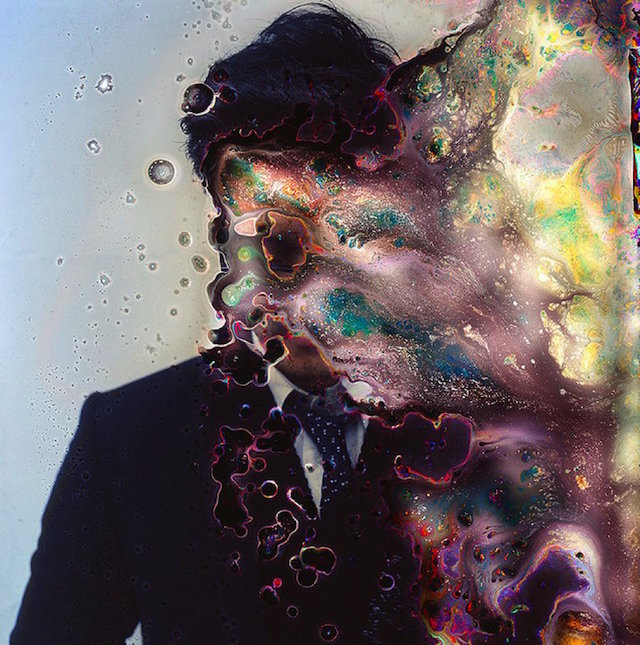
Gannon Burgett explains the process behind Seung Hwan Oh’s project Impermanence:
[I]t’s a series of microbe-mauled portraits that hardly resemble what they were originally captured as. Seung-Hwan gets these results by immersing developed film into water and then adding in various collections of microbes. Over the course of a few weeks, months or years, the microbes destabilize and eat away at the silver halide particles in the emulsion. The final images are what remains of the organic process taking place, where the dyes and emulsion run off and change color over time.
It’s an interesting approach to photography that takes a normally still medium and adds a dimension of something active, live, and dynamic. When you view Oh’s photographs, the question is no longer the significance of what is depicted; instead, what catches your eye is the tension between what is shown and what is already lost. Though art is naturally created to be consumed, in this case, the art itself is the act of consumption, the parts of the photographs that have been literally eaten away by a relentless force of nature. The result, in Oh’s word, can be witnessed as something that is “entangled creation and destruction that inevitably is ephemeral”.
Reviewing Letters to Vera, Philip Hensher marvels at what Vladimir Nabokov’s correspondence with his wife reveals about his talents as a writer:
The letters are full of rapturous comment, of course, but their substance, and the reason they are so absorbing, is Nabokov’s intense interest in the world around him. He knows that when you are in love, the slightest detail of the beloved’s world and days are interesting: what he might have learnt, through writing these letters, is that the specific is always interesting for readers, too. All through those 1926 letters, he remembers to tell Véra what he has eaten — it’s slightly comic, because Vladimir is not an adventurous eater, and it becomes a litany of good plain food — ‘lamb chop, and apple mousse… meatballs with carrot and asparagus, a plain brothy soup, and a little plate of perfectly ripe cherries… broth with dumplings, meat roast with asparagus and coffee and cake… chicken with rice and rhubarb compote’. The point is that Véra will be interested, because it’s her man eating his meals far away from her; we are interested because the writer evokes and specifies.
Nabokov is such a great letter writer because he wants to interest, not just pour out his emotions. These letters must have been a joy to receive. He keeps his eyes open, and concentrates on recording what he sees:
Alongside the paths coloured stripes are daubed on beech and oak trunks, and sometimes simply on the rocks, like little flags to show the way to this or that hamlet. I noticed too that peasants put red earflaps on their percherons and are cruel with their geese, of whom they have plenty: they pluck off their breast feathers when the geese are still alive, so that the poor bird walks around as if in a décolleté.
Love, and intense care for what will interest his readership of one, directed Nabokov’s writing, and shaped it for the future. The clarity of observation here about a moment of terrible animal sadness holds in it the flash of insight at the beginning of Lolita, the parable about the monkey learning to draw and producing an image of the bars of its own cage.
Maia Szalavitz looks at research that suggests many people do. She protests the idea that we should treat addiction as a progressive disease that only gets worse over time:
According to the American Society of Addiction Medicine, addiction is “a primary, chronic disease of brain reward, motivation, memory and related circuitry.” However, that’s not what the epidemiology of the disorder suggests. By age 35, half of all people who qualified for active alcoholism or addiction diagnoses during their teens and 20s no longer do, according to a study of over 42,000 Americans in a sample designed to represent the adult population.
The average cocaine addiction lasts four years, the average marijuana addiction lasts six years, and the average alcohol addiction is resolved within 15 years. Heroin addictions tend to last as long as alcoholism, but prescription opioid problems, on average, last five years. In these large samples, which are drawn from the general population, only a quarter of people who recover have ever sought assistance in doing so (including via 12-step programs). This actually makes addictions the psychiatric disorder with the highest odds of recovery. While some addictions clearly do take a chronic course, this data, which replicates earlier research, suggests that many do not.
She continues:
So why do so many people still see addiction as hopeless? One reason is a phenomenon known as “the clinician’s error,” which could also be known as the “journalist’s error” because it is so frequently replicated in reporting on drugs. That is, journalists and rehabs tend to see the extremes: Given the expensive and often harsh nature of treatment, if you can quit on your own you probably will. And it will be hard for journalists or treatment providers to find you.
 The Dish