Watching the Northern lights in real-time:
Quote For The Day
“I think one of the poignant things about human beings is that they’re so undefended, physically. And that there’s an absolute relationship between that defenselessness and everything that’s impressive about them. I think a lot of us would like to be turtles and porcupines, and I think that in a way one of the impulses of human beings is to defend themselves in a way that nature did not. But I think the other impulse is to just love the experience with nothing to protect oneself, and actually feeling in fact no barrier. People know about their mortality in a way that we can’t know that any animal knows. They know about Earth being a ball in space. Intelligence of the high human sort could be translated as defenselessness, because we can know many things that are very hard to bear,” – Marilynne Robinson, in an interview included in A Door Ajar: Contemporary Writers and Emily Dickinson.
Snakes On A Higher Plane
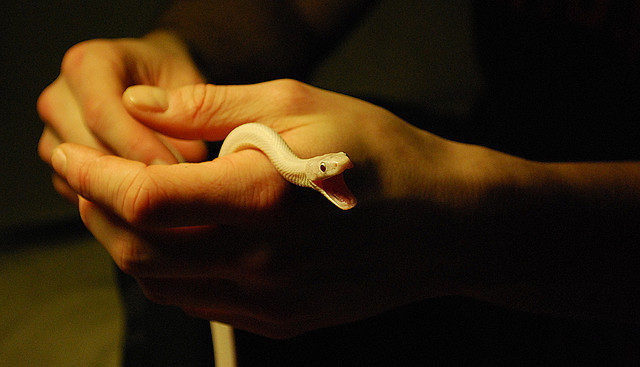
Asher Elbein paints a sympathetic portrait of Southern congregations that incorporate snake-handling into their worship rituals. “The point,” he writes, “is to have enough faith in God to take up something wild, untamed and unpredictable”:
That unpredictability, however, is the root of the danger. However acclimated to humans a snake might be, it’s never truly tame. The more often a person handles, the greater their chances for a bite. Bites aren’t necessarily fatal: Toxin is both metabolically expensive for a snake to produce and its only tool for subduing prey. So snakes often give “dry bites,” warning nips that inject none of their precious venom. A full bite from some vipers, like the copperhead, is easily survivable. Contrary to popular belief, though, it’s impossible to become immune to snake venom. Instead, successive bites often lead to worsening allergic reactions. Hensley claimed to have been bitten more than 400 times before he died. Coots was bitten eight times before he received the killing strike. Handling snakes is not a death sentence, but any handling could be your last.
Practitioners are well aware of this. There’s a constant repetition in recorded interviews: Don’t take up a serpent if you don’t feel the Spirit. Don’t handle for show. There’s death in that box, boy, and you open it at your peril. At the same time, they embrace the risk. Life and death rest entirely in God’s hands, they believe, and whatever happens while handling is His will. Sometimes He holds back the snake. Sometimes He calls them to Heaven. It’s not something they expect the rest of the world to understand.
(Photo by Chris Zielecki)
The View From Your Window

Brooklyn, New York, 6.28 pm
Finding Forgiveness
In a self-interview at The Nervous Breakdown, Tod Goldberg shares what he learned from sacred Jewish texts while researching his novel Gangsterland:
I actually learned more from the Talmud than I did the Torah, since I was already generally familiar with the Torah. The Talmud, however, has so much insight into the laws and philosophy that are the bedrock of the faith, plus essentially provides case law, which is pretty fascinating to read. I also read a great many books on Jewish thought and identity, which were incredibly helpful. What I learned and what I appreciated personally are vastly different than what was good for Gangsterland. What changed for me personally was a greater appreciation for what it has meant, historically, to be a Jew. That even if I don’t believe in every tenet of the religion per se, I am nevertheless a Jew, and with that comes history, and with that comes a certain a genetic duty. I also learned that the ancient Jews had an exceptionally nuanced understanding of human nature and were bedeviled by many of the same existential questions I still have, which made me feel pretty good, actually, because I think we all end up thinking our hopes and fears are uniquely idiotic, but here you have people in the 8th century concerned with the very things you are concerned by in the 21st. But the most important thing I learned reading all of these books was about forgiveness. Forgiving yourself. Forgiving others. Forgiving the mistakes you haven’t made yet. That was extraordinarily enlightening.
Creating Art, One Single Cell At A Time
Klaus Kemp, featured in the above short documentary, The Diatomist, carries on a Victorian tradition that marries art and science to beautiful effect:
Few did obsessive nature handicrafts like the Victorians, whether it was seaweed scrapbooking or shell arranging, something of the salon repression boiling over into insanely labored DIY arts. One of the fascinations was with the newly accessible microscopes, which showed previously invisible specimens such as the single cell algae diatoms, of which there are hundreds of different types in the world. With a single hair, practitioners would scoot the diatoms, encircled by iridescent glass-like silica cell walls, into kaleidoscope patterns only viewable beneath a lens. …
In the short documentary The Diatomist … [filmmaker Matthew] Killip visits Kemp at the work he’s perfected over years of research, showing some of the gorgeous miniature art, as well as expeditions to the water the diatoms call home. “It doesn’t matter whether it’s a horse trough, or a ditch, gutters, you name it, where there is water it’s worth having a look,” Kemp says in the film.
Chris Higgins spoke to Kemp about his work:
“As a youngster of 16 I had a great passion for natural history and came across a collection of sample tubes of diatoms from the Victorian era,” Klaus told Wired.co.uk. “I was immediately struck by the beauty and symmetry of diatoms. The symmetry and sculpturing on an organism that one cannot see with the naked eye astonished me, and after 60 years of following this passion I can still get excited from the next sample I receive or collect.”
Klaus is inspired by the original diatomists from the Victorian era whose works are well sought-after by collectors. Names such as Johann Diedrich Möller and R. I. Firth have inspired him so much that Klaus is planning to recreate some of their original exhibition slides himself. Finding those initial tubes while working for a Manchester biological supply company was just the first step of Klaus’ adventure in microscopy. He has since collected thousands of samples from many different sites, with each location having its own specific type or structure of diatom.
Writing About Death For A Living
Alex Ronan interviews Margalit Fox, who has written obituaries for the New York Times for nearly twenty years. Fox poignantly describes how she approaches cases of suicide:
One of the most heart-wrenching interviews I’d ever have to do was for a poet. I have maybe one suicide a year and they all seem to be poets. If I were an insurance company, I’d never write a policy for poets. This particular poet had shot himself, which I knew from other sources. … I knew I’d have to call this poet’s wife and ask her to confirm the cause of death. There is nothing in Emily Post on making that call. It’s bizarre and horrific that as a stranger you’re calling someone cold and saying, Hello, you don’t know me, but I’m going to ask about the most painful thing in your life, which just happened yesterday, and I’m going to publish it where millions of people can see it. I called up, I took a deep, silent breath, I introduced myself and then—I’d normally never be this familiar with a source—I said, Honey, what the hell happened? God bless her, she told me. It was New York, in the summer, they had a bedroom air conditioner that was very noisy and, as his last act of tenderness to her, he made sure it was on, knowing the noise of the AC would cover the sound of the shot.
She continues:
Suicides, particularly young suicides, are very, very painful. You can’t not be affected by having a story on your desk about someone in their twenties or thirties who has just shot himself. Very rarely is there an emotional toll, maybe once or twice a year. Happily, the vast majority of people we write about are people who’ve died in their beds in their eighties, having lived long, fruitful lives.
Why Was Jesus Really Crucified?

Douglas Main details a new paper from Yale University’s Dale Martin suggesting that it might have been because his disciples were carrying weapons:
The biblical books of Mark and Luke both state that at least one (and probably two or more) of Jesus’s followers was carrying a sword when Jesus was arrested shortly after the Last Supper, at the time of the Jewish festival of Passover. One disciple, Simon Peter, even used his sword to cut off the ear of one of those arresting Jesus, according to the Gospel of John. This militant behavior almost certainly wouldn’t have been tolerated by the Romans, led by the prefect Pontius Pilate, Martin tells Newsweek. For example, historical documents show that it was illegal at the time to walk about armed in Rome and in some other Roman cities. Although no legal records survive from Jerusalem, it stands to reason, based on a knowledge of Roman history, that the region’s rulers would have frowned upon the carrying of swords, and especially wouldn’t have tolerated an armed band of Jews roaming the city during Passover, an often turbulent festival, Martin says.
“Just as you could be arrested in Rome for even having a dagger, if Jesus’s followers were armed, that would be reason enough to crucify him,” says Martin, whose analysis was published this month in the Journal for the Study of the New Testament.
Reactions to the paper have been mixed. Bart Ehrman told Main that “it’s making me rethink my view that Jesus was a complete pacifist.” But not everyone is convinced:
Paula Fredriksen, a historian of ancient Christianity at Hebrew University in Jerusalem, says Martin’s paper has several holes “that you could drive trucks through.” For one, she doesn’t think it’s legitimate to assume that since carrying arms was illegal in the city of Rome, the same laws necessarily applied in Jerusalem. Control of the city wasn’t too tight, she argues, and the Roman prefect visited only during Passover, to help keep the peace. And during this time it probably would’ve been impossible to police the thousands of Jews that spilled into Jerusalem.
“I can’t even imagine what a mess it was,” she says. Furthermore, she says, the Greek word used in the Gospels that Martin interprets as sword really means something more akin to knife. And these could be easily concealed, she adds. “Only professionals,” like soldiers, “carried swords,” she says.
(Image: Caravaggio’s The Taking of Christ, 1602, via Wikimedia Commons)
“I Cannot Imagine My Freedom Without Women”
Richard Rodriguez recently sat down with “On Being” host Krista Tippett for a conversation about “The Fabric of Our Identity.” The entire exchange is worth listening to, but this passage from Rodriguez about women and religion, and their influence on his life as a gay Catholic, stands out:
[A]s a Catholic, I was surrounded by an iconography, which was luscious and physical, and there was the bleeding Christ on every cross that I ever saw. And the eroticism of the religion was, to my imagination, very, very rich from an early age. At some level, this church which denied me also gave me a great deal. I want to be clear about that. Um, I do not want to present myself in any way as oppressed. It did teach me, and this is the point of Darling. I’m — Darling in the book is not Richard Rodriguez. Darling in the book is a woman, a friend of mine, who has lunch with me in Malibu, California, on the day her divorce was finalized. She has since died of cancer. The chapter really is about women and religion. And I think that I came upon that theme, that subject, because I am gay.
Uh, I don’t want to talk about myself. But all I want to say to the Christian churches, is that the man that I’m with, I will say not even — I won’t even give myself the grandeur of this word. But his achievement and his importance to me is that he has loved me. And he has taught me the import of that word. The church will not give us that word. I date my emancipation as a homosexual man with the women’s movement. And I notice that Susan B. Anthony came to this place to argue for the vote for women. When women begin to call for the vote, it is a revolutionary act, and it liberates me.
And I’ll tell you how. For the first time, women are saying I don’t want to be identified merely with what I am at the house. In civic society, I don’t have to be somebody’s mother, or wife, or grandmother. I want to be judged equally with any man in the voting booth. And when women get the vote, they move out of the kitchen in something like the way that they allowed me several decades later, to move out of the closet. These movements are related to each other. I cannot imagine my freedom without women.
Listen to our Deep Dish podcast with Rodriguez here.
A Cloud Of Unknowing

Sociologist Jay Livingston recently took the Pew quiz on religious knowledge, which led him to the results of their survey of Americans’ religious literacy. He tries to explain the above findings, which show nonbelievers, Jews, and Mormons scoring the best:
Jews and Mormons have to explain to the flock how their ideas are different from those of the majority. Atheists and agnostics too, in their questioning and even rejecting, have probably devoted more thought to religion, or more accurately, religions. On the questions about Shiva and Nirvana, they leave even the Jews and Mormons far behind.
For Protestants and Catholics, by contrast, learning detailed information about their religion is not as crucial. Just as White people in the US rarely ask what it means to be White, Christians need not worry about their differences from the mainstream. They are the mainstream. So going to church or praying can be much more about feelings – solidarity, transcendence, peace, etc. That variety of religious experience need not include learning the history or even the tenets of the religion itself. As Durkheim said, the central element in religion is ritual – especially the feelings a ritual generates in the group. Knowing the actual beliefs might be a nice addition, but it’s not crucial.
 The Dish
