According to the British philosopher David Papineau, it’s a sport where nurture trumps nature:
When it comes to environments … cricket and soccer are like chalk and cheese. Every kid gets plenty of chance to kick a football around. But cricket skills are by no means easily acquired. It’s not just that you need special equipment and facilities: there are deep-rooted habits to overcome. Both batting and bowling are very unnatural, all sideways and no swiping. So you need to be taught young; if you haven’t been initiated before your teenage years, it’s probably too late. … I’d be surprised to find any top-class cricketers without at least one enthusiastic club cricketer somewhere in their family background.
If environments matter more in cricket than in soccer, then this makes cricketing skills look less genetically heritable than footballing ones. In football, most of the differences come from genetic advantages just because there aren’t many environmental differences (if you live in a soccer-mad nation, opportunities to play are everywhere). But in cricket, there would still be a wide range of abilities even if everybody had exactly the same genetic endowment, because only some children would get a proper chance to learn the game. In effect, environmental causes are doing a lot more to spread out the children in cricket than they are in football. To sum up, cricket runs in families precisely because the genetic heritability of cricket skills is relatively low.
Teju Cole shares a heartening report about Nigeria’s successful public health response to the Ebola crisis:
Meanwhile, Jon Cohen suggests that Ebola survivors could help stem the spread of the disease:
As far back as 431 B.C., the Athenian historian Thucydides recognized that people who survived the plague made for excellent caregivers. As Thucydides wrote: “It was with those who had recovered from the disease that the sick and the dying found most compassion. These knew what it was from experience, and had now no fear for themselves; for the same man was never attacked twice—never at least fatally.” Nicole Lurie, HHS’ assistant secretary for preparedness and response, is one of several doctors who suspect that people who survived Ebola may have developed immunity to that strain of the virus and could care for the infected with little risk to themselves. Lurie suggests that in these West African countries, where jobs are hard to find and Ebola carries such serious stigma with it that survivors sometimes are shunned, training survivors could be a win-win.
Michaeleen Doucleff notes that the CDC and WHO are on the same page when it comes to fighting the disease, but the horizon doesn’t look good:
Both agencies agree on how to turn the tide of this epidemic: Get 70 percent of sick people into isolation and treatment centers. Right now, [WHO’s Christopher] Dye says fewer than half the people who need treatment are getting it. If all goes well, Dye expects the goal of 70 percent could be reached in several weeks.
“Our great concern is this will be an epidemic that lasts for several years,” he says. The epidemic has hit such a size – and become so widespread geographically – that Ebola could become a permanent presence in West Africa. If that happens, there would be a constant threat that Ebola could spread to other parts of the world.
Rohit Chitale of the Armed Forces Health Surveillance Center calls the international spread of Ebola “a significant possibility,” leaving poorer countries at highest risk:
The [CDC and WHO] and many nations have established guidance for entry and exit screening (e.g., thermal or fever screening at airports), and many nations had put them in place weeks or even months ago. Regardless, some cases will probably be imported into other nations. However, [if] cases occur in nations with a strong medical and public health infrastructure, like the U.S., patients that are suspected for Ebola will be isolated, exposed patients will be quarantined, and we would expect little to no spread of cases locally. So this is really not a direct threat for nations with robust health systems. But where resources are lacking and health systems are inadequate (as in West Africa), and where initial cases are not quickly discovered and managed, there is a real threat of local spread in the community from imported cases.
James Ciment argues that Americans have a special obligation to help those suffering in Liberia:
Pioneers from America settled Liberia and established it as Africa’s first republic; they modeled its institutions after our own. If we are true to our values and obligations, we will not abandon Liberia again once the current crisis has passed. Our government has earmarked an unprecedented sum to reverse the epidemic in Liberia and its neighbors. But as Americans, we can and should give as individuals. There are any number of organizations doing sterling work in fighting Ebola and aiding its victims—Doctors Without Borders, Save the Children, Global Health Ministries. Find one online and send it money now.
Linker feels that Americans need to hear “a little less about how important it is for us to blow other people to bits and a little more about what it’s like to live in a world in which a single nation has the power to strike a deadly blow wherever it wishes, anywhere on the planet”:
How would we feel, I wonder, if we lived in a world in which another country was so powerful that it could inflict military pain on any nation, including us, with impunity? Without an act of imagination, we can’t even begin to answer that question — because we are the only nation in that position, or even close to it. Russia, our nearest rival, may be flexing its muscles in Ukraine. But as with all of Russia’s post-Soviet military adventures, this one is taking place right next door. The United States, by contrast, hasn’t fought a war with a neighboring power since the mid-19th century, and it regularly (as in: every few years) starts wars many thousands of miles from its territory. In this sense at least, America truly is an exceptional nation.
I will never write a word in defense of ISIS and its bloodthirsty, homicidal ambitions. But if we wanted to understand some of what motivates people from around the world to join its seemingly suicidal cause, we might start with the very fact of America’s incontestable military supremacy and the cavalier way we wield it on battlefields across the globe.
More reactions are appearing to new efforts to combat campus rape. Megan McArdle writes of a new affirmative-consent law proposed in California:
It seems to criminalize most sexual encounters that most people have ever had, which (I hear) don’t usually involve multistep verbal contracts. It appears designed to be unequally applied to men and women or, alternatively, to create a lot of cases of “mutual rape.” And it doesn’t fix the actual thing that makes rape hard to prosecute, or stop, which is that there are often only two witnesses who know whether or not the sex was consensual, one of whom was often intoxicated.
What bothers me is the twin rules that if a woman knowingly has any alcohol at all, a man cannot have sex with her without fear of being charged with rape, but while a woman’s ability to make decisions is degraded by alcohol, a man’s is never legally degraded.
Obviously if she was tricked into drinking alcohol or if she is so drunk that her speech is slurred or has lost her motor skills, let alone unconscious, she isn’t in a position to say no. But that is different from willingly having a drunk hookup with an equally drunk dude, and the next morning regretting the whole incident, and by the end of the week, with the encouragement of some friends, deciding that the guy should have said no to her willing action so now it’s rape. Makes me glad I’m married and don’t have to deal with the current situations on campus.
Responding to both Freddie and McArdle, Elizabeth Nolan Brown offers a class critique of the high-profile focus on campus rape:
[M]ainstream feminists have taken up the cause of affirmative consent on campus with vigor. It seems to epitomize critics’ charge that these feminists are only concerned with the problems of the privileged and middle-class. Only about one-third of Americans ever earn a college degree. Only about six percent of Americans are currently enrolled in college, and far less on traditional college campuses. Why are the intricacies of consent for this population so much more important than, say, finding funding to test the backlog of rape kits—something that could help catch existing rapists and protect people regardless of their educational attainment (or incapacitation) level?
Tara Culp-Ressler, meanwhile, talked to some college dudes about the White House campaign:
The college students who spoke to ThinkProgress said they welcome the shift away from approaching sexual assault as an issue that individual women need to protect themselves against. Targeting efforts toward men, they said, could eventually encourage more college guys to tell their friends that they shouldn’t take advantage of drunk people.
“Here at college, it means men on campus will set the precedent that sexual assault is not okay — and beyond that, that all of the microaggressions along the spectrum of harm that lead to rape culture are also not okay,” John Damianos, a sexual assault prevention activist at Dartmouth College who has been involved in advising the new White House Task Force, explained. Those microaggressions could range from making a rape joke, to suggesting that a sexual assault victim was “asking for it” because she wore a short skirt to a party, to catcalling a woman on the street.
Sorry, but Alan Arkin beat Leonard Cohen to that punch back in the 2006 movie Little Miss Sunshine. He plays the part of a grandfather in a nursing home who has decided to take up heroin addiction … “What’s it going to do, kill me?”
Another wasn’t a fan of the essay:
I wanted to agree with it, but as he went on, the essay went further from my expectation – a statement about dignity and quality of life in the face of our focus on more years – and into a “if it’s not going to always be awesome like now, forget it” entitlement piece. Where I really turned on him:
Today he can swim, read the newspaper, needle his kids on the phone, and still live with my mother in their own house. But everything seems sluggish. Although he didn’t die from the heart attack, no one would say he is living a vibrant life. When he discussed it with me, my father said, “I have slowed down tremendously. That is a fact. I no longer make rounds at the hospital or teach.” Despite this, he also said he was happy.
He swims, he reads, he lives independently, he enjoys his family. But he’s slowed down! Better off dead, since nobody can possibly live a vibrant life without climbing Kilamanjaro.
One of my aunts has been a cripple since childhood, when she contracted polio. She’s led a very interesting life, even with lots of outdoor activities, such as snow and water skiing. Good thing Zeke Emanuel wasn’t her father.
Another is even more harsh:
Emanuel’s piece is the kind of jibberish that makes it challenging to have serious discussions with religious people.
It’s easy to say dreamy things like that when your soul “lives” forever. When you consider the equally plausible (more plausible for me, but let’s say “equally plausible” for the sake of argument) chance that we have a limited amount of time sandwiched between an eternity of darkness and nothingness, I want every single second I can squeeze out before eternity continues on without me, and if some douchebag is willing to give up their precious time prematurely, I’ll gladly take theirs too.
Of course EVERYBODY hopes to have a good quality of life while they are alive, but what kind of dolt wants to die while there is still the potential of multiple decades of vibrant life? Not everyone is John McCain, Joe Biden, or Hillary Clinton, but to see those people in their 70s, if not 80s (McCain?) reminds me that even if a little slower, a little grumpier, and a little more prone to hyperbole, my 70s, 80s, and maybe even 90s can be a rich experience.
And I am looking as forward to those years, as my 40th year is coming up. Emanuel’s piece is a kind of preachy selfishness typically reserved for millionaire inheritance babies pining for a “normal life” in a studio apartment while most everyone else works their ass off just to get by.
Another thinks of the children, and more:
While I like several of Emanuel’s philosophical points about shortening old age, he doesn’t state one of them clearly enough: for some people, old age is just really boring. Which leads me to wonder if his comments are a bit academic when it comes to creativity, because there are a lot of people who don’t particularly value creativity and don’t practice it.
But my biggest problem with Emanuel’s proposal is that he doesn’t discuss a decision to “die at 75” if the person in question has a spouse or dependent child (such as a mentally handicapped child, perhaps one without siblings). Emanuel talks about his daughters, who are presumably independent, but he seems to think that by 75 a parent’s job is over. That’s true for most parents, but for some, there’s a dependent child who will be left without a caregiver if the parent dies. Certainly plans need to be made so the child will get decent care even when the parents are gone, but the child may need the comfort of a parent’s visits as long as possible when the child isn’t a fully functioning, independent adult.
For a couple, aging is kind of a mutual endeavor, and one person often supports the other in some way, while the other provides other kinds of support. In a lot of the marriages I’m familiar with (conventional marriages from the 1940s and ’50s), the aging male supports the wife financially, because his retirement and pension benefits are greater, and she supports him through caregiving – cooking or nursing, for instance. Each may act as an emotional anchor for the other. I knew one older couple where the husband, a physician, was warned that he might be developing prostate problems indicative of cancer. He chose to ignore the diagnosis and died a decade or so before his wife. She was devastated when he died, and when she developed dementia he wasn’t there to help her. She felt betrayed because he hadn’t cared enough about her to get medical care so they could be together longer.
I also question the decision to avoid medical care altogether after age 75 as an expedited path to a quicker death. I am thinking of conditions like Lyme disease or rheumatoid arthritis that make life pretty uncomfortable but may not lead to a quick and deadly end – just a long-drawn-out decline. It seems to me that there is a flaw in his medical reasoning, but I’m not a physician, so I’m just making guesses here.
Another makes many essential points:
As a former smoker who is also HIV positive, I want to chime in on Emanuel’s piece and the dying thread. I agree with Linker that Emanuel’s piece seems to be obsessively focused on productivity, and I have a problem with that. But, this has been a recent topic of discussion in our family, and I would like to share my thoughts.
Both my mother and her sister (mid-80s) are in full-time assisted living. Both have Alzheimer’s. Both are confined to wheelchairs. The last time I saw my mom – this summer – I lost it. She is no longer my mother. She can’t even put together a sentence. You can see her trying – but that’s about it. She’s not there. She’s gone. She is, sadly, a lump.
I will not die that way.
My siblings and I talk about dying well, and we talk about the fact that we have come to believe that part of living well means dying well. For my brother, that means driving a Harley into the Grand Canyon. My sister talks about taking a rowboat on Lake Michigan in January, and then slipping overboard. My plan is more involved. I want to spend a full summer at the family retreat, inviting my friends in staggered groups to hang out and say goodbye. And then taking poison.
No matter what, everyone in our family wants to die well. No matter what – and unlike Emanuel – suicide seems a decent enough option.
For me, this is not some “out-there” concept. During the AIDS crisis, I participated in gentle deaths. Usually it just involved cranking up the morphine. In both cases, I was the designated look-out. But, whether done in the hospital (with the tacit approval of hospital staff) or at home (with the tacit approval of Hospice staff), we knew what we were doing. The disease was gruesome and painful. Brain lesions often took away mental faculties. You know what it was like, Andrew. Helping our friends to die well was the humane thing to do.
My cousin insists that despite our talk, we won’t take action. And I admit I am slow at putting the plan on paper. I also admit that it is likely at least one of us – perhaps all three of us – will fail in our dream of dying well.
But I know this: At least our generation is talking about it – something my mom’s generation never did. We simply didn’t talk about death in our family and other than the basic paperwork (powers of attorney, wills, etc.); there was no discussion about how to die.
We are having that discussion now, and we should. And it WILL mean a gradual and eventual embrace that our deaths are a part of our lives – and that there’s nothing wrong with shaping them, no matter how you choose to do so.
My dad dropped dead of a heart attack at 70. It was shocking – very hard to deal with. But, it was a good death. He didn’t fuck around. He split. (He used to say, “Let’s blow this pop stand.” And, that’s what he did.)
Seventy is my goal, too. I figure that’s an outside shot anyway, given the fact that I’ve been HIV positive for now nearly twenty years. I have seventeen years to go to get me to seventy. If I make that – if I live as long as my father – I will be thrilled. (I will have beat the odds.)
And you bet your ass I will start smoking then. That’s my plan. I can’t wait to taste the sweet smoke and the nicotine rush of my beginning-of-the-end celebration.
For me, dying well has nothing to do with productivity. For me – like you – having been given a new lease on life in my late thirties – it’s about cherishing this precious gift but also knowing that part of the gift is to let go when the time is right. I hope I do it well. I hope my brother and sister do, too.
As an atheist, I take issue with this line of yours: “How ironic that it’s the faithless who are the most able to appreciate the struggles of other minorities.” How so? It’s only ironic if you ignore the fact that all of the world’s major religions preach persecution and victimhood to their flock – and not just that they are persecuted, but that they are UNIQUELY persecuted above all others.
I’m reminded of that old anti-drug ad with the father and son: “Where did you get this persecution complex?!!”
“You Jesus! I learn it from watching you!”
Another:
Those findings aren’t surprising, and they certainly aren’t ironic. Atheists pass by default. We never need do anything that marks us as atheist – we don’t look atheist, dress atheist, or attend atheist parties, or have atheist names. So we never feel vulnerable, unless we intentionally open ourselves up to it. Any discrimination we encounter is theoretical, and we can hide from it anytime we like without compromising our beliefs. This isn’t true of any other group on that list.
And another notes:
It’s probably worth adding that also according to Pew, Americans have the most negative associations with Atheists and Muslims. It’s a bit ironic that the most popular groups think they’re under attack while groups that empathize the most are perceived as the least positive/trustworthy.
The first and most important difference, plainly and simply: Obama didn’t lie us into this war. It’s worth emphasizing this point, I think, during this week when Obama is at the United Nations trying to redouble international support to fight ISIS, and as we think back on Colin Powell’s infamous February 2003 snow job to Security Council. Obama didn’t tell us any nightmarish fairy tales about weapons of mass destruction that had already been destroyed or never existed. He didn’t trot his loyalists out there to tell fantastical stories about smoking guns and mushroom clouds.
The evidence for the nature of the threat posed by the Islamic State is, in contrast, as non-fabricated as evidence can be and was handed right to us by ISIS itself: the beheading videos, and spokesmen’s own statements from recruitment videos about the group’s goal being the establishment of a reactionary fundamentalist state over Iraq, Syria, Jordan, and Lebanon. That’s all quite real.
The in-tray has been full of similar sentiments. My response is: sure, so far as it goes. But Tomasky’s argument doesn’t go very far. And the way in which Obama supporters have lamely acquiesced to this reckless war fomented by a dangerous executive power-grab is more than a little depressing. It strikes me as uncomfortably close to pure partisanship. I can’t imagine them downplaying the folly of this if a Republican president were in charge.
Sure, we are indeed not being grotesquely misled this time about non-existent WMDs. But we are going to war despite the fact that ISIS is no more a direct threat to the United States than Saddam was – arguably much less, in fact. We have no answer this time to the unanswered question last time: what if our intervention actually galvanizes Islamist extremism rather than calming it? And the Arab coalition that Tomasky cites as evidence that this war is a far less American-centric one than 2003 has some issues when you confront reality. Here’s the latest:
Jordan said that “a number of Royal Jordanian Air Force fighters destroyed” several targets but did not specify where; the Emirati Ministry of Foreign Affairs said that the air force “launched its first strikes against ISIL targets” on Monday evening, using another acronym for the Islamic State. American officials said that Saudi Arabia and Bahrain also took active part in the strikes, and that Qatar played a “supporting” role.
This may be important window-dressing, but window dressing it still is. It sure isn’t close to the coalition George H W Bush assembled in 1990 – and it’s much smaller than George W Bush’s coalition in 2003. More to the point, the key element of any successful strategy will be the position of the Sunni Arab tribes – and they are still sitting on the sidelines. Turkey is AWOL so far. And the fact that the Arab states do not want their contributions to be broadcast more widely reveals the depth of the problem. Obama has Americanized the problem. Once you do that, the regional actors get even more skittish, because the only common thing for so many of the populations represented by these autocrats is loathing of the United States. This is the Arab world. The US will never get anything but hatred and cynicism and contempt from it.
Then there’s the question of authorization.
George W Bush got a few Security Council resolutions (if not the final, vital one). Obama hasn’t even bothered – he’s bombing a sovereign nation without even feigning a request for formal authorization. GWB – against Cheney’s wishes – procured a clear declaration of war from the Congress. Obama seems to have decided that he is more in line with Cheney’s views of executive power than George W Bush’s – and has blown a hole so wide in any constitutional measures to restrain the war machine that he has now placed future presidential war-making far beyond any constraints. If that isn’t an outright abandonment of almost everything he has said he stands for, what would be?
Bush’s war had a vague and utopian goal: the establishment of a multi-sectarian democratic republic in Mesopotamia. He had close to no plans for the occupation; and no real understanding of how quixotic a project he was promoting. Obama’s goals are just as quixotic – “ultimately destroying” ISIS from the air alone – and he has no Plan B for failure. Bush tried to defeat a Sunni insurgency with a multi-sectarian government in Baghdad. It never happened – and we had to bribe the Anbar tribes instead, and, even then we needed 100,000 troops to keep the lid on the whole thing.
Obama says he is fighting a Sunni insurgency with a broadly based Baghdad government – but replacing Maliki has led to no such thing. There is still paralysis in Baghdad over the interior and defense ministries, no cross-sectarian national entity to take the fight to ISIS, and the real risk of a Shiite government actually reinforcing the Sunnis’ sense that the US and the Shiites are now intent on persecuting them even further. That makes the prospects for this attempt at pacification even worse than in 2006.
And look: I think Obama is sincere in doing what he can with the Baghdad mess; but we have to be crazy to buy this line of argument in counter-insurgency at this point in history. We are fighting a Sunni insurgency on behalf of a Shiite government and a near-independent Kurdistan, a fight which might well empower Iran and even Assad. This is about the worst formulation for this struggle as one could come up with. It does not bring Sunnis into the struggle; it may well keep them out.
Of course I wish I didn’t have to write this. And it is, of course, true that we are not torturing prisoners with the sadism and insanity of the Cheneyites. It is true we are not sending in 140,000 troops into another country. We are sending almost none – but to achieve the same result! To do the same thing we did last time and hope for a better outcome is the definition of insanity. But to do the same thing with even less of a chance to achieve it takes things to a new level of incoherence.
This is an illegal war, chosen by an unaccountable executive branch, based on pure panic about a non-existent threat to the United States, with no achievable end-point. Apart from all that, it’s so much better than Bush, isn’t it?
(Photo: Obama holds a bilateral meeting with Prime Minister of Iraq Haider al-Abadi during the 69th United Nations General Assembly in New York City on September 24, 2014. By Allan Tannenbaum-Pool/Getty Images.)
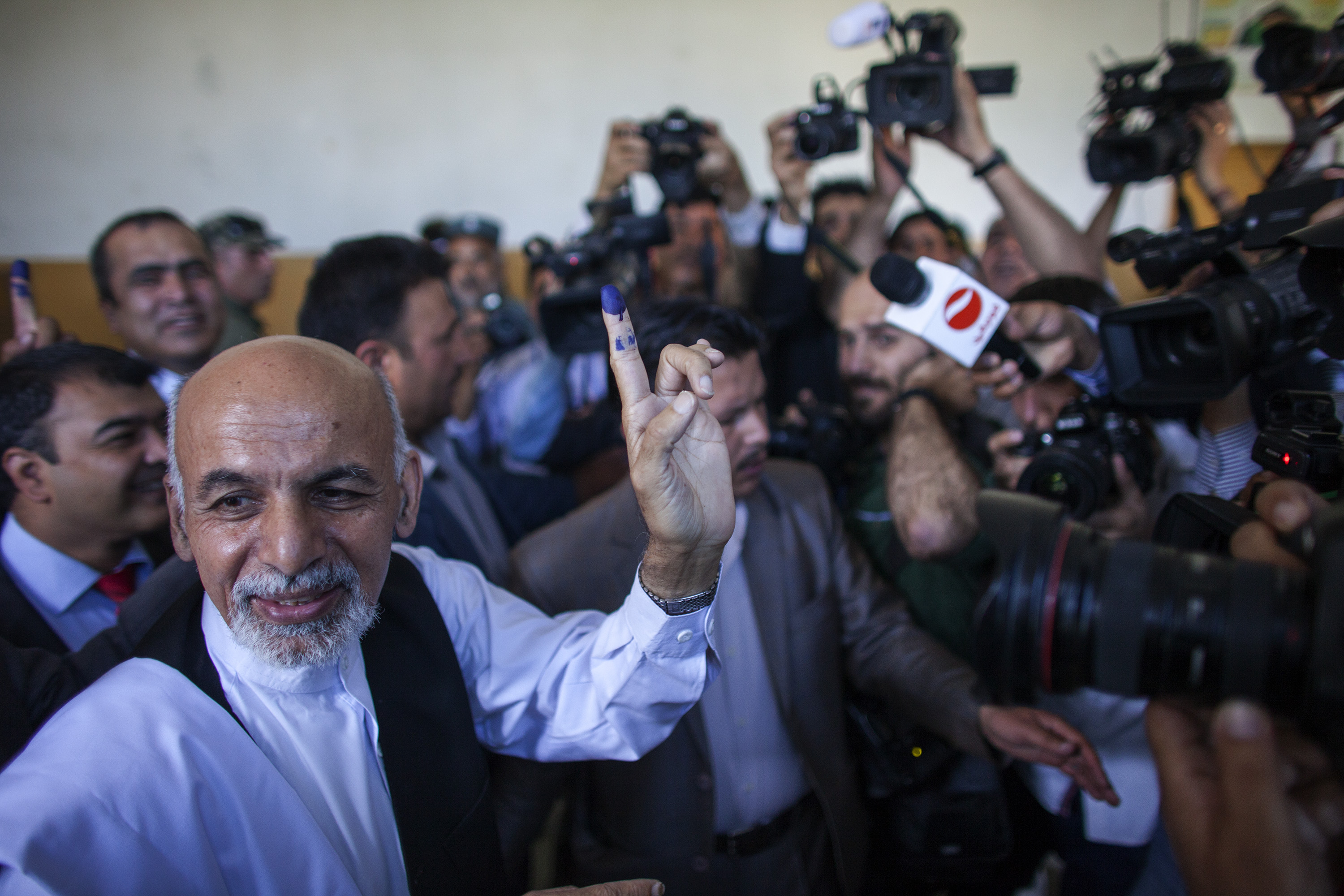
The runoff round of the Afghan presidential election on June 14 was massively rigged, and the ensuing election audit was “unsatisfactory,” a result of Afghan government-orchestrated fraud on a scale exceeding two million fake votes, completely subverting the will of the Afghan people. That is the watered-down conclusion of the press release of the European Union’s yet-to-be-released report detailing its thorough and non-partisan investigation of the entire Afghan election. The report was completed last week, according to sources in Kabul who have seen it, but political pressure has so far resulted in heavy redaction and kept it from public release.
The key point is this: Ashraf Ghani did not win the election.
The U.S. Center for Naval Analysis (CNA) concluded in July that it was mathematically impossible for Ghani to win, given Afghan demographics and the initial 46 percent to 32 percent first-round vote spread, according to sources familiar with the analysis. According to sources who reviewed the private report, the top experts in statistical analysis in the United States used every known computer model of election balloting and concluded that a Ghani victory was scientifically impossible. In simple terms, there is no mathematical doubt that Abdullah Abdullah won.
Though he admits there was “massive fraud,” Jonathan Murray defends the election:
As an auditor, I personally invalidated thousands of votes — a task which I did not take lightly. But in a country that has never before experienced a peaceful transfer of power from one leader to another, fraud and imperfect elections are to be expected. Democracy will mature over time in Afghanistan, and in five years elections will be more legitimate than they are now, and even more legitimate five years after that.
Some elections “experts” and academics will call the 2014 runoff a farce, and in some ways, that may be true. Nonetheless, the Afghan people who stood up to the Taliban and risked their lives to go to the polls deserved a clear and decisive result, and one which reflected the will of the people. I know more than a few Afghans questioned the point of the runoff if there was just going to be a power sharing agreement anyway. But the fact that these questions are being asked in the first place show that Afghans know just how much is at stake when it comes to future elections; while this will discourage some who will stay home next time, others will work that much harder for more transparency, less fraud, and higher participation.
Just as Afghanistan has been lucky in its choice of president, it has been fortunate in its choice of opposition leader. Abdullah is a veteran of the bloody conflicts of the 1990s. But, unlike many of his comrades and adversaries from that period, he is sober-minded, responsible, and moderate. The past few months have sown some ill will between him and Ghani, but he has shown himself able to rise above personal politics before: he did so when he joined Karzai’s first administration as foreign minister, he did so when he reined in potentially violent supporters after losing a fraud-ridden presidential contest to Karzai in 2009, and he did so when he resisted the threats of present-day backers (such as Atta Muhammad, the governor of Balkh) to launch a civil war in support of his most recent campaign. Abdullah saw Kabul’s future as a bomb-strewn rubble field and had no desire to be president of it.
Reasons for guarded optimism, however, go much deeper. Perhaps even more important than the election result itself is the power-sharing agreement that Ghani and Abdullah (aided by U.S. Secretary of State John Kerry) finalized over the weekend. Under this arrangement, Abdullah or his proxy will serve as the government’s chief executive, a newly created post that is expected to evolve into a prime ministership. Why is a rejiggering of the Afghan government so important? Because many of Afghanistan’s failures over the past dozen years have resulted from a mismatch between the structure of Afghanistan’s post-Taliban government and the realities on the ground.
(Photo: Afghan presidential candidate Ashraf Ghani holds up his inked finger as he speaks to media after casting his vote at a polling station on June 14, 2014 in in Kabul, Afghanistan. By Majid Saeedi/Getty Images)



 The Dish