Will Republicans Gut Obamacare?

Weigel previews what Republicans might do to the law if they take control of the Senate:

Every Republican senator and candidate knows that the Affordable Care Act passed in the budget reconciliation process, the only way to get a bill through without the threat of cloture. Every one of them thinks reconciliation can be used to gut it. “I think we got something with this tax issue,” McConnell reportedly told aides after the Supreme Court upheld Obamacare while defining its health care mandate as a tax. “Figure out how to repeal this through reconciliation.”

McConnell no longer talks like that in public. In a revealing interview with Politico’sManu Raju, McConnell walked through all of his 2015 priorities, all the ways they could be forced through in the budget process. He didn’t promise to repeal Obamacare. He didn’t even say that in a secret (then leaked) speech to a donor conference organized by the Kochs. The current plan is to use next year’s budget process to chip away at the law by ending the medical device tax, or ending the employer mandate, and forcing the president to veto or accept it. Basically, look at what the health care industry wants to change, then expect Republicans to agree with it.

Meanwhile, James Capretta and Yuval Levin suggest ways for Republicans to transition away from Obamacare:

[T]he insurance provisions of Obamacare have now moved millions of people into new coverage arrangements. Granted, many of those who have switched to new insurance plans did so because they concluded they had no other choice, and they would welcome a law that freed them up to get the kind of insurance they would prefer. For these people, the transition could be swift. But Obamacare also provides massive new subsidies to a relatively small portion of the population, and undoing those arrangements abruptly would be both unfair and unwise. Obamacare’s opponents should not make the same mistake its champions made in designing and implementing it.

Building in an adequate transition will not undermine the ultimate effectiveness of an Obamacare replacement plan. The goal is a functioning marketplace where consumers decide how to allocate resources, where all Americans have access to stable insurance, where quality care and medical innovation are rewarded, and where federal support for insurance enrollment is affordable for taxpayers. These are goals that are critically important for the long-term strength and vitality of the country, and they are goals that are more likely to be reached if Obamacare’s opponents wisely design short-term transition provisions to defuse opposition to a full replacement plan.


The Support For Obama’s War

Gallup finds that 60 percent of Americans support our attacks on ISIS. And a majority from both parties approve:

War Support

Aaron Blake is underwhelmed by these numbers. He observes that “the actions in Iraq and Syria have a lower initial level of support than almost every major U.S. military operation over the past three decades”:

60 percent is far less than the early levels of support for the wars in Iraq last decade (76 percent), Afghanistan in 2001 (90 percent), and the first Gulf War in the early 1990s (79 percent). It’s also less support than existed for smaller missions in Somalia in 1993, Afghanistan and Sudan in 1998 and Libya in 1986.

The only efforts which Iraq and Syria beat in initial popularity are the 2011 intervention in Libya, Kosovo in 1999, and Grenada in 1983. Given the negative coverage of the invasion in Grenada and the aforementioned war-weary American public in 2011, it’s not surprising to see Iraq and Syria outrank those too. Kosovo also ranked as a not-particularly-popular intervention.

Larison expects support to drop off:

The fact that only 39% favored military action a few months ago suggests that much of the current level of support for the war is ephemeral and won’t last as the war continues for months and years. That is especially true if the war is perceived as “not working,” and that perception is likely to grow thanks to the unrealistic stated goal of the war. As the Gallup report notes, the 60% figure is relatively lower than polling for most military interventions over the last thirty years, and once the initial “rally round the flag” effect wears off it is probably going to drop back down to significantly lower levels. The public’s underlying aversion to prolonged conflict is still there, and their opposition to sending ground forces into Iraq or Syria remains. Because there appears to be no effort to get Congress to vote on this anytime soon, and because the war is likely to last for several years, declining public support will become a serious political problem for the administration.

Who Ted Cruz Won’t Stand With, Ctd

A reader brings a personal perspective to a recent thread:

An issue that must be addressed is how Muslims in the Middle-East view Mid-East Christians in the context of the West’s recent military forays in the region: Mid-East Christians are viewed as subversives and American collaborators, because the US is considered a “Christian” nation.

During the 2003 invasion, Iraqi Christians were under constant watch by their neighbors who were looking for signs that these Christians were working with the American soldiers that were, in their view, unjustly occupying a Muslim country. There are many first-hand accounts of Chaldeans and Assyrians in Iraq being intimidated or threatened by both Shia and Sunni Muslims because they were perceived as traitors. This is especially true when American units would conduct sweeps of whole neighborhoods.

My aunt’s family was in Baghdad in 2005 when such a sweep hit their neighborhood.

After ransacking my aunt’s home (whose family is Chaldean), the Marine unit detained several “insurgents” in a nearby home. The next day, several dozen neighbors gathered in front of my aunt’s home and demanded that her husband explain what information he gave the Americans. One of the neighborhood elders (known as a “mukhtar”) demanded that the family turn their two young daughters over to the local militia until the detainees were freed.

My aunt’s family was lucky, as her husband was a well-known merchant with the financial power to bribe his way out of the predicament. Yet many other families were not able to meet the demands of their neighbors and ended up having family members kidnapped, raped, and/or killed. Any one of the neighbors could have been the ones to give some information (if any) to that unit; but it was the Chaldean family that became the prime suspects.

This is the reality that many Mid-East Christians live with every day. It is difficult enough for these Christians to publicly look to the West for help, much less to publicly voice support for Israel.

Getting Out The Female Vote

One cringe-worthy attempt from the GOP:

Joan Walsh raises an eyebrow:

Yes, admaker Rick Wilson and Americans for Shared Prosperity believe the way to convince women to vote for Republicans is to compare the president to a bad boyfriend. Obviously they think we’re idiots who put romance before reason, even in politics.

Meanwhile, on the Dem side, Greg Sargent explains why 53 percent is their magic number:

[The battle for the female vote] is often discussed in terms of the “gender gap,” i.e., the margin any given Democratic candidate enjoys among women. That’s important, but Dems are also eying another key goal: How to drive up the share of the 2014 electorate that women represent. Democratic strategists familiar with the hardest fought and probably most critical Senate races — in Colorado, Iowa, North Carolina, and Arkansas — all tend to gravitate towards citing 53 percent as an important, if approximate, threshold. That is, they privately say that if the electorates in their states approach 53 percent women, and their candidates enjoy a reasonable advantage among them (as some polls suggest they do already), then their chances of winning improve. This is key to Dem hopes of making the electorate look more like it did in 2012 than in 2010.

Albert Hunt agrees that women voters are key:

This year, it’s Democrats who are on the defensive. In the 10 most competitive Senate races, they are counting on different assets in different states: solid turnout of black voters in the South, Hispanics in Colorado and Alaskan natives. But almost everywhere, Democrats need a big margin — at least in the double digits – with female voters.

But Ramesh Ponnuru downplays the importance of the gender gap. He cites a recent CBS/NYT poll that had the GOP “six points up among likely voters and only one point down among women”:

In 2006, the gender gap was four points: Men gave Republicans 47 percent of their House votes, women 43. In 2010, the gap was six points (55 percent of men and 49 percent of women chose Republican House candidates). In the CBS/New York Times poll, the gap is seven points (49–42).

So the gap isn’t shrinking. It’s just that Republicans are doing alright this year among men and women alike. Shrinking the gender gap turns out to be unnecessary for political success.

Update from a reader:

I don’t get it: Lena Dunham can do a YouTube spot likening voting for the Dems to losing your virginity to the “right one”, but comparing President Obama to a bad boyfriend is something qualitatively different? The problem with this ad isn’t that it’s insulting or not clever, it’s lack of originality:

How Did Caffeine Come To Be?

New research shows that “caffeine evolved twice in nature—once in coffee, and a second time, completely independently, in tea and cacao”:

The study was co-directed by Victor Albert, a genome scientist at the University of Buffalo, and it compared the genetic code of the robusta coffee plant with the genetic code of tea and cacao plants. The researchers found that robusta plants use one kind of enzyme—known as a “methyltransferase”—to produce caffeine, while tea and cacao plants use another. Two organisms using different genetic instructions to achieve the same end is an example of convergent evolution, and the odds of it happening are long.

Why would caffeine evolve at all, never mind evolve twice? Evolutionary biologists theorize it could be protective; when caffeine-laced leaves drop to the ground, they contaminate the soil and prevent other plants from sprouting in the vicinity. Another explanation is one that might feel quite familiar to many of us, Albert explained to Nature: “caffeine habituates pollinators and makes them want to come back for more.”

The Best Of The Dish Today

First Day Of Autumn In Richmond Park

My friend Damon Linker didn’t take so well to Zeke Emanuel’s piece on why he hopes to die at the age of 75. Money quote from Damon:

Reading Emanuel’s essay, I began to despair — not just about the moral outlook it expresses, but about whether its readers will even recognize how monstrous it is. Emanuel has taken the ethic of meritocratic striving that currently dominates elite culture in the United States and transformed it into a comprehensive vision of the human good. Viewed in its light, the only life worth living is one in which you endlessly, relentlessly strive to look as smart and clever as possible in the eyes of other smart and clever people. The ultimate goal of such a life is to be considered the smartest and cleverest person of all. Once old age or any other misfortune gets in the way of continually striving for that goal, one might as well cease to exist.

I think that’s an over-reaction. One does not need to embrace the cult of “achievement” or “success” to find old age, especially really old age, to be increasingly burdensome, and therefore not worth extending indefinitely at the cost of everything else. I suppose you could come away from Emanuel’s piece thinking that it values human productivity as the sole human good and thereby tacitly endorses a “eugenic” point of view. But that’s not what I took from it.

Here’s what I took from it. Life is not a sprint; it’s a marathon for most of us. And it has a very different pace at the end than at the beginning. Accepting this slower pace does not mean we should end the race before it’s over; it merely means that toward the end, the kind of things we might have done to our bodies to keep them fully poised for the future should not be our top priority. I’ve long joked that if things get really bad for me in my 70s, I’ll just stop taking my AIDS meds. But it isn’t entirely a joke. A graceful acceptance of one’s ultimate term limit can be a source of joy and peace and freedom, as opposed to the desperate life-extending mentality that leaves so many of us to die in intensive care. It is a more natural and less hubristic way to live. And to die. I have a feeling Montaigne would approve.

Today, we witnessed the launch of yet another bombing campaign against yet another country in yet another war authorized neither by Congress nor the UN. We observed the power and endurance of golf in China; the self-pity of most minorities and especially white evangelicals; Tocqueville’s insights into the current Middle East religious wars; and Nicolas Sarkozy’s chutzpah when it comes to saving marriage from the gays. Plus: results from one of the toughest window view contests ever. One contestant writes:

It’s obvious I can never win the VFYW contest. I mean, this week I identified Iqaluit, of all places. I found the right apartment building. I found the right apartment. I even found the right window. But I didn’t find the right part of the window! Good grief, as Charlie Brown would say. It feels like Lucy has whisked the football away again.

In other news, I finally broke down, got over my cheap ways, and bought a subscription.

Join him and about 20 others today here, for as little as $1.99 a month. The top two posts today were Does The GOP Really Give A Shit About The Debt? and Can The Church Survive in America? Many of the other posts were updated with your emails – read them all here.  You can always leave your unfiltered comments at our Facebook page and @sullydish. Gift subscriptions available here. Dish t-shirts and polos are still for sale here.

See you in the morning.

(Photo: A red deer is seen through the morning mist in Richmond Park on September 23, 2014 in London, England. Tuesday marks the autumn equinox where day and night are of equal lengths. By Rob Stothard/Getty Images.)

Remembrances Of Things Freud

Michael S. Roth defends the Austrian’s relevance 75 years after his death:

Freud recognized that we are animals that respond to our biology through memory and story-telling. Psychoanalysis became a vehicle for telling those histories in ways that acknowledged our conflicting desires. Psychoanalysis isn’t a methodology to discover one’s true history; it is a collaboration that allows one to refashion a past with which one can live. The need to do so, and the impossibility of ever doing so definitively, has ensured the continued presence of Freud in our culture.

Seventy-five years after Freud’s death, we might well ask how we live with the intensity of these stories; how do we manage their meanings? Well, we now have culturally approved pharmaceuticals. The intensity and ambivalence of our desires have given rise to massive attempts to control them, and those controls have sometimes fueled these very desires. We may find that our medications create the desire for the feeling of intensity that they were supposed to protect us from.

Jon Kelly points out that “the gap between the pub Freud and what Freud actually wrote is often quite large”:

Although much of his body of thought – not least around “infantile sexuality” – was seen as dangerously radical during his lifetime, the more challenging aspects of his work were rarely dwelt on by the mass media. “From a historical perspective, he’s part of a general movement where people start to look more into themselves,” says Marianski. “There was a broad cultural shift in our culture – how you conceptualise the self?”

But there is much in Freud’s writing that makes the continued prominence of his terms appear incongruous. In particular, his theories of repression belong very much to a pre-sexual revolution world. “Now that young people seem to be at liberty to do whatever they want and talk about whatever they want, it’s very interesting that Freud would still be very interesting to them,” says James.

Better Reasons To Drop Bombs In Syria

Douthat identifies a few:

To the extent that these strikes have a limited military objective that either connects directly to the Iraqi front (by denying the Islamic State a secure rear) or targets groups plotting more actively against the United States, they trouble me much less than a more open-ended strategy in which we seek to conjure up a reliable ally (“you know, whatever the Free Syrian Army ever was,” to quote a U.S. official in Filkins’ piece) to be our well-armed boots on the Syrian ground.

Or put another way:

The idea that we can somehow hope to defeat ISIS outright in Syria, where we currently have no real allies capable of winning a war or securing a peace, without first seeing the Islamic State pushed back or defeated in Iraq — itself probably a long-term project — seems like the height of folly, and a royal road to another quagmire or bloody counterinsurgency campaign. But the possibility that strikes in Syria might modestly help our existing allies in Iraq seems at least somewhat more plausible, with a more limited worst-case scenario than a full-scale Syrian intervention if they don’t ultimately do much good.

But Larison fears that our limited involvement won’t stay limited:

Every step along the way, the administration has set down restrictions on what it would be willing to do, and it then cast those restrictions aside within days or weeks of imposing them. The administration is currently saying that there won’t be American forces on the ground engaged in combat, but as we should know by now every statement like this is entirely provisional and can be revoked at any time. Furthermore, because the administration persists in the lie that the 2001 AUMF covers this military action, it is very doubtful that the president will seek Congressional authorization for this war even if the war involves U.S. ground forces. I very much hope that Obama doesn’t yield yet again to the pressures in favor of escalation, but there is no reason to think that he will be able to resist them indefinitely.

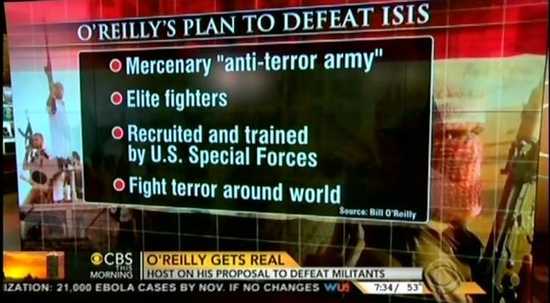
Bill O’Reilly’s Dumb Plan To Defeat ISIS

Oreilly

Oy vey:

[O’Reilly] knows advocating for American troops to take up the fight themselves is extremely unpopular. O’Reilly, problem solver that he is, has a solution: “elite fighters who would be well paid, well trained to defeat terrorists all over the world.” Since that worked so well in Iraq last time around. What we need is more Blackwater. In the O’Reilly fantasy, the 25,000-person force would be English-speaking, “recruited by the USA and trained in America by our special operations troops,” and dubbed “the Anti-Terror Army,” because the Avengers is already taken.

Allahpundit dismantles O’Reilly’s pipe dream:

The flaw is that there’s no obvious next step if the mercenaries succeed in routing ISIS from Raqqa and eastern Syria. Who takes over and rules that half of the country if that happens? Assad? He’ll butcher the Sunni civilians there and the Sunnis know it. A new sectarian rebellion against the regime would spring up overnight. Some sort of multinational Sunni force of Saudi, Turkish, and Jordanian troops? Iran will never let the Saudis have that kind of foothold, and besides, none of those countries want the headache of pacifying radicalized Sunni Syrian civilians. NATO doesn’t want it either, of course; an army of western peacekeepers would be even more culturally estranged from Syrian Arabs than a multinational Sunni force would.

The theoretical virtue of Obama’s “arm the Syrian moderates” plan is that if the moderates were to defeat ISIS, they’d be comparatively well positioned to take over as rulers of eastern Syria. They’re natives and they’re Sunnis; they’re probably acceptable to the locals. But of course, the moderates aren’t going to defeat ISIS, which puts us back at square one.

(Image via Barbara Morrill)

Face Of The Day

John Key Photo Opportunity With Maori Party & Act Party

Newly elected New Zealand Prime Minister John Key greets Maori Party Co-leader Te Ururoa Flavell at The Beehive in Wellington, New Zealand on September 23, 2014. On Saturday evening, the National Party leader was re-elected after defeating Labour opposition leader David Cunliffe. By Hagen Hopkins/Getty Images.