Choosing “Yes”

Freddie responds to Vanessa Grigoriadis’s piece on campus rape:

I think that it’s a mistake to create different standards of consent for college students. The potential unforeseen consequences scare me, and besides, a central aspect of the fight against sexual assault is to insist that rape is rape. I think it sends a retrograde message to suggest that there is a different standard that is applied only to college students. I would argue that a clear takeaway from the New York piece is that the establishment of this entire separate legal system for campus sexual assaults, while undertaken with good intentions, has added a layer of complexity and lack of accountability that has backfired badly. …

I feel strongly that explicit consent laws actually undercut the absolute ownership by the individual over her or his own sexual practice.

One of the most important parts of the feminist project is insisting that women own their own bodies. This has application to abortion, where the pro-life movement seeks to take physical control of women’s bodies away from them. And it has application to rape. The insistence of those who work against rape is that only the individual has the right to define appropriate and wanted sexual practice. With the informed consent of all adult parties, no sexual practice is illegitimate. Without that consent, no sexual practice is permissible. This is a humane, moral standard that has the benefit of simplicity in application and clarity in responsibility.

But it stems first and foremost from the recognition of individual ownership. To define the exact methods through which individuals can request and give consent takes away that control and turns it over to the state, or even more ludicrously, to a dean or some academic grievance board. We should be expanding the individual’s control over their own sexual practice, not lessening it. And we should maintain the simplest standard that there is: that if a person rejects a sexual advance, or is in such an incapacitated state that they cannot rejected that advance, or is under the power of the other party to the extent that they feel compelled to consent, sexual contact cannot morally or legally take place.

Scaring Up Some Votes

The Republicans are already using ISIS as a wedge issue:

Sargent passes along a new Scott Brown ad that also hypes the ISIS threat:

It’s true that the President’s approval on terrorism has plummeted and the GOP now holds a huge advantage on foreign policy. Republican strategists have been pretty explicit in explaining that they see this as a way to exploit a general public sense that things have gone off the rails, and polls do show high wrong-track numbers and rising worry about terrorism. If things go wrong, which is certainly possible, this could well redound to the benefit of Republican candidates.

But for now, it’s hard to imagine that arguments such as Brown’s above are going to cut it. After all, if GOP candidates are really going to paint the U.S. response to ISIS as insufficiently realistic about the nature of the threat, then that should theoretically open them up to thequestion of whether they support sending in ground troops. You’d think that if the criticism continues now that operations are underway, it would be harder for them to duck that basic follow-up.

Waldman agrees that ISIS fear-mongering is unlikely to work:

Despite the surface similarity between political attacks like those and the ones we saw when George W. Bush was president, there’s a crucial difference. Back then, there was a Republican president taking actions against America’s enemies, while Democrats supposedly didn’t want to protect the country (even if, in reality, elected Democrats gave ample support to the wars in Afghanistan and Iraq and other elements of the “War on Terror”).

Today, however, it’s a Democratic president who is taking action against terrorists. Even if you believe that action is inadequate, it still creates a fundamentally different impression with the public when they see Tomahawks launching and jets taking off from aircraft carriers on Barack Obama’s orders.

Which may explain why Josh Green found that few GOP ads thus far have mentioned ISIS:

Now that the U.S. has begun bombing Syria, those ads may start to materialize. Then again, maybe they won’t. Republicans leaders such as House Speaker John Boehner (R-Ohio) have endorsed Obama’s latest campaign. “ISIL is a direct threat to the safety and security of the United States and our allies,” Boehner said of the group formerly known as Islamic State in Iraq and the Levant, according to a statement. “I support the airstrikes launched by the president, understanding that this is just one step in what must be a larger effort to destroy and defeat this terrorist organization. I wish our men and women in uniform Godspeed as they carry out this fight.”


Because More Bombing Is Always The Answer

Mohammed Alaa Ghanem, writing in Politico, wants the US to target Assad, not just ISIS:

Assad’s record presents clear evidence: If his regime somehow survives the current conflict, ISIL will mysteriously regenerate itself while Assad approvingly observes. Unless the United States wants to be striking ISIL in Syria yet again in another five to 10 years, America should hit Assad now.

Larison pulls his hair out:

Attacking Syrian regime forces would drag the U.S. into a much larger, riskier, and more ambitious campaign that could have very dangerous consequences for U.S. pilots and could create yet another crisis in U.S.-Russian relations. The war against ISIS already promises to be long and desultory, and a war against the Syrian regime would make everything harder, raise the costs of the ongoing campaign, and risk the possibility of regime collapse and the even greater chaos that would consume the country as a result. The war against ISIS is a serious mistake, but fighting both the regime and ISIS at the same time would be a disaster.

Quote For The Day

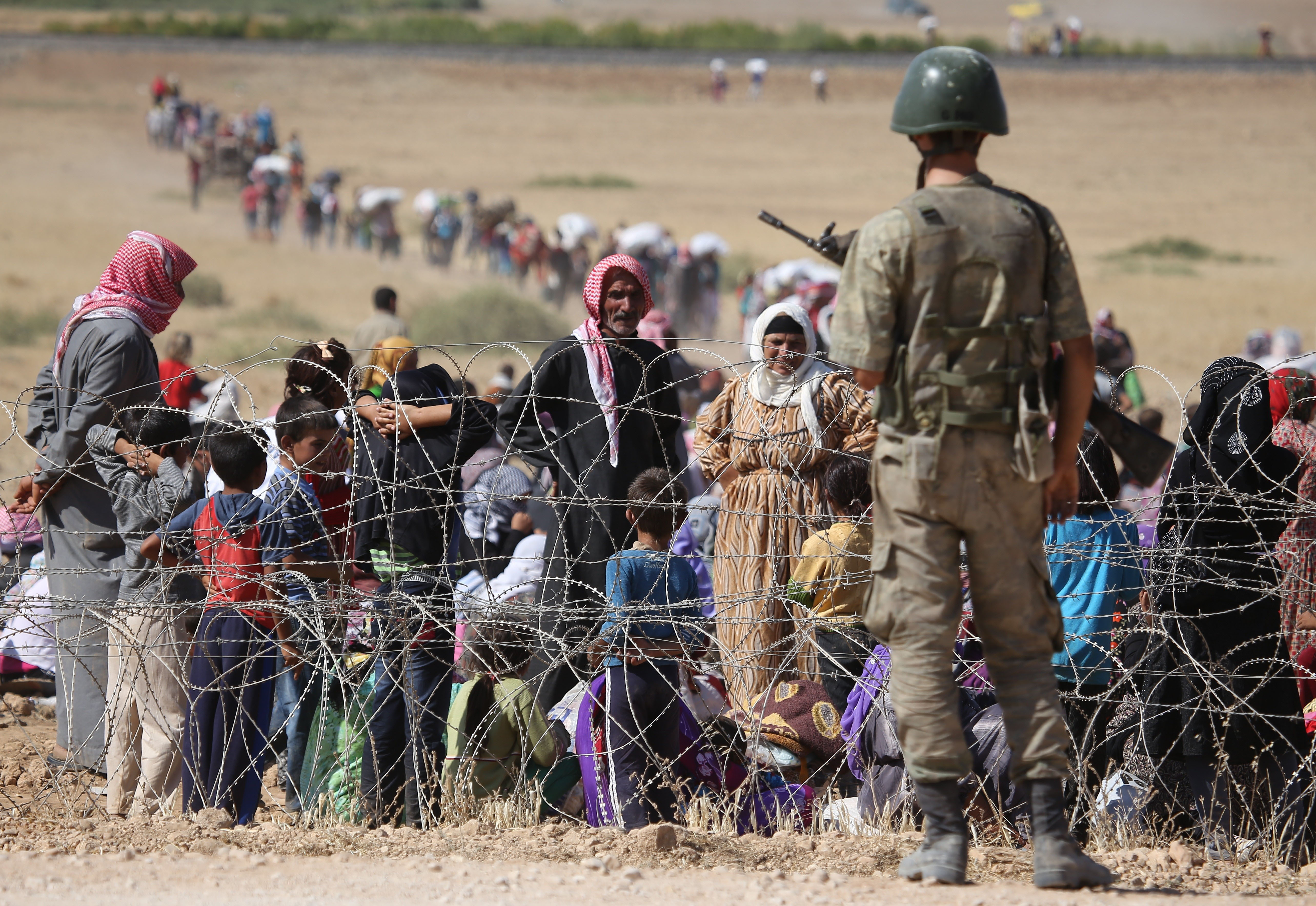
Syrians fleeing the war in their country wait to cross into Turkey

“We must begin by acknowledging the hard truth:  We will not eradicate violent conflict in our lifetimes.  There will be times when nations — acting individually or in concert — will find the use of force not only necessary but morally justified.

I make this statement mindful of what Martin Luther King Jr. said in this same ceremony years ago:  “Violence never brings permanent peace.  It solves no social problem:  it merely creates new and more complicated ones.”  As someone who stands here as a direct consequence of Dr. King’s life work, I am living testimony to the moral force of non-violence.  I know there’s nothing weak — nothing passive — nothing naïve — in the creed and lives of Gandhi and King.

But as a head of state sworn to protect and defend my nation, I cannot be guided by their examples alone.  I face the world as it is, and cannot stand idle in the face of threats to the American people.  For make no mistake:  Evil does exist in the world.  A non-violent movement could not have halted Hitler’s armies.  Negotiations cannot convince al Qaeda’s leaders to lay down their arms.  To say that force may sometimes be necessary is not a call to cynicism — it is a recognition of history; the imperfections of man and the limits of reason,” – Barack Obama, accepting the Nobel Peace Prize, December 10, 2009.

(Photo: Syrians fleeing from clashes between the Islamic State of Iraq and Levant (ISIL) militants and Democratic Union Party (PYD) forces in the Ar-Raqqah Governorate of Syria, wait at the Turkish-Syrian border to cross into Turkey on September 19, 2014 in Suruc district of Sanliurfa province of Turkey. By Orhan Cicek/Anadolu Agency/Getty Images.)

Can The Church Survive In America? Ctd

A reader writes:

In your coverage of the Montana couple denied communion, the age of the priest (27) is important to note. My husband and I (then in our late 20s and very devout) left the Church in 2006 when our retired priest was replaced by a young (and very conservative) one. Pope Benedict had just been elected, and a new (and also relatively young) bishop was appointed to our Diocese making conservative issues his priority. For years we had “hidden” in our little liberal church where we worked to end the death penalty and served in homeless shelters. When a priest would make the national news for denying communion or protesting an abortion clinic, we’d shake our heads and be thankful – that Church was not our Church. But all that came into question when our new priest arrived and the progressive values of our congregation started to wane.

As with their actions against the Nuns on the Bus, American bishops have been dismantling little liberal congregations like mine – and their best weapons are young, conservative priests.

We realized that the priests and nuns we had grown up with – Baby Boomers who started their careers with Vatican II – were all retiring and dying. Their messages of peace, acceptance and mercy and their commitment to good works for the poor were dying with them. Though young Americans are much more progressive on social issues like gay marriage, the young American men becoming priests now are decidedly not, and their influence as leaders in the Church will be felt for decades to come.

We couldn’t find another progressive parish to “hide” in and be the kind of Catholic you continue to be. I wonder if you are coming closer to the same realization we had in 2006 –  that the Church you belong to is the same Church that has turned away Paul and Tom. And that one day – as these young priests rise to higher ranks – the Church will eventually turn you away as well.

I know where my reader is coming from. I thank God daily for the Jesuits.

Busted With An Eggcorn, Ctd

One more round of reader eggcorns:

I’ve been enjoying the thread.  And then earlier tonight during happy hour, a friend said: “My Mom has a heart on for Pope Francis.”  I didn’t even bring attention to it, I just immediately thought, “I need to write the Dish!”

Another:

Someone said “Jew him down” around me when I was 15 and working  in an antique store one summer. But I heard “chew him down.”

I figured it meant when you talk someone into giving you a lower price one something, when you haggle, your jaw is moving up and down. You’re chewing down the price. Chewing them down. Chew him down.

I didn’t have tons of cause to use the expression once I was no longer working in an antique store, but I did use it from time to time, as I like to go to junk sales and flea markets. I think I was nearly 25 when I used it in front of the right person – someone who gasped, looked me in the eye, and said, “I can’t believe you would say something like that.” I was completely mortified when she told me what I actually heard in that antique store when I was 15.

Another:

I once mentioned to my wife that there was a new tapas bar in town and that we should go there, to which she responded, “Why would you want us to go to a topless bar!”

Another:

I can’t believe it took me so long to remember my biggest eggcorn. I’ve been saying since I was a kid that, in cold weather, “It’s a bit nipply outside.”

And another:

Okay, I haven’t seen this one show up on The Dish yet. I work in a group that designs and operates cutting-edge satellite instruments. One of my co-workers is an engineer known for being the best worrier in our building that something might go wrong with the latest instrument. My favorite phrase he always uses whenever he wants to point out a possible problem with a design or plan we’ve come up with is to start by saying: “But the flaw in the ointment is … “

Another:

I’m a family law trial attorney and often hear clients complain about being “lamblasted” by their spouses, etc. in relation to their often caustic situations.  I’ve always loved that, and I never correct them!

Another:

I’ve been greatly enjoying your threads on eggcorns, mostly because I feel like I’ve committed half of them myself.  Here’s another: When I was a kid, growing up in DC in the ’80s, my parents were friends with a couple named Mary and Barry.  They were always saying things like “we’re going out with Mary an’ Barry tonight,” etc.  I spent a good portion of my childhood thinking my parents were great friends with the mayor!

Another:

As a physician, my all-time favorite eggcorn is “sick-as-hell anemia”.

One more:

Years ago my then three year old son was having a tantrum about something I have long since forgotten.  Trying to make peace, I suggested he come join me for a nice bowl of chicken soup.  “NO!,” he screamed.  “OK, suit yourself,” says I.  “No, YOU shoot YOUR-self!!,” came the outraged reply.  Holy Moly.  He has since grown into a kind and gentle young man.

Read all of the reader entries here.

“A Thousand Little Saddams”

Reviewing recent Iraqi literature in light of the ISIS uprising, Max Rodenbeck turns to Zaid al-Ali’s The Struggle for Iraq’s Future, which he calls a “well-researched study of how Iraq has gotten into its current, worsening, and possibly terminal mess”:

The departure of Maliki, whose overstay of his welcome made him a sponge for dissent, could offer a window for reconciliation. Mainstream Sunni and Kurdish leaders, as well as some Shiites, had long demanded his exit. Yet the litany of failure that Ali describes is simply too long and wide-reaching to leave much room for optimism. Ali’s own concluding suggestions for how to right things seem sadly perfunctory. He also betrays, in occasional oversweeping judgments and in a peculiar lack of sympathy with the Kurdish yearning for independence (which seems only more justified by the ugly facts he himself reveals), an impractical wistfulness for an imaginary, whole, and complete Iraq.

What came to mind as I closed the book was the damning remark of a distinguished Iraqi exile I met in Kuwait shortly before the 2003 invasion. His father had served as prime minister under the monarchy whose overthrow in the bloody coup of 1958 had led to Iraq’s long era of turbulence. Still, he took a dim view of the looming ouster of Saddam Hussein, and held no dreams of return. “Of course the Americans will get rid of Saddam,” he said. “But what will we have then? A thousand little Saddams.”

And we have set ourselves the impossible task of trying to kill them all. And then what?

How Many New Ebola Cases?

Ebola

Lena Sun flags a new CDC report suggesting that 1.4 million West Africans could catch the virus by January:

The report released Tuesday is a tool the agency has developed to help with efforts to slow transmission of the epidemic and estimate the potential number of future cases. Researchers say the total number of cases is vastly underreported by a factor of 2.5 in Sierra Leone and Liberia, two of the three hardest-hit countries. Using this correction factor, researchers estimate that approximately 21,000 total cases will have occurred in Liberia and Sierra Leone by Sept. 30. Reported cases in those two countries are doubling approximately every 20 days, researchers said. “Extrapolating trends to January 20, 2015, without additional interventions or changes in community behavior,” such as much-improved safe burial practices, the researchers estimate that the number of Ebola cases in Liberia and Sierra Leone could be between approximately 550,000 to 1.4 million.

Meanwhile, Siobhán O’Grady points out a distressing pattern in aid distribution:

[A] United Nations Office for the Coordination of Humanitarian Affairs report released Monday sheds light on a different kind of neocolonialism taking form in the region’s Ebola crisis: Rather than coordinating an effort to combat the massive outbreak, the United States, the United Kingdom, and France are instead sending disproportionate amounts of aid to the territories they once controlled. This lack of coordination among the three largest donors to the fight against Ebola ignores the reality of borders between Liberia, Sierra Leone, and Guinea, where political lines are more a trace of colonialism than an accurate representation of modern-day relationships between the border communities of the three developing nations.

Zoe Chace compares the international community’s response to the Ebola outbreak to its actions following the 2010 earthquake in Haiti:

The response to the 2010 earthquake in Haiti was massive: Billions of dollars in donations poured in. “It had everything,” says Joel Charny, who works with InterAction, a group that coordinates disaster relief. “It had this element of being an act of God in one of the poorest countries on the planet that’s very close to the United States. … And the global public just mobilized tremendously.” People haven’t responded to the Ebola outbreak in the same way; it just hasn’t led to that kind of philanthropic response. From the point of view of philanthropy, the Ebola outbreak is the opposite of the Haiti earthquake. It’s far from the U.S. It’s hard to understand. The outbreak emerged over a period of months — not in one dramatic moment — and it wasn’t initially clear how bad it was. Donors like being part of a recovery story. In Haiti, buildings and lives were destroyed. The pitch was, let’s help them rebuild. In the case of Ebola, it’s been harder to make a pitch.

Not surprisingly, Tara Smith notes that the NGOs at the forefront are struggling:

Doctors Without Borders (also known by its French name,Médecins Sans Frontières, or MSF) has led the international battle against Ebola, and where its workers have had success in the past, they have been completely overwhelmed now for months. MSF International President Joanne Liu has made multiple appeals to the United Nations, begging for additional assistance, noting on Sept. 16:

As of today, MSF has sent more than 420 tonnes of supplies to the affected countries. We have 2,000 staff on the ground. We manage more than 530 beds in five different Ebola care centres. Yet we are overwhelmed. We are honestly at a loss as to how a single, private NGO is providing the bulk of isolation units and beds.

The plea has fallen on sympathetic ears, but the response has been slow and insufficient. The United States has answered the call to some extent, promising 3,000 military personnel and up to $750 million in aid. Even this massive amount is less than what the World Health Organization has called for: a minimum of $1 billion, and even that will only keep infections contained to the “tens of thousands.”