“A Clown Made Of Mummified Foreskin And Cotton Candy”

An epic takedown of Trump and, more importantly, the Miss America scholarship sham:

John Oliver and his team are really kicking ass with this new show. Previous Dish on Last Week Tonight segments here, here and here. He’s proof that ad-free long-form journalism can work, and be highly engaging and entertaining, if supported long and steadily enough.

Is Diet Soda Making Us Fat? Ctd

The latest in artificial sweetener scares:

Artificial sweeteners might be triggering higher blood-sugar levels in some people and contributing to the problems they were designed to combat, such as diabetes and obesity, according to new findings published Wednesday in the journal Nature. Although the precise reasons behind the blood-sugar changes remain uncertain, researchers suspect that artificial sweeteners could be disrupting the microbiome, a vast and enigmatic ecosystem of bacteria in our guts.

Svati Kirsten Naruta reminds us that the “news” isn’t really new at all:

There have been a lot of major news stories about the science behind artificially sweetened products. But I didn’t see a single one this week that acknowledged the ones written earlier this year, or in 2008, or 2005. More often than not, each individual story gives the impression that the latest science is either totally new or surprisingly compelling.

“It seems to amplify every time,” Purdue University’s Susan Swithers told Quartz. “Things don’t have to be shocking and new to get this shocking and new treatment.” Swithers herself has been featured in news stories about artificial sweeteners and diabetes, including an NPR one asking “Do diet drinks mess up metabolisms?” in 2013.

Not many news outlets have the space, time or resources to contextualize, at length, each meaningful scientific study. But there’s something wrong with a cycle in which reporters constantly react to press releases from academic institutions or scientific journals by generating uniquely attention-grabbing stories based on each one.

Daniel Engber looks at the historical pattern:

The supposed risks of saccharin, like those of other sweeteners, have a way of glomming on to whatever other fears happen to be in the public mind. In Roosevelt’s day, we worried over fraud in manufacturing – flour cut with sawdust, coffee mixed with powdered acorns—and saccharin was decried as a cheapo surrogate for sugar. By the time Richard Nixon declared a war on cancer, the sweeteners were seen as dangerous carcinogens. These days we’re more concerned with diabetes and obesity, and so the putative effects of drinking diet soda have shifted once again. Now they’re blamed for bringing on the very thing they’re meant to counter: a growing scientific literature hints that artificial sweeteners could make us fat.

And evidently the first sweetener gave the Romans lead poisoning. Previous Dish on sweetener research here. And Aaron Carroll has made the case that however bad artificial sweeteners might be, sugar is worse.

A 19th Century Frenchman Explains the 21st Century Middle East

Drawing on his recent book, Tocqueville in Arabia: Dilemmas in a Democratic Age, Joshua Mitchell applies the French thinker’s insights about the emergence of democracy to today’s Middle East:

Alexis de Tocqueville long ago wrote that the democratic age is upon us. By this he meant that the “links” to family and tribe that held us fast in the aristocratic age were breaking apart before our eyes. dish_Alexis_de_tocqueville_croppedThe political consequence of this social de-linkage, however, was not necessarily benign democratic governance. Indeed, he worried that attempts would be made to refortify the old links, to reaffirm roles at the moment when delinked persons were emerging. What we today often identify as “Islamic Fundamentalism” is just such an attempt to re-fortify the old links, to re-enchant the world. Herein lays the dilemma of the Middle East. Caught in the matrix of the political and social arrangements of the twentieth century that defy credulity, drawn and at the same time repulsed by the fugitive freedom they see on Western shores but only dimly understand, nascent citizens more than occasionally dream of returning to an enchanted world for which an imagined Islam provides a ready guide.

Under these wildly unstable conditions, U.S. foreign policy-makers should take the long view. Democratic governance will not arrive soon in the Middle East. If it does at all, it will emerge only when families and tribes become much less important than they now are. Citizens and entrepreneurs―the building blocks of democratic governance and of market commerce―do not spring up spontaneously out of societies where families and tribes still retain their hold on the imagination. The slow process by which that changes, moreover, cannot easily be accelerated by U.S. foreign policy.

In the meantime, in the interludes of peace, diplomatic and cultural outreach and, above all, higher education initiatives intended to help the younger generation understand and thrive in the disenchanted world it will inherit offer perhaps the most constructive ways to engage the region.

Update from a reader:

Let’s face it. Nothing explains the Middle East.

(Image of Tocqueville by Théodore Chassériau via Wikimedia Commons)

A Classic Conundrum

What makes a piece of literature a classic? For Saket Suryesh, the work must be introspective:

We, as readers, are able to find our own feelings in such words despite the distances between us and the time and space they were originally composed in because those emotions are universal. The world which surrounds these feelings may change, but the emotions themselves do not. Consider, from Heart of Darkness, the lines: “She carried her sorrowful head as though she were proud of that sorrow, as though she would say, I — I alone know how to mourn for him as he deserves.” Simple words but an ache rises from the heart of even the modern reader, for who wouldn’t want to be loved thus?

Eric Williams, though, refuses to accept that a classic work can exist outside of time and space. He argues, “‘The Classics’ are a fluid and dynamic category, changing with times and tastes and history, and not something transmitted to us across the aesthetic ether”:

The danger of the numinous label of “The Classics” is that it kills texts. It becomes holy writ, studied for its intrinsic rightness, ahistorical and timeless. Nothing is more dangerous. Books are discrete historical objects, written by specific individuals at specific times, and their subsequent histories reflect how people envisioned literature, artistic merit and important ideas in the larger context of their times and culture. By all means, read them for their beautiful language and interesting imagery, and interpret them based on your own private and individual history and perspectives. But at the same time, read them as historical documents, fully aware of the baggage that comes with them and fully cognizant that someone somewhere decided that the book in your hands had more value than other books. Echoing Suryesh, read the classics voraciously — but, I would add, always thoughtfully, critically and historically.

Paul’s Foreign Policy Predicament

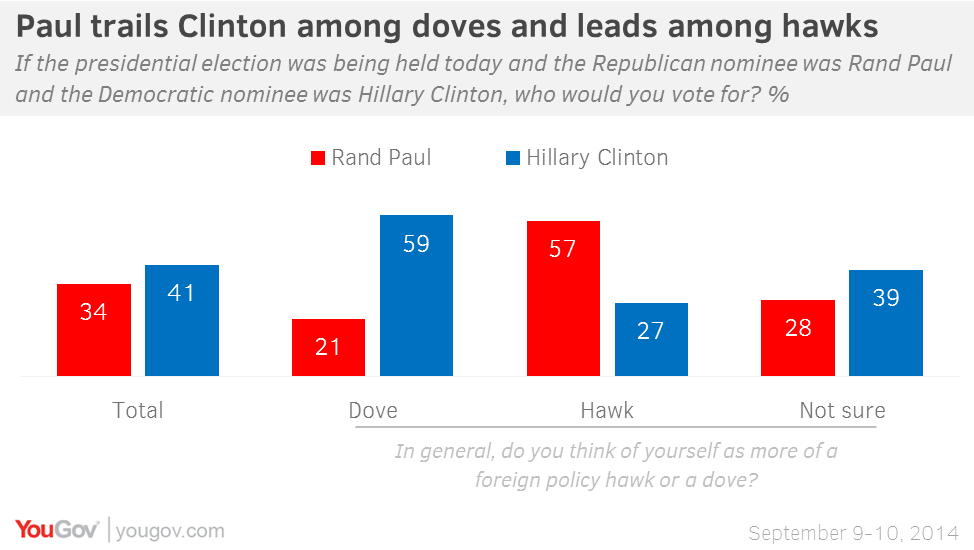
Doves prefer Clinton to Paul:
Paul Clinton

Larison analyzes the survey:

Doves clearly prefer Clinton despite the fact that a few more respondents (correctly) perceive her to be a hawk. However, Clinton also seems to benefit from the fact that 30% of respondents inexplicably perceive her as a dove, and only 27% perceive Paul that way. For all of the attention paid to Paul’s foreign policy views in political media over the last few years, his position is not very well-known or clear to the public at large, since 24% identify him as a hawk and 49% aren’t sure what to call him. Oddly enough, that might be just what Paul wants, since it gives him room to move back and forth between hawkish and dovish stances.

If public opinion or his conscience are guiding him toward military confrontation with ISIS, and if his better judgment guides him away from the available alliances on the ground, he is rapidly backing himself into the trap of Clintonian foreign policy. That means airstrikes and harassment, carried out indefinitely.

An airstrikes-only approach provides all the satisfaction of conflict, and little risk of major casualties for U.S. forces, which quickly swing public opinion against a president and his party. But in recent times, this policy has always had one of two endings. When President Obama and Hillary Clinton did it in Libya, this “smart power” strategy resulted in a stateless region of chaos; the Libyan government can hardly meet safely in the territory it claims to rule. When Bill Clinton did it with his no-fly zone in Iraq, it settled into a kind of stalemate. It was a relatively light drain on U.S. budgets, but it was also vaguely humiliating. A domestic uprising against Saddam never materialized to justify our policy. And American hawks could put pressure on the president for a more robust policy of regime change. What’s the point of military engagement, they’d ask, if victory isn’t on the table?

But Weigel finds that Paul’s anti-war supporters trust him:

The crisis in Iraq, which has caused a surge in the numbers of Republicans ready to send ground troops back into the Middle East, has not really rattled Paul’s people. He has what very few political figures still have; his supporters assume that he simply must agree with them, no matter what he says.

Boys Forced To The Altar

Nina Strochlic considers the sad fate of the child grooms in the developing world:

They are often forced to drop out of school and take menial jobs to support their new family. This perpetuates the cycle of poverty that led to their marriage in the first place. Generation after generation will struggle to lift themselves out of this tradition.

In fact, 156 million men alive today were married as children, according to the most recent UNICEF data. Despite that massive figure, there is scant research or work being done to address the issue of child grooms, meaning there are tens of millions of young boys and men who are almost virtually invisible in research, advocacy, and on-the-ground prevention work.

“There is a very strong voice of men in the community saying, ‘Because of child marriage I don’t have good job, I’m a conditional laborer, I can’t have a good education.’ That’s why this is creating a strong background for the cycle of poverty,” says Sabitra Dhakal, who’s leading the Tipping Point movement in Nepal. “Child marriage is not only a bad practice for girls, it is really a bad practice for boys too.”

Forget Footnotes

Tim Parks has an axe to grind over the academic staple:

[I]t’s time to admit that the Internet has changed the way we do scholarship and will go on changing it. There is so much inertia in the academic world, so much affection for fussy old ways. People love getting all the brackets and commas and abbreviations just so. Perhaps it gives them a feeling of accomplishment. Professors torment students over the tiniest details of bibliographical information, when anyone wishing to check can simply put the author name and title in any Internet search engine. A doctoral student hands in a brilliant essay and the professor complains that the translator’s name has not been mentioned in a quotation from a recent French novel, though of course since the book is recent there is only one translation of the novel and in any event anyone checking the cited edition will find the translator’s name in the book.

There is, in short, an absolutely false, energy-consuming, nit-picking attachment to an outdated procedure that now has much more to do with the sad psychology of academe than with the need to guarantee that the research is serious. By all means, on those occasions where a book exists only in paper and where no details about it are available online, then let us use the traditional footnote. Otherwise, why not wipe the slate clean, start again, and find the simplest possible protocol for ensuring that a reader can check a quotation. Doing so we would probably free up three or four days a year in every academic’s life. A little more time to glean quotes from Barthes, Borges, and Derrida…