“Uber For My Uterus”

That’s what Kat Stoeffel calls a new program from Planned Parenthood. Marcotte explains:

Now, patients in Minnesota and Washington will be able to talk to a nurse online and even get their birth control medication mailed to them at home in an unmarked package. In October, the program will be expanded to STI consultation, and even mail-order medications for chlamydia. There’s even a phone app!

“The service is expected to be especially appealing to clients living in rural areas who don’t have ready access to a clinic,” writes Dan Browning at the Minneapolis Star Tribune. But it’s not just access that’s likely appealing to those people. The Planned Parenthood website highlights that the service is “discreet.” This is great for those who would rather not be seen going into a family planning clinic or picking up a package with the iconic round birth control pill dispenser at the pharmacy. Discretion can also be critical for young people living at home who don’t want their parents to know that they’re sexually active. (For STI services, the promise of discretion is likely an even bigger draw.)

Tara Culp-Ressler cites an example:

Right now, since women need to visit a doctor’s office in person to obtain a prescription for birth control, they can end up in a tight spot if they can’t get an appointment in time, especially if they live in a rural area. [Sarah Stoesz, the president and CEO of Planned Parenthood in MN, ND, and SD] told the Tribune that the first woman to take advantage of Planned Parenthood Care ran out of birth control pills and couldn’t see her regular physician soon enough; fortunately, she discovered this new option online.

When Rape Allegations Are False

https://twitter.com/JessicaValenti/status/513036486602924032

Cathy Young tackles an uncomfortable truth:

False rape accusations are a lightning rod for a variety of reasons. Rape is a repugnant crime—and one for which the evidence often relies on one person’s word against another’s. Moreover, in the not-so-distant past, the belief that women routinely make up rape charges often led to appalling treatment of victims. However, in challenging what author and law professor Susan Estrich has called “the myth of the lying woman,” feminists have been creating their own counter-myth: that of the woman who never lies. More than a quarter-century ago, feminist legal theorist Catharine MacKinnon wrote that “feminism is built on believing women’s accounts of sexual use and abuse by men”; today, Jessica Valenti urges us to “believe victims en masse,” because only then will we recognize the true prevalence of sexual assault.

But a de facto presumption of guilt in alleged sexual offenses is as dangerous as a presumption of guilt in any crime, and for the same reasons: It upends the foundations on which our system of justice rests and creates a risk of ruining innocent lives.

Young illustrates how the issue is so damn complex:

Not all reports classified as unfounded are necessarily false. In some cases, women who were victims of rape were disbelieved, pressured into recanting, and charged with false reporting only to be vindicated later on—the kind of awful story that adds to people’s skittishness about discussing false accusations.

Some police departments have been criticized for having an anomalously high percentage of supposedly unfounded rape charges: Baltimore’s “unfounded” rate used to be the highest in the nation, at about 30 percent, due partly to questionable and sometimes downright abusive police procedures, such as badgering a woman about why she waited two hours to report a street assault. By 2013, an effort to provide better training and encourage full investigation of all complaints reduced that rate to less than 2 percent.

Megan McArdle insists that good stats are incredibly hard to find:

What we know is that we don’t know. We should not presume that every rape victim is telling the truth because it would make it easier for victims to come forward. Nor should we presume that every rape accusation has a 50 percent chance of being false. We should look at the facts in each case and judge them with the knowledge that some women do lie about rape — for revenge, to cover up some problem in their own lives, to get attention and sympathy from others. And also with the knowledge that men lie, too, violating their victims a second time in order to cover up their crimes. And that while men have gone to jail for rapes they did not commit, many other men have avoided the jail time they deserved for terrible crimes against women.

That’s not a very satisfying answer, because rape is inherently a hard crime to prosecute. If someone comes into a police station with their face bashed in, you can be pretty much certain that unless they’re a professional boxer, a crime has occurred. If a rape kit shows evidence of sexual intercourse, however, all that tells you is that … something happened. Because this is something that a lot of people do to each other voluntarily, you cannot proceed immediately to the arrest. Usually there are only two witnesses, telling different stories. Often drugs or alcohol were involved, and intoxicated people make lousy witnesses.

Previous Dish thread on the controversial topic here.

Legal Weed Heads East

Matt Ferner flags a poll from last week showing that an astonishing 65 percent of likely voters in DC support the city’s legalization initiative:

The NBC4/Washington Post/Marist poll’s finding that district voters support legalization by almost a 2-1 margin “is the highest support ever for a marijuana legalization ballot initiative,” Adam Eidinger, chair of D.C. Cannabis Campaign, the group backing the legalization measure, said in a statement. “It vindicates the work of this campaign so far, but we still have more work to do turning out the vote come Election Day.”

Only 33 percent of likely voters oppose legalization, which puts the scolds on the Washington Post’s editorial board in the distinct minority. Meanwhile, WaPo’s Aaron C. Davis and Peyton M. Craighill register a “major shift toward support [of legalization] among African Americans”:

The District’s black residents, who now account for half its population, once opposed marijuana legalization, partly out of fear it could lead to addiction among black youths. But as new studies have suggested otherwise, that attitude has evolved. One study last year showed that blacks account for nine out of 10 arrests for simple drug possession in the District, while another showed that was the case even as usage likely varied little among races. According to the poll, 56 percent of likely African American voters say they would vote for legalization, a near identical number to a broader question about support for legalization asked in a Washington Post poll in January. Together, the polls confirm a complete reversal of opinions among African Americans from four years ago. Then, 37 percent were in favor of legalization and 55 percent opposed.

But Jacob Sullum warns that even if Initiative 71 were to pass, Congress could still get in the way:

Legalization of the cannabis industry would be left to the D.C. Council, which could be overridden by Congress. Congress also could block implementation of Initiative 71, as it did for years with Initiative 59, the medical marijuana measure that D.C. voters approved in 1998. The last congressional effort to stymie marijuana reform in D.C., led by Rep. Andy Harris (R-Md.), consisted of an amendment that would have barred the District from spending public money “to enact or carry out any law, rule, or regulation to legalize or otherwise reduce penalties associated with the possession, use, or distribution” of a controlled substance. The House approved Harris’ amendment in June, but it was dropped from the final version of the spending bill. Harris plans to try again if Initiative 71 passes.

As Matt Connolly notes:

A full-scale legalization effort, complete with dispensaries like those seen in Washington and Colorado, could provoke the ire of national conservatives again. It’s a fight D.C. is used to having, and its outcome might depend on how the other states with legalization measures – Oregon and Alaska for recreational, Florida for medical – end up voting.

Know dope.

The Michael Moore Of The Right?

In an interview conducted as he awaits sentencing for violating campaign-finance law, Dinesh D’Souza reveals the inspiration behind the “documentaries” he’s produced, such as 2016: Obama’s America (trailer above) and America: Imagine the World Without Her:

I went back and watched Roger and Me, which I think is [Michael Moore’s] best film. It’s got an interesting premise: General Motors closes down a big auto plant that his dad happened to work at, and he’s going to go find the CEO of General Motors and demand to know why. Now, it fails intellectually, because there is an obvious reason why General Motors might want to close that plant—i.e., it’s not making money. And one possible reason it’s not making money is General Motors has been paying people like his dad way too much and can make cars much cheaper in North Carolina or other countries. You can’t proceed without confronting that argument. But Michael Moore’s presumption is that the CEO of General Motors, Roger Smith, is just a mean guy who wants to deprive working people of their livelihood. So intellectually, it’s ridiculous.

But visually, cinematically, narratively, it works. This clownish Michael Moore showing up everywhere, the cops in dogged pursuit. All of that works. What Michael Moore understands is that a movie traffics in the language of emotion. The intellect is subordinate to that.

On the Obama question, D’Souza is actually copying Moore’s intellectually ridiculous oeuvre.

He starts, as Moore does, with a crude reductionist idea of a public figure – Obama as seeking revenge on a colonial America – undergirded by nothing but D’Souza’s own pop-psychologizing of Obama’s relationship with his own father. Everything else needed to explain the actions of a center-left president (who has waged more wars in more places than most American presidents) is moot. For D’Souza, a crude narrative of racial revenge is all that’s really necessary to understand the Obama presidency – and he then simply adds layer upon layer to this caricature, which feeds paranoia and conspiracy theories and glib ideology as powerfully as Moore once did.

D’Souza once believed in making serious arguments for a more conservative view of the world. It’s telling about his own evolution – and the degeneration of public discourse in America – that he has largely given that up in favor of really lucrative propaganda designed to monetize the polarized red state masses. He’s another example of the power of the right-wing media-industrial complex. Its ability to reward its propagandists with fantastic monetary awards without any need to engage critics has transformed conservatism in this country – for the gridlocked, ideological worse.

Is The Border Crisis Over? Ctd

Border Crossings

Dara Lind relays further evidence that the answer is yes:

[T]he fact that, as of August, fewer children are arriving this year than arrived at the same time last year indicates that this isn’t just a seasonal slowdown. It really looks like the flow of children into the country has slowed down to nearly manageable levels for the time being.

Indeed, the US government is no longer overwhelmed by the flow. Border Patrol officers are legally required to turn unaccompanied children over to the Department of Health and Human Services no more than 72 hours after they’re apprehended. At the worst parts of the crisis this summer, they weren’t even close to meeting that deadline — they took an average of more than three weeks. Now, according to Deputy Homeland Security Secretary Alejandro Mayorkas, they’re back to normal, turning kids over to HHS well within the 72-hour window.

In another post, Lind contrasts Ted Cruz’s border rhetoric with this new reality:

Cruz warned explicitly that promises of “future amnesty” would only make the problem worse. On June 30th, President Obama gave a Rose Garden speech explicitly promising to take further executive actions on immigration. Those promises included, in Cruz’ words, “plans to give amnesty to millions more who arrived in our country illegally.” Cruz said that because of those plans, Obama was responsible for the border crisis — and predicted that “the surge of unaccompanied children trafficked to the United States by drug cartels and transnational gangs will not ebb until Congress restrains the President from taking any further executive action.”

That’s not what happened. The surge has ebbed — largely due to law-enforcement efforts by US and Mexican authorities, and Mexican efforts to catch children traveling through Mexico before they arrive in the US.

Recent Dish on that ebb here.

Feeding Off Our Humanity

In Liberia medical care for is restricted due to  recent outbreak of the Ebola virus.

The latest on Ebola is even more alarming than you thought:

[N]ew research suggests that the speed at which it’s spreading is totally out of proportion to past outbreaks. Thomas House, a mathematician at the UK’s University of Warwick, used historical data from outbreaks reported by the World Health Organization24 in totalto create a mathematical model for the spread of the virus. By analyzing information on the timing of the outbreaks, the number of cases, and the number of people who died, he was able to develop a model that describes the pattern of all outbreaksexcept for one. The current outbreak is off the charts.

And House can’t explain why:

“It could be a mutation,” he said. “It could be that the way that society is structured has changed as West Africa’s developed: People are in contact with more other people. It could be that control efforts or the behavioral response are just different. My model isn’t detailed enough to say exactly which one.” It is detailed enough to raise the panic level, though.

And the UN is scrambling:

Acting on the initiative of the Obama administration, the 15-nation U.N. Security Council unanimously adopted a resolution [last] week declaring the Ebola virus a threat to international peace and security, and urging the U.N.’s member states to rally financial, political, and medical support to contain the plague. The resolution was co-sponsored by 131 countries, the largest official show of international support for a Security Council resolution in history, according to the United States.

“This is likely the greatest peacetime challenge that the United Nations and its agencies have ever faced,” Margaret Chan, the director-general of the World Health Organization, warned the council this week. “None of us experienced in containing outbreaks has ever seen, in our lifetimes, an emergency on this scale, with the degree of suffering, and with this magnitude of cascading consequences.”

Benjamin Hale shudders:

The most striking thing about the virus is the way in which it propagates. True, through bodily fluids, but to suggest as much is to ignore the conditions under which bodily contact occurs. Instead, the mechanism Ebola exploits is far more insidious. This virus preys on care and love, piggybacking on the deepest, most distinctively human virtues. Affected parties are almost all medical professionals and family members, snared by Ebola while in the business of caring for their fellow humans. More strikingly, 75 percent of Ebola victims are women, people who do much of the care work throughout Africa and the rest of the world. In short, Ebola parasitizes our humanity.

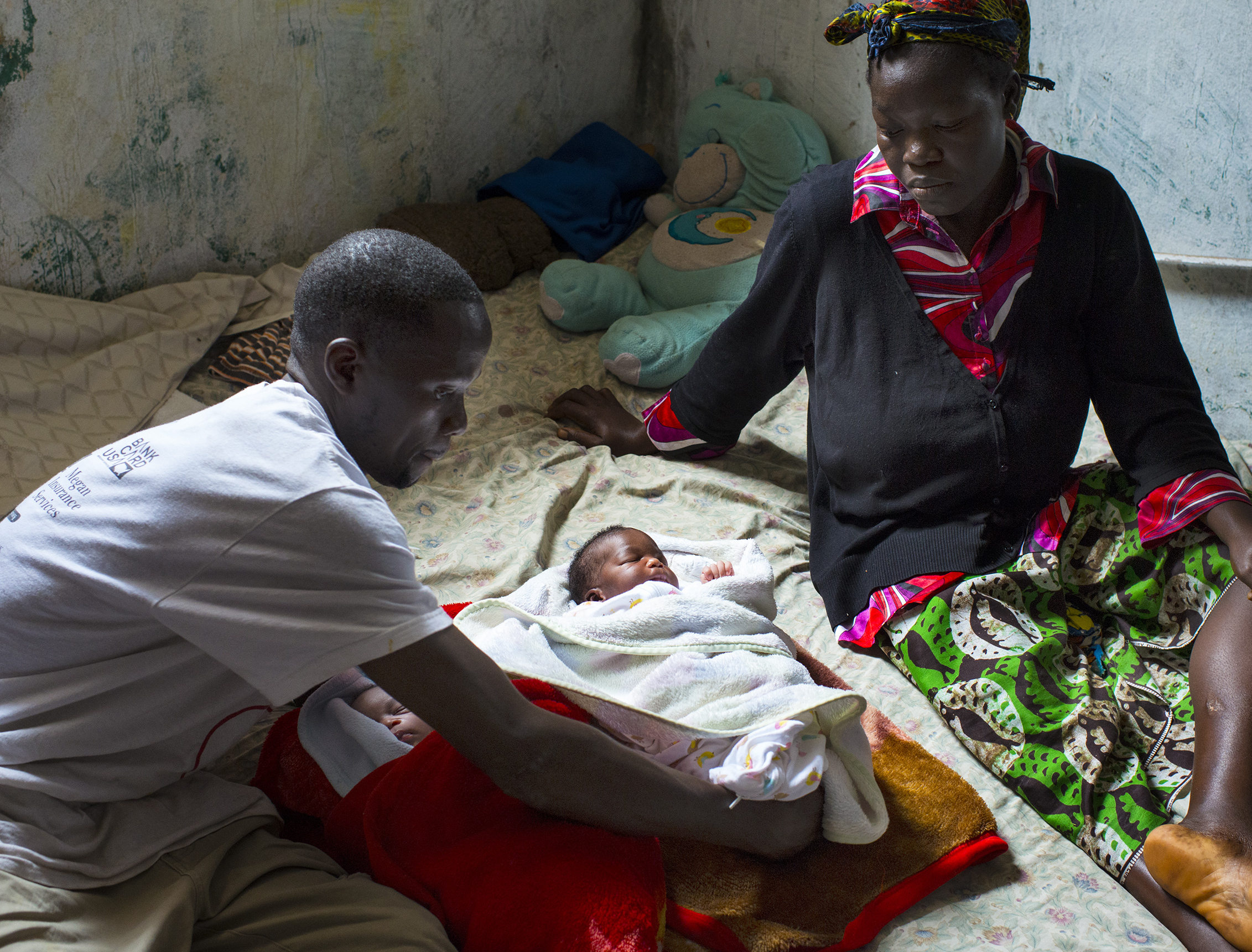
(Photo: Victor Fayiah, 40, and his wife Comfort Fayiah, 32, are seated on a mattress on the floor of a room with their twin girls, Faith and Mercy, discussing their ordeal in Monrovia, Liberia on September 19, 2014. Comfort went into labor and delivered the girls on the ground in the yard of her church assisted by a local medic and a church mother because she could not get medical care; most hospitals and clinics were closed for non-Ebola treatment. The closed facilities are an attempt to protect medical staff and other patients from Ebola. By Michel du Cille/The Washington Post via Getty Images)

Does The GOP Really Give A Shit About The Debt?

enator Lindsey Graham (R-SC)

It’s been a remarkable aspect of the foreign policy “debate” over the last month that I haven’t heard a single leading Republican express misgivings about a new Iraq war’s impact on fiscal policy. And yet, for a few years now, we have been subjected to endless drama about the mounting debt when it comes to anything the government wants to do. Cost was one (ludicrous) reason to oppose Obamacare; it’s behind cutting off 3 million long-term unemployed from any benefits; it has led to proposals to turn Medicare into a premium support system and for cutting social security. Some of this fiscal vigilance I find useful – if it weren’t so transparently  a way to dodge GOP responsibility for the debt and to blame Obama for all of it and if it weren’t raised as a matter of urgency when the world economy was deeply depressed (the one time when fiscal lenience is warranted). But it is hard to resist the conclusion, after the last few weeks, that it’s all a self-serving charade.

I mean: where are the fiscal conservatives now? The ISIS campaign is utterly amorphous and open-ended at this point – exactly the kind of potentially crippling government program Republicans usually want to slash. It could last more than three years (and that’s what they’re saying at then outset); the cost is estimated by some to be around $15 billion a year, but no one really knows. The last phase of the same war cost, when all was said and done, something close to $1.5 trillion – and our current travails prove that this was one government program that clearly failed to achieve its core original objectives, and vastly exceeded its original projected costs.

If this were a massive $1.5 trillion infrastructure project for the homeland, we’d be having hearing after hearing on how ineffective and crony-ridden it is; there would be government reports on its cost-benefit balance; there would be calls to end it tout court. But a massive government program that can be seen as a form of welfare dependency for the actual countries – Turkey, Iran, Jordan, Kurdistan – facing the crisis gets almost no scrutiny at all. And what scrutiny it gets is entirely due to partisanship and the desire to portray this president as effectively useless.

Now take a look at the international disgrace that is the resilient torture and detention camp at Gitmo. It has been kept in operation – despite the huge damage it does in our campaign to restrain Jihadism – by the same people who have been hyper-ventilating about a British loser decapitating innocents in the deserts of Mesopotamia. Its cost? They don’t care. But ask yourself: if this were a domestic program, would there really be any debate? Some context:

At a cost of $2.8 million per prisoner per year, Guantánamo is the most expensive prison in the world. (The costliest prison in the U.S., the Colorado Supermax, at $78,000 per prisoner per year.) And the costs will continue to rise as facilities that were built to be temporary, like the Camp America Dining Facility, deteriorate. In addition to the dining facility repairs, the 2015 defense budget also calls for $11.8 million to upgrade a medical clinic that was never built to serve an aging population of prisoners. Congress earmarked another $69 million to renovate Camp 7, the top-secret facility that holds the 15-high value detainees who were tortured in CIA black sites prior to their transfer to Guantánamo. In March, The Miami Herald reported that the ground below the facility had shifted, causing the floors and walls of the building to crack.

Obama took office and proposed saving the US much of that $15 billion, by transferring the tortured detainees to super-max prisons in the mainland. The GOP blocked it – and continue to. Their only arguments are an appeal to irrational panic and fear of terrorists – which, come to think of it, is their only real response to the latest Sunni insurgency in Iraq as well. Some of us held out hope that the sheer fiscal drain of a perpetual, lose-lose war against a constantly replenishing Jihadism empowered by our intervention might temper some of this unreason. But we’ve just seen how a couple of videos can snap the GOP – and most of the country – into a fiscally reckless “do something whatever it costs” mindset, in which the debt is the last thing on any Republican’s mind.

They are frauds and hysterics. Anyone who cares about our fiscal future and believes the GOP is the part of our polity most able to address it is deluding herself. The past and the present definitively say otherwise.

(Photo:  Senator Lindsey Graham (R-SC) coming off the Senate floor after votes is asked by reporters about the situation in Iraq and the capture of a suspect in the 2012 Benghazi attack, on Capitol Hill in Washington, DC Tuesday June 17, 2014. By Melina Mara/The Washington Post via Getty Images.)

A Hundred Thousand Displaced

TURKEY-SYRIA-KURDS-REFUGEES

The Guardian explains how this state of affairs came to be:

The border region of Kobani, home to half a million people, has held out for months against an onslaught by Islamists seeking to consolidate their hold over swaths of northern Syria. But in recent days, Isis extremists have seized a series of settlements close to the town of Kobani itself, sending as many as 100,000 mostly Kurdish refugees streaming across the border into Turkey. “I don’t think in the last three and a half years we have seen 100,000 cross in two days,” the representative for the UN refugee agency (UNHCR) in Turkey, Carol Batchelor, told Reuters. “So this is a bit of a measure of how this situation is unfolding, and the very deep fear people have about the circumstances inside Syria and, for that matter, Iraq.”

A Kurdish commander on the ground said Isis had advanced to within 9 miles (15km) of Kobani. A Kurdish politician from Turkey who visited Kobani on Saturday said locals told him Isis fighters were beheading people as they went from village to village. “Rather than a war this is a genocide operation … They are going into the villages and cutting the heads of one or two people and showing them to the villagers,” Ibrahim Binici, a deputy for Turkey’s pro-Kurdish People’s Democratic party (HDP), told Reuters.

Juan Cole marvels, “I lived to see the day when thousands of Kurds take refuge in Turkey”:

For anyone who knows the history of the Turkish government’s dirty war against Kurdish separatists in the 1970s and 1980s, it is a startling reversal to see Syrian Kurds flooding for refuge into Turkey. The influx was not smooth and Turkish security did at points try to stem it. But actually Turkey has something like a million Syrian refugees already.

The Kurds have since halted ISIS’s advance, it seems. Meanwhile, Aki Peritz doubts the US has the political will to defeat ISIS:

[I]t remains unclear whether America has the popular stamina to take on this group for what clearly will be a years-long struggle. The latest polling from the New York Times and CBS News show clear majorities approving airstrikes against ISIL fighters in both Iraq and Syria, but only 48 percent of Americans are in favor of training and providing military equipment to rebels in Syria—the fighters who would actually have to hold the ground presumably vacated by ISIL. Congress may have given President Obama the green light to arm the rebels, but it’s not clear the American people are behind him.

As the United States expands its air campaign and put more “advisers” on the ground in and around Iraq, will Americans continue to support this effort – and probable casualties? After all, without sustained public support, any extended military campaign is doomed to fail. And people are anxious about the lengthy time horizon: Some 83 percent of Americans are either “very concerned” or “somewhat concerned” with a long and costly involvement in Iraq and Syria.

Josh Rogin and Eli Lake examine the administration’s “mission to build an ISIS-killing army in Syria”:

Many lawmakers don’t see how training 5,000 Syrian rebels a year, assuming trustworthy, vetted brigades can be found, can defeat an ISIS army that the CIA estimates may already have 31,000 fighters and growing. “The goal is not to achieve numerical parity with ISIL, but to ensure that moderate Syrian forces are superior fighters trained by units,” Hagel said.

Even some lawmakers who support the plan don’t believe the administration’s claims that the Syrian rebels will only fight ISIS after being trained by the U.S., rather than focusing on their real enemy, the regime of Syrian President Bashar al-Assad. After all, that’s what the FSA is saying openly it plans to do.

Larison rolls his eyes:

No one seriously thinks that arming and training a few thousand rebels will make much of a difference or do much good, but it is the relatively risk-free option (for Americans) that provides a temporary sop to insatiable hawks while also providing cover for fence-sitters that want to be considered “serious” on foreign policy without having to take big political risks by backing more aggressive measures. Finally, many members of Congress endorsed this policy just so that they could get it off the agenda before the elections, so majority support in Congress for arming Syrian rebels may be shown to be illusory much sooner than we might have guessed.

(Photo: Syrian Kurds wait near Syria’s border at the southeastern town of Suruc in Sanliurfa province, on September 20, 2014. Tens of thousands of Syrian Kurds flooded into Turkey on Saturday, fleeing an onslaught by the jihadist Islamic State group that prompted an appeal for international intervention. By Bulent Kilic/AFP/Getty Images)

Can The Church Survive In America?

This embed is invalid


I used to believe – and a part of me still does – that the question of homosexuality was not that big an issue for Catholicism. Gays are only a tiny minority of the population at large; the power and beauty of the church’s core understanding of heterosexuality sustains most people’s interest and commitment; and the central teachings of Jesus – of forgiveness of sins, redemption, charity, mercy – are so much more important than issues relating to human sexuality and romantic love.

When I was asked – with mind-numbing regularity – how I could remain happily gay and a Catholic, I answered honestly that, for those very reasons, I could live with institutional dissonance, as any thinking member of a hierarchical church has to, from time to time. But I think now that I misread a couple of things – and that the whole question may be a much bigger deal than I once believed and hoped. Here’s a story that underlines the problem:

A Catholic church in Montana has told two gay men that they can no longer receive communion simply because of their gay marriage and, in order to do so again, they must file for divorce. The two men, Paul Huff, 66, and Tom Wojtowick, 73, have been together for over 30 years and were married in Seattle in 2013. They’ve attended Saint Leo The Great Catholic Church in the town of Lewistown since 2003 and have also been members of the church’s choir. The’ve also now been denied participation in that church group.

Maybe years ago, removing two faithful choir members because they’re gay would have passed some kind of muster. First off, the couple wouldn’t have been out of the closet and so the entire don’t-ask-don’t-tell paradigm would have allowed the pastor to ignore the fact that two gay men were in the choir – or to keep their expulsion on the down-low; second, they would probably have been too ashamed to protest, and their peers too embarrassed to support them. But those two conditions are now no longer close to being met:

Huff and Wojtowick have received support from many of the church’s congregation. Forty members have reportedly either voiced their disapproval of the church’s offensive decision or have quit attending mass there altogether. One parishioner has suggested the title of a song sung at the church be changed from “All are Welcome” to “Some are Welcome.” How apt.

The controversy has now led to the bishop intervening and holding a meeting with 300 parishioners to air views. The bishop claims there is polarization in the congregation over this and is now mulling the decision to bar the couple from the sacraments and from participation in their church – unless they get a civil divorce and sign a statement supporting civil marriage as exclusively heterosexual. Yes, the church is now in favor of divorce as a condition for being a Catholic! If that sounds perverse, you’re not wrong.

Here’s the problem: maintaining doctrinal orthodoxy requires penalizing two men, aged 66 and 73, who have been committed to each other for thirty years and are pillars of the local community. Here’s a brief profile of who these two men are:

Huff and Wojtowick have both historically been active in their community and in their church. Huff is a two-time past-president of the local Kiwanis Club, chairman of the Fergus County Fair Board, board member of the Lewistown Art Center and formerly served as an organist and cantor in the St. Leo’s church choir.

Wojtowick recently retired as executive director of the Central Montana Council on Aging, and has served as either a board member or chairman of the Lewistown Public Library, Lewistown Art Center, and as an adviser to the Central Montana Medical Center Home Health and Hospice Program. Wojtowick is a four times elected representative of the Fergus County Community Council.

It’s kinda hard to portray these two as some kind of subversive force. More to the point, the core reason behind the church’s position is the natural law teaching barring all non-procreative sex. I don’t know how much non-procreative sex the two men are now having, but it’s not entirely crazy to assume it’s no more than any heterosexual couple past menopause and in retirement. So the sodomy question has to be pretty moot.

And the action against the men came not because they are gay but because they decided to celebrate their love and friendship with a civil marriage license. So they’re not really being targeted for sex; they are being targeted for their commitment and responsibility and honesty. And the only reason they have been excluded on those grounds is because they are gay.

If the church upholds this kind of decision, it is endorsing cruelty, discrimination and exclusion. Pope Francis’ view is that this is exactly the kind of thing that requires the church to exercise mercy not rigidity. But allowing a married gay couple to sing in the choir as an act of “mercy” would merely further expose the fragility of the church’s thirteenth century views of human sexuality. It would put the lie to the otherness of gay people; to the notion that it is essential or even possible for a tiny minority to live entirely without intimacy or love or commitment. It also reveals that gay men have long been a part of the church – and tolerated, as long as they lied about their lives and gave others plausible deniability with respect to their sexual orientation. It is an endorsement of dishonesty.

None of this is compatible with the core moral teachings of the church – about fairness, truth, compassion, forgiveness, mercy and inclusion. And this is clear to large numbers of Catholics – especially the younger generation who will rightly view this kind of decision as barbaric and inhuman. There is only so much inhumanity that a church can be seen to represent before its own members lose faith in it. I recall the feelings of my own niece and nephew who lost a huge amount of respect for the church when they heard a homily denouncing the civil marriage of their own uncle. I notice the outcry among Catholic high school students when a teacher was fired for the very same reason. When a church responds to an act of love and commitment not by celebration but by ostracism, it is not just attacking a couple’s human dignity; it is also attacking itself.

What was once a blemish can become a defining wound. It has split one small parish. It may slowly wreck the whole church.

Update from a reader:

Question: Why would the church need these two men to get a “divorce”… for a “marriage” that isn’t even recognized by the Roman Catholic Church?

Possible Answer: Did a member of the Roman Catholic clergy just recognize and affirm the existence of a gay marriage?

Dish followups to this post here and here.
Saving The Planet On The Cheap

Last week, Krugman contended that it can be done:

I’ve just been reading two new reports on the economics of fighting climate change: a big study by a blue-ribbon international group, the New Climate Economy Project, and a working paper from the International Monetary Fund. Both claim that strong measures to limit carbon emissions would have hardly any negative effect on economic growth, and might actually lead to faster growth. This may sound too good to be true, but it isn’t. These are serious, careful analyses.

He noted the “dramatic progress in renewable energy technology, with the costs of solar power, in particular, plunging, down by half just since 2010.” But Michael Levi points out that the “optimistic cost estimates have little to do with cheap solar.” Those estimates are possible only when you figure in the impacts of nuclear power, carbon capture technology, abundant bioenergy, and increased efficiency:

Krugman does an important service by rebutting those on both the right and the left who claim that serious climate action requires turning our economic system upside down. (It’s a good guess that this Wednesday column from Mark Bittman, which basically called for the end of capitalism in order to deal with climate change, provoked Krugman to write his latest.) But the sorts of policies you pursue if you think that serious climate action is mostly about wind and solar are fundamentally different from those you pursue if you believe otherwise. A central upshot is that if the modeling exercises that Krugman touts are correct, and countries pursue policies based on a belief in wind and solar, the actual costs of cutting emissions will be far higher than what Krugman claims. At the same time, if the modeling exercises Krugman highlights are wrong, he hasn’t given us particularly strong reason to believe that steep emissions cuts would be cheap.

McArdle also throws cold water in Krugman’s direction. She hesitates to draw too many conclusions from the New Climate Economy study he cites:

The details are a bit fuzzy so far (the report promises more in a forthcoming technical appendix). But most of the benefit seems to come from reducing respiratory diseases in the developing world and ending fossil-fuel subsidies, which are, no matter what you may have heard on the Internet, also concentrated in the developing world, not the U.S. tax code. …

This is not to say that the report is wrong. But many of the people who read it seem to have come away saying, “OK, great, it’s free, why can’t we do it?” Even if this is a free lunch over the long term, it is not a free lunch right now to the people who would need to make major changes in their lives. No matter how long you point to the equations, they will resist.