Smartphone Sex

Megan Patterson interviews Kara Stone about Sext Adventure, a game she designed to be played on smartphones:

You mentioned to me a couple of weeks ago that a lot of women that hear the title Sext Adventure, and they just hear the word “sext” and assume that it’s made to appeal to guys, and not women. When that’s not remotely true at all!

Yes, totally! I think partly it’s the assumption that video games are for men, and I think if I heard about a sexting game, I’d be like, “Ugh, it’s gonna be dish_sexting hetero, it’s gonna be for men, and it’s gonna be by a bunch of white dudes who think they’re funny.” So I recognize that.

It has been funny seeing guys who play it, expecting one thing, and then they end up getting random dick pics, or not being able to get the exact kind of body type they want, or the gender they want. I’ve gotten a few emails being like, “Um, how do I make sext bot a woman?” I can imagine them having played a few times, like, “I can’t get the right narrative!” I didn’t make this game to troll dudes, but it’s a very funny consequence.

I was thinking more about making a game everybody could play, and also explore sexuality in a cyborg light, to get people thinking about the roles of gender and technology. We often gender technology, and sentient technology might not have gender. What would that mean? How would it express desire? How would it understand humans?

In other sex-and-tech news, Kottke points to amusing erotic poetry formed exclusively from snippets of iPhone 6 reviews:

I have really big hands

Would be an understatement.

This is quite helpful.

When the tips of your fingers are grasping on for dear life,

Your fingers need to secure a firm grip.

I can still wrap my fingers around

Well…

More of everything.

More here.

(Image via Sext Adventure)

Play It Again, Sam

A cool new TED-Ed animation explains why we love repetition in music:

As professor Elizabeth Hellmuth Margulis wrote earlier this year:

Cultures all over the world make repetitive music. The ethnomusicologist Bruno Nettl at the University of Illinois counts repetitiveness among the few musical universals known to characterise music the world over. Hit songs on American radio often feature a chorus that plays several times, and people listen to these already repetitive songs many times. The musicologist David Huron at Ohio State University estimates that, during more than 90 per cent of the time spent listening to music, people are actually hearing passages that they’ve listened to before. The play counter in iTunes reveals just how frequently we listen to our favourite tracks. And if that’s not enough, tunes that get stuck in our heads seem to loop again and again. In short, repetition is a startlingly prevalent feature of music, real and imagined.

Face Of The Day

dish_fotdlight

Photographer Nicolas Rivals creates portraits out of spinning molten metal:

While other artists use pigments to paint, Nicolas Rivals uses light. His work isn’t exactly a painting as it is an photo captured through long exposure then flipped to create a sort of Rorschach image made of light. Nicolas has another series of light paintings featuring a bright circle of light floating in the middle of an urban setting. He said: “There is always hope that even in the depths of night a glimmer will appear. Light is never as reassuring as the anguish of the shadow. A little light, a little sense, would for a moment, make the chaos disappear”.

Rivals is a member of the Prisme Noir collective. See more of his work here.

Authoring Anxiety

Ben Mauk sums up The Emerald Light in the Air, the new story collection from Donald Antrim:

These stories appeared in The New Yorker over the span of about 15 years. Yet how conspicuously consistent their interests! They are at once many stories and the same story, with slight but ultimately trivial differences among the various shades of alcoholism, childlessness, parental ambivalence, dead mothers, artistic ambitions, mood-stabilizing medications, and myriad other signifiers of middle-class “anxiety and suicidality.”

This arresting sameness … I would attribute not to any creative drought on the part of Antrim (whose novels are enormously fecund, fun, and surreal), but to the peculiar ambition of the collection: it wants to be a miniature mythology. Its stories don’t aim to delight us with rare and precise Flaubertian details, or to present a wide and sparkling array of humanity. Instead, the book wants to wash over us in waves of familiarity. We are made to recognize the human hubris at work in each story precisely because the humans depicted are sketchily, almost indifferently drawn.

In a profile of Antrim, John Jeremiah Sullivan offers insight into the roots of the author’s “art of anxiety.” He relates the story of how Antrim got over his fear of electroconvulsive therapy – with the help of a phone call from David Foster Wallace:

On the phone, Wallace said immediately, without prompting: “I’m calling to tell you that if they offer you ECT, you should do it. You’ll be all right.”

Wallace, who had undergone the procedure himself, spent at least an hour telling Antrim that he shouldn’t be afraid, that he would still be there when it was over, that it would still be there. He was saying it as one writer to another, giving the only kind of reassurance Antrim could possibly take seriously at that moment. Wallace told him that the treatment was going to help him, he would see. “He just kept repeating his own story,” Antrim said, “sort of cycling through it, because he could tell it was comforting me. When we hung up, I walked straight to the doctors and told them I was ready to start.”

A month passed in the ward, while nothing happened — not nothing, only flickerings. “Green conductive gel dried on my forehead. Weeping.”

Around the 11th time he underwent the shock, Antrim said, something shifted. Not subtle, dramatic. “The color came back on.”

It wasn’t a permanent fix — he went back into the hospital again, in 2010, and again underwent ECT. In all, between those two pe­riods, he submitted to the procedure 55 times. He is unequivocal in his belief that without it he would be dead.

In another review of The Emerald Light in the Air, David L. Ulin returns to this theme of mental illness:

Depression is a theme, and also suicide, or not suicide so much as the threat, the possibility of it, like another form of solace to be called upon when the living gets to be too much. “Some days, he’d curled in a ball on the floor,” Antrim writes of the protagonist in the title story, “and promised himself that soon, soon, soon — it would be his gift to himself — he’d walk up to the barn and lie down with the rifle.” That he never does is something of a Pyrrhic victory: survival, yes, but at its own psychic price.

And yet, the title story is in its way the most upbeat in the collection, ending on a note of reconciliation, if not quite hope. As the final effort … it suggests an arc or movement: from the surreal to the real.

A Short Story For Saturday

This week’s short story, Andre Dubus’ “Killings” (pdf), is notable not just for the way it portrays the way one family grieves, but for being turned into a brilliant film by director Todd Field, In the Bedroom. We suggest reading the story – it’s not long – then watching the movie counterpart. Here’s how the story begins:

On the August morning when Matt Fowler buried his youngest son, Frank, who had lived for twenty-one years, eight months, and four days, Matt’s older son, Steve, turned to him as the family left the grave and walked between their friends, and said: ‘I should kill him.’ He was twenty-eight, his brown hair starting to thin in front where he used to have a cowlick. He bit his lower lip, wiped his eyes, then said it again. Ruth’s arm, linked with Matt’s, tightened; he looked at her. Beneath her eyes there was swelling from the three days she had suffered. At the limousine Matt stopped and looked back at the grave, the casket, and the Congregationalist minister who he thought had probably had a difficult job with the eulogy though he hadn’t seemed to, and the old funeral director who was saying something to the six young pallbearers. The grave was on a hill and overlooked the Merrimack, which he could not see from where he stood; he looked at the opposite bank, at the apple orchard with its symmetrically planted flees going up a hill.

Keep reading here. You can also find “Killings” in Dubus’ Selected Stories. Rent In the Bedroom here. Peruse previous SSFSs here.

The View From Your Window Contest

VFYWC_223

You have until noon on Tuesday to guess it. City and/or state first, then country. Please put the location in the subject heading, along with any description within the email. If no one guesses the exact location, proximity counts.  Be sure to email entries to contest@andrewsullivan.com. Winner gets a free The View From Your Window book or two free gift subscriptions to the Dish. Have at it.

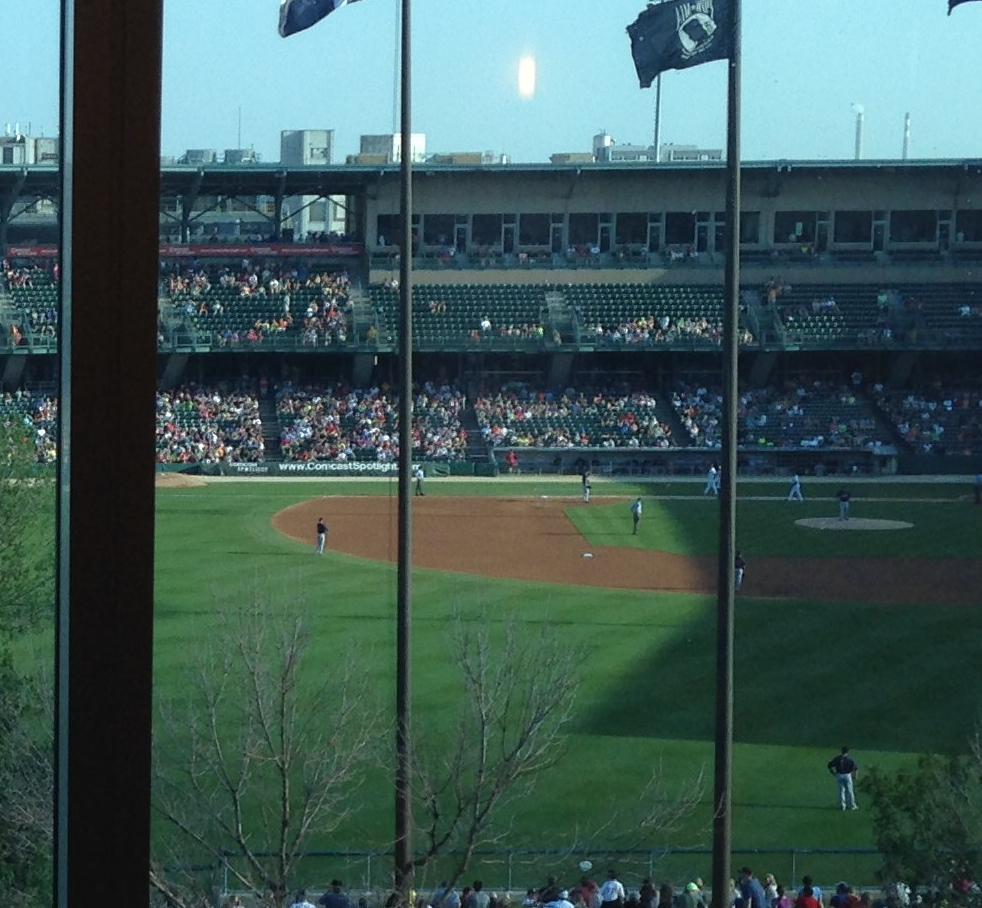
Also, check out this extra-credit guess for last week’s contest, in which a reader didn’t just ID the city and hotel, but dug even deeper to determine the day, time and exact moment of the live baseball game being played in the background:

aaa

Turns out full replays of all minor league games are on MiLB.com. The view photo was taken during the Indianapolis Indians’ June 17th game against the Gwinnett Braves, in the bottom of the 1st inning. Indians player Chris Dickerson had just been hit by a pitch. Two Indianapolis coaches and a trainer are escorting him down the 1st base line to check on his injuries. In the view photo, Dickerson and the trainer are just behind the flag pole, but the two coaches (long white pants) are VFYWC-222-Ballgameclearly visible. The above picture is taken from the game video at 19m:13s, (a few seconds after the view photo) when the coaches, trainer (in black) and Dickerson arrive at first base. Notice the shadows and position of first basemen and umpire are exactly as in the view. Sure enough in the background is the window of the JW Marriott  our photographer of the view is no doubt in the window in the upper right. The video cameraman is also visible in the view photo  he is in red, behind 1st base in the visitors dugout. My best guess is that the view photo was taken at video mark 19m:05s. I’ll bet the video is trimmed to start at the nominal game time of 7:05. Aligning the video time with that start time, the view was taken at 7:24:05 pm. Cool.

After checking the original image’s EXIF data, our reader was within seconds of the exact time the photo was taken. Incredible.

Browse all our previous window view contests here.

Why Shame The Messenger?

In a review of Glenn Greenwald’s No Place to Hide, Andrew O’Hagan shakes his head that “crazily, it was often journalists who opposed Snowden’s actions and hated what Greenwald was writing”:

On the not at all ironically titled CNN show Reliable Sources, there was a discussion about the leaks with a dramatic onscreen graphic carrying the legend ‘Should Glenn Greenwald be prosecuted?’ Walter Pincus of the Washington Post felt it was all Julian Assange’s doing (which it wasn’t), while Andrew Ross Sorkin of the New York Times used his CNBC show to say he would arrest Greenwald for seeming to want to get Snowden to Ecuador.

Perhaps we should just be grateful that these commentators didn’t form the wellspring of journalistic endeavour in the darkest days of apartheid. But Greenwald brilliantly describes the period they have brought into being under Obama’s extended wing. We learn that journalism, perhaps in imitation of Western governance itself, has ripped up the rulebook since 2001. It’s less a question of ‘What’s the real story?’ as ‘Whose side are you on?’ That this should be a disaster for the generally liberal-minded will not occur to these bin-rakers and text-inspectors, who think warriors for digital privacy are not that different from the men who would cut off your head. Such commentators are building the dark places they claim to hate – they spread their own kind of terror and advocate their own intolerance – and for such people, no matter what cave or desert or studio they reside in, the truth is always the enemy.

Sacking Plastic Bags, Ctd

A researcher who studies the environmental effectiveness of recycling admits that he “can’t stand” the plastic-bag ban:

Part of the reason can be found in the quote you cited:

Although plastic bags’ manufacture is relatively energy intensive (according to the Australian government, a car could drive 36 feet with the amount of petroleum used to make a single plastic bag) …

Doesn’t the author realize that she has just refuted herself? The proper gist of that sentence is:

Plastic bag manufacture is remarkably energy-cheap (a car could drive 36 feet with the amount of petroleum used to make a single plastic bag).

Thirty-six feet is a little more than four parking spaces. What the writer is saying – and this is a fact – is that if you recycle your plastic bags, you literally burn more fuel driving across the parking lot to the recycling bin than you save by recycling!  It’s just another example of innumeracy that such an argument can actually be made in favor of the ban.

He adds:

The plastic bag ban is a valid policy approach for exactly one environmental hazard: litter, and specifically marine litter.  In that perspective, a sharp curtailment of use would be greatly welcome, as long as it is done with knowledge of the fact that many of the alternatives (paper bags, laundered reusable bags) are significantly more energy- and resource-intensive than plastic bags.

Anyway, in terms of the energy demands of a reasonably comfortable western lifestyle, bag choice is more or less trivial. If people are looking to reduce their carbon footprint, they should take those reusable bags and hoof it down the sidewalk instead of driving.

Another reader spots an apparent error in the history of plastic bags we referenced:

The chronology mentions reports of suffocation occurring in 1959, but I believe that had to do with the plastic used to cover dry-cleaned clothing.  The plastic used for that purpose was very flimsy and clingy, which is what caused the suffocation hazard.  There’s a scene in “Mad Men” in the first season where Sally is walking around in the plastic and Betty berates her not for wearing the plastic but for possibly wrinkling the clothes.

The Wikipedia entry for plastic bags says that the patent for the material was in 1965, so I don’t think plastic bags were ever in use prior to that time.  I don’t remember plastic bags on the scene until the early eighties.  Most grocery store paper bags that I remember from the sixties and seventies did not have handles.  I think those came later in response to the plastic.

Our reader appears to be correct. Jeffrey L. Meikle, in his American Plastic: A Cultural History, describes the suffocation deaths of 80 children as the “dry-cleaning bag tragedy of 1959.”

Gang Rule

Graeme Wood flags research from David Skarbek, author of The Social Order of the Underworld, suggesting that prison gangs play an indispensable role in maintaining order in California penitentiaries:

“Prison gangs end up providing governance in a brutal but effective way,” he says. “They impose responsibility on everyone, and in some ways the prisons run more smoothly because of them.” … For example, consider the Aryan Brotherhood – a notoriously brutal organization whose members are often kept alone in cells because they tend to murder their cell mates. You can take the Brotherhood at its word when it declares itself a racist organization, and you can do the same with the Black Guerrilla Family, which preaches race war and calls for the violent overthrow of the government. But Skarbek says that at lights-out in some prisons, the leader of each gang will call out good night to his entire cellblock. The sole purpose of this exercise is for each gang leader to guarantee that his men will respect the night’s silence. If a white guy starts yelling and keeps everyone awake, the Aryan Brothers will discipline him to avoid having blacks or Hispanics attack one of their members. White power is one thing, but the need to keep order and get shut-eye is paramount.

The Beauty Of Plumes

dish_smoke

Thomas Herbich captured the surprising elegance of cigarette smoke:

Over the last three months photographer Thomas Herbrich snapped some 100,000 individual photographs of smoke, looking for unexpected anamalies and fortuitous coincidences where familiar shapes emerged. It’s fascinating to see how the brain tries to create order out of chaos, just like looking up at the clouds, suddenly familiar patterns seem to stand out: faces, hands, or scrolls of paper.

Herbich spoke to D.L. Cade about the project:

I was very surprised by how extremely quickly smoke move[s]. It’s easier to photograph a racing car! The rising of cigarette-smoke is actually so quick that conventional flash equipment is too slow, as is the photographer – only a few milliseconds pass between recognition of the subject and the taking of the shot, a length of time in which the smoke has already changed again.

I therefore used a quick flash with a flash duration of 1/10000 sec. or faster – and took more than 100,000 digital photos in three months (which killed one camera). The “poor” photos were immediately separated out on the laptop and rejected. Only 20 or so of the photos actually made the shortlist.

See more of his work here.