A Poem For Saturday

Dish poetry editor Alice Quinn writes:

There is no one I would rather read on the subject of Frank O’Hara than John Ashbery. He introduced the Collected Poems of Frank O’Hara, which Alfred A. Knopf originally published in 1971, edited by Donald Allen. And now he’s written a short introduction to the 50th anniversary edition of Lunch Poems, which debuted as Number Nineteen in the legendary City Lights Pocket Poets series, and is now reissued with facsimiles of previously unpublished letters between O’Hara and his editor, Lawrence Ferlinghetti.

On the outside, though, the book looks exactly as it always has, and we learn in one of the O’Hara letters that the familiar—and to so many of us cherished—cover was the choice of the poet, “What color is lunch? Maybe some sort of lipsticky red? (My favorite colors are actually orange and blue.)” We also learn that he didn’t care about the chronological arrangement of the poems in his first major book but did want the date of composition listed after each poem “as it is in Allen’s [Ginsberg’s] Reality Sandwiches.”

“No other poetry collection of the ‘60s did more to shatter the congealed surface of contemporary academic poetry,” Ashbery writes. “Freed from his Museum of Modern Art desk job for an hour or so at lunchtime, O’Hara wanders the streets of midtown, free-associating about trips he has taken, including a recent one to Spain on MoMA business, on which I accompanied him, and to Paris, where he has many friends. . . .Frank’s disabused enthusiasm carries the reader to a marvelous half-fictive universe where we bump elbows with Lana Turner, Billie Holiday, Rachmaninoff, and the Mothers of America, whom he urges: ‘let your kids go to the movies! . . .They may even be grateful to you/ for their first sexual experience.’ Horrors! To compound this unthinkable suggestion, O’Hara even gets away with using the word ‘fuck’ more than once, and yet he’s no macho spewer of hard truths, but a kind, inquiring, deeply curious and attractive youngish man, passing a few minutes of speculative rumination before heading back to the office, like all of us.”

“Song (Is it dirty)” by Frank O’Hara:

Is it dirty
does it look dirty
that’s what you think of in the city

does it just seem dirty
that’s what you think of in the city
you don’t refuse to breathe do you

someone comes along with a very bad character
he seems attractive. is he really. yes. very
he’s attractive as his character is bad. is it. yes

that’s what you think of in the city
run your finger along your no-moss mind
that’s not a thought that’s soot

and you take a lot of dirt off someone
is the character less bad. no. it improves constantly
you don’t refuse to breathe do you

– 1959

(From Lunch Poems, Expanded 50th Anniversary Edition © 1964, 2014 by Maureen Granville-Smith, Administratrix of the Estate of Frank O’Hara. Used by permission of City Lights Books, San Francisco)
 

Feminism Meets Occupy Wall Street

Rachel Hills profiles feminist writer Laurie Penny, author of Unspeakable Things: Sex, Lies and Revolution:

[Penny] is skeptical of attempts to take the bite out of the gender equality movement. “I think the whole question [of rebranding feminism] is very indicative of how threatening a lot of people find feminism and gender liberation in general,” she says. “My first response to that is always that feminism is threatening to the status quo. It is a legitimately scary idea for people who are invested in things staying the way that they are. There’s only so far you can dress it up.”

But Penny seems unsettled by the increased acceptance of feminism by society at large:

Not for her is the “tepid and cowardly” mainstream feminism focused on getting more women into boardrooms, or stamping out sexy music videos. “Let others construct an unchallenging feminism that speaks only to the smallest common denominator,” she writes.

Tara Wanda Merrigan provides an overview of Penny’s arguments. A big one:

For her, Lean In and its “middle-class, aspirational” feminism isn’t enough, because “while a small number of extremely privileged women worry about the glass ceiling the cellar is filling up with water.” … [W]hile many mark feminist achievement based on how many female CEOs there are in the Fortune 500, those measures obscure the fact that women are still the majority of minimum-wage earners, which is unfortunate since economic success can be majorly empowering. Therefore, feminists ought to think about progress at the bottom rungs of the ladder as much as the top.

Kat Stoeffel interviews Penny, addressing the question of topics assigned to female writers:

[Q.] You write that women “are allowed to talk only about their gender” and men “are allowed to talk about absolutely anything except their gender.” As a woman writer, have you been nudged toward gender issues?

[A.] You would not believe the amount of times — still — various magazines ask me to write pubic hair. Do you shave or not? Should you shave or not? For a long time, my decision not to write about pubic hair was a feminist position in itself. It matters to me a bit. We can have an interesting conversation it. But this endless collapse of the political into the personal …

As somebody who cares about this issue but also cares about a lot of other things, too, it’s been a fight to carve out a position where gender and power are important and they stand in conversation with every other aspect of politics. My blog began as an attempt to position feminism in radical left politics. It’s an attempt to avoid feminism becoming an echo chamber, which I think some people would like it to become. I understand that pubes are a legitimate source of anxiety. But I don’t understand why I don’t get infinite requests to write about domestic work or the economic roots of sexual violence or the stuff that is not necessarily sexy in the same way but is still an intimate question about work and power.

Salon has an excerpt from Penny’s book. She certainly doesn’t pull punches:

The idea that there is any such thing as Everygirl, a ‘typical’ woman who can speak to and for every other person on the planet in possession of a vagina, is one of the major sexist fairy tales of our time. Patriarchy tends to see all women as alike; it would prefer that we were all interchangeable rich, pretty, white, baby-making straight girls whose problems revolve around how to give the best blow jobs and where to buy diet pills. No man would ever be expected to write a book speaking to and for all men everywhere just because he happens to have a cock. The original feminist statement that the personal is political has been undermined by the insistence, in every media industry still run and owned by powerful men, that all women’s politics be reduced to the purely personal.

Getting The Last Word

Roger Grenier contemplates how writers approach death:

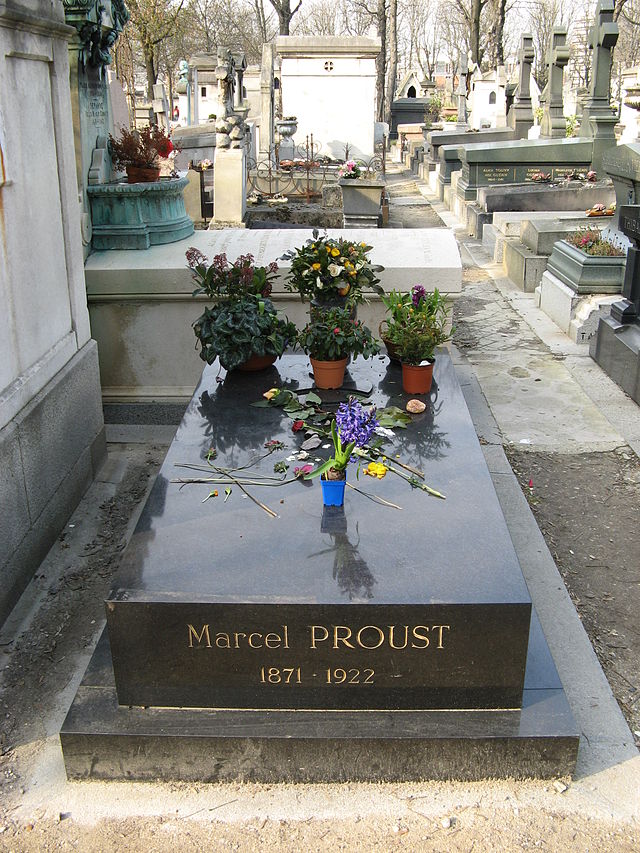
With certain authors, including some of the very greatest, we cannot speak of a last work. With them an entire640px-Marcel_Proust_(Père_Lachaise) life’s work is constantly put back on the loom, and so is condemned to remain unfinished. Friedrich Nietzsche, Marcel Proust, Robert Musil are in this category. Nietzsche wavers between the desire to construct and a totally free form. Only death stopped Proust from pasting strips of paper onto his manuscripts and his page proofs. With Musil, we never stop digging away at the mass of unpublished pages that supplement The Man Without Qualities. Critics attribute his inability to finish to masochism. But is having more and more to say, trying to reach perfection, really masochistic?

Saint Bonaventure, the Franciscan philosopher nicknamed the Seraphic Doctor, supposedly had the unique privilege of continuing his memoirs after his death. François-René de Chateaubriand, the first great French Romantic, was jealous: “I don’t hope for such a privilege, but I would like to resuscitate at the ghostly hour—at least to correct my page proofs.”

This chimerical wish was provoked by Chateaubriand’s worries about his Memoirs from Beyond the Tomb. More than once, this monument, which he intended to be posthumous, was in danger of becoming antehumous, due to the financial problems that always plagued the viscount. He gave some readings from the Memoirs in February and March 1834, and accounts of those readings were published. One can find fragments of the memoirs in his 1836 “Essay on English Literature.” Yet he complained, “I prefer to speak from the bottom of my grave.” In 1836, he sold the Memoirs to a company that promised to publish nothing until after his death. The affair took a worrisome turn in October 1844. The company sold rights to Emile de Girardin to publish excerpts from the Memoirs in his newspaper, La Presse. An unhappy Chateaubriand later wrote about seeing his Memoirs reduced “to bits and pieces”: “No one can form an idea of what I have suffered in being compelled to mortgage my grave.”

(The grave of Marcel Proust, via Wikimedia Commons)

Have We Outgrown Growing Up? Ctd

A reader chuckles at the notion that high culture has ceased to exist:

Responding to A.O. Scott’s essay, Freddie writes:

There is no such thing as high culture. There probably never was but even if there was it died long, long ago. Outside of your fantasies, there is no group of intellectual elitists looking down their noses at the music or TV you like. Such people do not exist.

I find that amusing, considering this article from yesterday’s issue of the New Yorker on the resurgence of the Frankfurt School (probably history’s foremost critics of “low culture”). One passage:

Culture appears more monolithic than ever, with a few gigantic corporations – Google, Apple, Facebook, Amazon – presiding over unprecedented monopolies. Internet discourse has become tighter, more coercive. Search engines guide you away from peculiar words. (“Did you mean . . . ?”) Headlines have an authoritarian bark (“This Map of Planes in the Air Right Now Will Blow Your Mind”). “Most Read” lists at the top of Web sites imply that you should read the same stories everyone else is reading. Technology conspires with populism to create an ideologically vacant dictatorship of likes.

I agree with Freddie’s claim that lovers of pop culture are not “an oppressed and denigrated minority,” but to say that there is “no group of intellectual elitists looking down their nose at the music or TV you like” is just plain wrong. As a PhD student in Communications, I sit in classes with some of them on a daily basis.

Another is skeptical of the entire end-of-adulthood argument:

I’m sure A.O. Scott wrote that piece with the best of intentions, but it amounts to a navel-gazing bout of bullshit.

If we have reached the “death of adulthood,” it’s because “adulthood” has in large part been a mirage. You don’t magically become “adult” by dressing a certain way, or having a certain amount of money, or going to a certain club, or deciding that you need Brahms instead of early Beatles.

The older I’ve gotten, the more I’ve realized that the adults I trusted growing up weren’t mystical sages. They were winging it. Children need older authority figures, but those figures are only doing the best they can. As you age, you still put away “childish” (I would say immature) things – unreasonable expectations of fame or wealth, the ache and burning of teenage love, and most of all, the belief that being a certain age magically mutates you into a separate “adult” creature.

Count me in with Lewis. If you’re a 50-year-old guy worrying about the culture of being “adult,” you’re exhibiting the type of immature mindset of a 12-year-old, when you thought “acting grown up” was terribly important. I like Marvel movies; I’m also a divorced 30-something working a corporate day job in a law firm. I’m sure as hell not going to devote all of my time to reading Russian philosophers at night to satisfy someone else’s illusion.

Another is on the same page:

I think we’re finally allowed to admit that in a lot of ways, we never grow up. Think about it: do we ever stop behaving like we’re in high school? Workplace hierarchies are similar to the ways we grouped or were grouped as teenagers. There’s still bullying and peer pressure. We wear “uniforms” that fit the environment, and our time is scheduled when it isn’t outright micro-managed. On a personal level, we still have our cliques that include or exclude based on the same ridiculous set of preferences and prejudices that we picked up as older teens or young “adults.”

My parents, born of the Depression, were “grown ups.” But my memories of their lives, and the lives of their friends, aren’t so different from what I see in my peers or in the peers of my adult kids. The exterior that we’re willing to show has changed, and our parents and grandparents were willing to put up with a lot more discomfort than we are. But there was never an adulthood. There was just the extent to which people were willing to conform. Which today, isn’t so much.

Meanwhile, a 23-year-old reader notes that disposable entertainments have a long pedigree:

Every generation has produced pop culture that wasn’t considered respectable and wasn’t discussed or analyzed in a serious way. Bawdy saloon and beer-hall tunes thrived in the age of Wagner and Strauss, dime pulp novels outsold Fitzgerald and Faulkner, and five-cent peep shows brought in viewers in numbers that would rival any superhero movie today. I think we’re at a pop-culture moment where we no longer put away things we enjoy simply because we fear looking childish. I’m not ashamed to admit that I have been moved to tears both by Harry Potter and Wilfred Owen. To argue that a vast swath of Americans don’t value “pleasures based on work, ambiguity, or difficulty” because adults are reading The Hunger Games is to construct a straw man of staggering size.

I agree with Freddie that being an adult has to do with your ability to be a productive human who cares for others and is thoughtful and self-aware both about one’s actions and place in the world. As far as I’m aware, seeing The Avengers is not an impediment to that.

Face Of The Day

Muslims Protest IS Violence

A young man chants as Muslims gather for Friday prayers on the street outside the Mevlana Moschee on a nation-wide action day to protest against the Islamic State (IS) on September 19, 2014 in Berlin, Germany. Muslims across cities in Germany followed a call by the country’s Central Council of Muslims to protest against the ongoing violence by IS fighters in Syria and Iraq. By Sean Gallup/Getty Images.

Paternity Pays, Ctd

A reader makes a nuanced argument:

There are some real problems with Miller’s position. Men increase their hours, while women reduce theirs. As a rather natural consequence, men get bonuses and raises. This happens when one works longer hours and work harder. Women want to work less. As a rather natural consequence, women have trained employers to be suspicious of women after they have children. Even if a particular women works longer and harder, she is tainted by the general reaction. I don’t think this is the fault of employers. Employers have the rather sad duty of living in the real world where economic decisions actually matter and have consequences. Thus, they are typically a conservative (in the traditional sense) bunch who go with what mostly happens: a women will work less and want more time off.

What we really need to do is to stop being a society that demands that the adults in a two-parent family both work. We need to re-organize back to the idea of one parent works to support the family and one stays home. We should be egalitarian about which one stays home and encourage fathers to stay home as much as mothers.

But we need to give employers both the message that the working parent can be fully counted upon to work and the stay-at-home parent can take on the real responsibility of raising children (which is wildly hard work, so much so that I would never, ever do it; even the sight of a day care center is enough to make me queasy).

The easiest way to do this is to credit the stay-at-home parent with Social Security credits equal to the working parent. The bonus for society would be fewer workers, higher wages for the remaining workers, and neighborhoods with adults home to keep track of the children. The time from after school to parents return is the most dangerous time for children and, with a parent home, that would end. Not only do studies clearly show children do better in two parent families (the sex of the two parents really doesn’t matter), but that children do even better in two-parent families where one stays home and takes on the daily task of raising the children (please see: Family Structure and Children’s Health in the United States: Findings From the National Health Interview Survey, 2001­ – 2007, published by the CDC).

For far, far too long, we’ve allowed our society to be organized to optimize what is best for corporate profits. We need to organize around what is best for our citizens, particularly families. I write this as a single gay man without children, but someone who fully recognizes a society that puts children and families first will be a healthier one.

Flowery Speech

dish_pansies

Robin Lane Fox surveys a history of plants in poetry:

Surprisingly, the poetry of flowers is often patchy and ill-informed. None of the ancient Greek poets mentions the brilliant wild tulips that run like red rivers through parts of the Greek landscape. Chinese poets focus on a narrow canon of flowers, soaked in symbolism and hidden meanings. They say nothing about the heavenly wild flora, the superb shrubs and mountain flowers that have transformed Western gardens since their collection and introduction by Europeans. John Milton’s poetry describes bunches of flowers that would never flower during one and the same season. No gardener, especially in Britain this year, would agree that April is “the cruellest month” and in no gardens or landscapes known to me does April breed “lilacs out of the dead land,” least of all on the American East Coast within range of the young T.S. Eliot.

The exceptions prove the rule. Sappho had an engagingly sharp eye for the flowers of her native Lesbos, including milk-white pansies. Theocritus’ poems, some three hundred years later, include particular flowers from his second home, Cos, and also from Sicily or southern Italy that he probably therefore visited. Shakespeare of course observed and included many flowers, and D.H. Lawrence was also unusually alert, not just to dark blue Bavarian gentians but to the dark trunks of almond trees, which he acutely observed during his time in Taormina and rendered in poetry there. William Cowper could garden well, but among living poets, only James Fenton has had a garden that challenged expert gardeners with its assemblages of snowdrops and highly unusual plants.

(Photo by Susanne Nilsson)

What A Drip

Colin Marshall introduces Dripped, an animated tribute to Jackson Pollack:

In its 1940s New York City setting, painting-swiping protagonist Jack lives not just to make world-renowned canvasses his own, but a part of him. When he gets these works of art back to his apartment, he doesn’t even consider selling them; instead, he chews and swallows them, thus enabling him to assume in body the forms and colors famously expressed in paint on their surfaces. We are what we eat, and Jack eats art, but even becoming the art of others ultimately leaves him unsatisfied. Determined to paint and eat a canvas of his own, he finds his stomach can’t handle his work in progress. Thrown into a bout of frustration, an angered Jack tosses one of his paintings to the ground, randomly splattering it with every color at hand. And thus he discovers, in this animated fantasy, the technique that Jackson Pollock would pioneer in reality.

The Collapse Of Arab Civilization?

That’s how Hisham Melhem characterizes the decades-long series of crises that led to state failure in the Arab heartland and the rise of ISIS:

Arab civilization, such as we knew it, is all but gone. The Arab world today is more violent, unstable, fragmented and driven by extremism—the extremism of the rulers and those in opposition—than at any time since the collapse of the Ottoman Empire a century ago. Every hope of modern Arab history has been betrayed. The promise of political empowerment, the return of politics, the restoration of human dignity heralded by the season of Arab uprisings in their early heydays—all has given way to civil wars, ethnic, sectarian and regional divisions and the reassertion of absolutism, both in its military and atavistic forms. With the dubious exception of the antiquated monarchies and emirates of the Gulf—which for the moment are holding out against the tide of chaos—and possibly Tunisia, there is no recognizable legitimacy left in the Arab world.

And in his view, neither Arab nationalism nor Islamism is a viable solution, being both “driven by atavistic impulses and a regressive outlook on life that is grounded in a mostly mythologized past”. He concludes:

The Islamic State, like al Qaeda, is the tumorous creation of an ailing Arab body politic.

Its roots run deep in the badlands of a tormented Arab world that seems to be slouching aimlessly through the darkness. It took the Arabs decades and generations to reach this nadir. It will take us a long time to recover—it certainly won’t happen in my lifetime. My generation of Arabs was told by both the Arab nationalists and the Islamists that we should man the proverbial ramparts to defend the “Arab World” against the numerous barbarians (imperialists, Zionists, Soviets) massing at the gates. Little did we know that the barbarians were already inside the gates, that they spoke our language and were already very well entrenched in the city.

Cool Ad Watch

Not cool so much as powerful:

[youtube https://www.youtube.com/watch?v=UNw-ikgLhS8]

Tim Nudd details the PSA:

With the United Nations General Assembly meeting next week, the world’s leading NGOs—Oxfam, Save the Children, Care, Amnesty and a hundred more—have banded together for a new PSA, directed by [Martin] Stirling, that attempts to capture the horrors being endured by ordinary Syrians on a daily basis. … The stylistic choice of using reverse footage almost becomes a moral choice here—it’s the hook that makes the piece haunting, and shareable, and thus capable of making a difference. The film is the centerpiece in the NGOs’ #WithSyria campaign, which drives viewers to a petition asking the UN Security Council to take next steps to protect civilians.

Stirling’s previous ad calling attention to the plight of Syrian civilians is here.