Spare The Rod.

enten-datalab-spanking-2

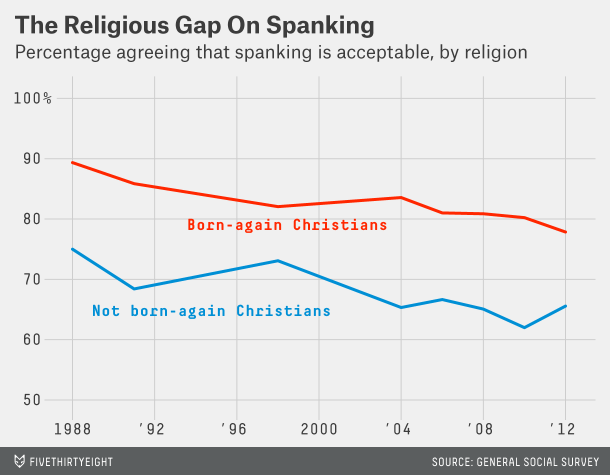
Responding to the Adrian Peterson scandal, Harry Enten provides the above chart:

There is a large gap when it comes to religion. The subsample on religion has been included in the GSS only occasionally, yet there is a clear divergence. Born-again Christians are, on average, 15 percentage points more likely than the rest of the population to agree that spanking is an acceptable form of punishment.

Amanda Marcotte expands on the religious angle:

Christian conservatives defend the practice of spanking children, even with weapons, by saying that parents are not supposed to do so in anger.

“You want to be calm, in control, and focused,” writes Chip Ingram of Focus on the Family and that a parent who embraces corporal punishment “is not an angry, insensitive person with a big club and a vicious agenda.” This echoes a common refrain from parents to justify spanking, that they don’t do it in anger and they reserve it for serious infractions that require a lot of time and processing so the child doesn’t do it again.

Unfortunately, parents are overestimating their own abilities to keep it in check. Researchers at Southern Methodist University strapped audio recorders onto the arms of 33 mothers to see if and when they used spanking, and found that instead of retreating to a quiet space to calmly administer a spanking, mothers who spank are just hitting in anger and frustration. Kids got spanked for finger-sucking, messing with pages of a book, or getting out of a chair when they weren’t supposed to. Parents who spank say they do so around 18 times a year, but the SMU researchers found it was closer to 18 times a week.

In Defense Of Amazon

Clay Shirky believes critics of the company are misguided:

I’d always aspired to be a traitor to my class (though I’d hoped it would be for something a bit more momentous than retail book pricing), but treason is as treason does, so here goes:  The reason my fellow elites hate the people who run Amazon is that they refuse to flatter our pretensions. In my tribe, this is a crime more heinous even than eating one’s salad with one’s dessert fork. The threat Amazon poses to our collective self-regard is the usual American one: The market is optimized for availability rather than respect. The surface argument is about price, but the deep argument is about prestige. If Amazon gets its way, saying, “I published a book” will generate no more cultural capital than saying “I spoke into a microphone.”

Given their deep ambivalence about expanded participation in the making and selling books, it’s worth noting some scenarios Amazon’s critics aren’t afraid of: They aren’t afraid that books will become less accessible. They aren’t afraid that there will be fewer readers. They aren’t afraid that fewer books will be published. Bezos understands that running a great bookstore is more like running a great grocery store than running a great opera company; it enrages my people that he’s unwilling to pretend otherwise.

Meanwhile, Joshua Gans asks, “When Amazon provides the world’s largest bookstore – and it is getting larger and larger – how do authors compete in the market for attention?”

Specifically, while it is nice to believe, as Shirky appears to do, that just “getting it out there” will let the cream rise to the top, Amazon doesn’t provide a platform that quite does that. Instead, Amazon provides a rating platform and, when there are small numbers involved (as they must to have a long tail work out), then we get distortions creeping in. Put simply, people who hate the concept of a particular book, need not have read it to give it one star and distort the picture. [Craig] Mod argues that Amazon can surely do better with its data and I would argue it surely has an interest to do better.

But how to do so is not that obvious. The standard in terms of how to start has been shown to us by researchers at eBay. As I noted a few months ago, Chris Nosko and Steve Tadelis were able to theorise about a better rating system and then also test that it would improve outcomes for consumers. So while we can praise Amazon for putting a competitive wind into an old and rigid industry, we must also be careful to continue to hold them to the fire of accountability for the efficiency of the platform in attention they are creating. It is only if they do so that the old gatekeepers and ‘standard bearers’ will face the challenge Shirky is hoping for.

(Full disclosure: The Dish has an informal business relationship to Amazon through its affiliate revenue program, which virtually anyone can join. The program only generates about 3% of our annual revenue, just about enough to pay and provide health insurance for our interns. And if there’s any doubt that the Dish has long aired criticism of the company, see here, here, here, here, herehere and here. We will continue to do so.)

Haters Be Calling This War A “War” Ctd

Looking at how the Obama administration has hemmed and hawed over whether this campaign against ISIS counts as a “war”, Dave Uberti ponders the meaning of the word today:

In the past, nations typically fought wars against other nations or enjoyed peace, providing a dichotomy that was easy for politicians to communicate, the media to relay, and the public to understand. Wars ended and, perhaps as importantly, the concept of victory or defeat was unambiguous. But that era is long over, said Martin J. Medhurst, a Baylor University professor of rhetoric and communication. “War, in the American experience, has not been a simple question since the end of World War II,” he said. “The whole nature of what is a war, how to conduct warfare, and how to know whether you win or lose has become very murky in the past half century.”

The administration’s capitulation on the word choice is notable, Medhurst added, as it represents a starting point for the evolution of political discourse surrounding the war. “Once you invoke the term ‘war’ — whether it’s literally, as was the case with Vietnam, or not, as was the case with the War on Poverty — once you invoke that metaphor, you’ve put all of those marbles in the game,” he said. “There’s almost no going back.”

Tanisha Fazal brings up some other reasons why the nomenclature matters:

A major reason states do not declare war upon non-state actors is because doing so would accord these actors the very legitimacy, rights and status that states are fighting to keep them from gaining. We observe this most easily in civil wars, where rebel groups might declare war upon states, but states tend not to reciprocate, instead labeling rebels as criminals or terrorists.

There are other reasons not to expect a US declaration of war against ISIS. As I have shown, all states have pretty much stopped declaring war. The US is no exception – Congress has not declared war since World War II. This decline is not due to a decline in war – there have been plenty of wars and armed conflicts since the Second World War, and the US participated in many of them. Rather, once states issue a formal declaration of war they unequivocally oblige themselves to comply with international humanitarian law. And as the standards of complying with international humanitarian law have risen over time, states appear to be increasingly reluctant to step over the bright line of issuing a formal declaration of war.

But Friedersdorf, responding to Ambinder’s contention that this really isn’t a war, insists that it is, and that Obama must get permission from Congress to wage it:

Yes, the War on Terrorism is different from other conflicts in various ways. But why does the number of troops needed as compared to Iraq matter? Why does the cost, which is only “negligible” in terms of the rest of a gargantuan military budget, matter? Why must Obama be graded on a curve set by George W. Bush and Dick Cheney?

If American war planes are firing missiles at a foreign nation or militia, that is war. Everyone understands as much with respect to foreign countries. Imagine an Iranian drone carried out a single targeted missile strike on an Israeli settlement. Would that be an act of war? Or not so much, because it’s merely part of “a balance of measures—political, military, legal, and otherwise,” to degrade Zionism? What if Russia stationed, in a foreign country, just a tiny fraction of the troops that Bush mobilized for the occupations of Iraq and Afghanistan?

And Ilya Somin takes on what he considers “the strongest of the newer arguments for Obama’s decision”, i.e. that there’s no need to declare war because ISIS itself has already initiated it:

The self-defense theory has several virtues. It does not rely on a strained interpretation of the 2001 Authorization for the Use of Military Force, or the 2002 Iraq AUMF. And unlike John Yoo’s theory of executive war powers, it does not give the president blanket authority to initiate new wars on his own.

But the idea nonetheless has some real flaws. ISIS’ atrocities in beheading two American journalists and holding a few other Americans hostage are horrendous. But it’s hard to argue they are an attack against the US on a large enough scale to count as a war. Serial murderers such as Ted Bundy and the Unabomber probably killed as many or more Americans than ISIS did before Obama ordered air strikes against it (like ISIS, the Unabomber even did it for political reasons). The same is true of quite a few pre-9/11 foreign terrorists. Yet few claim that their actions amount to initiating a war against the United States.

An Actual War On Women

Aki Peritz and Tara Maller want to know why ISIS’s use of rape and sexual slavery as weapons of war isn’t getting more press:

The Islamic State’s (IS) fighters are committing horrific sexual violence on a seemingly industrial scale: For example, the United Nations last month estimated that IS has forced some 1,500 women, teenage girls, and boys into sexual slavery. Amnesty International released a blistering document noting that IS abducts whole families in northern Iraq for sexual assault and worse. Even in the first few days following the fall of Mosul in June, women’s rights activists reported multiple incidents of IS fighters going door to door, kidnapping and raping Mosul’s women.

IS claims to be a religious organization, dedicated to re-establishing the caliphate and enforcing codes of modesty and behavior from the time of Muhammad and his followers. But this is rape, not religious conservatism. IS may dress up its sexual violence in religious justifications, saying its victims violated Islamic law, or were infidels, but their leaders are not fools. This is just another form of warfare.

Even women and girls who escape these horrors still face sexual exploitation in refugee camps. Chandra Kellison reports on what she observed while working with Syrian refugees in Lebanon this summer:

Three-quarters of those displaced in Lebanon are women and children who have lost a family member to war and remain vulnerable inside and outside of their new community. A generation of Syrian kids have the far-away gazes of battle-hardened soldiers returning from war. Displaced girls, especially, face the triple jeopardy of war, domestic violence and attacks from neighboring men. Only the immediate threat of war diminishes during the journey from Damascus to Beirut. Their new normal is neighbors, single women, engaging in survival sex with a series of resourceful men and widows pretending to call husbands who are really dead, all in a bid to seem less vulnerable to kidnappers, harassers, and attackers in their Lebanon. …

Not even the most fertile imagination could have conjured a better monster-in-the-dark than IS. The Brothers Grimm could not compete with stories spreading from city to city of savages that force children to use severed heads as soccer balls. By comparison, the terror caused by IS had reduced the perceived danger of a few opportunists who punch down the dignity and emotional integrity of refugee women and girls through offers that cannot be refused, because the needs of their families are too dire.

The View From Your Window

Quebec-Canada-1046am

Quebec, Canada, 10.46 am. A different reader writes:

I covered the referendum in Quebec in 1995 for Harper’s (pdf), and particularly the aftermath. It’s difficult to convey the intensity of the passions that were stirred up in the final days before the vote – and the deflated and bewildered sense of disappointment separatists felt in the days after their narrow loss (50,000 votes out of 5 million cast). The slogan for the Oui/Yes side was AND IT ALL BECOMES POSSIBLE – which described both the promise and the menace that was lurking just beneath the surface. The ugly slurs about the the No side winning because of “money and the ethnic vote” that the Oui leader made on the night of the loss perfectly match the ugliness that is emerging in Scotland.

There is no easy way to break up a country, even one as civilized and seemingly docile as Canada. Quebec dodged a bullet in 1995. I hope Scotland is as lucky.

Quote For The Day II

“For some time I have been disturbed by the way CIA has been diverted from its original assignment. It has become an operational and at times a policy-making arm of the Government. This has led to trouble and may have compounded our difficulties in several explosive areas. I never had any thought that when I set up the CIA that it would be injected into peacetime cloak and dagger operations. Some of the complications and embarrassment I think we have experienced are in part attributable to the fact that this quiet intelligence arm of the President has been so removed from its intended role that it is being interpreted as a symbol of sinister and mysterious foreign intrigue—and a subject for cold war enemy propaganda.

With all the nonsense put out by Communist propaganda about “Yankee imperialism,” “exploitive capitalism,” “war-mongering,” “monopolists,” in their name-calling assault on the West, the last thing we needed was for the CIA to be seized upon as something akin to a subverting influence in the affairs of other people… I, therefore, would like to see the CIA be restored to its original assignment as the intelligence arm of the President, and that whatever else it can properly perform in that special field—and that its operational duties be terminated or properly used elsewhere,” – Harry Truman, December 22, 1963.

My take on the CIA as an increasing malignant cancer on our democracy is here.

War Will Keep Them Together

https://twitter.com/Khaleed1949/statuses/511845817125044224

Remember that schism between al Qaeda and ISIS? Well, there’s nothing like a new war with the Great Satan to help patch that up. Adam Taylor passes along some salient news and poses a troubling question:

In a two-page message posted to Twitter accounts that represent both groups, al-Qaeda in the Arabian Peninsula (AQAP) and al-Qaeda in the Islamic Maghreb (AQIM) asked their “brothers” in Iraq and Syria to “stop killing each other and unite against the American campaign and its evil coalition that threatens us all.” It’s an unusual move. The two groups are perhaps the most notorious of the al-Qaeda-linked groups: AQAP operates in Yemen and Saudi Arabia, and it has been described as the “most lethal Qaeda franchise” by the Council on Foreign Relations, while AQIM operates in Northern Africa, in particular Algeria, Mali and Libya. Analysts say a joint statement from the two is unprecedented. …

[T]he statement calls on all jihadist groups to unite against a common enemy: “crusader America” and the alliance of states backing the U.S. plan to strike the Islamic State. This language echoes the Islamic State’s own language and presents a bigger concern: Might U.S. strikes against the Islamic State cause it to reunite with al-Qaeda and other extremist groups it opposes?

Aymenn al-Tamimi translates and analyzes the statement. In his view, the answer to that question is “not necessarily”:

This statement does not mean AQAP and AQIM are getting closer to IS or warming to the idea of pledging allegiance to IS. Indeed, they have firmly rejected IS’ Caliphate declaration, and have maintained their loyalty to al-Qa’ida Central (AQC). For comparison, note that members and supporters of Jamaat Ansar al-Islam- an Iraqi jihadi group (with a Syrian branch) which like al-Qa’ida does not accept IS’ claim to be a state or caliphate- have also denounced the U.S. airstrikes etc. targeting IS as constituting war against Islam, and like al-Qa’ida would want an ideal situation where all jihadis having the end-goal of a Caliphate unite against a common enemy, while rejecting IS’ assumption of supreme authority.

Meanwhile, much though Obama takes pains to deny that there is anything religious or civilizational about this war, that’s not how ISIS sees it:

[N]o matter how delicately the White House wants to frame renewed military operations in the region, it’s serving up rich propaganda fodder for the militant group in Washington’s crosshairs. As Morning Mix’s Terrence McCoy notes, the Islamic State is all too happy to paint the coming battle as a civilizational conflict. In its own glossy publication, Dabiq, the terror organization hails its plans to fight the “crusaders in Washington” and sees its rise amid the chaos of the Middle East as an evocation of history. …

In any event, it’s all dubious propaganda for the Islamic State, which as Obama noted, spends most of its time killing fellow Muslims and faces a constellation of largely Muslim factions — Kurdish militias, Syria’s Assad regime, the Iraqi government, Iran, and the Sunni Gulf states — arrayed against it. And, given Obama’s caution, the Islamic State can’t count on the same slip of the tongue of the president’s predecessor. Just days after the attacks of Sept. 11, 2001, President George W. Bush warned that “this crusade, this war on terrorism, is going to take a while.”

Is Britain’s Security Council Seat In Jeopardy?

Elaine Teng takes the question seriously:

Strictly speaking, the Scottish referendum should not affect Britain’s Security Council seat, but reform of the U.N. is increasingly in the air. Currently, there are five permanent Security Council members who hold veto power (the U.S., France, the U.K., Russia, and China), and ten rotating members elected by the General Assembly to serve two-year terms. There’s a general consensus that the Council should be expanded to 20-25 permanent members, but that’s when things start to get tricky. Which countries should join? India, a nuclear power home to a fifth of the world’s population? Germany and Japan, two of the world’s largest economic powers who contribute more to the U.N. budget than any country other than the U.S.? Nigeria, to give Africa a seat and correct the skew of power towards Western countries? Should France and Britain’s seats be combined into a single European seat to better accommodate the changing political realities?

Independence could accelerate these conversations, especially since the Scottish referendum comes just two days after the opening of the U.N.’s General Assembly on Tuesday. Should Scotland become independent, the position of the new, much smaller Britain on the Security Council might be called in to question. (An independent Scotland would apply for U.N. membership, a process that should be relatively smooth and straightforward.)

Stewart M. Patrick dismisses such speculation:

This is not going to happen. The near-certain outcome, if the Scots unwisely choose to go it alone, is that the authorities in Edinburgh will immediately recognize the UK government’s UNSC claim. A newly independent but closely integrated Scotland has everything to lose and nothing to gain by disputing the UK’s permanent seat. (Nationalism may be “political romanticism,” in Isaiah Berlin’s words, but even the most starry-eyed Scots understand that a country of fewer than six million has no permanent slot on the UNSC). Perhaps more surprisingly, the attitude of the remaining permanent four UNSC members will be identical: they will quickly recognize the rump United Kingdom as the state entitled to permanent membership.

Scotland Is Not So Easily Broken

The Final Day Of Campaigning For The Scottish Referendum Ahead Of Tomorrow's Historic Vote

Whatever tomorrow’s result, Alex Massie anticipates that the Scots will make peace with the result:

There will be a deep sadness in many places if Scotland votes Yes and, in other parts, some raging disbelief if she votes No. How could it be otherwise? This may be a wee country but the matter of Scotland is nothing small. Some folk will leave if we vote Yes and that, I think, will be a great pity. Others will react poorly to a No vote but at least cling to the consolation that losing a battle is not the same as losing a war. The nationalists have known defeat before and coped; they can do so again. Their faith will remain. It will be harder, I think, for Unionists to accept the song is over.

But hatred? Real hatred? How can we really hate our opponents? We may think them sorely mistaken but we can also agree – if we try to remember to do so – that they are not motivated by baser motives than we are ourselves. They are our brothers and sisters, fathers and mothers, husbands and wives, sons and daughters. Our neighbours too. To hate them is in some sense to deny a part of ourselves.

In that respect we really are all in it together. Today, tomorrow and Friday too. Come what may. Be not afraid. It is, probably, going to be fine. The little white rose of Scotland, so small and sharp and sweet, will still bloom.

Peyton Craighill interprets the polls:

The most recent poll using the most robust methodology will generally offer the best picture of where things will end up. In this case, that would be the phone poll from Survation completed Sept. 12 that showed 42 percent in favor of independence and 49 percent opposing, with 9 percent unsure. The survey reached respondents on both land lines and cellphones.

The 9 percent who are unsure in the Survation poll are a critical group. If they do turn out to vote on Thursday, their choices have the potential to sway the vote one way or another.

Tim Stanley would be unsurprised by a Yes victory. One reason why:

Historically, turnout in Scottish elections is low – in about the mid-sixties. But this time around some 97 per cent of Scots have registered. Now, why would someone go to the effort to register for the first time? To vote negatively (NO) or to vote positively (YES)? A local journalist put it to me that many of those new voters will be working-class Scots motivated by national passion. It’s unlikely that they’re fired up by David Cameron, Ed Miliband or the prospect of Devo-Max (which sounds like a reunited Eighties pop group).

Isabel Hardman visited both campaigns:

Which was the better operation, Labour No or the Yes camp? The two sessions I’ve attended in the past two days will not be entirely representative of their respective national campaigns, which unlike a stick of rock will vary depending where you cut. But the Labour lot seemed more organised, presumably because Labour is an experienced ground war party, while the Yes troops today were more enthusiastic and passionate. Even ‘No’ voters congratulated the two men on their impressive campaign.

Yes don’t have the media on their side – only one paper has come out in favour of independence – so their focus is so much more on grassroots support. Perhaps this makes them appear more sincere and energetic.

Peter Geoghegan is befuddled by Westminster’s mistakes:

The choice tomorrow didn’t have to be binary, but the third option – more powers for Holyrood without full independence – was left off the ballot paper. Then on Tuesday, just two days before the vote, Scotland woke to news that ‘devo max’ was back on if they voted No. The specifics of the additional powers seem both vague and unworkable, but the medium was more important than the message. The pledge, which could effectively usher in federalism across the UK, was delivered not after months of discussion, or even in person by the prime minister. Instead, ‘the vow’ was splashed across the Daily Record. If Westminster thinks that the front page of a tabloid is the best way to talk to Scotland in 2014 then it really has learned nothing from the referendum.

Ewan Morrison takes the Yes campaign down a notch:

In truth, the Yes camp is a ragged collection of factions all seeking power for themselves – a bigger slice of the political pie in a much smaller country. The unity and positivity behind the singular Yes has masked the divisions on the Yes side, between Greens who want no more drilling and the “it’s-our-oil” men; between steady state anti-capitalists and “business for Scotland”. There are even within the Yes camp factions of the old left that have long been pushed out of modern politics. The chanted “Yes”, it turns out, is as much about silencing the dissent among the ranks of Yes followers as it is about silencing opponents.

How will so many disparate and vying factions manage to create a better, more “positive” Scotland? We could have had an answer to this if months back the Yes factions had actually made concrete plans for the future and recognised their divisions, but instead they chanted the mantra of fantasised unity: Yes Yes Yes. This is why the word plastered all over our country has come to mean absolutely nothing. It’s an illusion of positivity. A hope about hope. A pure advert, selling us something we don’t need, something that does not even exist – a post-political dream of a new nation untroubled by the conflicts of the past or grim realities of the world beyond. Say it enough times and you start to believe it. Yes Yes Yes. Say it and see it too many times, and it vanishes into meaninglessness.

Clive Crook, who thinks Scotland could come to regret independence, nevertheless favors it:

It comes down to this: Scots are bound more tightly to each other — by history, culture and ethnicity – than they are to the rest of the U.K. In this sense, Scotland is, and for centuries has been, another country. Its desire for full nationhood has waxed and waned, but it certainly isn’t new. The union is hundreds of years old, but the things that make Scotland different haven’t been smoothed away, which tells you something.

What has changed in recent decades is that the U.K. has become both less hospitable to the Scots and less necessary.

And Paul Wells’ hunch is that “an independent Scotland would, in 30 years, be doing fine and maybe better than fine”:

And that the United Kingdom, whose history is rich in upheaval, could handle this one with little difficulty. There would be transition costs, and they would be borne disproportionately by people whose means are so modest they have a hard time handling any new cost, but a lot of them will vote Yes tomorrow anyway. That’s only irrational if you assume voters are, or should be, profit maximizers before all else.

All of the Dish’s Scotland coverage here.

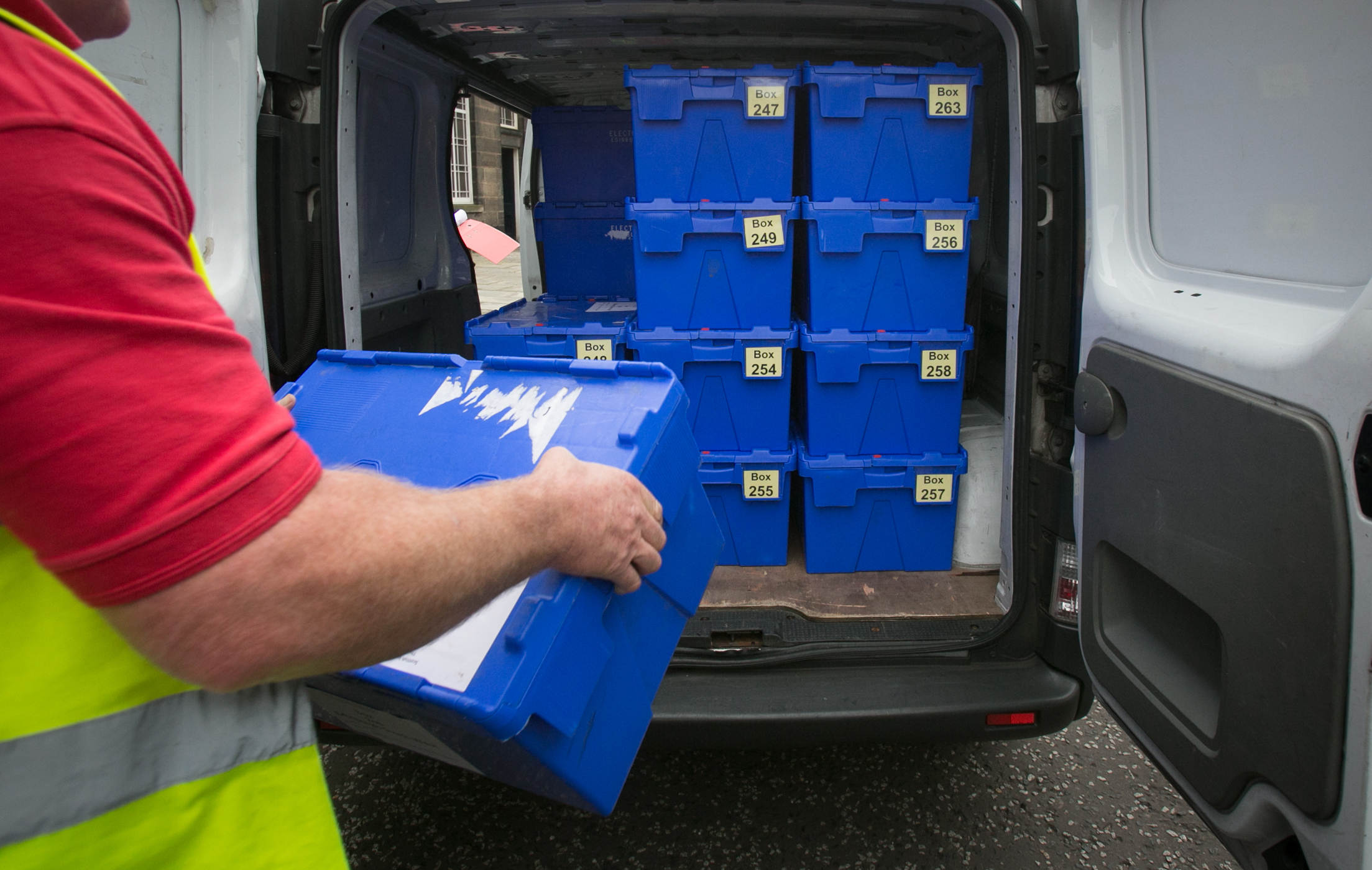
(Photo: Ballot boxes are carried to a waiting van as ballot boxes that will be used in the Scottish independence referendum are collected from New Parliament House for delivery to Edinburgh’s 145 polling stations on September 17, 2014 in Edinburgh, Scotland. By Matt Cardy/Getty Images)