The Best Of The Dish Today

The Final Day Of Campaigning For The Scottish Referendum Ahead Of Tomorrow's Historic Vote

There’s a kind of hush all over Britain tonight, as Herman’s Hermits once had it. That bitter old lion, Gordon Brown, delivered a barn-burner for the union:

Tell them this is our Scotland. Tell them that Scotland does not belong to the Scottish Nationalist Party. Scotland does not belong to the Yes campaign. Scotland does not belong to any politician – Mr Salmond, Mr Swinney, me or any other politician. Scotland belongs to all of us. This is not their flag, their country, their culture, their streets. This is everyone’s flag, everyone’s country, everyone’s culture and everyone’s streets. Let us tell the people of Scotland that we who vote No love Scotland and love our Scotland.

It was arguably the strongest speech in the campaign – and even revived calls for Brown to get back into politics. Watch it all here. And isn’t it marvelous the way this referendum has really brought out a huge outpouring of democracy, of debate in every venue, and a staggering 97 percent registration rate? At a time when politics seems increasingly distant from most voters’ lives, in which political elites become as despised as economic elites, the simple ballot and the simple question have brought real democracy back to life. The Guardian introduced a new point:

A decision of such gravity – to break away from a 300-year-old union – should be the settled will of a nation. The very fact that Scottish opinion is so closely divided is itself a weakness in the case for independence. Moves of such import should command enduring and overwhelming support, as the creation of the Holyrood parliament did in 1997.

But what if the vote isn’t as close as it now seems to be? The referendum has achieved a 97 percent registration rate, as Tim Stanley has noted. You think all those new voters want to keep the status quo? But, as usual, the Onion FTW:

A tragedy is unfolding in Scotland. One glance at this week’s headlines reveals that the region’s fractious political situation is intensifying, with separatist activists gaining more and more support every day. Barring something drastic, Scotland seems bound inexorably for a cataclysm. Can the United States stand idly by as Scotland descends into civil war? …

How many Scots need to die before Obama says “Enough is enough” and steps in? The United States has a moral imperative to intervene, starting immediately with air raids to break the militant separatists before they gain a stranglehold on power. But that will not be enough. We need boots on the ground as soon and in as great numbers as possible.

Where is John McCain when you need him?

Full Dish coverage of Scotland in one place here. Elsewhere on the blog today, I tried to add some historical perspective to the growing hysteria over Russia and Iraq and Syria. Readers revealed their own personal eggcorns – after my epic embarrassment. We noted that Obama has not just given ISIS the mother of all propaganda coups, but has actually brought Al Qaeda and the Caliphate into an alliance. Pretty great start, no? Instead of letting these fanatics fight each other, we’ve gone and made them all want to fight us. I hope Lindsey Graham is satisfied.

As for the midterms, the Democrats seem to be holding weirdly steady. Could it be a function of general loathing of the GOP?

Many of today’s posts were updated with your emails – read them all here.  You can always leave your unfiltered comments at our Facebook page and @sullydish. 20 more readers became subscribers today. You can join them here – and get access to all the readons and Deep Dish – for a little as $1.99 month. Gift subscriptions are available here if you’d like to introduce the Dish to others. A reader gets what we’re trying to do here:

[Dish editor] Chris, thank you so much for posting [my email on husband beaters]. You have no idea how much it brightened my day/week/month and probably my year. It’s also interesting to me which part you cut out of my email. I don’t know if it was just to keep it snappy or not to attract the pure shitstorm that comes with even mentioning men’s rights activists? Either way I wouldn’t blame you.

I’ve been reading Andrew since this 2006 article on the rise of fundamentalism. At the time I was wrestling with a lot of questions about faith and his words in this felt like a revelation to me. I’ve been reading ever since. When I have strong opinions about politics or other things that go on in the world, I usually talk with friends and family, but I can never be sure I’m not just in an echo chamber. I can look for conversation online, but, well … you know how bad the comments section can be. It’s full of people yelling half-formed opinions into an abyss of pure noise and never really listening to what others have to say.

But even getting a passing mention on the Dish is special to me. It’s actually having a seat in a full conversation. I’m sure some readers will disagree with what I say, and I welcome that, but even being one voice on the Dish tells me at least I’m asking the right questions.

See you when the conversation resumes in the morning.

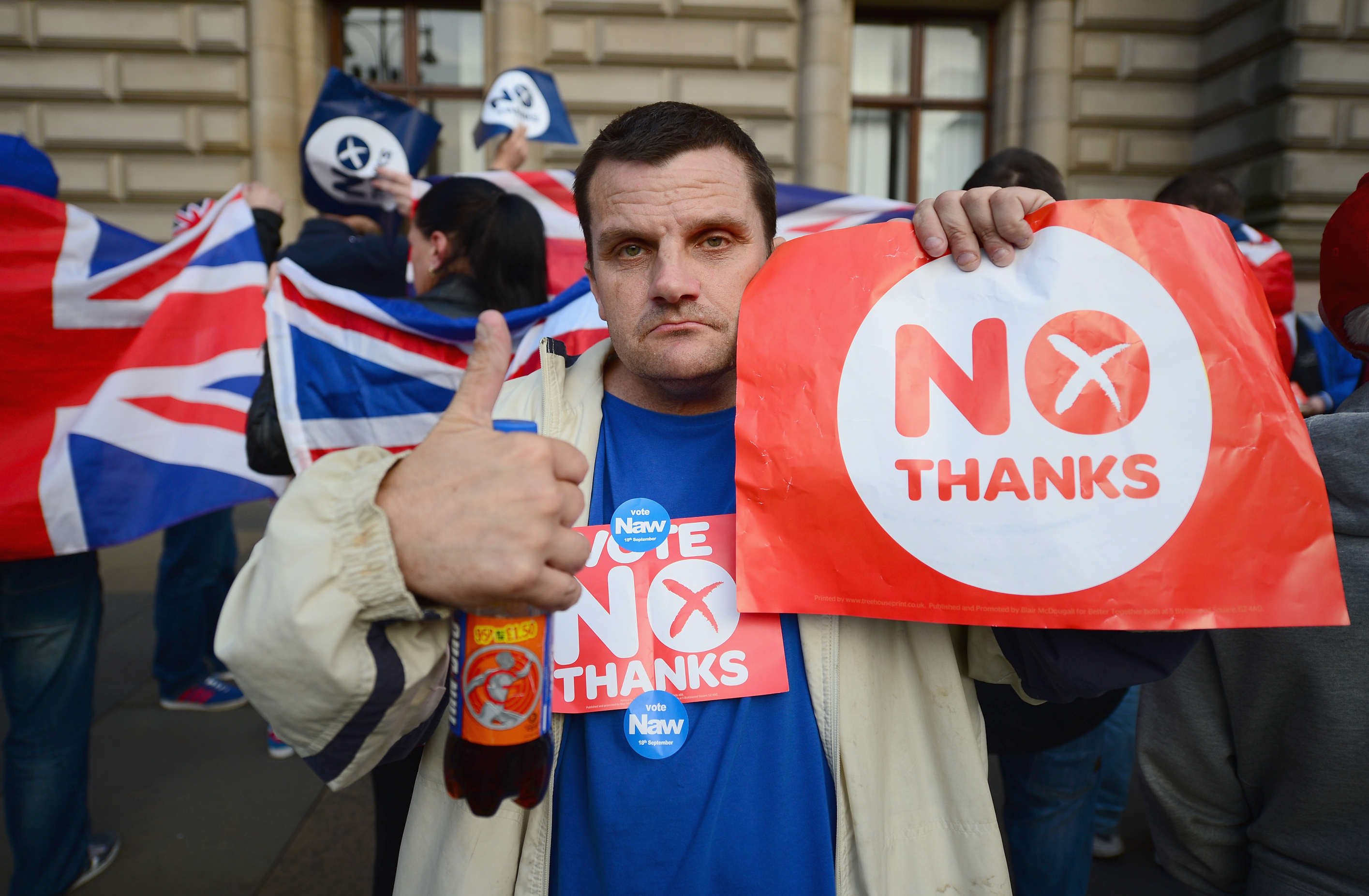
(Photo: Unionist supporters gather near George Square, where Yes activists had been holding a pre-referendum event in Glasgow, Scotland on September 17, 2014. By Jeff J Mitchell/Getty Images)

The Great “Unraveling”?

[Re-posted from earlier today.]

I’m a huge admirer of Roger Cohen’s writing – and can appreciate many of the thoughts percolating in his latest column on what he sees as a disintegration of the world order. He manages to cite Scottish independence, the rise of ISIS, and the devolved powers to Eastern Ukraine – and even Ebola! – as part of a trend toward dissolution and anarchy.

But when I look at all the developments he is citing, I don’t really see anything that new. Take Iraq – please. What we are witnessing is the second major Sunni revolt since they were summarily deposed from power by the United States in 2003. How is this new? The Sunnis have long since believed in their bones that Iraq is theirs by right to govern. They despise the Shiites now running the show. The entire construct Syria_and_Iraq_2014-onward_War_mapof Iraq in the first place was designed on the premise of permanent Sunni rule over the majority. That rule necessarily had to be despotic – as all attempts to permanently deny rights to a majority in the country must be.

So we removed the despot – as we did in Libya – and we have an ongoing power-struggle that is a continuation of the same power struggle Iraq has been hosting since time immemorial. I mean look at that map on the right, from Wiki on the current division of power and land in Iraq. Does it look familiar? It looks like every map of Iraq’s sectarian divide since time immemorial. And we think we will change that by air-strikes?

My fear is that the catastrophic error of 2003 will never lead to a stable state, because the Sunnis will never tolerate or trust majority Shiite rule. Yes, we bribed them enough to switch sides temporarily in the “surge”. But they knew we’d leave; and they knew what they had to do when we did. The only conceivable way to avoid such a scenario would be to stay in Iraq indefinitely – but that too is untenable, for both the Iraqis and for us.

The Beltway nonetheless decided – against all the evidence – that the surge had worked, that sectarian passions had subsided, and that a multi-sectarian government would be able to overcome the profound rifts in Iraqi society that have always been embedded in its DNA. We were sold a bill of goods – by Petraeus and McCain and the other benign imperialists. They have spun a narrative that Iraq was “solved” in 2009 – and that the absence of US troops led to subsequent failure. But they flatter themselves. We never had any real reason to believe these sectarian divides had been overcome – and after a decade of brutal and traumatizing mutual slaughter, why on earth would they be?

Iraq was unraveled in 2003; in my view, it has thereby become the battle-ground for the simmering, wider Sunni-Shiite civil conflict that has also been a long-running strain in the region. Our own solipsistic focus on ISIS as another al Qaeda against us – again the narrative of the utterly unreconstructed neocon right and the pious interventionist left – misses this simple fact. We cannot see the forest for our own narcissistic tree.

When you look at Russia and Ukraine from the same historical perspective, the unraveling meme also seems unpersuasive. Russia is a proud and ornery and mysterious country. It has gone from global super-power to regional neo-fascist state in a matter of decades. Its sphere of influence has retreated from the edge of Berlin to the boundaries of Ukraine, which it simply controlled for an extremely long time.

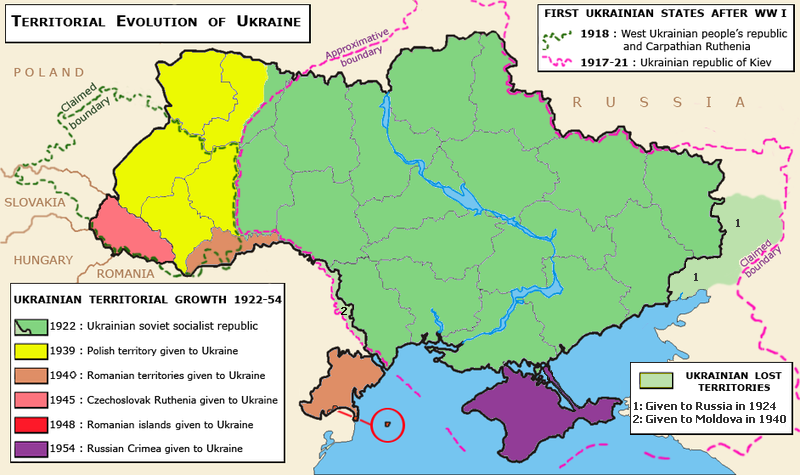
Ukraine has never existed as an independent country for very long; as you can see from another Wiki map on the left, it is itself a cobbled together mix of land lost to Russia, gained from Poland and Czechoslovakia and Romania. It was “given” the Crimea by the Soviets only in 1954. And throughout, Russia has obviously been its big brother, with a deep belief in its right to dick around with its near-abroad (a similar historic belief to the Sunnis faith in their own right to rule).

Ukraine-growthAnd what is sometimes lost in all this is that the last pro-Russian leader of the country was democratically elected and then deposed by a revolution from the European-centered populations of the West of the country. Russia did not start this; it reacted to a sudden, revolutionary loss of a pliant neighbor. Anyone with any inkling of Russian history would know what would happen next. I’m not defending Putin’s military and pseudo-military aggression. I am saying that the resolution reached this week – with significant autonomy for the Eastern, Russian-speaking provinces together with a new trade pact with the EU is a perfectly logical way to resolve this. And if Scotland demands outright independence, who could deny the East Ukrainians for wanting more autonomy?

Then Scotland. I don’t know what will happen – and, yes, the term “unraveling” is the most apposite in this case. But what the campaign has shown is that the unraveling has already taken place, that the desire for self-government and the disdain for the Westminster elites have combined to make the current arrangement anachronistic. But that kind of change – conducted democratically and peacefully – is not the same thing as an undoing. It is an adjustment to an emergent, new reality. And it increases democracy in the UK, rather than diminishing it.

What I’m saying is that America is in great danger of over-reacting to all these things, and blundering into new errors because of a generalized anxiety about declining relative US power, and PTSD from 9/11 in which every Jihadist in a hummer with a knife and a social media presence is imminently going to come over here and slit our collective throats. So my “hysteria” about this new, unknowable, fast-escalating rush to war is actually the opposite. It’s really a call to calm down, to breathe deeply, to stop reacting to the news cycle like neurotic lab-rats and to remember history – ours and theirs.  And to carry on.

I thought Obama was the man to sell this message. But he has been overwhelmed by the collective freak-out. Maybe he’ll regain his composure, keep this war limited and contain these loons for others, with much more at stake, to fight. Or maybe American amnesia will take hold again – and the Jacksonian impulse will once again trump every rational attempt at a foreign policy that isn’t always doomed to repeat the errors of the past. From the way things are going, it’s America’s own history of Jacksonian violence against outsiders that will prevail. We believe we are immune from history – that it can be erased, that what matters is just the latest news cycle and the political spin that can be applied to it. But history will have – and is having – the last word.

“Scotland’s Impending Disaster”

BRITAIN-SCOTLAND-INDEPENDENCE-VOTE

That’s how one reader puts it:

I am an American and I love Scotland and Scottish culture. My father is from Scotland, my grandfather served as an officer in a famous Scottish regiment, The Black Watch, and he was given an award for bravery posthumously by the King of England in WWII. I am involved with Scottish charities in the US and have been a Trustee representing one of the largest Scottish charities here in the U.S.

Sometimes when dealing with the home country, I’ve heard my fellow Scottish-Americans mutter, “The smart ones left”. I can’t help but feel this may be true, as the “Yes” vote seems an increasing possibility.

Who rules who? The last three prime ministers are Scottish or of Scottish descent. The Scots have historically been a force at the Bank of England. Scotland is subsidized by the rest of the U.K. and, unlike the English, they have their own separate parliament. In fact, it makes (barely) more sense that England would tell Scotland to leave at this point, rather than the other way around.

This isn’t the thirteenth century or even the seventeenth century. There’s 300 years of cooperation and prosperity with the English. Where was Scotland before the Union in 1707? It was broke! That’s why they agreed to join. The U.K. assumed their debt and gave Scotland access to their markets to trade. I hope they like independence, because they’re coming out the same way they went in.

Oh and by the way, the only people the Scots like to fight with more than the English are with each other. You can see it now with the violence and intimidation (mostly by the SNP it seems) as the vote gets closer. And if there’s a “Yes” vote in Scotland tomorrow, get ready for a Shetland Independence vote as well. Huge economic incentive for these folks with a big slice of what’s left of the North Sea oil. We reap what we sow …

Another is also worried:

While we wait for the Scots to decide what they want to do, it might be worthwhile to consider the ramifications beyond Britain.

I have seen a couple of people speculating about the implications for various places in Europe: Catalonia, Northern Italy, etc.  And no doubt there will be an impact there.  But what nobody seems to be talking about (at least in my limited browsing) is the impact beyond Europe. The Middle East and Africa are full of countries that are completely artificial constructs, with no relation to the reality of the nations (or tribe, or ethnic groups, or what-have-you) on the ground.  If Scotland can become a separate country, why not Kurdistan?  Why not Somaliland?  Etc., etc., etc.

How will Britain, or any other country that recognizes Scotland as a separate country, justify not doing the same for others?  How will they justify the last half century norm of treating virtually all national boundaries (Bangladesh and South Sudan being the only exceptions I can think of) as set in stone?  Will China decline to recognize Scottish independence, lest it be used as justification for considering independence for Tibet or Xinjiang?

If it happens, there is a huge can of worms being opened up, not just for Britain but for the entire world.

Another reader:

I like many in Northern Ireland, England, and Wales are waking up to the possibility that a part of our identity may, in many important and resonant ways, cease to exist by this time tomorrow.

The British aspect of national identity in Northern Ireland is, as can be expected, complex. Between the hardline orange unionists and the revisionism of Sinn Fein that sees British influence as nothing but negative, there are many in the province who hold a kind of conflicted affection for being British.
It comes less from a conflict of national identities than a kind of hierarchy.

I would view myself, first and foremost, as Northern Irish, possessed of a mongrel mix of Celtic traits that borrows from Irish and Scottish influence. Because of this, I have no issues with being described as Irish. But both Irish-ness and British-ness seem inaccurate designations that prompt a “yes, but” rather than a “no, actually”.

If Scotland secedes, our closest cultural link with the rest of the UK will disappear. In the short term, this will lead to a crisis in political Unionism that, frankly, will be an entertaining watch. Over the long-term, a referendum on a united Ireland will be inevitable. The Scottish debate, while notably mature by Northern Irish standards, has so far failed to present a positive case for Britishness beyond the financial implications for the Scots. I would fear that a national conversation in Northern Ireland would be dominated by the extremes of both sides, leaving the rest of us, with complex identities that can love Radio 4, value the NHS, and still despise the England rugby team with a jihad-like passion, out in the cold.

Follow all of our Scotland coverage here.

(Photo: A pro-independence supporter blows a “Yes” balloon during a rally in Glasgow’s George Square on September 17, 2014, ahead of the referendum on Scotland’s independence. Campaigners for and against Scottish independence scrambled for votes on Wednesday on the eve of a knife-edge referendum that will either see Scotland break away from the United Kingdom or gain sweeping new powers with greater autonomy. By Leon Neal/AFP/Getty Images)

Who Would Replace Cameron?

Daniel Berman predicts a Yes vote would be bad news not only for David Cameron, but also for other prominent Conservatives:

Cameron’s successor will be chosen for a very specific task; leading the Conservative party into the elections due next spring, not for the next two, three, five, or ten years. As such there are a number of considerations that may well lead the leading factions to settled on someone less prominent.

The first will be the nature of their ascension. Cameron’s fall will be interpreted as a judgement on Cameron’s tenure as leader, and the entire policy of his government. At the very least it will be seen as a repudiation of his handling of Scotland. The Chancellor, George Osborne is associated with both, and his recent entry into the Scottish campaign, the only senior Tory to do so, will reinforce that impression. This does not mean that Osborne or the Cameron faction will be without resources or prospects. Just because they cannot win a leadership contest in 2014, does not mean they would necessarily be unable to in 2015 or 2016. As such they have every interest to delay the issue of a permanent leader as long as possible, while also preserving as many existing MPs as possible in next year’s elections. The current MP intake is far friendlier to Cameron than any of their potential replacements will be. Both goals can be accomplished by backing a lesser-known right-winger as leader.

Is Britain Doomed Regardless?

Gordon Brown’s stirring speech against Scottish independence:

But, even if Scotland votes no tomorrow, Cassidy wonders if the union can survive:

For, although the unionist side seems likely to win this round, in the longer term the impact of the referendum could well be disastrous for those who want to maintain the status quo. About the best they can hope for is a federalized Great Britain that retains the word “United” in its name but is, for most intents and purposes, two separate countries. And even that outcome may prove to be unsustainable. Indeed, the English, who today are lamenting the possible dissolution of their beloved union, may well end up kicking the Scots out of it. …

Imagine what will happen if there’s a “no” vote, and, over the next few years, “devo-max” is enacted. “At that point,” Janan Ganesh, a columnist for the Financial Times, notes, “MPs representing Scottish seats at Westminster, who are overwhelmingly Labour, will be voting on legislation that scarcely affects their constituents. Anybody who thinks this will be allowed to stand does not talk to enough Tory MPs, many of whose private views on Scottish independence already range from insouciance to glee.”

Nora Biette-Timmons suggests that, either way the vote goes, it will strain the union:

Some Conservative Party leaders, for instance, are urging Westminster to revoke the voting rights of Scottish MPs over English-only legislation if Scotland ultimately chooses not to secede on Thursday. Others are calling for more dramatic constitutional overhauls of the United Kingdom. “While the majority of us would like Scotland to stay in the UK, a large majority of us in England now want devolution for our country too,” John Redwood, a Conservative MP from southeast England, wrote in the Financial Times on Wednesday, on the eve of the independence vote. This devolution, he argued, could take the form of an English Parliament as well. “What has emerged from the Scottish referendum is the idea of a federal state, with much greater power being exercised in the constituent nations of the union,” he noted. “What is fair for Scotland now also has to be fair for England.”

And the Tories might even be able to compete with UKIP on that platform. More Dish on Scotland here.

Face Of The Day

INDIA-PAKISTAN-KASHMIR-FLOOD

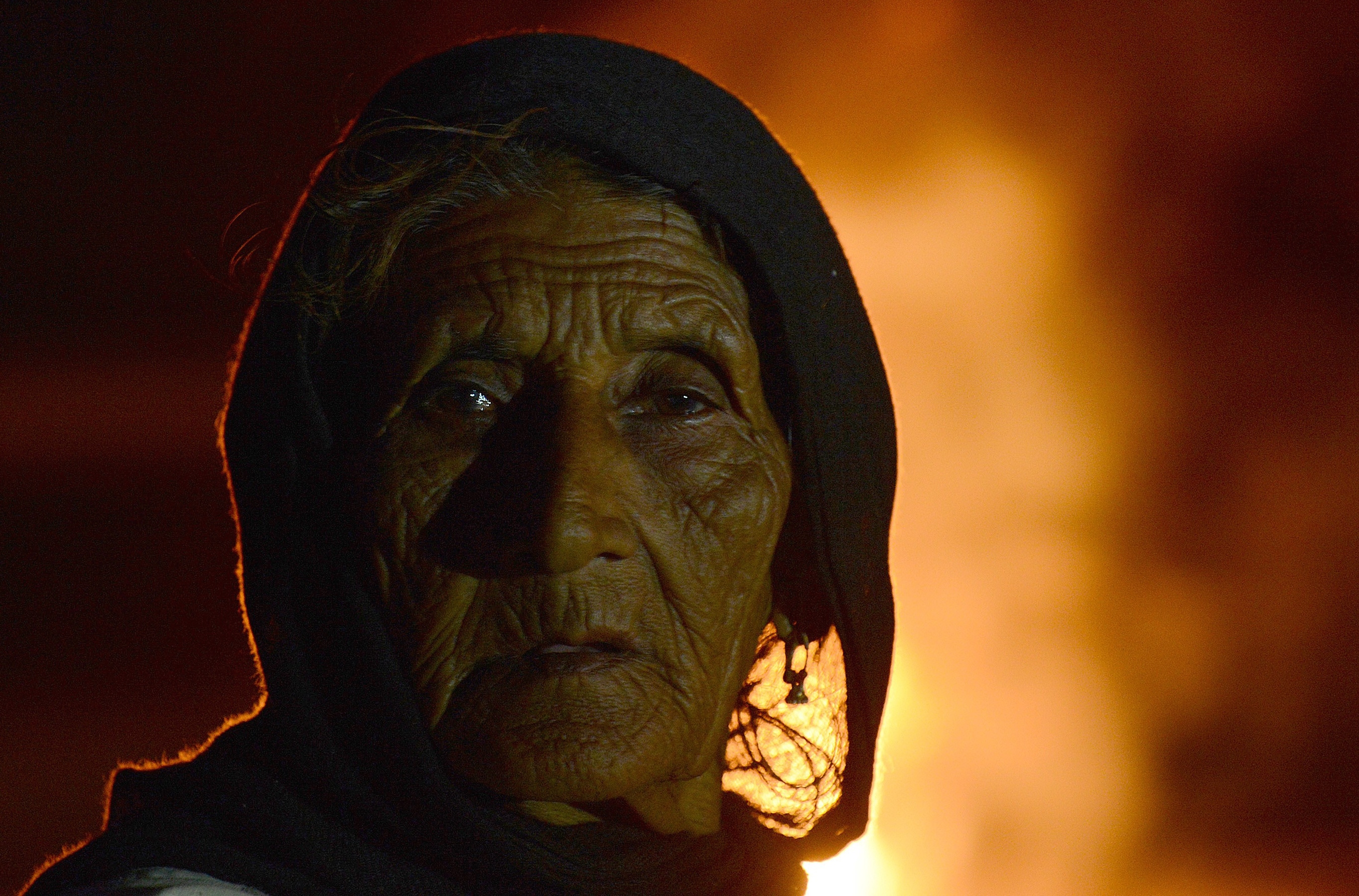
A Kashmiri flood victim sits at a bonfire outside a tent in Srinagar on September 17, 2014. Army and other emergency officials have battled to rescue tens of thousands of people stranded by the floods, triggered by heavy monsoon rains, that hit the northern Himalayan region and neighbouring Pakistan. By Tauseef Mustafa/AFP/Getty Images.

Did Snowden Tip Off Al-Qaeda’s Cryptographers? Ctd

Contradicting a report issued last month by the intelligence firm Recorded Future (and subsequently dismissed as state-sponsored agitprop by Greenwald), Murtaza Hussain highlights a new report from Flashpoint Global Partners that concludes that Snowden’s leaks about NSA surveillance were not to blame for improvements in jihadist groups’ cyber security:

The report itself goes on to make the point that, “Well prior to Edward Snowden, online jihadists were already aware that law enforcement and intelligence agencies were attempting to monitor them.” This point would seem obvious in light of the fact that terrorist groups have been employing tactics to evade digital surveillance for years. Indeed, such concerns about their use of sophisticated encryption technology predate even 9/11. Contrary to claims that such groups have fundamentally altered their practices due to information gleaned from these revelations, the report concludes. “The underlying public encryption methods employed by online jihadists do not appear to have significantly changed since the emergence of Edward Snowden.”

These findings are notable both for empirical rigor through which they ascertained, as well as their contradiction of apparently baseless statements made by high-ranking U.S. officials regarding the impact of the leaks on U.S. national security. This is particularly important as it pertains to the ongoing public debate over the alleged threat of ISIS.

In Joseph Cox’s reading, the report actually questions whether al Qaeda’s counter-surveillance methods have improved dramatically in the first place:

The history of Islamic terrorists using encryption far predates Snowden, and even Wikileaks. An early milestone was an article in Al-Qaida in the Arabian Peninsula’s (AQAP) English language magazine Inspire in October 2010, which exhorted readers to use encryption. The programme suggested then was Asrar al-Mujahideen, originally launched back in 2007. It runs in a similar vein to popular open source encryption Pretty Good Privacy (PGP), utilising public and private keys to securely send files and messages. A 2.0 version was available in 2008, and after this other programmes came out for popular chat programmes, then Android and Symbian mobile devices.

From Asrar al-Mijahideen in 2007 to developments today, Flashpoint’s findings suggest jihadists haven’t made any major changes to their use of encryption: they’re just taking established models and applying them to different areas, such as instant messaging services or mobile phones.

Passions Running High In Scotland

https://twitter.com/BradenDavy/status/512280185690140672

So what else is new? But Brenda Kutchinsky, a Scottish No voter, argues that the independence referendum has unleashed a “collective madness”:

I am as passionately Scottish as anyone who is planning to vote Yes, but I am being made to feel as if I don’t deserve to belong in my own country. … One of the region’s wealthiest businessmen, Charles Ritchie, has dared to speak out against both independence and the alleged bullying behavior of the Yes campaign. In the past two months, his company has reportedly received two hoax bombs in the post and one live bullet in a box of matches. I have heard that the police are now investigating this terrible matter. Two weeks ago, I summoned up my courage and put a No Thanks poster in my window, against the advice of friends who said it would open me up to abuse and possibly even a brick through my windowHow ridiculous that I should be worried about the consequences of expressing my opinion to people among whom I have lived happily for 15 years, but this is the climate of fear in which I am currently residing.

But Leonid Bershidsky emphasizes that in a global context, “both the secession and anti-secession campaigns have been courteous, nonviolent and affable”:

“Within the set of civil wars, secessionist wars are not only the most common, but are additionally among the longest and bloodiest types of warfare,” Bridget Coggins, now at the University of California at Santa Barbara, wrote in her 2006 doctoral thesis, based on a database of the secession attempts from 1931 to 2002. Of these 275 attempts, 195 were characterized by violence on at least one of the sides.

Although that suggests rather a lot of peaceful disengagements, many derive from Britain’s relatively nonviolent dismantling of its empire after World War II — a policy orchestrated, at least partly, by Prime Minister Harold Macmillan, who was of Scottish descent. Ask Chechens, East Timoreans, Sudanese, Kosovars, Eritreans – or the leaders of the countries from which they fought to split – about playing by the rules; the word “massacre” figures prominently in the histories of these independence bids. … Comparing Scotland with Chechnya or Crimea may seem far-fetched, but Northern Ireland during the so-called Troubles was a hot spot on a similar scale, and its own secession referendum in 1973 was boycotted by the Catholic population. Passions in Scotland, by contrast, run no higher than they would during a local soccer match.

Bershidsky sees the relatively calm campaigns as evidence of the status quo’s soundness, asking “What would a division solve that negotiations within the current scheme of things can’t?” Tom Rogan argues that it’s in the Scots’ economic interest to vote No:

Consider a few statistics. Scottish exports account for only 6.3 percent of the U.K. total, whereas England accounts for 74.1 percent. While Scotland has a slightly higher total employment figure than England does, it has a bloated public sector (22.1 percent of total employment vs. 17.4 percent in England). The Scottish work force is also less productive than its English counterpart. Most disconcerting: Measured per 10,000 adults in the U.K., Scotland has fewer businesses than Northern Ireland and Wales, and a staggering 21 percent fewer than England. The business community has been clear about its view of the referendum. Even the Royal Bank of Scotland has threatened to leave Scotland if independence occurs. In short, the Scottish independence movement has subjugated itself to voodoo economics.

But the prospect of independence sends Suzanne Moore into paroxysms of enthusiasm:

Surely if this “political reformation”, as John Harris described it, happened anywhere else, we would be calling it a velvet revolution and marveling at democracy in action. It may well be fierce, shouty and messy, but these are undeniably voices from below and we should listen. The SNP, once conservative and narrow-mindedly nationalist, has turned itself into something that can harness progressive forces. … All this fretting about neighbors becoming foreigners is a denial about who we already are. Rather than post-national identities, post-sovereignty is the aim. Open borders, mobility and federalism could have been offered through devo max – but they weren’t, so now we have the entire establishment yelling “no, no, no.” So I say yes. Take a leap towards self-rule. One can be on the side of change or against it. The thing is, change is here now, whatever happens. Finally, thankfully, yes.

More Dish on tomorrow’s vote here.

The Senate Is A Coin Flip, Ctd

Senate Control

Aaron Blake ran simulations with the WaPo’s election model. The result:

The battle for control of the Senate is a pure toss-up. Not just like a this-is-very-close toss-up, but like a 50-50-odds toss-up. Our team ran 10,000 simulations using our most recent ratings of the 36 seats up for grabs on Nov. 4. It showed Republicans with a 50.03 percent chance of winning the Senate and Democrats with a 49.97 percent chance of holding the Senate. Again: pure toss-up.

Ben Highton asks, “What explains this over-performance by Democrats, or under-performance by Republicans?”

One possibility is that the “midterm penalty” — the loss in vote share suffered by the president’s party in the midterm — is shaping up to be smaller than in the past. That penalty is estimated by comparing midterm and presidential election years from 1980-2012.  For 2014, we have applied the average penalty, taking into account uncertainty due to variation in past midterm penalties along with the uncertainty that arises simply because 2014 is a new election year.  But it is plausible that the size of the midterm penalty in 2014 may end up being smaller than in the past.  This could be the consequence of voter discontent with the Republican Party, as Nate Cohn has noted.

Another possibility is that there are idiosyncratic features of individual races that the background fundamentals cannot easily capture, and which favor Democrats in certain races. For example, maybe some candidates in the key races are just better or worse in ways that we cannot easily measure — but that the polls are capturing.

Harry Enten presumes that the Democrats’ advertising advantage has played a role:

Democratic Senate candidates and the outside groups supporting them have enjoyed advertising edges in almost all the competitive Senate contests over the past few weeks. Three of their larger advertising leads have been in Colorado, Michigan and North Carolina — the three states where we’ve seen the biggest movements toward Democratic candidates in the FiveThirtyEight forecasts. New Hampshire, one of the few competitive states to move toward the GOP over the last week, is also one of the few states where Republicans have had an advertising advantage. …

The question is whether Republicans and their affiliated groups can catch up. If they can, then we may see a reversion to the mean, and the Republicans’ more robust position might be restored. If Democrats maintain their lead on the air — and if that edge is what’s driving the Democratic run over the past few days — then they might able to overcome a bad national environment.

Andrew Prokop provides more details on the Democrats’ advertising edge:

Some of this advantage is because more Democratic incumbents are at risk, and incumbents usually have an easier time raising money than challengers. But Democrats are getting substantial support from Super PACs and dark money groups as well — the Washington Post’s Matea Gold describes how close allies of Senate Majority Leader Harry Reid are coordinating a major outside spending effort. The top disclosed donors to these pro-Democratic groups include wealthy financiers Tom Steyer and James Simons, as well as media mogul Fred Eychaner and former New York City Mayor Michael Bloomberg, and several unions, according to BOpenSecrets.

Recent Dish on the Senate races here.

Busted With An Eggcorn, Ctd

A flood of emails came in following my bleg for examples of eggcorns. The most commonly cited one:

An eggcorn I am guilty of is “for all intents and purposes”.  I guess I thought it was an extreme statement, therefore I was guilty of stating the phrase as for all INTENSIVE purposes.

Another:

A former employer always said “let’s nip this in the butt” instead of bud, and I always had to stifle a laugh picturing what it would accomplish.

Another:

My favorite example dates back to the early ’90s, when an abstract for a presentation at a computer conference talked about the need to “integrate desperate mail systems”. Why yes, I’ve seen quite a few of those.

That’s actually a malapropism, which many readers are confusing for an eggcorn. Wikipedia helps with the distinction:

The unintentionally incorrect use of similar-sounding words or phrases in speaking is a malapropism. If there is a connection in meaning, it can be called an eggcorn.

But we can’t pass up this malapropism:

My all-time favorite, culled from the annals of Freshman Literature classes everywhere, is Honoré de Ballsac.

Back to the eggcorns:

As a person who sends and receives thousands of so-called professional emails, I can’t tell you how many times I’ve seen a point described as “mute” instead of “moot”.

Another:

For some reason my marketing colleagues are all about “flushing out” concepts these days, rather than fleshing them out. Granted, most of them would be better off flushed …

Another:

People routinely say “breech the subject” when (I’m 98% sure) they mean broach.

And another:

Not too embarrassing, but I long thought that in the Pledge of Allegiance, we were describing the attributes of the Almighty when we said, “one nation, under God, invisible, with liberty and justice for all.”

On that note:

One of my younger brothers when we were little thought the opening verse of the patriotic hymn America the Beautiful went like this: “O, Beautiful for spaceship guys … ”

Another reader:

When I was a kid, my father had an employee in his business who was somewhat developmentally challenged. He used tons of eggcorns, but my favorite was that he called varicose veins “very close veins” – a pretty good description.

One more for now:

Stevie Nicks’ song “Edge of Seventeen” is an eggcorn. Someone told Stevie they had been doing whatever it was they were doing since the age of seventeen. Stevie heard “edge of seventeen” and decided to use that as the title of one of her hit songs.

Many more to come …