The Fed Is Getting Back To Normal

Ylan Mui has the details of yesterday’s Federal Open Market Committee meeting, in which Federal Reserve Chair Janet Yellen laid out a plan to draw down the Fed’s massive stimulus program in light of the economic recovery and the upward trajectory of the job market:

The improving outlook means that the recovery no longer needs as much support from the nation’s central bank.

Since the start of this year, the Fed has been slowly reducing the amount of money it is pumping into the economy. The central bank said Wednesday it will reduce its purchases of Treasuries and mortgage-backed securities to $15 billion in October, down from $85 billion a month last year. The Fed expects to end the program altogether when it meets next month.

Still, the Fed said it will maintain the size of its balance sheet for now –which stands at $4.4 trillion — by reinvesting maturing securities. The Fed holds more than four times as many assets as it did before the 2008 financial crisis. Though the central bank said Wednesday it is committed to shrinking the balance sheet to a more normal size, it formally announced it does not plan to sell any of its assets, a reversal of the plan laid out three years ago. Instead, the Fed said it will eventually stop reinvesting maturing securities and let them run off. However, the central bank said Wednesday that process will not start until after it has successfully raised its benchmark interest rate.

Neil Irwin rejoices at the prospect of a return to boring monetary policy:

For the last six years, Federal Reserve policy has been sexy, or at least as sexy as monetary policy can ever be. Leaders of the central bank have had to improvise answers to tremendously consequential questions. What should the Fed do to combat a severe financial crisis? (Pretty much anything they could think of, and then some, was the answer.) What should the Fed do to stimulate a depressed economy when interest rates are already near zero? (Buy trillions of dollars in securities and pledge to keep interest rates at zero for a really long time.) Should it consider more radical measures like lifting its target for inflation? (No.)

But now, the big questions of Fed policy have mostly been answered, all the more so after this week’s meeting of the Federal Open Market Committee and the news conference on Wednesday by Janet L. Yellen, its chairwoman. And that is terrific news.

Michael Grunwald is on the same page:

It’s true that our recovery from the Great Recession has been slower than previous recoveries from ordinary recessions. But it has been much stronger than previous recoveries in nations that endured major financial crises—and much stronger than Europe’s current recovery. The euro zone’s output has not yet reached pre-crisis levels; it’s still struggling with 12% unemployment and a risk of deflation.

We’re doing a lot better than that. We had more effective bank bailouts, more generous fiscal stimulus—until Republicans took over the House after the 2010 midterms and began demanding austerity—and much more accommodative monetary policy. It’s all worked remarkably well. We’ve faced some headwinds—the contagion from the near-collapse of Greece in 2010, the turmoil after we nearly defaulted on our debt in 2011—but the economy has continued its path of slow but steady growth. That’s why Yellen was able to discuss those mind-numbing “policy normalization principles,” the guidelines the Fed will follow as it starts raising rates and reining in its bloated balance sheet in 2015. We’re approaching normal. And the Fed’s forecast for the next few years also looks pretty decent.

But the Bloomberg View editors oppose ending the Fed’s extraordinary measures:

[T]he Fed has better tools than monetary policy to mitigate financial threats to the broader economy. It can require banks to fund themselves with more loss-absorbing equity, and it can pressure them to steer clear of obvious trouble spots. As a member of the Financial Stability Oversight Council, it can also push for better monitoring of risks that might be building outside the regulated banking system. For monetary policy, the biggest question is whether the Fed can get employment back to pre-recession levels without generating too much inflation. The concern is that structural changes such as shrinking labor-force participation and decelerating productivity might have made that goal impossible. If so, and without government action to combat stagnation, central bankers might have to write off the livelihoods of millions of people as a permanent loss.

So far, there’s little evidence that the Fed has reached the limit of what it can do. Giving up too soon would be a tragedy, even if inflation temporarily overshoots the Fed’s target. Hence, the central bank would do well to maintain room for maneuver.

And Andrew Flowers notes that the debate over the effectiveness of the third round of “quantitative easing” is not settled:

The latest Survey of Consumer Finances showed that the typical household’s income fell by 5 percent (after adjusting for inflation) from 2010 to 2013 — which covers all of QE2 and the bulk of QE3. And economic inequality rose. Because the rich tend to hold a greater percentage of their assets in stocks, and stock prices rose, 2013 saw a widening disparity in wealth.

Critics of QE3 have also worried about inflation. With the Fed effectively printing money to buy $1.6 trillion in bonds, and all this money sloshing around, the prices of all sorts of goods and services could increase, and nullify whatever stimulative effect the program was supposed to have. However, inflation rates have barely budged and remain below the Fed’s 2 percent target, and inflation expectations are stable. This “inflation hysteria” has not materialized, QE3 supporters say; not yet, say the critics.

He also observes that the Fed’s long-term growth projections are pessimistic:

Specifically, the midpoint forecast for real gross domestic product growth in the longer run was lowered to 2.15 percent, down from 2.20 percent in June. In early 2009, when the Fed first began releasing projections, the longer-run midpoint forecast was 2.60 percent. That’s a huge drop. … This “longer run” growth projection is equivalent to potential growth — defined as the economy’s growth rate when using all available resources but without leading to debilitating inflation. And the Fed is not alone in revising down its views of long-run growth: The nonpartisan Congressional Budget Office also revised down potential GDP this year.
West Africa’s 9/11?

The West African country of Liberia is crippled by a recent outbreak of the Ebola virus.

Compiling coverage of the Ebola epidemic from around the region, Margaret Hartmann points to a reflection by Liberian journalist Makanfi Kamara on how the outbreak, whose death toll is approaching that of September 11, 2001, is impacting her society in a similarly extreme way:

The Ebola virus has not only caused tragedy and changed the lives of people affected, but it has also drastically affected our life style. Liberians are so used to greeting each other by touch – a hand shake here, an embrace there, even a kiss. Where we used to share cups, bowls and spoons; beds, clothes and shoes; we now think thrice about potential threats of infection from our closest friends and relatives. Instead, we wash hands religiously at every door post, keep a distance beyond arm’s length and sometimes bow to greet each other like the Chinese. Some women have even put their male partners “on dryer” – a moratorium on sexual activity until the Ebola Season is over. And many men have admitted that, fearing for their own lives, they have decided to “abide by the rules of the game” – fidelity.

There are also direct and indirect psychological effects:

where members of households and families are infected with Ebola, the dichotomy of care vs. neglect persists, because of the fear of infection being transmitted. Where armed government forces go shooting at unarmed people contesting an imposed quarantine; or where family revenue streams get dried up because of epidemic-preventive regulations imposed by government or private employers; it gets really disturbing and forces people to find new ways to adapt to the situation. Then, there is the sight of dead bodies lying all over, in the streets; and the depression of thinking you could be next and the stigma it leaves you with.

Alex Park remarks on the chaos:

On Monday, Liberia’s legislature announced that the House of Representatives had canceled an “extraordinary sitting” to discuss the outbreak because its own chamber had been tainted by “a probable case of Ebola” and was being sprayed down with chlorine. The statement didn’t specify the source of the infection, but it noted that one of the chamber’s doormen had recently died after a “short illness.”

Liberia is ill-equipped to fight off the Ebola outbreak. Its entire national budget for 2013-2014 was $553 million, with only $11 million allotted for health care—about what Kanye West and Kim Kardashian are estimated to have spent on their Bel Air mansion in 2012. Despite its meager resources, last month Liberia’s legislature allocated $20 million to battle virus. But the nation had already burned through a quarter of that money by the first week of September.

James Gibney wants China to pitch in, considering its deep economic investment in Africa:

With much fanfare, China has said it will increase the number of its medical personnel in Sierra Leone to 174 and raise its total amount of assistance to roughly $37 million. I know, I know: Relative to the U.S., China remains a poor country, and its growing willingness to extend humanitarian assistance outside its borders is a good thing. But consider this: China has close to 20,000 citizens working and living in Guinea, Liberia and Sierra Leone. Setting aside U.S. money flowing into Liberia’s lucrative shipping registry, China’s investment in those three countries dwarfs that of the U.S. (In fact, China’s trading relationship with Africa overall is twice that of the U.S.) It recently signed deals for iron ore mining in the region that collectively run into the billions of dollars.

Laurie Garrett fears that the US military mobilization announced yesterday won’t be enough to curb the epidemic:

Nothing short of heroic, record-breaking mobilization is necessary at this late stage in the epidemic. Without it, I am prepared to predict that by Christmas, there could be up to 250,000 people cumulatively infected in West Africa. At least 30 nations around the world, I dare predict, will have had an isolated case gain entry inside their borders, and some will be struggling as Nigeria now is, tracking down all possibly exposed individuals and hoping to stave off secondary spread. World supplies of PPEs (personal protective equipment, or “space suits”), latex gloves, goggles, booties — all the elements of protection — will be tapped out, demand exceeding manufacturing capacity, and an ugly competition over basic equipment will be underway.

The great African economic miracle will be reversing, not just in the hard-hit countries but regionally, as the entire continent gets painted with the Ebola fear brush. Mortality due to all causes will soar in the region, as doctors, nurses, and other health care workers either succumb to Ebola, become full-time Ebola workers, or flee their jobs entirely.

But a reader objects to the doomsaying of Michael Osterholm, whose op-ed last week stoked fears of the virus mutating and becoming airborne:

Ebola is a horrible disease, but fear mongering over such an unlikely scenario hinders our ability to fight it properly.  We’ve already seen people raising concerns over flying patients back to the US for treatment when this is actually quite a safe scenario if proper precautions are taken.  The difficulty in Africa is they lack the healthcare infrastructure to take those kinds of precautions at a high enough level to prevent the disease from spreading.

It’s also worth keeping in mind that the forces of evolution not only push Ebola towards spreading more effectively but also towards being less lethal.  Dead patients don’t spread viruses very well.  So while random mutations could, in theory, make it airborne, what’s even more likely is random mutations would make Ebola non-lethal. What makes the virus scary is also what makes it evolutionarily unsound, and in the long run, that’s a good thing for all of us.

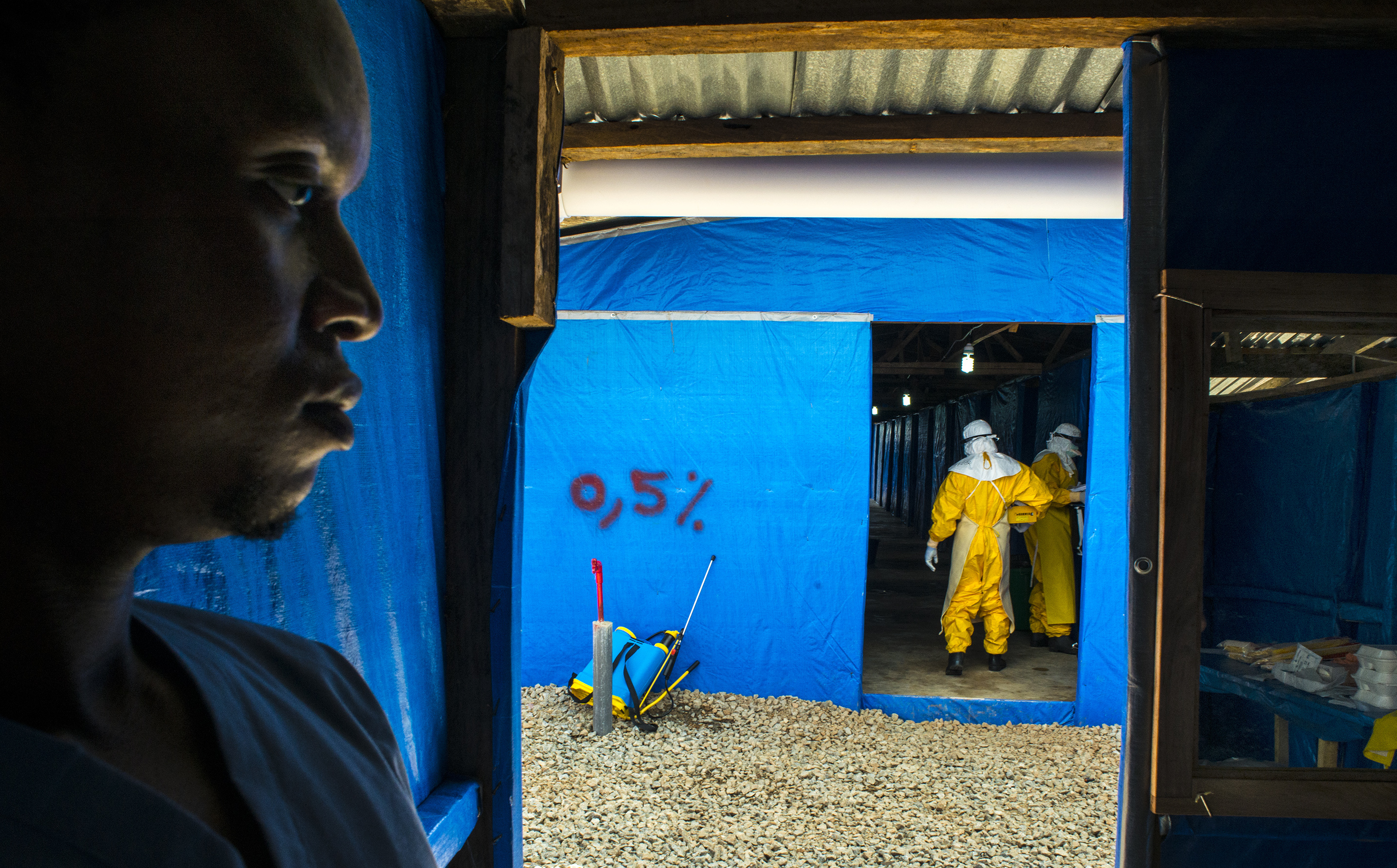
(Photo: James Momoh stands by as colleagues enter the suspected Ebola case ward Bong County Ebola Treatment Unit, on Tuesday September 16, 2014. The newly opened 50 bed unit is managed by International Medical Corp, and was built by Save the Children. By Michel du Cille/The Washington Post via Getty Images)

A Vote Against Inequality?

Katie Engelhart views the Scottish vote as a manifestation “of the increasingly hot debate about rising global inequality and what we should do about it”:

Scotland’s pro-independence movement differs from similar movements in places like Catalonia, Kurdistan, and eastern Ukraine in that it does not revolve around hard identifiers like language, religion, and ethnicity (or Russian military backing). What divides Scotland and England is a vocal lilt and a legacy of 14th-century clan warfare—seemingly surmountable obstacles to keeping a country together. As a result, Scottish nationalists have taken to claiming that London is to blame for all of Scotland’s economic ills. They contend that, with independence, Scotland can strike a different kind of compromise with its citizens. They argue that a vote for independence is a vote against inequality.

Reporting from Scotland, Noah Caldwell heard over and over again “the belief that Scots are fairer, more caring and more egalitarian than the rest of the United Kingdom”:

Initially a bemusing, inconsequential assertion, after enough repetition I realized it was a fundamental motivator for Yes voters, and therefore key to understanding independence. Since Scottish nationalism isn’t an outright ethnic, religious or linguistic movement, it relies heavily on socio-cultural definitions of “Scottishness”—namely, a shared egalitarianism. It’s the bedrock of the country’s liberal politics. It’s why First Minister Alex Salmond believes Scotland will be the next Denmark or Norway. Its roots, however, are hard to pin down, and even harder for Scots to explain to a panting American journalist on a beat-up retro road bike. It is, essentially, a living, breathing myth.

Gordon Brown connects to push for Scottish independence to globalization:

Globalization comes down, in practical terms, to the shift from the national sourcing of goods and services to their global sourcing, and from a reliance on national flows of capital to global flows, and it is matched by our ability to communicate easily and instantaneously beyond old borders and around the world.

And secessionist groups may be on the rise not in spite of these global forces — but because of them. In the years of the Industrial Revolution, people turned to political nationalism to cushion their regions against the uneven, inequitable patterns of growth. Now, people who see themselves as victims of change are turning back to — and organizing their politics around — old loyalties and traditional identities. They seek to insulate themselves against what appears like an unstoppable juggernaut of economic disruption and social dislocation. But because change seem to threatens to sweep aside long-established customs, values and ways of life, political nationalism becomes a credible vehicle for their response.


Scotland’s Day Of Reckoning

The Guardian is live-blogging the Scottish vote. From their afternoon summary:

A final poll has put the no vote on 53% and yes on 47%, in line with other recent predictions. The poll, by Ipsos Mori for the London Evening Standard, also found that 90% of Scots said they intended to vote today, with 57% saying they based their votes on hope more than fear.

Ben Page, the chief executive of Ipsos Mori, unpacks that poll:

[T]here is the idea of “silent Nos” – that there is a spiral of silence making some intimidated “No” voters less likely to agree to take part in surveys at all, or to say they are undecided or refusing to say how they will vote and biasing the sample. The challenge for us is spotting them in the polling data and how to treat them. If “shy Nos” really don’t want to take part in even internet surveys, or completely private phone calls, then even with samples that are demographically matched to Scotland’s population, we will be understating the size of a No vote. We will see.

The Guardian is also keeping tabs on the voting process:

Polling stations have been busy all morning, with some reports of queues, but there have been no complaints of intimidation of voters, and the threatened potential “carnage” has not been in evidence. Unconfirmed reports suggest that there has so far been one arrest at a polling station.

Murdoch dismisses reports of violence:

Carl Bialik explains when to expect results:

For the election junkies who want to watch results as they come in, I’ve put together a guide to how early Friday morning could unfold: when the 32 local councils can be expected to report their constituents’ vote counts, what percentage of the electorate each area represents, and which way voters from each area can be expected to lean. The registered voter numbers are solid and were provided Wednesday by Dougie McGregor, who works in the office of the referendum team’s chief counting officer. (He said those numbers might change slightly when final counts are available.) The times and the electoral lean, though, are rough enough to warrant a number of caveats

His guide:

Scotland Vote Guide

Sacking Plastic Bags

Katie Rose Quandt contemplates California’s new plastic-bag ban:

There is evidence that bag bans and taxes can cut down on some of this waste: Ireland’s 2002 tax cut bag usage between 75 and 90 percent. An analysis of bag use in Australia found that 72 percent of customers accepted single-use bags that were offered for free. When a nominal fee was charged, usage dropped to 27 percent (33 percent switched to reusable bags and 40 percent made do without).

But there’s one major downside to bag bans: Although plastic bags’ manufacture is relatively energy intensive (according to the Australian government, a car could drive 36 feet with the amount of petroleum used to make a single plastic bag), other kinds of bags use even more fossil fuel. A heavy-duty, reusable plastic bag must be used 12 times before its global warming impact is lower than continuing to use disposable bags, according to a study by the UK Environment Agency. A cotton bag takes 132 uses, and a paper bag—which will still be legal with California’s 10-cent fee—must be used four times before its global warming impact is less than using single-use bags.

And Brian Palmer reflects on grocery bags of yore:

The free handled paper bag dominated the market for only a brief period before the plastic bag came onto the scene in the late 1950s. Then the oil company Mobil brought the familiar petroleum-based plastic bag to market in the 1970s. These “T-shirt” bags (so named for their shape) cost less than half as much as a paper bag, and the economics proved irresistible. By the early 1980s, the plastic bag had become grocers’ packaging of choice.

From the very beginning, however, the plastic bag has been no stranger to controversy. Consumers hated the bag’s wobbliness at first and the fact that it wouldn’t stand up on its own. In 1959, reports of dozens of children suffocating on the bags led to calls for a ban, but manufacturers responded with a nationwide safety campaign. The plastic bag was saved.

But soon enough we became aware of another reason to ban the bag: it’s an environmental disaster.

Previous Dish on the plastic vs canvas debate here and here.

Husband Beaters, Ctd

Another reader shares his story:

I am a large, physically capable male who worked as a bouncer in bars through most of university. My ex-wife was emotionally and physically abusive. She would hit/attack me without warning, sometimes when I was asleep, sometimes during sex (out of the blue), rarely in front of witnesses, even though the kids saw her do it a couple of times.

When my ex-wife would hit me, I would challenge her later (after a cool-down). I would ask her why she did it, and why she felt it was ok to hit me, but not ok for a man to hit a woman. Her response was a few apologies, many deflections and dismissals, and often “My mom did a lot worse to my dad.”

FYI: for very personal reasons, I am a violence-against-women activist and have been since my late teens. I do not strike or abuse women. I am a firm feminist. My ex-wife would use that to her advantage, knowing I wouldn’t respond other than verbally and to try to protect myself without striking back. I didn’t even grab her wrists – except once, when she attacked me while I was sleeping and I was disoriented on awakening.

My ex-wife was abused/beaten by her mother and sexually abused by a family member. I tried very hard to be understanding and accommodating of her life trauma. Some of the writers on this thread, and in articles on other sites, have minimised the kind of injury a woman can effect on a large male. Some writers even call them “little taps” and “harmless taps”.

I still have PTSD flashbacks from my ex-wife hitting me, with her fists or other objects, or a pillow or fists during sex, because she had a sudden flashback to the sexual abuse she suffered as a child and she lost self-control (and chose to lose it).

My two now-adult children are still edgy around the subject. They were witnesses to their mother hitting their father – however “little” the blows were. The blows she landed caused no permanent physical injury, but they were in no way harmless. While I understand the context of my experience and my ex-wife’s issues, the lasting pain of those “little taps” is pretty profound (that and the emotional abuse that accompanied it). I have difficulty getting people to believe the deep emotional injury those “harmless taps” caused, and I have been mocked for my ongoing anguish.

Under male stereotypes, I should be just brushing off the fact that the person I ostensibly loved most (my spouse) perpetrated physical violence against me on a regular basis.

Another sends the above video:

Long-time reader, sometime emailer here (you’ve actually published a couple of my emails a few years back, about Bioshock/Ayn Rand and about loyalty to a sports team). Full disclosure: I’m male, I have never been the victim of domestic abuse, so this is not something I’ve ever experienced (thank goodness). I’ve been following your “Abuse In The Public Eye” thread for some time, and I am not at all surprised that there are stories of women domestically abusing their husbands/boyfriends.  When I was a teen and a college student, I assumed that if there was a case of domestic violence it would be a man striking a woman.  That is, until I saw a stand up routine by Christopher Titus.

This is a man, in his 40s, who’s had a very rough life (psychotic mother who committed suicide, alcoholic father) and the way he deals with it is basically making a comic routine out of all the awful things he’s had to deal with. His awful experiences include an ex-girlfriend who would physically abuse him.  Now, much of the information is from a comedy routine, so it’s played for laughs, but as Titus puts it, his girlfriend would routinely lose her temper (because she was bipolar) and “crack me in the face”.  But he doesn’t leave.  He stayed for months, even moving in with her after she beats him up watching a Christmas special.

Seeing Green

dish_judasingreen

Michael Gorra shares insights from Green: The History of a Color by Michel Pastoureau:

In the Renaissance the color’s chemical instability made it seem “false” and even treacherous, a “deceptive color, simultaneously appealing and disappointing.” As such, it became associated with games of chance or hazard; think of the green baize with which tables for cards or craps or pool are covered even now. The color here carries a symbolic charge that is inseparable from its use—gambling means green. It connotes luck, the ups and downs of a player’s fortunes, and it also suggests avarice.

A sixteenth-century painting by Quentin Massys shows a money changer spreading his wares on a table covered by a verdant cloth, and in fact the Seven Deadly Sins had each their color. In early modern Europe pride was seen as red and black betokened anger, while in pictures the greedy Judas was often clad in green. In northern Italy, as Pastoureau writes, “dishonest debtors” might be clapped into the stocks wearing acornuto verde, and bankrupts were later said to have taken “the green bonnet.”

Other scholars have touched on aspects of Pastoureau’s project, most notably John Gage in his 1993 Color and Culture. But none of them approaches his range or indeed his prodigality, a range that makes Green and its companions seem stuffed with rarities and wonders, an attic of all the centuries, right up to Babar’s cheerful lime suit.

(Image: depiction of Judas by Fyodor Andreyevich Bronnikov via Wikimedia Commons)

The Sociology Of Style

Rachel Signer praises the new book Women In Clothes:

It is a striking endeavor in that it is … verifiably “crowd-sourced” and contains no input from anyone who could be considered a style icon, although a former fashion model and a prominent fashion critic are amongst those who contributed survey responses. The book is, in this sense, a truly contemporary item, representing an age brought along through the Internet’s dominance, in which all opinions are valid, and sharing private thoughts and practices is acceptable.

Jenna Sauers also recommends the collection:

Most affecting, for me, were the roundups of answers to single survey questions, both for the specificity of the unique responses and for their shared engagement. I liked learning that Eileen Myles resents the way men can let themselves go, because she wants the same “freedom to be a pig” that men have, and that Audrey Gelman and I both tuck our blouses into our tights. Clothes are vehicles for memory, objects of economic trade, and products of history. The anthology succeeds as an investigation into this often seen, but rarely looked at, element of our material culture.

Elisabeth Donnelly talked to the authors about what they learned from their research:

What have you learned about the ethics of clothes in the Western world?

[Sheila Heti]: We interviewed the Mother Jones reporter Mac McClelland about this — and the conclusion she came to (she is a woman who doesn’t buy herself clothes) is that there’s really no good solution. You can say it’s bad to shop at places like H&M because the (mostly women) who work in the factories that make these are labouring under terrible conditions, yet the minimum wage in America is so low that many people cannot afford clothes except those that are made in these factories.

So it’s hard propose a likely ethics of clothes in America when wages are so low. I would like our book to help a little bit, simply by saying: maybe you don’t need to buy and consume as much. Maybe a new shirt is not the solution. Shop more carefully and make what you have last.

Eternal Sunshine Of The Rodent Mind

Maria Konnikova examines the work of neuroscientist Roberto Malinow, who appears to have wiped out the memories of rats:

Malinow’s team used Pavlovian conditioning to teach the rats to fear a tone: each time the tone sounded, they would feel an electric shock in their feet. Soon, as predicted, they froze at the tone itself. Then, the U.C.S.D. scientists did away with both the tone and shock. Instead, they stimulated the relevant nerve cells – the route between the hearing centers and the fear centers—by shining a blue light pulse. The rats froze, as though they had heard the tone. Not only had the researchers created a memory but they could trigger it without making any environmental changes.

They then went a step further:

if they could use light to make a rat react as though it were recalling a painful shock, perhaps they could also use it to make the memory of the shock go away. The idea is closely related to the notion of modifying memory – reconsolidation, the process in which we recall a memory and, often, subtly change it as we do. (It’s described in detail in Michael Specter’s recent piece for the magazine.) However, instead of working at the level of the stimulus (desensitizing a rat’s memory by playing a tone repeatedly without a shock), you would do it at the level of the synapse. For fifteen minutes, the researchers stimulated the nerve cells that had been responding to the tone and shock in a pattern that has previously been shown to cause L.T.D., the rough equivalent of playing the tone repeatedly with no ill effect. By the end of those fifteen minutes, the rats had forgotten their fear: they no longer froze. Using light stimulation alone, Malinow’s team had been able to extinguish the memory completely.