Don’t Keep Your Cool

In an excerpt from his new book The Meaning of Human Existence, E.O. Wilson sums up an evolutionary history of selfish and cooperative tendencies. “In a nutshell,” he writes, “individual selection favors what we call sin and group selection favors virtue. The result is the internal conflict of conscience that afflicts all but psychopaths”:

The internal conflict in conscience caused by competing levels of natural selection is more than just an arcane subject for theoretical biologists to ponder. It is not the presence of good and evil tearing at one another in our breasts. It is a biological trait fundamental to the human condition, and necessary for survival of the species. The opposed selection pressures during human evolution produced an unstable mix of innate emotional responses. They created a mind that is continuously and kaleidoscopically shifting in mood — variously proud, aggressive, competitive, angry, vengeful, venal, treacherous, curious, adventurous, tribal, brave, humble, patriotic, empathetic and loving. All normal humans are both ignoble and noble, often in close alternation, sometimes simultaneously.

The instability of the emotions is a quality we should wish to keep. It is the essence of the human character, and the source of our creativity. We need to understand ourselves in both evolutionary and psychological terms in order to plan a more rational, catastrophe-proof future. We must learn to behave, but let us never even think of domesticating human nature.

The Geography Of Suicide

Global_AS_suicide_rates_bothsexes_2012

The World Health Organization recently released a report (pdf) illustrating suicide risk across the globe. Tanya Basu unpacks it:

One dramatic trend the WHO reports is that countries in the developing world have suicide rates that are many times higher than the Western world. “Despite preconceptions that suicide is more prevalent in high-income countries,” the report states, “in reality, 75 percent of suicides occur in low- and middle-income countries.”

The high male-to-female ratio of suicide victims is also rapidly equalizing, particularly in the developing world. The changing makeup of the global workforce and its increasing inclusion of women have made women more susceptible to the socioeconomic stress that increases the likelihood for suicide. While the male-to-female ratio for high-income countries is 3.5, the ratio is almost even in low-income countries at 1.6. The divide is particularly close in the Western Pacific (0.9), Southeast Asia (1.6), and the Eastern Mediterranean (1.4).  Variation in suicide rates by age is also important. Younger women in the 15-to-29 age bracket are as likely as their male counterparts to commit suicide in developing countries at a 1:1 ratio. The gap widens up to middle age, but in general, data indicates that the gender of suicide victims can be male or female, unlike the male dominance of suicides in the developed world.

Steven E. Hyman argues that rich and poor countries alike are failing their mentally ill citizens:

In the United States, for example, the federal Mental Health Parity and Addiction Equity Act, which banned much of the previously existing health insurance discrimination against people with mental illness, was passed only as recently as 2008. However, the regulations needed to implement the law languished for five years, issuing only in 2013. Such late but laudable reforms notwithstanding, in the United States and other high-income countries, many individuals with chronic mental illness become homeless or are imprisoned, often for offenses that stem from their disorders.

The low priority of mental illness in the health care systems of many [low- and middle-income countries (LMICs)] is attested to by health budget allocations that generally lie in the range of 1 to 2 percent of health expenditure. As a result, health care spending on mental disorders is often less than US$0.25 per capita in low-income countries and averages less than US$2.00 per capita globally. The WHO estimates that 80 percent of individuals with mental illnesses in LMICs do not receive meaningful treatment. And when treatments are available, they are often in the form of medications dating from the 1950s that should have been long superseded by more modern medicines.

Bill Gardner considers one reason why:

[W]ith cost-effective means to treat mental illnesses we could relieve an enormous burden of human suffering and greatly increase human productivity. But we neglect the care of the mentally ill relative to our care for those with other disorders. Hyman documents how policy makers discount the importance of mental illness and asks why. One reason is the stigmatization of the mentally ill. But then what explains stigmatization? [Hyman writes:]

I believe that a seemingly more arcane but powerful cognitive distortion also plays a role in the deprioritization of mental illness: the belief that mental disorders should somehow be controllable, if only the affected person tried hard enough or adhered to a better set of beliefs.

The symptoms of mental disorders are derangements of thought and emotion. Our sense of personal autonomy tells us that we determine what we think and can at least shape what we feel. So if we can control ourselves, why can’t they?  The suspicion that the mentally ill are responsible for their state may be built into who we are.

Barack Obama, Neocon?

image001 (1)

In Obama’s reluctance to refer to his military operation against ISIS as a war, Uri Friedman reads an implicit embrace of the notion of perpetual war:

The distinctions between war and peace, of course, have long been murky (think America’s “police action” in Vietnam during another seemingly endless conflict: the Cold War). And few declarations of war are as clear as, say, those issued during World War II. Obama, moreover, has been careful to present his counterterrorism measures as limited to specific groups in specific places that pose specific threats to the United States—rather than, in his words, a “boundless ‘global war on terror.’” But over the course of his presidency, these efforts have expanded from Pakistan and Yemen to Somalia, and now to Iraq and Syria. “This war, like all wars, must end,” Obama declared at National Defense University.

[Last] week, the president set aside that goal. Thirteen years after his predecessor declared war on a concept—terror—Obama avoided explicitly declaring war on the very real adversary ISIS has become. All the same, U.S. soldiers are now going on the offensive again in the Middle East. What is the nature of their enemy? Is it peacetime or wartime? After Wednesday’s speech, it’s more difficult than ever to tell.

Allahpundit thinks Obama has adopted the same logic Bush used to justify invading Iraq in 2003:

He’s spent six years using, and even expanding, the counterterror tools that Bush gave him, but not until now did he take the final step and adopt Bush’s view of war itself.

Obama isn’t responding to an “immediate” threat against the U.S. in hitting ISIS; he’s engaging in preemptive war to try to neutralize what will, sooner or later (likely sooner), become a grave strategic threat. It’s like trying to oust the Taliban circa 1998 for fear of what terrorists based in Afghanistan might eventually do to America — or, if you prefer, like ousting Saddam circa 2003 for fear of what he might eventually do to America with his weapons program. Obama’s going to hit ISIS before cells nurtured in their territory hit us, and good for him. But let’s not kid ourselves what this means: If, as Conor Friedersdorf says, Obama’s now willing to preemptively attack a brutal Iraqi enemy for fear of what he might do down the line to America and its interests, he should have also supported the war in Iraq in 2003.

Former Bush advisor William Inboden unsurprisingly depicts that shift as the president waking up to reality:

It is often forgotten today, but in President Jimmy Carter’s last year in office he developed an assertive policy towards the Soviet Union including a major defense buildup, support for rebels fighting the Soviets in Afghanistan, and suspending any further arms control agreements. Carter adopted these policies after the many traumas of 1979, culminating in the Soviet invasion of Afghanistan, made him realize that the previous three years of his Cold War policies had been naïve and weak. Six years into his presidency, perhaps President Obama has now arrived at a similar “Carter moment” and realizes that with just over two years left in his administration, he needs to make a similar shift.

Americans Support Strategy They Know Won’t Work

Screen Shot 2014-09-15 at 11.55.24 AM

Aaron Blake flags a new poll showing lackluster public confidence that Obama’s approach to ISIS will work, even though most support military action against the group:

This vote of no/little confidence, without a doubt, owes in part to the tough situations in the two Middle Eastern counties the United States has attempted to stabilize over the past decade: Afghanistan and Iraq. Given those experiences, it’s not surprising that Americans would be pessimistic about succeeding against the Islamic State.

But Obama’s persistently low approval rating on foreign policy suggests that it’s also in large part because people doubt he’s up to the task. Polls have repeatedly shown that people don’t think Obama is tough enough. This is an extension of that.

Philip Klein observes that Americans want ISIS destroyed but don’t want to make too many commitments or sacrifices to that end:

A Wall Street Journal poll found that an overwhelming 74 percent of Americans favored at least air strikes against the Islamic State. But before seizing on this as evidence that Americans are now on the side of the uber-hawks, it’s telling that just 34 percent supported sending combat troops. Another way of thinking about this is that Americans don’t like it when the bad guys are kicking the U.S. around on the world stage and the president doesn’t seem to have any sort of plan to do anything about it. But that doesn’t necessarily mean that, in actuality, they are willing to do whatever it takes to stop the bad guys. …

The reality is that if Americans don’t want to bear the costs, they will have to tolerate a certain level of chaos in the world and the insecurity that comes along with it. On the other hand, if they want the U.S. to project strength and leadership abroad — and to aggressively respond to threats against American interests — there’s no way to do it on the cheap.

Daniel McCarthy names this shallow popular hawkishness as the main reason Obama warmed up to the idea of bombing Iraq again:

Obama resorts to bombing because our pundits demand that he “do something.” Leaving Iraq to its own devices, to suffer, burn, and ultimately rebuild, is too cruel, and ISIS with its spectacular propaganda videos makes a great cable news bite and social-media campaign. It’s evil, it’s scary, it’s on YouTube, so what are we going to do about it? Obama would be weak and callous if he did nothing. That he can’t actually do much that matters in the long run is unimportant—our humanitarian urges and Islamophobic fears will be satisfied as long as we get some kind of action right now. So we bomb.

There’s no political risk in bombing, as there is in putting “boots on the ground.” There won’t be too many body bags shipped home to Dover AFB to trouble voters. What’s more, bombing can be of any intensity political conditions demand: if John McCain is howling louder than usual on “Meet the Press,” just drop a few more bombs. That shows you’re a real leader.

Who Ted Cruz Won’t Stand With, Ctd

https://twitter.com/michaelbd/status/510997278078025729

The fallout continues from Cruz throwing a group of Arab Christians under the bus. KLo interviews Andrew Doran, the executive director of the group in question. Why, exactly, does Doran think the crowd booed Cruz?

There were several Syrians present who were outraged when Syria’s regime was lumped in with the Islamic State by Cruz; others are Palestinian Christians; some were insulted that he was politicizing the summit and lecturing them. (Most of them know a little more about the Middle East than the junior senator from Texas.) It was rude, to be sure, but we might remember that many of those present have to return to the Middle East — and many people there were watching these events closely. This has weighed heavily on us since the speech. I was backstage and so it was difficult to see, though I did hear people shout, “Talk about the Christians.” It wasn’t the only comment, to be sure, but that comment by itself certainly cannot be reasonably characterized as anti-Israel. To interrupt a speech is of course unacceptable, but the sentiment wasn’t unreasonable.

Dougherty despairs:

To look upon the displacement of over a million Christians, to listen to the death rattle of Christianity in the Middle East, and complain that they didn’t flatter a country that offers them no material assistance is, frankly, the reaction of a sociopath.

The political movement to get Americans to care about the plight of Middle Eastern Christians was a fragile one. This was always a difficult task for the reasons French philosopher Régis Debray outlines; the victims are too religious to excite the left and too foreign to excite the right. And by exploiting his credibility among conservative Evangelicals, Ted Cruz’s calumnious goading and showboating at this conference gave this movement a political decapitation, telling conservatives that it’s perfectly ok to ignore these people.

James Zogby wishes Cruz had put himself in the shoes of Arab Christians:

[I]n this entire sad and sordid affair, the only ignorance and bigotry on display was that of the senator himself. He cared not a bit for the feelings of Arab Christians. Blinded by his own lack of understanding and concern, Cruz appeared to be more interested in scoring political points with his conservative base than in taking the time to know what Christians in Lebanon, Palestine, Jordan, Syria, Egypt and Iraq really feel and want.

Had Cruz listened, he would have heard about their difficult relationship with Israel—its brutal occupations of Palestinian, Lebanese and Syrian lands and the disproportionate violence it has used, with impunity, in its many wars against several Arab countries.

Dreher remains deeply troubled by the incident:

Do the Christians of the Middle East hold opinions contrary to our own about the state of Israel? Many, probably most, probably nearly all of them, certainly do. Are they Jew haters? Some are, no doubt, and that is wicked. Are they driven by conspiracy theory? Sure, and I have been on the West Bank and heard some insane ones — but the entire Arab world works that way, to a degree that beggars belief.

The Middle East Christians are like us: flawed, sometimes badly flawed. But they are unlike us in that we are not at the mercy of hostile Muslims, many of whom wish to exterminate us. They are like the Israelis in that way, but again, they are unlike the Israelis in that they have no way to defend themselves except by their wits.

That usually means making alliances with unsavory actors. People who have to be afraid at every moment for their lives don’t have the luxury of being morally selective in who their friends are. If you are looking for somebody clean in Middle East politics, you will search in vain.

To me, it’s an insight into the neoconservative vision of the world. The actual world is not something they are interested in; the fantasy world in which they are the vanguard of freedom, and in which all opposition to Israel’s policies are anti-Semitism, is one they want to live in. The trouble is when they actually make contact with reality. They can’t handle it – and Cruz is almost a cardboard cut-out version of that ideological rigidity.

Obama’s New War: Dumb Dumb Dumb Dumb Dumb

President Obama Addresses The Nation To Outline Strategy On ISIS

As you are by all accounts aware, the US now faces its deadliest foe, its most terrifying enemy – the likes of which we have never seen – in the deserts of Iraq. If we do not send ground troops into that country again, we will all die at home, says Butters. 90 percent of the country think we are directly threatened by the new Caliphate. And far from calming the hysteria, our leaders have fanned it.

Very few people in political leadership have laid out what this group is actually capable of, what the limits of its potential are, or examined the contingent reasons behind its recent sudden advance. It has been framed as an abstract but vital fight against “pure evil” – a rubric the originator of the phrase “axis of evil” knows more about than most. Here’s a must-read on reality:

Despite its territorial gains and mastery of propaganda, the Islamic State’s fundamentals are weak, and it does not have a sustainable endgame. In short, we’re giving it too much credit.

Consider the fall of Mosul, which catapulted the impression that the group is a formidable force able to engage on multiple fronts simultaneously and overpower a U.S.-trained army that dwarfs its size. In reality, it was able to gain such vast territory because it faced an impotent opponent and had the help of the broader Sunni insurgency. The Iraqi army, lacking professionalism and insufficiently motivated to fight and die for Sunni-dominated Mosul, self-destructed and deserted. The militants can be credited with fearlessness and offensive mobility, but they can hardly be said to have defeated the Iraqi army in combat. At the time, Islamic State militants represented less than 10 percent of the overall Sunni insurgency. Many other Sunni groups helped to hold territory and fight off Iraq’s Shiite government and Iranian-backed militia forces …

The Islamic State’s capture of Sinjar in the northern province of Nineveh further added to perceptions of its dominance and helped precipitate Washington’s decision to carry out airstrikes in Iraq. But that episode was also misinterpreted. Kurdish forces were not only taken by surprise, but since they had only recently filled the vacuum in Sinjar left by Iraq’s fleeing army, they were stretched too thin and poorly equipped to sustain a battle outside their home territory. Lacking ammunition and other supplies, they conceded the territorial outpost and retreated within their borders in Iraqi Kurdistan.

Read the whole thing. IS is already over-stretched, and the regional powers who are actually threatened by it, have been slowly mobilizing against it. All of that was happening before Obama decided to Americanize the conflict. Immediately, there is less incentive for the regional actors to do the work themselves, and IS now has a global legitimacy – the US president is now its chief enemy! – it can leverage for further recruits.

Those Sunni recruits are likely to come from the region, especially if Shiite forces from Baghdad, Tehran and Damascus are its foes. But more importantly, this titanic global struggle will create and foster indigenous, Jihadist terror in the US in response to the war. The only terror attacks we have suffered since 9/11 have been these kinds of attacks. And we just incentivized them.

Let me be clear. I have no illusions about Jihadism or the evil of ISIS. I passionately oppose everything they stand for in every single respect. I abhor their brutality, their twisted version of religion, their pathetic neuroses disguised as faith, their inability to cope with the modern world, and their foul theocracy. But everywhere this kind of extremism has flourished in the Middle East – think of al Qaeda’s failed attempt to turn Jordan – has collapsed because the vast majority of Muslims – like anyone anywhere – do not want to be governed by these murderous loons. That’s why al Qaeda distanced itself. Zawahiri knows that the Caliphate’s path is self-defeating in the end.

So we had a chance to allow that process to take place, to see regional actors be forced to confront it, to allow natural alliances – temporary and durable – form in that region. But a couple of videos and we lost our shit. I am not a pacifist. I do not oppose all wars. What I am opposed to is a dumb war. What I am opposed to is a rash war. A war based not on reason but on passion, not on principle but on politics.

If that sounds familiar, you’re not wrong. But that was a different person at a different time. And we will all live with the consequences of his capitulation to panic.

(Photo: U.S. President Barack Obama delivers a prime time address from the Cross Hall of the White House on September 10, 2014.  By Saul Loeb-Pool/Getty Images.)

Desperately Seeking Moderates

Juan Cole complicates the administration’s plans to fight ISIS in Syria by partnering with “moderate” rebel factions:

Obama’s desire to support a “moderate” opposition will lead him to back to the Muslim Brotherhood of Syria. But Saudi Arabia, one of Obama’s major partners, has declared the Muslim Brotherhood as a terrorist organization, and they have the money to make that stick. With Egypt and Saudi Arabia against the National Coalition and the Free Syrian Army (because of their Muslim Brotherhood ties), Obama by allying with them is basically allying with the murky Islamic Front, which has some al-Qaeda elements and now has turned openly anti-democracy and anti-rights for minorities.

Saudi Arabia will provide training camps for the rebels of the “moderate” opposition. But it is rumored that the Saudis are behind the splinter group from the Free Syrian army, the “Islamic Front.” It rejects democratic elections. The Islamic Front is full of people who have continued to have rigid religious views but who are trying to find new allies. The Saudis will be training people, in other words, very much like the Islamic State fighters in their fundamentalism, but who are less hostile to Saudi Arabia and perhaps slightly less openly brutal. That’s a “moderate” Sunni opposition?

Even the NYT editorial board is skeptical of this plan. Jamie Dettmer still wonders who these “moderates” are supposed to be, anyway:

Who in rebel ranks can be trusted not to turn Western-supplied weapons against the West later, or switch sides as we’ve seen in Mali and other countries racked by Islamist rebellions? Who can receive arms that won’t be shared with ISIS or the official al Qaeda affiliate in Syria, Jabhat al-Nusra? Who won’t embarrass the West by engaging in some act of egregious cruelty, torturing prisoners or executing foes?

There were not many moderates around two years ago, as I found in Al Bab then, and there are far fewer now. A year ago the town was overrun by ISIS and many of the young rebels joined the group; others who remained loyal to brigades affiliated with the FSA pulled out. The bulk of those, according to locals, hooked up with the Islamic Front, a coalition of Islamist militias who are the second largest fighting insurgent formation after ISIS. The front has close ties with al-Nusra.

Mark Kukis explains why arming rebel groups is always dangerous, and especially so in a volatile place like Syria:

By definition rebel groups do not answer to authority. They tend to take whatever arms, training and funding they can get from friendly governments and pursue their own agenda. Any rebels backed by Saudi Arabia and America can be expected to do the same. … What goals the rebels might have for themselves will be difficult to know. The fighters who will soon begin arriving at training camps in Saudi Arabia probably will not have a sense themselves of what the future holds beyond the fight against ISIS. But we can all be sure that nothing good will come of the effort apart from any blows these guerrillas manage to land against ISIS. This is because the region as a whole is in such turmoil. Even if the Syrian rebels depart Saudi Arabia as moderates, they will not likely remain so as they wage war in lands where extremism and instability prevail.

Abuse In The Public Eye, Ctd

With the Oscar Pistorius verdict reached (and seen above), many commentators are comparing the case to the Ray Rice incident, including Charlayne Hunter-Gault:

Of course, it’s a coincidence that these two cases are in the public eye at the same moment, thousands of miles apart. No, Ray Rice did not kill his fiancée; he knocked her out cold. But, in this country, as in South Africa, the abuse and, yes, the murder of women is beyond horrendous, and most cases go unpunished or, unless the accused is a big guy with big bucks and a big rep, unnoticed. (And many times even then.) … For many, the Pistorius verdict was a disappointment; though he has still been convicted of a serious crime, with the possibility of up to fifteen years in prison, he escaped the most serious consequences.

Hadley Freeman’s take:

We know what it takes for people to believe that a woman has been abused by a famous, powerful man: they need to witness the actual abuse. The NFL only accepted that American footballer Ray Rice had done a Really Bad Thing when the video of him slugging his then fiancee Janay Palmer unconscious in an elevator was leaked [last] week. The earlier video of him dragging her unconscious out of the lift was, apparently, not good enough: the NFL had to see the punch because previously they’d apparently thought he knocked her out with a kiss. Rice, like Pistorius, was simply too lucrative for the sporting industry to lose just because of a pesky domestic-abuse charge.

Within minutes of [Judge Thokozile] Masipa wrapping up her verdict, South Africa’s Paralympic committee issued a statement that “if Pistorius wishes to resume his athletics career then we wouldn’t step in his way”. What’s a little culpable homicide between colleagues?

Denise Brown (sister of the late Nicole) brings a personal touch:

My sister was once overheard saying, “He’s going to kill me and get away with it.” And it’s been alleged that O.J. Simpson was once overheard screaming at my sister’s grave and blaming her for what she has done to him and his life. Until all of us have zero tolerance for domestic violence, especially from male athletes—who, with their superstar statuses are protected and coddled rather than held up to a higher standard of being—we will see this horror played out again and again.

Others are asking, more generally, how to address domestic violence. Jonathan Cohn has some policy suggestions:

Broad, cultural messages appear to make a differencenot just what young children see and hear, from their families and neighbors but also from their role models on television and in sports arenas, may have an impact. In addition, many researchers think it’s possible to reach kids more directly, through schools or through their parents. According to these researchers, themes should include how men treat womenand how they express their own emotions. “[We should] raise boys and men so they know it’s fine to cry and to show fear or other ‘weakness,’ and that expressing anger is not the only acceptable emotion for males,” says Nancy Lemon, Boalt Lecturer at the University of California-Berkeley Law School and author a leading textbook on domestic violence law. Among the ideal targets for the interventions are the kids most at risk of becoming abusers later in lifethe ones who, while very young, are victims of or witnesses to abuse in their homes.

It all sounds very plausible. And there’s sporadic evidence that some programs have produced positive results on a small scalefor example, 2000 California high-schoolers who participated in a program called “Coaching Boys Into Men” said they were less likely to engage in abusive behavior and more likely to stop a friend from showing abusive behavior. But overwhelming social science evidence, the kind that undergirds other successful government and private sector programs, doesn’t really existpartly because nobody has had the funds or opportunity to do the necessary, long-term research. “We don’t really know for sure what works,” says Richard Gelles, a professor at the University of Pennsylvania and author of The Violent Home.

Eugene Volokh notes a challenge of zero-tolerance policies:

Indeed, my understanding is that this is already one reason why some wives don’t report abuse by their husbands: If the husband is arrested and imprisoned, he’ll lose his job, and when that happens the family loses, too. But a zero-tolerance policy, under which the employer obligates itself to permanently fire the husband, and in a situation where the loss of income has such a dramatic financial effect, would only exacerbate the problem. This is an aspect of what I call the anti cooperative effect of law: Sometimes measures to fight crime actually cause people to fear cooperating with law enforcement.

Now maybe on balance a zero-tolerance policy would still do more good than harm. The senators’ letter argues, for instance, that the policy would “send a strong message that the league will not tolerate violence against women by its players, who are role models for children across America.” If that’s right, then maybe (1) the deterrent effects plus (2) the norm-setting effects (the message sent to children across America) will on balance protect women more than the anticooperative effects will jeopardize them.

But on the other hand, the anticooperative effect will, at least in some measure, decrease the deterrent effect.

The President’s Bullshit Legal Basis For War, Ctd

Ilya Somin takes down John Yoo’s defense of the Obama administration’s argument that the 2001 AUMF grants the president authority to go to war with ISIS:

Yoo claims that the 2001 AUMF [Authorization for Use of Military Force] authorizes preemptive and preventive attacks against any terrorist group that might threaten the United States, because it states that “The President has authority under the Constitution to take action to deter and prevent acts of international terrorism against the United States.” But if that passage really gave the president blanket authority to wage war against “international terrorism,” there would have been no need for the more specific authorization to “use all necessary and appropriate force against those nations, organizations, or persons he determines planned, authorized, committed, or aided the terrorist attacks that occurred on September 11, 2001, or harbored such organizations or persons.” It is a longstanding principle of legal reasoning that we should not interpret laws in such a way as to render large parts of them completely superfluous.

Yes: you read that right. John Yoo and Barack Obama are now in the same camp. But Marty Lederman defends the AUMF argument:

The Administration’s interpretation of the 2001 AUMF … avoids the need even to opine on the scope of the WPR [War Powers Resolution of 1973] and Article II, let alone to blow large holes in them.  The only law that it affects is the interpretation of a single force authorization statute.  And it keeps the ultimate decision-making authority in Congress’s hands.  If Congress disagrees with that understanding of the 2001 AUMF, it could easily say so in the course of enacting a new, more tailored authorization statute for use of force against ISIL.

Whatever one’s views on the merits of the interpretation might be, then, there is a good case to be made that this unexpected maneuver was, at a minimum, much better than the (realistic) alternatives, and perhaps even a masterstroke that deftly threaded the needle without disregarding congressional will. Contrary to Jack Goldsmith’s reaction, then, this is not an “adventure in unilateralism [that] cements an astonishing legacy of expanding presidential war powers.”  It is almost the opposite: the one available move that avoids such an expansion.

Eric Posner responds to Lederman’s contention that Congress somehow remains in control of the course of events:

This is really a political argument, not a legal argument, but it is worth noting that in Lederman’s hand it becomes a precedent that justifies the use of military force when the public and Congress “really” supports it, whether or not Congress acts officially through its voting procedures. Another loophole to be widened in future iterations. What of the claim that Congress can turn around and take away the president’s authority—the great virtue of a statutory approach? But this would mean assembling a veto-proof majority in both Houses—which is not going to happen. Indeed, the opposite is more likely to happen—as has happened before (above all, Kosovo): Congress will be constrained to “support the troops” and vote for the money they need to continue operations.

Andrew Rudalevige puts his finger on the argument’s fatal flaw:

The biggest problem with the chosen rationale is that ISIL broke rather firmly with al-Qaeda, has been repudiated by it (for being too extreme, amazingly), and was not in itself associated with the 9/11 attacks. It is not an “associated force” even under the administration’s earlier definition of same. That ISILists use consistently “heinous tactics” is true, but does not, unfortunately, make them very special. …

There is, in short, a six degrees of separation problem with the current rationale. Using the logic of the old game that tied actor Kevin Bacon to pretty much everyone in the world, one could probably discover AQ connections to most current and future actors with evil intent against the United States.

But Jack Goldsmith finds the argument troubling for another reason:

[M]y objection to the Islamic State AUMF gambit is not that it is illegal in the sense that the use of force is illegal (because Article II remains in the background). The objection is that the President who wanted to cabin the AUMF, and who had the opportunity to put the United States on a more focused and responsible legal path for fighting Islamic terrorists, has instead stretched the AUMF beyond all recognition and probably ensured that it will be the legal basis for war against Islamist terrorists for quite a while to come. (Even if Congress ultimately authorizes force, the interpretation of the AUMF for the interim period will stand as a precedent.)

I have heard from a lot of people that the President would like to receive authorization from Congress but that Congress is too dysfunctional to give it to him. I don’t buy it. When the national security is threatened, Presidents who try hard enough to get the support they need from Congress, even when (as is not really the case here) the use of force is controversial. Indeed, both of the last two uses of force for military action in Iraq – in 1990 and 2002 – were controversial and were made possible only after enormous and risky political efforts by the two Bush White Houses.

So Obama is winging it. If this goes south, as all wars in the Middle East do, we have only the emperor to hold accountable, and he’s outta here in a couple of years. Goldsmith also wonders why the administration keeps switching from one legal argument to another:

Force has been used in Iraq against ISIL for over a month, and yet in the course of a week the administration has floated three different legal theories for the strikes.  In truth, it is possible that all three legal bases – Article II, the 2001 AUMF, and the 2002 AUMF – may support aspects of the operation (though I am most skeptical of the 2001 AUMF basis).  Why not just say that?  The administration needn’t choose, and when all three bases of support are combined, the legal case is strengthened.

The reason, I fear, is that politics and public emotion dictated this decision, and everything since has been an ad hoc attempt to justify and defend a decision that had already been made.

Am I Over-Reacting?

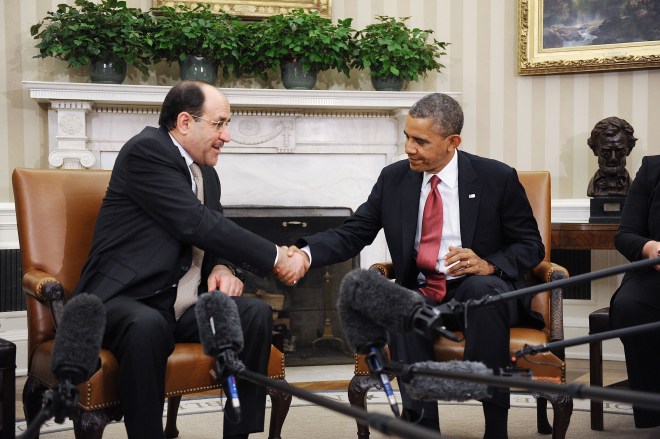
Obama Meets With Iraqi Prime Minister Nouri al-Maliki At White House

Well, it wouldn’t be the first time. Ambers, whose views I deeply respect, urges all of us to take a chill pill. He thinks this is simply part of the global police operation that we allegedly consented to in 2001 and that it’s vastly better and different than Bush’s “Global War On Terror”:

I don’t actually think, in his heart of hearts, Obama believes that the U.S. is going to “war” with anyone. Counterterrorism campaigns do not neatly fit into our black-and-white descriptions of the way conventional wars begin and end. There will never be “victory” in the sense that terrorists will stop trying to attack the United States. What there will be, instead, is managed risk. A constant effort to detect and degrade the threat. A balance of measures — political, military, legal, and otherwise — focusing on the capacity of terrorists to create havoc outside their geographical boundaries. Preventing them from obtaining or developing weapons of mass destruction.

But it seems to me that this ignores one critical lesson we have learned (or I thought we had learned) from the war on terror from 2001 onward. That simple lesson is as follows: American military force to pummel Jihadists from the skies can create as much terror as it foils. Our intervention can actually backfire and make us all less safe. How many Jihadists, for example, did the Iraq War create? Our intervention gave al Qaeda a foothold in Iraq and then, by creating a majority Shi’a state for the first time, helped spawn Sunni support for the Caliphate. If the Iraq War was designed to counter terrorism, it failed. It may well be that any Shi’a majority state in Iraq will always be at war with its Sunnis. Expecting this new government to be any different is mere window dressing for the immense and powerful centrifugal forces beneath.

If the impact of military force were that simple, we could wipe out Jihadism from the face of the earth. But force is never that simple, it’s especially complex in the countervailing myriad of factions and nations and sects of the Middle East, and it wins no friends, and merely makes more enemies. What Ambers is talking about is a global version of Israel’s policies toward the Palestinians. We are “mowing the lawn” with this kind of action, which spawns more hatred of the US, does not lead to a political settlement, and in fact makes such a settlement less likely, and therefore future “police actions” inevitable. It’s a cycle of violence breeding violence, in which we enable and empower Jihadism, rather than insisting that this is a problem first and foremost for the Muslim and Arab world, not us.

So Yemen is no longer producing Jihadists? And Somalia? We’ve turned them into perpetual, low-level Jihadist factories, churning them out as we continue to decimate them.

And our wars in other people’s countries are inevitably unpopular – would you like some distant super-power suddenly striking your town or village? – and so immediately undermine a huge amount of what they are trying to achieve. This is truer now than ever – after the US has been revealed as an incompetent occupier, an inveterate meddler and a practitioner of torture. We are the biggest recruitment tool that Jihadism has ever had.

All of that seems to have been wiped from our collective memory banks in a single month. We do not seem to understand that because there is a problem, we are not necessarily the solution. We may even unwittingly be part of the problem! Now, of course, if terror groups are plotting attacks on the US, I’m glad and grateful that we have a police operation to monitor and take them out when we are in danger. But that is emphatically not the case in Iraq and Syria. ISIS – even the war machine tells us – posed no threat to the homeland – until we intervened. We have created a new and vital narrative that all but encourages loser-wannabes in the West to launch terror attacks because the US is attacking Muslims again. Of course, this isn’t fair to the good intentions of the president, but the Middle East is never fair. We actually begin this war with what we usually end a war with: reluctant allies, pitiful military support, and a commitment from the Arab world that is – how shall I put it? – somewhat typically restrained and two-faced. As for all those arms we have been plying all those countries with? Well, it appears only American arms are really capable of doing anything. Remind me again why we have bankrupted ourselves for this?

A reader captures my mood. I asked my reader if he was as depressed about this whole reversion to the one percent doctrine as I was. He replied:

Yes. Totally and utterly depressed. As in: I give up. It’s as if America (and, more depressingly still, Obama) hasn’t learned a single thing about what feeds jihadism. And they seem to have forgotten totally about the threat of homegrown terrorism (the only form of terrorism that’s actually been successful in America since 9/11), and what feeds that.

And the sheer hysteria from Hagel, Kerry, etc. about the ISIS threat. The job of the president at times like this should be to fight the hysteria, not feed it. Things are so bad that when I think about the Scotland vote I think:  Hey, maybe Vermont will secede and I could move there and not be part of all this. So, in a word: Yes.

And if I could sum up my response to this act of folly and amnesia, in a word, it would be: No.

(Photo: Iraqi Prime Minister Nouri Al-Maliki (L) shakes hands with U.S. President Barack Obama in the Oval Office at the White House November 1, 2013 in Washington, DC.  By Olivier Douliery-Pool/Getty Images.)