“Jihadi John” Baits Britain

https://twitter.com/neetzan/statuses/510927391485464576

Another video emerged Saturday night showing the beheading of British aid worker David Haines at the hands of the same ISIS headsman who murdered James Foley and Steve Sotloff. Anoosh Chakelian reports on how the British government is reacting:

Cameron has decided to resist pressure to recall parliament to deal with the issue until after the Scottish referendum on Thursday this week. According to the Telegraph, after the vote, he is expected to lay out detailed plans for dealing with the threat from IS. This could include airstrikes, over which he has been prevaricating for weeks. MPs are likely to be recalled to parliament the day after the UN General Assembly in New York next week to make a decision on how to combat Iraq and Syria’s extremists. In the meantime, the Foreign Secretary Philip Hammond is today meeting foreign leaders in Paris to make plans for how to tackle the threat. The BBC reports that this summit is expected to concentrate on US plans to target the militant group by giving Iraq military support, stopping foreign fighters travelling to the Middle East to join the group, and cutting the group’s funding.

Nico Hines expects Cameron to take the bait:

The provocation is likely to end any hesitation in Britain over launching strikes against ISIS in Iraq. Cameron has already begun securing support in Parliament for a vote that would sanction attacks in the coming days.  Writing on Twitter, Cameron underlined his determination to act decisively against the terror group. “The murder of David Haines is an act of pure evil,” he wrote. “We will do everything in out power to hunt down these murderers and ensure they face justice no matter how long it takes.” Last week Foreign Secretary Philip Hammond was publicly overruled by Downing Street when he said strikes in Syria were off the table. The British government insists that all options are available in the quest to destroy ISIS.

But Jaime Dettmer notes that the prime minister’s intentions are still unclear:

While he pledged to confront ISIS in his statement, he also left unsaid whether he would push for strikes such as those the United States has begun carrying out. “Step by step, we must drive back, dismantle and ultimately destroy ISIL and what it stands for,” he said. “We will do so in a calm, deliberate way — but with an iron determination. We will not do so on our own – but by working closely with our allies, not just the United States and in Europe, but also in the region.” He instead listed five steps the UK would take to combat ISIS: Working with the Iraqi and Kurdish governments, working within the U.N. to mobilize efforts against the group, supporting the U.S. in intelligence gathering and logistics, continue its humanitarian efforts in northern Iraq, and beef up the UK’s counter-terrorism efforts at home.

You want to start a global war? All you need is a social media presence and a psychopath and the entire world will stop in its tracks.

And the beat goes on …

You Don’t Really Exist

stone-optical-illusion-blog480

Discussing his new book, Waking Up: A Guide to Spirituality Without Religion, Sam Harris uses the above image to explain why:

It certainly looks like there is a white square in the center of this figure, but when we study the image, it becomes clear that there are only four partial circles. The square has been imposed by our visual system, whose edge detectors have been fooled. Can we know that the black shapes are more real than the white one? Yes, because the square doesn’t survive our efforts to locate it — its edges literally disappear. A little investigation and we see that its form has been merely implied.

What could we say to a skeptic who insisted that the white square is just as real as the three-quarter circles and that its disappearance is nothing more than, as you say, “a relatively rare — and deliberately cultivated — experience”? All we could do is urge him to look more closely.

The same is true about the conventional sense of self — the feeling of being a subject inside your head, a locus of consciousness behind your eyes, a thinker in addition to the flow of thoughts. This form of subjectivity does not survive scrutiny. If you really look for what you are calling “I,” this feeling will disappear. In fact, it is easier to experience consciousness without the feeling of self than it is to banish the white square in the above image.

Damon Linker has a must-read review of the book here. Waking Up is our latest Book Club selection, introduced here. Buy it here and join the discussion at bookclub@andrewsullivan.com.

The CIA’s Contempt For Our Democracy

I’d argue that one of Barack Obama’s core weaknesses these past six years has been his appeasement of the CIA. It’s an agency that has come to believe that it is above the law, outside any constitutional accountability, and empowered to fight countless little wars – undeclared, covert, and with no democratic checks – and to spy and torture and become what is in effect a paramilitary adjunct to our constitutional armed CIA Director John Brennan Speaks At The Council On Foreign Relationsforces. With that kind of untrammeled power, as well as the capacity to hide itself under the vast cloak of government secrecy, it is not surprising that its chiefs dictate to presidents rather than the other way round.

And so, in its concerted and passionate attempt to conceal its war crimes under Bush and Cheney, it has done all it can to stymie and delay and censor the Senate Intelligence Committee’s inquiry into the torture years. It has tried to turn this vital act of accountability and truth into a partisan affair, in league with Republicans who see nothing wrong with torture anyway and are committed to bringing it back. It actually spied on the Senate Committee itself, an act that is not so much remarkable for its illegality (the law is for others, not the CIA), as indicative of its conviction that it can get away with anything.

The CIA chief, John Brennan, initially denied any such thing – either a transparent, bald-faced lie or a sign that even he doesn’t control the agency he runs. The CIA is, in fact, now so out of control that one of its key defenders and enablers for years, Senator Feinstein, has finally seen it as the threat to our democracy that it is. And yet we still haven’t seen the Senate report, because the CIA so censored it to render it unintelligible, and the bare-knuckled Beltway brawl to bring it to light is still underway. The CIA top brass are not just content with their legal impunity for some of the foulest war crimes, but they want the record erased, obliterated and classified. That way, they set a precedent for future wars and war crimes over which the American people and the American president have little or no control.

The contempt for our democracy continued last week, as McClatchy reported:

Tensions between the CIA and its congressional overseers erupted anew this week when CIA Director John Brennan refused to tell lawmakers who authorized intrusions into computers used by the Senate Intelligence Committee to compile a damning report on the spy agency’s interrogation program …

After the meeting, several senators were so incensed at Brennan that they confirmed the row and all but accused the nation’s top spy of defying Congress. “I’m concerned there’s disrespect towards the Congress,” Sen. Carl Levin, D-Mich., who also serves as chairman of the Senate Armed Services Committee, told McClatchy. “I think it’s arrogant, I think it’s unacceptable.”

“I continue to be incredibly frustrated with this director,” said Sen. Martin Heinrich, D-N.M. “He does not respect the role of the committee in providing oversight, and he continues to stonewall us on basic information, and it’s very frustrating. And it certainly doesn’t serve the agency well.” Sen. Mark Udall, D-Colo., said he was “renewing my call” for Brennan’s resignation.

The person missing here is the president.

John Brennan has been exposed as the head of an agency that clearly broke the law and precipitated a constitutional crisis by spying on its own Congressional overseers, as a bald-faced liar or know-nothing when asked about it, and as someone who continues to refuse to answer basic questions from those whom he is supposed to defer to. The CIA’s explanation for this contempt for Congress is that someone else at the agency should answer the questions:

Levin dismissed Brennan’s defense that CIA Inspector General David Buckley was the appropriate person to answer Feinstein’s questions. “It may or may not be appropriate for the (CIA) IG to answer, but it’s not appropriate for Brennan to refuse to answer. If he doesn’t know the answers, he can say so,” said Levin. Levin continued, “He either knows the information or he doesn’t. If he doesn’t know the answers, OK, tell us. It’d be kind of stunning if he didn’t know the answers to those questions, but if that’s what he wants to say, he should tell us.”

Of course he should. But the ultimate responsibility for Brennan’s misconduct, lies and contempt for his Congressional over-seers belongs to the president who appointed him. And he has backed Brennan to the hilt throughout. It’s past time we blamed Brennan for the rogue CIA now at large. This is the president’s doing. And the president’s policy. And the president’s legacy.

(Photo: Getty Images.)

When A Black Woman Kisses A White Man

Ashley Southall tells the story of a possibly racist misunderstanding:

The actress, Daniele Watts, who appeared in “Django Unchained” and plays Martin Lawrence’s daughter on the FX show “Partners,” revealed the incident last week in a note on Facebook. She said she was “handcuffed and detained” by the officers “after refusing to agree that I had done something wrong by showing affection, fully clothed, in a public place.” … Ms. Watts’s boyfriend, Brian James Lucas, a celebrity raw food chef, said in his account of the incident posted to Facebook on Friday that the officers’ questions indicated that they suspected the couple were a prostitute and her client after observing their different skin colors, his numerous visible tattoos and her shorts. He did not say what questions the police had asked. Mr. Lucas also accused the officers of threatening to call an ambulance and to drug Ms. Watts “for being psychologically unstable.”

Yomi Adegoke contextualizes the incident:

Cases such as Daniele’s illustrate why intersectionality is crucial to any discussion of racism and, more pressingly, any discussion of feminism. We must face the facts — this would not have happened to Daniele had she been a black man, nor would it have happened if she were a white woman. … As it stands, black women are sexualised to such a degree — and black people criminalised to such a degree — that it appears the police are unable to fathom something as common as an interracial relationship in anything other than sexual terms, despite an incumbent biracial president.

And Elizabeth Nolan Brown takes the occasion to describe the extent to which non-black women are not hassled by the police.

The only correlate I have to stories of routine street harassment and cruelty by cops is how often I haven’t been bothered, arrested, or abused. And let’s just say I’m no angel. I have absolutely walked the streets of so many cities drinking alcohol from travel mugs, ducking into dark parks and alleys to sneak a joint or a kiss; purchased drugs and even untaxed cigarettes in the relative open; and generally engaged in the kind of semi-suspicious and minimally-criminal public behavior that I’m certain would get someone with darker skin or more testosterone at least harassed (if not arrested or assaulted) many times over. …

I wish everyone had the privilege I’ve had to not just break dumb laws without really fearing repercussion but even simply to go about regular life without being treated like a criminal. Incidents like this one with Watts, however, show how it’s not merely about the attitudes of cops. Excluding everything the officers did or didn’t do once they showed up, there’s still the fact that someone seems to have called them on an assumption that this young black woman cozying up to a white man must be a prostitute. Absent anything the cops did in Chris Lollie’s case, there’s still the fact that someone called them in to investigate a black man suspiciously sitting idly. There’s the fact that in my decade of living, working, walking, loitering, and sometimes breaking the law in cities, no one has ever called the cops on me.

Update from a reader:

Listening to the police tapes of the encounter clouds the narrative a bit. The police can’t go around randomly asking for ID – but they do have a right to ask for ID when they receive a call about a potential crime in progress, in this case what witnesses thought was public sex in a car. While that initial call to the police might have been racially-motivated (or they might have actually been getting frisky in the front seat), the actions of the officer seem to be pretty standard response: check IDs and move along. She was briefly detained when she refused. But come on: a cop, after getting a call about a possible crime, is obliged to investigate and is not just going to walk after if someone is being uncooperative. Racial bias in policing is deplorably common, but alleging racism over basic policing protocol doesn’t help the cause.

Is The Anti-ISIS Coalition Coalescing?

The Obama administration is now saying that “several” Arab countries will participate in an air war against ISIS but won’t say which:

Secretary of State John Kerry, speaking from Paris, declined to say which states had offered to contribute air power, an announcement that White House officials said could await his return to testify in Congress early this week. State Department officials, who asked not to be identified under the agency’s protocol for briefing reporters, said Arab nations could participate in an air campaign against ISIS in other ways without dropping bombs, such as by flying arms to Iraqi or Kurdish forces, conducting reconnaissance flights or providing logistical support and refueling. “I don’t want to leave you with the impression that these Arab members haven’t offered to do airstrikes, because several of them have,” one State Department official said.

Ian Black considers the interests of our likely partners, saying Arab support is symbolically important but might not be that helpful:

Military capability is not a problem: Saudi Arabia, the UAE and Qatar together have hundreds of advanced fighter aircraft, though the six-member Gulf Cooperation Council (GCC) has next to no experience of coordination. Politically, however, fighting with the US would require greater determination than they have yet shown to tackle the jihadis who have sent shockwaves across the region.

Offers of help – most likely from the Emiratis and Saudis – attest to the gravity of the situation. Washington may be cautious given that the Iraqi military has extensive experience of working with the US but none with the Gulf states. The UAE is the most assertive country in the GCC and recently sent jets to Egypt to bomb Islamist targets in Libya. But the more reluctant royals in Riyadh may prefer to be told they can make a more useful contribution in counter-extremism messaging, bankrolling Iraqi tribes or training Syrian rebels.

The administration continues to insist that Iran will not be part of our anti-ISIS coalition, but Jack Goldstone argues that we need them in this fight:

If Iran can be persuaded to adopt a similar role in Syria to the role it is already accepting in Iraq—assent to an inclusive, majority-led but minority-respecting regime, with the United States playing an active role in supporting the military forces of the government—and therefore to withdraw its active support of Assad, Iran can align itself with the broader Sunni coalition that President Obama is seeking to back a political solution in Syria. Creating such an alignment will be incredibly difficult, but it could bring huge benefits to the entire Middle East. Beyond the immediate crisis of ISIL in Syria and Iraq, co-operation between the United States and Iran, and between Iran and Sunni states in the region, in supporting inclusive states in both Syria and Iraq could help to reduce the Sunni-Shia rifts that have kept the region in turmoil.

Khamenei claims we actually did invite Iran into the coalition, but he turned us down:

“Right from the start, the United States asked through its ambassador in Iraq whether we could cooperate against Daesh,” Iran’s supreme leader Ali Khamenei said in a statement on his official website, using the Arabic acronym for IS. “I said no, because they have dirty hands,” said Khamenei, who has the final say on all matters of state in the Islamic Republic. “Secretary of State (John Kerry) personally asked (Iranian counterpart) Mohammad Javad Zarif and he rejected the request,” said Khamenei, who was leaving hospital after what doctors said was successful prostate surgery.

At the same time, Allahpundit doesn’t see how we realistically dismantle ISIS in Syria without Assad’s help:

[I]t’s not Americans who are going to be fighting street to street in ISIS’s Syrian capital, Raqqa. That’s so far afield politically from what Obama promised on Wednesday night, it’s hard to believe voters would ever tolerate the casualties. It’s also hard to believe any “moderate” rebel force will be strong enough within the next, say, five years to do that fighting for us. If anyone’s going to do it, it’s going to be — ta da — Assad’s troops, with Iranian backing. Right? And that assumes that Assad will have the means and motive for reconquering cities in Syria now held by ISIS. If the U.S. can hem ISIS in to a few strongholds like Raqqa, maybe Assad will be content to leave them alone there while he re-consolidates power in the rest of the country. Why, we might even end up with U.S. and Syrian air assets bombing Raqqa in tandem informally. Either way, to truly “destroy” ISIS, there’s bound to be some sort of quiet coordination with Assad at some point.

By way of explaining its reluctance to participate in this war, Adam Taylor takes a look at Turkey’s complicated relationship with ISIS:

Turkey’s entanglement with the Islamic State goes deeper than the hostages, however. Turkey shares a long border with Syria, and some towns in southern Turkey ended up becoming staging grounds for Islamist rebel fighters, including the Islamic State, in the early days of the Syrian war. Ankara tolerated their presence, apparently believing that anything bad for Bashar al-Assad’s Syrian regime was good for Turkey.

They were wrong. As Anthony Faiola and Souad Mekhennet reported for The Post this year, Turkey did eventually crack down on the Islamist fighters, but only after things began to go bad for Turkey: Last year,  the border town of Reyhanlı was hit by a wave of bombings that were blamed on the Islamic State, and there are fears that the extremist group might try further to provoke and destabilize Turkey.

And Rami Khouri is skeptical of the entire coalition-building endeavor:

Announcing a coalition before its members are on board is an amateurish way of operating, because it makes the local players – Arab governments of already mixed legitimacy in this case – look like hapless fools who snap to attention when an American gives the order. Washington is correct to say that a combination of effective local military action and inclusive domestic political systems are required for progress in destroying ISIS, in Iraq especially. I lack confidence in this aspect of the American approach because it is foolhardy to expect that such important requirements can be forged quickly and in the heat of battle – after the U.S. has just spent a full decade and trillions of dollars in Iraq trying but failing to achieve precisely those two important goals. We can even see some counterproductive consequences of the U.S. legacy, such as rampaging ISIS troops taking from the retreating Iraqi security forces the fine arms and equipment that Washington had provided.

How Trolls Are Born

Henry Farrell flags a paper (pdf) on sites that “allow users to ‘upvote,’ or ‘downvote’ posts and comments”:

[The researchers] use some complicated statistical and experimental techniques to reach two key findings:

(1) People who write low-quality posts are more likely to write again when they get negative attention. Furthermore, the quality of their posts deteriorates. This goes beyond the simple adage that you shouldn’t feed the trolls by giving them attention. The evidence suggests that negative feedback can perhaps actually create trolls. It also suggests that people getting negative feedback are more likely to give others negative feedback, too, spreading the infection.

(2) People who write high-quality posts are encouraged by positive attention to write more. However, they aren’t as encouraged by positive attention as bad posters are by negative attention. Furthermore, the quality of their posts does not go up. Broadly speaking, encouragement doesn’t seem particularly effective.

Scotland’s Independence Day Approaches

Groundskeeper Willie weighs in:

But, even with that key endorsement, Sam Wang calculates that No is favored to win:

There was some excitement over a YouGov/Sunday Times survey showing the “yes” vote leading by 2%. However, that now appears to be an outlier. The most recent five surveys, all completed in the last 10 days, show a lead for No by 4.0 ± 1.3%. As of today, that means a 95% probability that the referendum would fail in an election held today.

Felix Salmon, on the other hand, predicts that Scotland will vote Yes:

I still think the Yes campaign is going to win, just because, given the choice, nations tend to want independence. Especially when they’re voting for a peaceful divorce from a country (more realistically, a city) which doesn’t care about them and doesn’t share their values. Would Scotland be worse off as an independent country? Yes. Is that sufficient reason to vote no? No.

A.L. Kennedy is taken with the idea of independence:

[L]et’s repeat that question: “Should Scotland be an independent nation?”

That shouldit is philosophicalhas opened up areas of aspiration and communal possibility. It’s not about money, not about habit, it’s aboutwith one wordchanging the course of a nation’s history and finally ending an empire. Which is to say, it’s about voting and effecting actual, real-world change. This may be a once-in-a-lifetime opportunity. Or it may lead votersNorth and South of the borderto expect more from every appeal to their settled will, which is what a democratic election involves, after all: Politicians beg for power from the people, even if it often seems otherwise.

Daniel Berman rattles off the many mistakes of the Unionists. A biggie:

The NO campaign has not been lacking in dire warnings; the Scots have been threatened with the loss of everything from the Pound(the Bank of England has said there will be no currency union), to the BBC. Yet the effectiveness of these attacks has been undermined by the signs from Osborne and others that Westminster is willing to offer them whatever they want if they don’t leave. Would a government this desperate really treat Scotland like an enemy? At the same time, however, the threats have been sufficient and blunt enough to be interpreted as hostile, uniting many Scots in the view that the English see them as an “other” that all too many southern voters would like to see suffer. NO has done what the SNP’s best efforts have failed to do: made Scots feel like a distinct nationality, even if they remain, or wish to remain, within the borders of the United Kingdom.

Ilya Somin considers Scotland’s economic prospects:

Whether independent Scotland ends up with a larger welfare state than it has now or a smaller one depends in large part on whether the Scots will be able to finance higher government spending with North Sea oil revenue. Oil production in that region has declined 40% over the last four years, so this may well be a wasting asset. Its future prospects are unclear. It is also far from certain whether the British government will simply let Scotland keep all of the oil, as opposed to insisting on a division proportional to Scotland’s percentage of the UK population.

Jordan Weissmann also examines Scotland’s oil reserves:

The Scottish National Party has optimistic estimates [about North Sea oil] based on the assumption that investing in better technology will let the industry drill more oil out of the ocean. Sir Ian Wood, a billionaire Scottish oil executive, has called those predictions a “fantasy,” and said that revenues from the North Sea “will simply not be there in 25 to 30 years’ time.” The U.K.’s Office for Budget Responsibility thinks output will be far lower than the nationalists hope.

As the Guardian soberly put it, “oil should be a crucial factor in weighing up how Scots vote on 18 September, but the scale and longevity of the country’s fossil fuel wealth remains a matter of debate.”

Matt Ford reads through Scotland’s draft constitution:

The U.S. constitution is heavily influenced by British democracy, but also by its perceived shortcomings. So is Scotland’s draft document. Instead of welding the elected House of Commons to a House of Lords, Scotland’s legislature would be unicameral and elected by proportional representation. Elizabeth II would reign as the first Queen of Scots in more than three centuries, but Scots would have a monarch as an expression of their sovereignty, not the other way around.

Scots law, long distinct from the Anglo-Norman legal tradition, would outpace it on human-rights protections, too. The Scottish constitution would explicitly forbid discrimination on the basis of age, disability, gender reassignment, marriage or civil partnership, pregnancy or maternity, race, religion or belief, sex, and/or sexual orientation. To safeguard these rights, the constitution would also enshrine total judicial independence. With few exceptions, U.K. courts cannot strike down laws passed by Parliament.

And Clive Crook fears that Scotland will come to regret independence:

The question Thursday is whether Scotland should stay in the U.K. for Scotland’s sake. It’s a close call. Though many small countries do well, they face risks that big countries can more easily absorb. One such risk is that they fail to get along with their bigger neighbors. An independent Scotland would need good relations with England more than England would need good relations with Scotland. That’s something Scots should keep in mind.

The main danger, in fact, is that the divorce they’re contemplating might turn bitter. This could happen easily, and if it did, Scotland would be the weaker party. As that became obvious, Scots might pine for the benefits of a tolerably, even if not blissfully, happy union.

Earlier Dish on Scotland here.

How Does One Cover A Coronation?

Francis Wilkinson warns that, even if no serious challenger emerges, Clinton’s nomination won’t be a cake-walk:

A Clinton coronation, if indeed that’s what Democrats give us, will be boring for Democrats and catastrophic for the news media. More than 200 reporters obtained credentials to get a glimpse of Clinton politicking. If she doesn’t get viable competition from Democratic opponents, she may have to invent it. Otherwise reporters will rely on internal feuds and Republican attacks to produce the kind of conflict on which campaign narratives depend.

To get a sense of the anti-Hillary caucusers, Jay Newton-Small attended an speech in Iowa by Bernie Sanders:

Sanders’ event was a relatively low-key affair attended by more than 450 people–still a decent crowd, considering the next caucuses are more than 16 months away. Most who showed were left-leaning populists who supported John Edwards in 2008 and consider themselves solidly in the anti-Clinton camp.

“I like the issues Bernie’s hitting, his anger, because I’m angry,” says Mark Brooks, 62, an Air Force veteran who believes Clinton is too “corporate” to be a good president. “This isn’t the country I defended,” he adds.

Meanwhile, Ben Jacobs finds evidence of Martin O’Malley’s shadow campaign.

Muslims In The Melting Pot

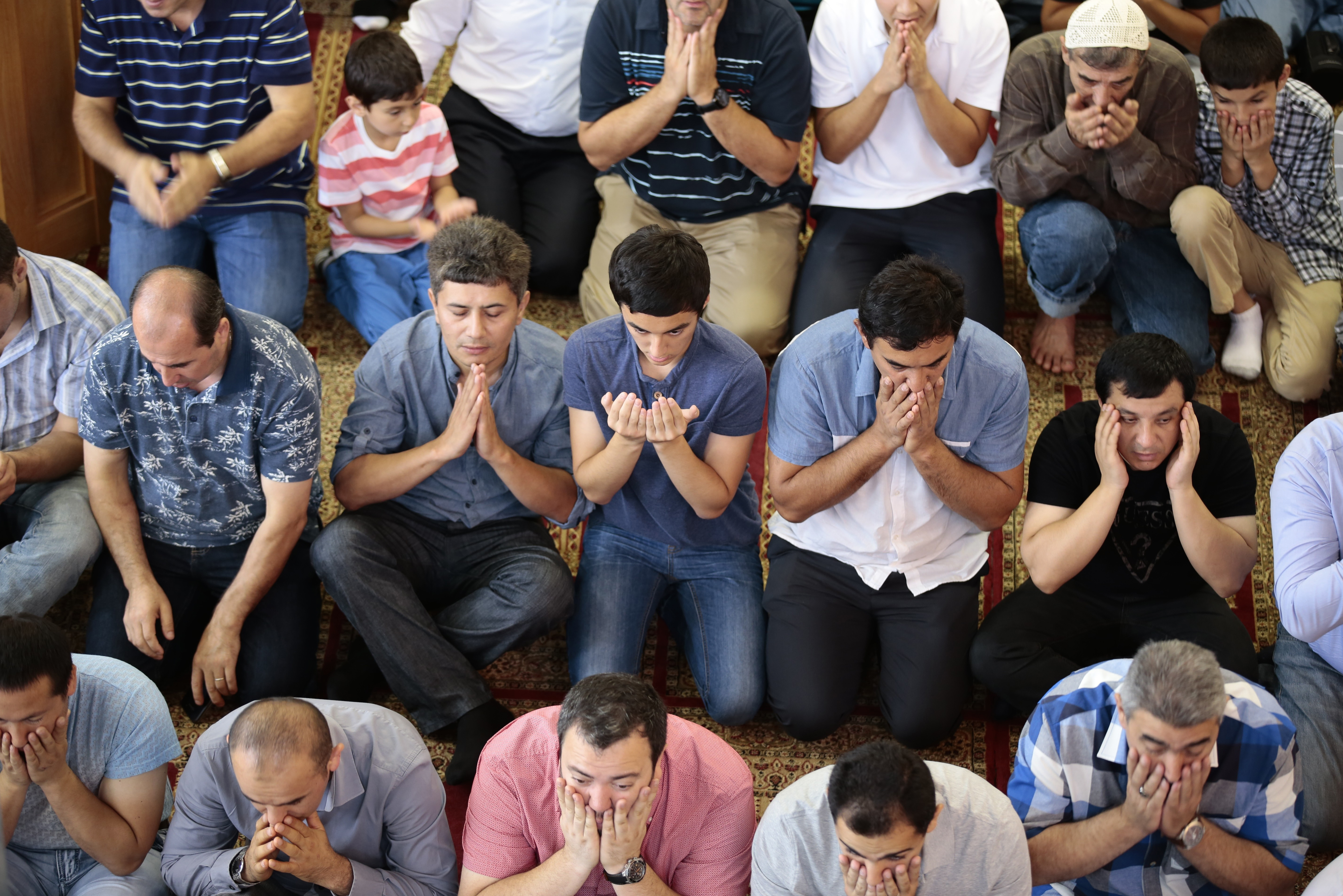
Eid al-Fitr prayer in New York

The Economist reminds us of “how well America is assimilating a religious minority that has often struggled to feel at home in Europe”:

[America’s Muslims] are almost as likely as other Americans to report a household income of $100,000 or more. The same cannot be said of the Pakistanis who came to work in the now-defunct textile mills of northern England or the Turks who became guest workers in West Germany. Many American Muslims arrived in the 1970s to complete their higher education and ended up staying. Muzammil Siddiqi, chairman of the Fiqh Council of North America, which issues fatwas, or religious opinions, to guide the behaviour of the country’s Muslims, is typical: he was born in India and holds a Harvard PhD in comparative religion. There is a stark contrast between this group and some of the more recent immigrants from Somalia, who have fewer qualifications and lower wages (as do African-American Muslims, who make up about an eighth of the total). This divide, if anything, makes America’s Muslims look more like the nation as a whole.

On various measures of integration, Muslims score fairly well. A Pew study from 2011 found that 15% of Muslims who are married or living with someone have a spouse of a different faith. This may sound low, but it is higher than the intermarriage rate for American Jews at a comparable moment in their history, and above that of modern Mormons. According to the Pentagon, there were 3,600 Muslims on active duty in the armed forces in January 2012, the most recent date for which numbers are available.

(Photo: Muslims living in New York City perform Eid al-Fitr prayer at Eyup Sultan Mosque on July 28, 2014. By Bilgin Sasmaz/Anadolu Agency/Getty Images)