The Clintons Go To Iowa

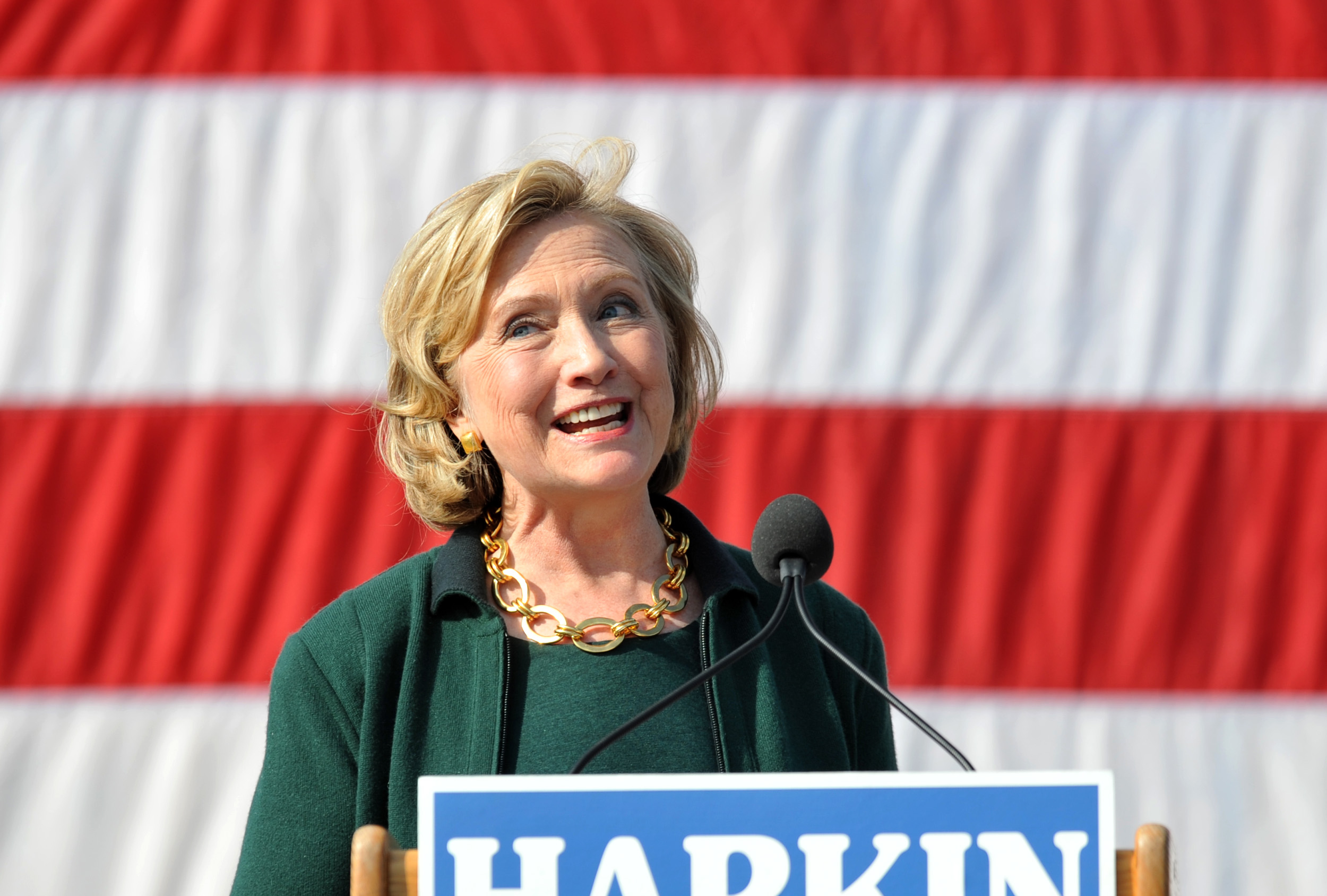
Hillary Clinton Attends Annual Tom Harkin Steak Fry In Iowa

Jay Newton-Small captures the atmosphere at Iowa Sen. Tom Harkin’s Steak Fry, “a Democratic fundraiser that has become known as a presidential launchpad.” Clinton still won’t admit that she wants the presidency:

“Are you running?” reporters repeatedly shout at Hillary. She demurs. She even pretends not to notice when, the event having finally started down the hill, a speaker starts asking the crowd: “Are you fired up? Are you ready to go? Are you ready for Hillary? ARE YOU READY FOR HILLARY?” he screams as the crowd roars.

“Are you ready, Hillary?” a reporter yells. She ignores all this and chats away with Harkin and his wife Ruth.

Ben Smith answers for Clinton – “she’s running”:

Today’s Clinton campaign, like the one back [in 2008], is a tractor trailer moving down the highway, one whose driver — Hillary — can exert some control over its direction and speed, but whose stopping distance is measured in miles, and who can barely control the thing at all once it’s rolling downhill. So the question isn’t what she’s done to run; it’s whether she’s made any effort to hit the brakes, or whether anything has fallen unexpectedly across her path.

Noam Scheiber spots a big chink in Clinton’s armor:

The problem is the general caution that defines her political style.

Of Bill Clinton it was often said that if you put him in a crowded room, he would gravitate toward his harshest critic, determined to win them over. Hillary strikes you as the oppositethe sort who huddles with friends and allies while eying the detractor warily from a distance. The Harkin steak fry speech, and the political strategy it foreshadowed, was basically the rhetorical equivalent of this tic. Hillary’s impulse was to hold close the ideas that have served her well, year in and year out, while steering clear of any possible dissent from establishment opinion. Sensibility-wise, it’s about as far as you can get from where Democrats are these days.

Lexington wonders how Hillary would “govern America at a time of alarming and seemingly insoluble gridlock”:

In his own speech, Bill Clinton tackled this directly. The country was “less racist, less sexist and less homophobic” than it had ever been. It was more diverse than ever before, and more interdependent with the rest of the world (he painted word-pictures of Iowa farmers digitally studying world commodity prices in real-time). Yet more than ever before, Americans did not want “to be around people that disagree with us.” For this reason, it was vital to elect more politicians who went to work without “ears plugged up” and “blinders on”.

Is Hillary Clinton this kind of politician? The question is a serious one, and it is one she will need to answer if and when she decides to run for president. She cannot expect voters to elect her simply because it is “her time”, or because she would be the first woman president (though such arguments were made by a worrying number of those at the steak fry). The idea of being president is not enough to make Mrs Clinton president, in short.

Ana Marie Cox was alarmed by rhetoric of Hillary supporters at the event:

“It’s interesting, but it’s not the main reason I support her,” one male “Students for Hillary” member told me about the idea of a first female president. His companion, a female freshman, was even more cautious: “It’d be nice to see more women in politics,” she said, “But if you push hard for it, it becomes an issue you didn’t ask for.”

Such dry reasoning was unsettlingly common with the student contingent at the steak fry. Unprompted, they offered analysis rather than real reasons for their support. “The Democrats can’t eat their own,” said one of them, serious. “We’ve got to coalesce around Hillary because there’s really no one else, and we can’t let the Republicans win.” It sends a shiver up your spine when a guy who probably isn’t even shaving regularly basically quotes Mark Penn.

(Photo: Former Secretary of State Hillary Rodham Clinton speaks to a large gathering at the 37th Harkin Steak Fry, September 14, 2014 in Indianola, Iowa. By Steve Pope/Getty Images)



The Green Badge Of Knowledge

It’s what London cabbies get when they pass a grueling test that requires them “to learn by heart all 320 sample runs that are listed in the Blue Book, the would-be cabbie’s bible,” along with committing to memory “the 25,000 streets, roads, avenues, courts, lanes, crescents, places, mews, yards, hills, and alleys that lie within a six-mile radius of Charing Cross.” In a deep-dive look at the process of conquering “The Knowledge,” Roff Smith compares old-school cab drivers to those using modern technology to navigate the city:

Proponents of Uber say Sat Nav technology makes The Knowledge obsolete. Not surprisingly, London’s cabbies disagree.

They’re quick to point out that Sat Navs have a knack for getting things wrong, do not always pick the best or quickest route, and that having thousands of cabs idling curbside while their drivers punch in addresses for their Sat Navs will further clog London’s streets, where average speeds have already dropped below nine miles an hour.

It’s not simply a matter of speed, either, cabbies say. A driver who relies on Sat Nav doesn’t know the city. “I like to put it this way,” says 18-year veteran David Styles, who writes a blog about life behind the wheel: “When gentlemen have enjoyed supper at their club with their old regimental chums, they need a taxi to take them to the station. As they can generally afford to live in East Sussex, their station, Victoria, is only six minutes from Pall Mall. Depending on which entrance they want, they ask for The Shakespeare, Old Gatwick, or Hole in the Wall. Show me a Sat Nav which not only has that database but can be programmed in seconds, and I’ll buy shares in it myself.”

He continues: “And actors don’t want to arrive at the front of the theater. They want the stage door. And yes, we have to learn those too.”

Hail one of London’s iconic “black” cabs (which nowadays can come in any color) from anywhere you please within the greater London area, tell the driver where you want to go—it doesn’t matter whether it’s the Tower of London or some obscure pub in an outer suburb—and by the time you’ve climbed in the back seat and closed the door, he’ll have already calculated the most direct, swiftest route, without ever looking at a map.

The Now Economy

“Over the past century, and especially the past four decades,” argues Paul Roberts, “we have created a sophisticated, self-feeding socioeconomic system that is marvelously efficient at catering to our desires.” He reflects on how an instant-gratification culture led us to an “Impulse Society”:

If we could step back a century, before the rise of the consumer economy, we would be struck not only by the lack of affluence and technology but also by the distance between people and the economy, by the separation of economic and emotional life. People back then weren’t any less wrapped up in economic activities. The difference lay in where most of that activity took place. A century ago, economic activity occurred primarily in the physical world of production. People made things: they farmed, crafted, cobbled, nailed, baked, brined, brewed. They created tangible goods and services whose value could be determined, often as not, by the measurable needs and requirements of their physical, external lives.

That relationship changed with the rise of the consumer economy.

Sophisticated, large-scale industrial systems assumed the task of making many of the things we needed, and also began to focus on the things we wanted. As the consumer economy matured, an ever-larger share of economic activity came from discretionary consumption, driven not by need but by desire, and thus by the intangible criteria of people’s inner worlds: their aspirations and hopes, identities and secret cravings, anxieties and ennui. As these inner worlds came to play a larger role in the economy—and, in particular, as companies’ profits and workers’ wages came to depend increasingly on the gratification of ephemeral (but conveniently endless) appetites—the entire marketplace became more attuned to the mechanics of the self. Bit by bit, product by product, the marketplace drew closer to the self.

The Best Of The Dish This Weekend


I spent the last three days in Portland, Oregon, the kind of city I could easily live in: manageable, green, easy-going, mellow, polite. And I spent it with a few hundred entrepreneurs and activists, preparing and debating and sharing experiences about the burgeoning cannabis industry. It felt a lot like a gathering more than ten years’ ago of activists and ordinary gay folks, anticipating the possibility of civil marriage rights. It had the same energy, the same nervousness, and the same excitement. And, for me, the big reveal was the staggering level of innovation, imagination and technology that will transform the cannabis market as only American capitalism can.

And the people there defied every stereotype people want to apply to those of us who want to end the destructive, self-defeating Prohibition of a plant that is much less harmful than alcohol or tobacco. We’re long since past the age of Cheech and Chong; past the dumb giggles and condescending jokes, and mercifully beyond the boomer divide that still somehow sees this is as some kind of culture war issue, rather than a sane, pragmatic, gradual reform that will end persecution of so many, and improve the lives of countless more. So, yes, it did remind me of marriage equality – not least because the logic behind it is just as powerful and the opposition just as intellectually weak. If, like me, you’ve had the wind knocked out of you by Obama’s capitulation to neoconservatism, there are still some areas where the last six years can yield some durable domestic progress –  and this is one of them. Unless, that is, Obama’s panicked blunder so emboldens the forces of reaction that it puts more of what we have achieved since the Bush-Cheney nightmare in jeopardy.

This weekend, we took our minds off the new Americanized war in the Middle East, and feasted on the poetry of Jericho Brown. I was gut-punched by this poem in particular. A secular meditation on prayer – from the Village Voice advice columnist! – is well worth re-visiting; I’ve rarely heard a homily that revealed and explained so much.

We aired the key to happiness; the cheeky face of a giant fruit-bat; the freedom from body dissatisfaction that veiled Muslim women enjoy; and a view of conservatism very close to my own – by Roger Scruton. Plus: the novel WWII soldiers couldn’t put down.

The most popular post of the weekend was Why Obama Launched Another War; and The View From Your Window Contest – a toughie.

See you in the morning.

The Awe And The Almighty

8524859690_54fb1ea6aa_b

Tania Lombroza explains what experiencing awe does – and doesn’t – have to do with religious belief:

What we do know is that inducing experiences of awe can influence reported belief in God, potentially as a result of the need for accommodation that such experiences produce. One set of studies induced feelings of awe with videos of the natural world, and found that people subsequently reported greater supernatural belief. This was in part because awe made people less tolerant of uncertainty, and uncertainty is known to increase people’s confidence in agency and order.

But the picture is more complex. Endorsing a powerful and benevolent God may be one way to cope with uncertainty, but it isn’t unique. We know from related lines of work that science itself, especially scientific theories that offer clear structure and predictability, can also deliver many of the psychological benefits associated with belief in God, including a compensatory response to uncertainty. This suggests that experiences of awe could boost people’s confidence in science. In particular, awe could boost confidence in natural laws and orderly scientific theories — a prediction that, to my knowledge, has yet to be tested.

Certainly, people differ in the extent to which they experience awe, though there’s no evidence that this tendency is greater among believers than among atheists. But people may similarly vary in the extent to which awe induces uncertainty, and in the extent to which that uncertainty is found aversive. For some, uncertainty could prompt inquiry rather than disquiet, a scientific rather than a spiritual journey.

(Photo by Michel Ziembicki)

Equal In The End

Alex Mar tours the Forensic Anthropology Research Facility (FARF) in San Marcos, Texas, America’s largest “body farm” for studying human remains:

The odor is strong as I walk among the cages, the air redolent with the heavy, sour-wet scent of these bodies letting go of their bile, staining the grasses all around them. I look at the sprawl, each individual in its strange shelter, shriveled and shocked-looking; each with more or less of its flesh and insides; each, in its post-person state, given a new name: a number. They died quietly, in an old-age home; they died painfully, of cancer; they died suddenly, in some violent accident; they died deliberately, a suicide. In spite of how little they had in common in life, they now lie exposed alongside one another, their very own enzymes propelling them toward the same final state. Here, in death, unintentionally, they have formed a community of equals.

The Soul Of John Updike

14852448109_9bf220b03a_k

In a review of Adam Begley’s Updike, William Deresiewicz finds that writer’s short story, “Pigeon Feathers,” offers telling insight into his religious beliefs. In the story, the character David is asked by his mother to kill the pigeons roosting in their barn, which gives him “the sensation of a creator.” How Deresiewicz describes what happens next:

It is when he’s burying these creatures that he has his epiphany. He has never seen a bird up close before. “Across the surface of the infinitely adjusted yet somehow effortless mechanics of the feathers played idle designs of color, no two alike, designs executed, it seemed, in a controlled rapture, with a joy that hung level in the air above and behind him.” Now he knows “that the God who had lavished such craft upon these worthless birds would not destroy His whole Creation by refusing to let 
David live forever.”

The story is a credo at once theological and artistic.

David finds God by emulating him. He creates. That he creates by killing
the story’s brazen moral scandalonly draws him nearer to his model, for He does the same, as Piet in Couples understands. The more important point lies in the way in which he kills: carefully, cleverly, with a patience both of seeing and of skill. It takes no wit to recognize a third, implied creator, intermediate between the other two. The boy creates the birds; the artist creates the boy; the deity creates them all. “Controlled rapture” is a precise description of the state in which the patterns of Updike’s own work, here and elsewhere, have been so evidently crafted. The joy hangs level 
everywhere around us.

This is the argument from design, and it is also an argument for design. Updike believed in art as imitation, a tracing of the wonders God has put in pigeons and in Davids. “Pigeon Feathers” tells us that people do not matter, not even to themselves, unless they have immortal souls. Elsewhere Updike makes a corollary statement about fiction. Without souls, he asks, “are mundane lives worth writing about?” Art becomes a form of affirmation. Updike didn’t want a better world, he only wanted this one, forever. He may not have thought that everything was holyhe wasn’t pious or sentimentalbut he thought that it was beautiful, to use the language of art, and he certainly thought, to use the language of Genesis, that it was good. And men and women (their sins 
included)they were very good.

Recent Dish on Updike’s faith here.

(Photo by Partha S. Sahana)

The Ideology Of ISIS

Kevin McDonald argues that its origins are not at all medieval, but rather modern, and indeed, even Western:

It needs to be said very clearly: contemporary jihadism is not a return to the past. It is a modern, anti-traditional ideology with a very significant debt to western political history and culture. When he made his speech in July at Mosul’s Great Mosque declaring the creation of an Islamic state with himself as its caliph, Abu Bakr al-Baghdadi quoted at length from the Indian/Pakistani thinker Abul A’la Maududi, the founder of the Jamaat-e-Islami party in 1941 and originator of the contemporary term Islamic state. Maududi’s Islamic state is profoundly shaped by western ideas and concepts. He takes a belief shared between Islam and other religious traditions, namely that God alone is the ultimate judge of a person, and transforms this – reframing God’s possession of judgment into possession of, and ultimately monopoly of, “sovereignty”. Maududi also draws upon understandings of the natural world governed by laws that are expressions of the power of God – ideas at the heart of the 17th-century scientific revolution.

Ella Lipin focuses on its allusions to Islamic eschatology and how ISIS uses the promise of an apocalyptic battle as a recruiting tool:

In July, ISIS released the first two issues of Dabiq, its digital magazine, revealingly named after a Syrian town believed to be the site of the future climactic battle, to be fought between Muslims and Romans, that will lead to Judgment Day.

The use of Dabiq draws from hadith, revered accounts of the Prophet Muhammad’s sayings or practices. The relevant passage states that the end of days won’t come until the battle at Dabiq. After the battle, the triumphant Muslims will go on to conquer the Western world (symbolized by Constantinople). ISIS reprinted this hadith in full in the first issue of its new publication. Herein lies ISIS’s propaganda strategy: employ Islamic apocalyptic tradition – with the West as the modern day Romans – to mobilize followers. Both the organization and its new recruits understand this script, made all the more relevant and compelling by the recent debate about U.S. airstrikes in Syria. …

This interpretation of events is not limited to Sunni extremists; a large number of Muslims believe these events may be imminent. A 2011-2012 Pew survey found that a high percentage of Muslims in the Middle East believe they would witness events leading to the Day of Judgment. In Iraq, where ISIS has recently expanded, 72 percent of respondents expect to experience the coming of the Mahdi, a messianic redeemer who will restore the political and religious purity of Islam. While the figures were lower in other Muslim countries—Tunisia (67 percent), Lebanon (56 percent), Morocco (51 percent), the Palestinian Territories (46 percent), Jordan (41 percent), and Egypt (40 percent)—the apocalyptic tradition clearly resonates deeply throughout the region.

Last week, Laurie A. Brand looked into how ISIS is trying to promote its ideology by rewriting the school curriculum in the areas it controls:

The term “Syrian Arab Republic” is to be removed completely and replaced with “the Islamic State,” and the Syrian national anthem is to be discarded or suppressed. There is to be no teaching of the concepts of national patriotism (wataniyyah) or Arab nationalism (qawmiyyah); rather, students are to be taught that they belong to Islam and its people, to strict monotheism and its adherents, and that the land of the Muslim is the land in which God’s path (shar’ Allah) governs. The words “homeland” (watan), “his homeland,” “my homeland,” or “Syria” are to be replaced wherever they are found with the phrases “the Islamic state,” “his Islamic state,” “land of the Muslims” or the “Sham (or other the Islamic State-governed) Province.” The teacher is instructed to replace any gaps in Arabic language and grammar instructional materials that may result from the suppression of these terms with examples that do not conflict with sharia or the Islamic State. In addition, all pictures that violate sharia are to be removed, as are any examples in mathematics that involve usury, interest, democracy or elections. Finally, in the science curriculum anything that is associated with Darwin’s theory or evolution is to be removed and all creation is to be attributed to God.

Meanwhile, Michael Koplow cautions against conflating the defeat of ISIS with the defeat of the ideas it espouses:

ISIS’s ideology is a revolutionary one seeking to overturn the status quo and to constantly expand, which makes it particularly susceptible to living on beyond the elimination of its primary advocate. Much like Voldemort’s life force after he attempts to kill Harry Potter as a baby, ISIS’s ideology will not die just because its host body is decimated. It will lurk around until another group seizes upon it and resurrects it, and much like ISIS seems to be even worse than al-Qaida, whatever replaces ISIS is likely to be more radical still. The problem with Obama’s speech yesterday was that it set an expectation that cannot be fulfilled. Yes, ISIS itself may be driven from the scene, but the overall problem is not one that is going to go away following airstrikes or even ground forces.

The Carpaccio Dog

dish_carpacciodog

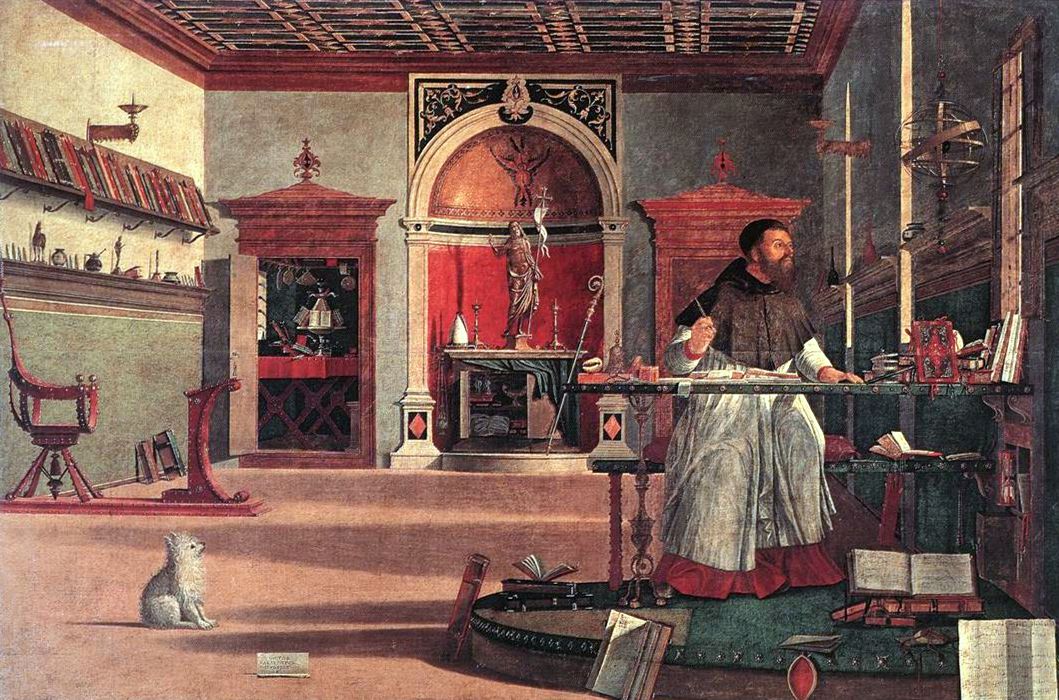
In an essay exploring how Vittore Carpaccio portrayed animal life, Jan Morris turns her eye to “the Carpaccio dog”:

Vittore has been called pantheistic. I am quite sure he revered Nature, anyway, or he could not have painted the birds and beasts as he did. He seems to have loved them in the way Montaigne loved his cat—as equals, unpatronizingly, clear-eyed, never gushingly. Consider the little dog in his celebrated painting concerning Saints Jerome and Augustine, one of the most famous dogs in all art—the Carpaccio Dog, in fact. Nearly everyone wonders what kind of dog he is. Ruskin, in 1851, thought he was exactly like his white Spitz Wisie (which he described, during a nadir in that animal’s career, as being a “poor little speechless, luckless, wistfully gazing doggie”). Pompeo Molmenti (1907) considered him “a lively little spaniel.” Terisio Pignatti (1958) believed him to be a Maltese puppy, and called his coat “fluffy.” So did Kenneth Clark (1977) in his book Animals and Man. I myself though (2014) prefer to think of him as a dog of no particular breed, a tough urchin mongrel, cocky, feisty, and fun, rescued from the street perhaps by one saint or another, and cherished by multitudes down the centuries. To me he is simply the Carpaccio Dog. Doggie indeed! Fluffy my foot! …

In a preliminary sketch for his picture about Jerome and Augustine, the Carpaccio Dog was not a dog at all, but what seems to be a cat, a crouching, weasely thing with a collar around its neck. Having failed so abysmally in this exercise, Carpaccio gave up, turned the animal into a dog and, so far as I know, never tried to paint a small feline again.

(Image: The Vision of St. Augustine, 1502, by Carpaccio via Wikimedia Commons)

Quote For The Day

TheFaulknerPortable

“When the shadow of the sash appeared on the curtains it was between seven and eight o’ clock and then I was in time again, hearing the watch. It was Grandfather’s and when Father gave it to me he said I give you the mausoleum of all hope and desire; it’s rather excruciating-ly apt that you will use it to gain the reducto absurdum of all human experience which can fit your individual needs no better than it fitted his or his father’s. I give it to you not that you may remember time, but that you might forget it now and then for a moment and not spend all your breath trying to conquer it. Because no battle is ever won he said. They are not even fought. The field only reveals to man his own folly and despair, and victory is an illusion of philosophers and fools,” – William Faulkner, The Sound and the Fury.

(Photo of Faulkner’s Underwood Universal Portable typewriter by Gary Bridgman)