Playing with fire never looked so beautiful:
Seeing The Glass As Half-Empty
As a species, we’re prone to it:
Negative events affect us more than positive ones. We remember them more vividly and they play a larger role in shaping our lives. Farewells, accidents, bad parenting, financial losses and even a random snide comment take up most of our psychic space, leaving little room for compliments or pleasant experiences to help us along life’s challenging path. The staggering human ability to adapt ensures that joy over a salary hike will abate within months, leaving only a benchmark for future raises. We feel pain, but not the absence of it.
Hundreds of scientific studies from around the world confirm our negativity bias: while a good day has no lasting effect on the following day, a bad day carries over. We process negative data faster and more thoroughly than positive data, and they affect us longer. Socially, we invest more in avoiding a bad reputation than in building a good one. Emotionally, we go to greater lengths to avoid a bad mood than to experience a good one. Pessimists tend to assess their health more accurately than optimists. In our era of political correctness, negative remarks stand out and seem more authentic. People – even babies as young as six months old – are quick to spot an angry face in a crowd, but slower to pick out a happy one; in fact, no matter how many smiles we see in that crowd, we will always spot the angry face first.
Face Of The Day

Sage Sohier captured the expressions of people being treated for facial paralysis:
Sage Sohier spent three years at a facial nerve clinic, photographing people in the beginning stages of treatment of facial paralysis for her series “About Face.” The portraits of men, women, and children of all ages and ethnicities with varied causes and visible extents of paralysis are striking. Looking directly into the camera, directly at the viewer, the patients smile.
Sohier adds:
Most people I photograph are acutely aware of their imperfections and try to minimize them. Some have confided in me that, in their attempt to look more normal, they strive for impassivity and repress their smiles. They worry that this effort is altering who they are emotionally and affecting how other people respond to them.
See more of her work here.
War Stories
During World War II, book publishers began to mass-produce cheap copies of their most valuable hardcovers, selling them to the army for pennies. Yoni Appelbaum looks back at which titles made a particular impression on GIs:
No book generated more passion among its readers than A Tree Grows in Brooklyn, a gritty coming-of-age novel. On a Pacific island, a lucky soldier given a new copy “howled with joy,” but knew he’d have to sleep on top of it if he hoped to hang onto it long enough to finish it. A 20-year-old Marine “went through hell” in two years of combat, but wrote from his stateside hospital bed that the book had made him feel human again. It might, he conceded, be “unusual for a supposedly battle-hardened marine to do such an effeminate thing as weep over a piece of fiction,” but he was now making his way through the book for the third time. In France, the colonel commanding an anti-aircraft battalion being shelled by German artillery found one of his soldiers reading the book between explosions. “He started to read us a portion … and we laughed like hell between bursts. It sure was funny.” The tough West Pointer later found a copy of his own, and was tempted to pull it out and read it while wounded and pinned down by enemy fire. “It was that interesting,” he recalled, in a letter to the publisher.
Appelbaum goes on to describe how the publishers’ wartime gamble helped the industry flourish after troops came home:
Suddenly, anyone who wanted to could fill a shelf with books. Paperbacks lost their stigma. The Armed Services Editions succeeded in “conditioning the younger generation to be perfectly at home with books in paper covers.” The new technology, initially feared and scorned, proved to be the industry’s salvation. Many readers first hooked with paperbacks later purchased hardcovers, fueling sales and providing the old-line publishing industry with a vastly larger market for its wares.
Talk Yiddish To Me
Tanya Basu asks what the future holds for the Ashkenazi language:
Joseph Berger, a religion reporter for The New York Times, explores [the future of Yiddish] in his book, The Pious Ones: The World of Hasidim and Their Battles with America, published Tuesday. In it, Berger recounts meeting Rabbi Hertz Frankel, the principal of a Satmar girl’s school in Brooklyn, home to the largest concentration of Yiddish speakers in America, along with a large population of Orthodox Jews. Frankel comments on how secular Judaism has contributed to the death of Yiddish and a simultaneous loss of traditional Jewish identity:
The secular community is dead, dead, dead. There’s no Yiddish press, no Yiddish theater [not quite accurate since there is one still-vibrant group, the National Yiddish Theater-Folksbiene]. Dead, dead, dead. There were hundreds of Sholem Aleichem schools, Peretz schools. Where are they? How many Yiddish books are being published? The secular people dominated everything and now they’ve lost. Hasidim are pushing everyone to be more religious, more Jewish.
Rabbi Frankel’s bemoaning of the potential extinction of Yiddish illuminates a greater issue: The language has become synonymous with Orthodox Judaism and has lost its meaning within the secular parts of the faith. It’s a dying language among mainstream Jewish Americans but a thriving one among the Hasidim, who speak the language almost exclusively.
We Have Nothing To Learn From Ants

E.O. Wilson spells out why we shouldn’t look to the insects for moral guidance:
[A] question I hear a lot is, “What can we learn of moral value from the ants?” Here … I will answer definitively: nothing. Nothing at all can be learned from ants that our species should even consider imitating. For one thing, all working ants are female. Males are bred and appear in the nest only once a year, and then only briefly. They are pitiful creatures with wings, huge eyes, small brains and genitalia that make up a large portion of their rear body segment. They have only one function in life: to inseminate the virgin queens during the nuptial season. They are built to be robot flying sexual missiles. Upon mating or doing their best to mate, they are programmed to die within hours, usually as victims of predators.
Wilson goes on to explain why it’s “a bit of a stretch” to refer to human societies as “superorganisms”:
It is true that we form societies dependent on cooperation, labor specialization and frequent acts of altruism. But where social insects are ruled almost entirely by instinct, we base labor division on transmission of culture. Also, unlike social insects, we are too selfish to behave like cells in an organism. Human beings seek their own destiny. They will always revolt against slavery, and refuse to be treated like worker ants.
Thinking Like A Conservative
Roger Scruton calls it an “unusual and precarious exercise,” especially because conservatives “believe that good government is not grounded in abstract ideas but in concrete situations, and that concrete situations are hard to grasp”:
Conservatism does not fit easily with abstract ideals. And for many of its defenders that is all that Conservatism amounts to – the suspicion of ideals. After all, the socialist ideal of equality has led to the belief that patriotism is racism, and that the attachment to an established way of life is merely unjust discrimination against those who do not share it. The result has been a cantonisation of society in the name of “multiculturalism”. And the liberal ideal of universal human rights has likewise led to a downgrading of attachment, since attachment is a form of discrimination and therefore a way of giving preference to those who already belong.
Abstract ideals, Conservatives argue, are inevitably disruptive, since they undermine the slow, steady work of real politics, which is a work of negotiation and compromise between people whose interests will never coincide.
Seeing politics in that way, however, Conservatives are exposed to the complaint that they have no positive vision, and nothing to offer us, save the status quo – with all its injustices and inequalities, and all its entrenched corruption. It is precisely in facing this charge that the real thinking must be done. In How to Be a Conservative, I offer a response to this ongoing complaint, and in doing so distance Conservatism from what its leftist critics call “neoliberalism”. Conservatism, I argue, is not a matter of defending global capitalism at all costs, or securing the privileges of the few against the many. It is a matter of defending civil society, maintaining autonomous institutions, and defending the citizen against the abuse of power. Its underlying motive is not greed or the lust for power but simply attachment to a way of life.
A Poem For Sunday

“To Be Seen” by Jericho Brown:
Forgive me for taking the tone of a preacher.
You understand, a dying manMust have a point—not that I am
Dying exactly. My doctor tells me I’ll liveLonger than most since I see him
More than most. Of course, he cannot be trustedNor can any man
Who promises you life for looking his way. PromisesCome from the chosen: a lunatic,
The whitest dove—those who hearThe voice of God and other old music. I’m not
Chosen. I only have a point like anyonePaid to bring bad news: a preacher, a soldier,
The doctor. We talk about GodBecause we want to speak
In metaphors. My doctor clings to the metaphorOf war. It’s always the virus
That attacks and the cells that fight or dieFighting. Hell, I remember him saying the word
Siege when a rash returned. HereI am dying while
He makes a battle of my body—anything to be seenWhen all he really means is to grab me by the chin
And, like God the Father, say through clenched teeth,Look at me when I’m talking to you.
Your healing is not in my hands, thoughI touch as if to make you whole.
(From The New Testament © 2014 by Jericho Brown. Used by permission of Copper Canyon Press. Photo by Andrew Malone).
Andrew W.K. Teaches Us How To Pray
A reader of Andrew W.K.’s Village Voice advice column wrote in frustrated about being asked to pray for an older brother diagnosed with cancer, describing it as “kneeling on the ground and mumbling superstitious nonsense.” W.K. responds this way:
Prayer is a type of thought. It’s a lot like meditation — a type of very concentrated mental focus with passionate emotion directed towards a concept or situation, or the lack thereof. But there’s a special X-factor ingredient that makes “prayer” different than meditation or other types of thought. That X-factor is humility. This is the most seemingly contradictory aspect of prayer and what many people dislike about the feeling of praying. “Getting down on your knees” is not about lowering your power or being a weakling, it’s about showing respect for the size and grandeur of what we call existence — it’s about being humble in the presence of the vastness of life, space, and sensation, and acknowledging our extremely limited understanding of what it all really means.
Being humble is very hard for many people because it makes them feel unimportant and helpless. To embrace our own smallness is not to say we’re dumb or that we don’t matter, but to realize how amazing it is that we exist at all in the midst of so much more. To be fully alive, we must realize how much else there is besides ourselves. We must accept how much we don’t know — and how much we still have to learn — about ourselves and the whole world. Kneeling down and fully comprehending the incomprehensible is the physical act of displaying our respect for everything that isn’t “us.” …
The paradoxical nature of this concept is difficult, but it is the key to unlocking the door of spirituality in general, and it remains the single biggest reason many people don’t like the idea of prayer or of spiritual pursuits in general — they feel it’s taking away their own power and it requires a dismantling of the reliable day-to-day life of the material world. In fact, it’s only by taking away the illusion of our own power and replacing it with a greater power — the power that comes from realizing that we don’t have to know everything — that we truly realize our full potential. And this type of power doesn’t require constant and exhausting efforts to hold-up and maintain, nor does it require us to endlessly convince ourselves and everyone else that we’re powerful, that we know what we’re doing, and that we’re in control of everything.
Morgan Guyton, who works for a Christian campus ministry, asks himself hard questions after reading this agnostic approach to prayer:
There’s so much disdain among my fellow clergy folk for “spiritual but not religious” people. The stereotype we have in our heads is the clueless hippie who thinks that s/he can attain spiritual groundedness by shopping organic and doing yoga. Andrew W.K. makes it hard to write him off as a goofy hippie. I can’t speak for anybody else, but I know that in my own head, my rage against spiritual but not religious people is largely an expression of my deep anxiety about spending the rest of my ministry career on a ship that’s rapidly sinking. What if I’m actually obsolete because people can become a loving, humble, mature community without the grape-juice-soaked chunk of communion bread that I have to offer?
Now that I’m working in a secular university, I’m meeting so many students who seem more compassionate, humble, and disciplined than I am, but they don’t seem to have any inclination or need to be anything other than secular. A response that clergy like me often make to atheists is to say, “I don’t believe in the God you don’t believe in either.” And then we talk about how the silly god-caricatures of popular Christianity are not the same thing as the true God, who is the “source of being” and “a complete mystery.” But how is the mysterious God that sophisticated Christians believe in different than what Andrew W.K. calls “the size and grandeur of what we call existence.”
How much do I know that what I’m doing when I pray is more than what Andrew describes as “gaining strength by admitting weakness” or “turning [myself] over to [my] own bewilderment”?
The View From Your Window
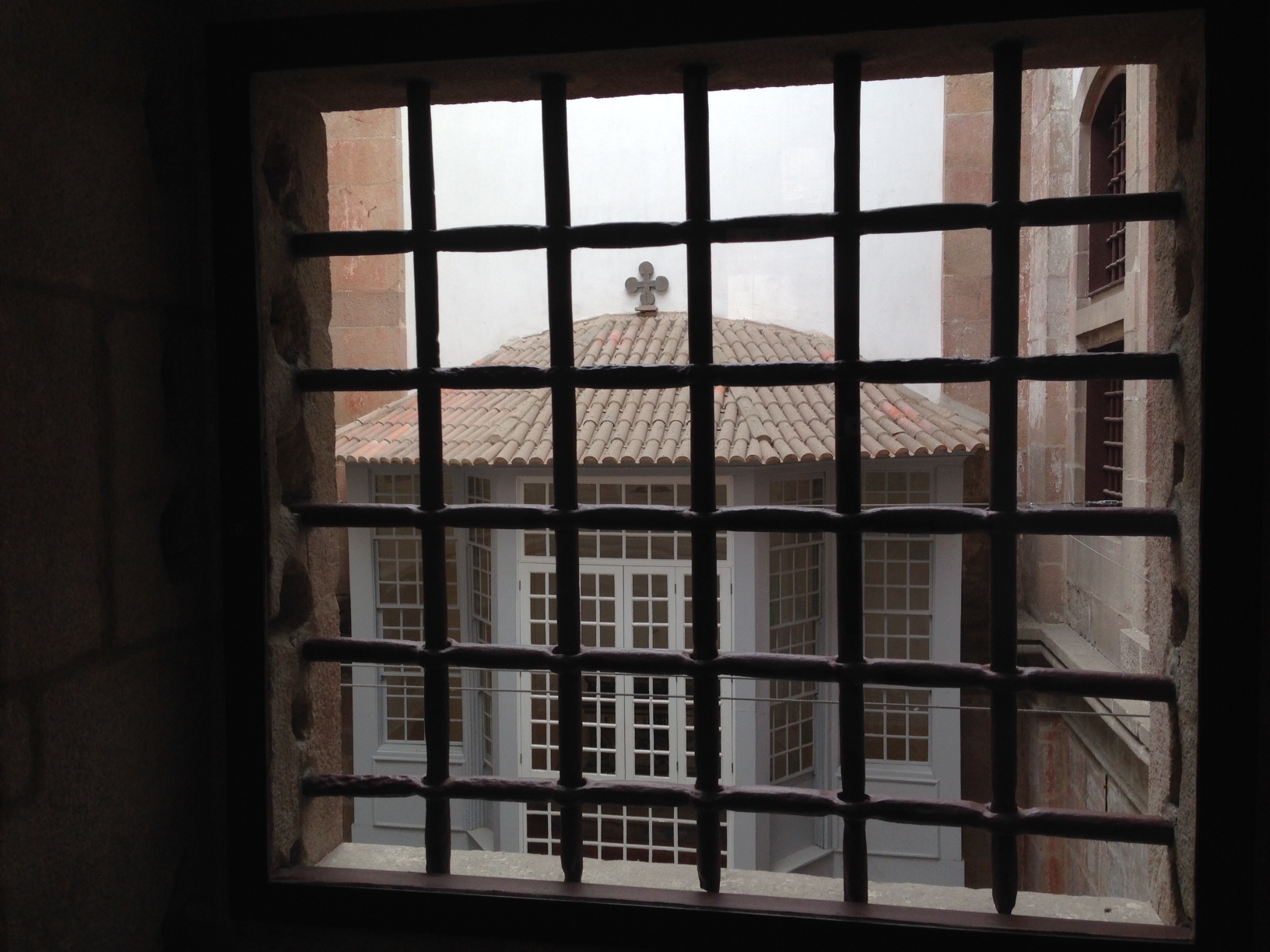
Porto, Portugal, 11.05 am
 The Dish