Reductio Ad Nietzsche

Simon Smart lauds Nick Spencer’s Atheists: The Origins of the Species, remarking that “the most challenging aspect of this work is the way it illuminates the inherently naïve optimism contained in New Atheism’s rendition of the ‘God is dead’ trope”:

While there has been no shortage of non-believers who viewed the demise of the divine as ushering in an era of untrammelled human progress, no less a figure than Friedrich Nietzsche understood the great shadow that would be cast across Europe if, as he hoped, the rejection of Christianity came to fruition. Such a move would signal the ruin of a civilisation, and he wrote about “the long dense succession of demolition, destruction, downfall, upheaval that now stands ahead.”

Something of a dark prophet, Nietzsche envisioned troubled times ahead – a prediction that the 20th century’s atheist regimes fulfilled with alarming efficiency. Nietzsche’s importance, writes Spencer, lies in his understanding that metaphysics and morals are inseparable. Nietzsche was under no illusion that you could hold on to Christian ethics – which he saw as degenerate slave mentality – while jettisoning the Christian faith.

In reply, PZ Myers expresses his exasperation with all the Nietzsche-love from believers:

And then Spencer and Smart drag out one of my pet peeves: Nietzsche. Not Nietzsche the philosopher, of course, but Nietzsche the dolorous atheist. Nietzsche the regretful non-Christian. Nietzsche the sorrowful, reluctant thinker who praises Jesus while weeping sincerely, and simultaneously predicting cultural cataclysm because we’re losing our faith. It’s the only atheist message the devout want to hear — if you’re going to abandon religion, at least be sure to stroke the pastor’s ego on your way out the door.

These guys always make Nietzsche sound like a 19th century S.E. Cupp, which is an awfully nasty insult to deliver to a guy you’re praising. …

You know what? Fuck the Christian cartoon Nietzsche. He’s wrong, he’s annoying, and I feel no obligation to respect his views of a lovely essential Christian dogma. Also, as noted above, if atheism is a reaction to false authority…why the hell do you think citing a philosopher who has been dead for over a hundred years will make us roll over and surrender? Nietzsche ain’t the atheist pope, either. Christians can keep trying to shoehorn atheism into obligatory tropes that they’re subject to, but all it does is convince us that Christians don’t know what they’re talking about.

Previous Dish on Nietzsche and atheism here, here, here, and here.

Veiled Self-Acceptance

https://twitter.com/umamame/status/507385985076703232

Alice Robb flags some new research about the hijab and body image:

study published in the August edition of the British Journal of Psychology suggests that the hijab actually offers some protection against the body dissatisfaction that plagues many Western women.

A team of psychologists, led by Malaysian-born British psychologist Viren Swami at the UK’s University of Westminster, interviewed 587 Muslim women in London, 369 of whom regularly wore some sort of hijab. Their ages ranged from 18 to 70; the mean age was 27. The majority – about 79 percent – were unmarried, and they represented several ethnic groups – Bengali, Pakistani, Indian, and Arab. More than three-quarters held an undergraduate degree.

Swami and his team gave the women several tests to measure their attitudes toward their bodies – and the women who wore Western dress scored higher on every scale of body dissatisfaction. When subjects were asked to look at several sketches of women’s bodies and pick the one they would most like to have, the choices of the women who wore the hijab more closely resembled the bodies they actually possessed. On a measure of “drive for thinness” – determined by answers to questions about preoccupation with body weight, fear of becoming fat, and excessive concern with dieting – women who didn’t wear the hijab scored, on average, 3.58 out of 6 points, compared to 2.87 for women who cover up. Women who wore Western dress also registered a higher degree of “social physique anxiety,” or concern with how others perceived their physical appearance: 3.26, versus 2.92, on the 6-point scale.

Previous Dish on veiling and beauty standards here.

Going To War For God?

Nigel Biggar praises Karen Armstrong’s forthcoming book, Fields of Blood: Religion and the History of Violence, as “a magisterial debunking of the secularist tale” that claims “religion is essentially and uniquely generative of division and violence.” A run down of why she finds that tale too simple:

Armstrong’s corrective, complicating history includes a number of nicely water-muddying, stereotype-confounding details. For example, in the so-called Wars of Religion, Protestants and Catholics not infrequently fought on the same side against imperial forces: in its final phase, during the Thirty Years War, Catholic France came to the rescue of Protestant Sweden. Second, whereas that famous son of the Enlightenment, Thomas Jefferson, owned slaves, the inspiration for the abolitionist movement was originally and predominantly Christian. Third, the first genocide of the 20th century was committed by zealous secularists, the Young Turks, against (Christian) Armenians. Fourth, it was the Tamil Tigers, a non-religious, nationalist movement, which pioneered suicide bombing, and most suicide bombing in Lebanon during the 1980s was performed by secularists. Fifth, so deep-rooted were the habits of coexistence between Christians and Muslims in Bosnia that, during the 1990s, it took the Communist Slobodan Milošević three years of relentless nationalist propaganda to turn the former against the latter. Sixth, James Warren Jones, the instigator of the infamous Jonestown massacre in 1978, was not a religious zealot but a self-confessed atheist, who ridiculed conventional Christianity. Next, Ayatollah Khomeini’s critique of the regime of Shah Reza Pahlavi in the 1960s has much in common with Pope John XXIII’s contemporaneous critique of unfettered capitalism. And finally, what is striking about the 9/11 bombers is not how much they knew about Islam, but how little.

Ian Bell, however, points to questions that he believes Armstrong leaves unanswered:

What is it about humanity that allows it to receive and accept messages of love and compassion yet use faith in such precepts to justify mass murder? Freudian hokum invoking the trinity of id, ego and superego might once have been called upon. Armstrong prefers neuro-anatomy and a near-Marxist account of elites, class, oppression and exploitation.

“Each of us,” she writes, “has not one but three brains which co-exist uneasily.” We acquired this collection at various stages of evolution. The oldest is a reptilian remnant, utterly self-interested; the second, the limbic system, allows empathy; the youngest, acquired perhaps 20,000 years ago as the neocortex or “new brain”, grants us self-awareness. We can stand back, as Armstrong puts it, from our primitive instincts. We can also be imbued with faith and utterly murderous.

This is neat. It is also, for the sake of an argument, convenient. Armstrong understands religion in terms of the human search for – indeed, need for – meaning. Most of the major faiths make larger claims to do with a deity and absolute, eternal truth. If that is what is going on, surely the ugly, insistent claims of our buried “old brain” would be overwhelmed. It might be a mistake to claim, crudely, that religion causes war. But to put the question in the context of a fine and eloquent book: why has the impulse to faith failed to suppress our brutish taste for warfare?

Face Of The Day

dish_giantfruitbat

Traer Scott photographs nocturnal animals like the giant fruit bat above:

Nocturnal animals come in all shapes and sizes and constitute a wide variety of species, from reptiles to mammals to insects. “That’s what really kept me fascinated with this project,” [Scott] said. “I was really struck by the diversity, from bugs to giant cats and everything in between. I do see [my book Nocturne] as a family album of sorts. They’re not technically family but they all share this trait.”

Many of the animals in the book, it turns out, were actually photographed during the day in order to better accommodate the schedules of their human handlers at zoos, shelters, and educational centers around the Northeast. “Sometimes, it was better to photograph them during the day because they were a little more calm,” Scott said in an interview. “That way, they didn’t get freaked out by me or the camera. The big cats were asleep all day, so there was a lot of waiting for some of them to wake up. I couldn’t exactly go in and poke them and say, ‘Hey, wake up!’ ”

See more pictures from the series here.

What’s “Awkward” Anyway?

Elif Batuman expands on her definition of awkwardness as “the consciousness of a false position”:

Here is the top-rated definition of awkward in Urban Dictionary: “Passing a homeless person on your way to a Coin Star machine.” In other words, denying that you have any spare change while carrying a whole jar of change, a transparent column of money, right in front of the person. In fairness, although there is a sense in which you can spare the change, there is also a sense in which you can’t. Who are you, after all—the one per cent? The one per cent doesn’t use the Coin Star machine.

“Awkward” implies both solidarity and implication. Nobody is exempt. Awkwardness comes from the realization that, when you look around the world, it’s difficult to identify anyone who isn’t either the victim or the beneficiary of injustice. Awkward moments remind us that we are never isolated individuals, and that we are seldom correct when we say, “Not in my name.” Awkward moments are, by definition, relatable. Hence the tagline for “Curb Your Enthusiasm”: “Deep inside you know you’re him.” This is a key distinction between Larry David’s comedy of awkwardness and its closest predecessor, Woody Allen’s comedy of anxiety. Anxiety is pathological, neurotic (a word you don’t see so much anymore); awkwardness is existential, universal.

Corporeal Appropriation

Cultural appropriation in fashion isn’t limited to the clothes themselves. Stacia L. Brown takes issue with a Vogue article on “the era of the big booty”:

The ways in which black women and their bodies are discussed in mainstream, predominantly white media matters. “Vogue” isn’t the only publication to frame conversation like this poorly. Just this month, The New York Times published a piece on “natural hair” titled, “Curls Get Their Groove Back.” It’s a multi-paragraph missive about the “new” trend of white women eschewing hair-straightening and “cultural bias” against white women with curly hair. One line is given to the discussion of black hair.

Back in April, Carimah Townes argued along similar lines:

In an article comically entitled “Rear Admirable,” Vanity Fair showcases social media sensation Jen Selter, who skyrocketed to fame after posting photos of her butt on Instagram. The pictures used in the spread include a backside shot of Selter in a black corset, and another of the model in 1940s-inspired, fishnet lingerie. The accompanying text describes Selter as a “member of a rapidly rising subset of Instagram stars: young women unfraid to share their deeply bronzed, sculpted figures.”

The takeaway message is that showing off curves in a public way is not only a new phenomenon, but looking darker, “or bronzed,” is the new way to be beautiful. It’s a breath of fresh air to see curves and darker skin tones applauded by a world-renowned publication, but disappointing that Vanity Fair used a white Jewish woman to convey a newly-accepted norm.

America’s Creepiest Home Videos

Richard Metzger spotlights The Memory Hole, a deeply weird video project thought by some to “have been culled from over 300,000 VHS tapes housed in a basement storage space belonging to the producers of America’s Funniest Home Videos“:

It’s very Gummo meets Un Chien Andalou meets like Andy Milligan meets Tim and Eric. The producers are aspiring to get either David Lynch or Werner Herzog to host the show as a computer generated character. The pilot they’re currently shopping around Hollywood is probably the hottest thing since Jackass started making the rounds on VHS in the late 90s. Everybody wanted to see that tape and the same thing seems to be happening for The Memory Hole‘s sizzle reel which already has quite a reputation.

The Memory Hole is a terrifyingly REAL glimpse into the dark heart of America in the later part of the 20th century… it’s also a gut-busting, hilariously “new” form of comedy.

More weirdness here and here.

A Poem For Saturday

jericho_5

Dish poetry editor Alice Quinn writes:

Copper Canyon Press has just released a new book by Jericho Brown, welcomed by Pulitzer-Prize winning poet Yusef Komunyakaa, who is not given to exaggeration, as follows:

Jericho Brown’s The New Testament chronicles life and death, personal rituals and blasphemies, race and nation, the good and the bad, as well as illuminating scenarios of self-interrogation and near redemption. The lyrical clarity in this poignant collection approaches ascension. And here the sacred and profane embrace … The New Testament is lit by signifying, an anthem of survival and jubilation.

We’ll post three poems from this stunning book in the days ahead.

“Romans 12: 1” by Jericho Brown:

I will begin with the body,
In the year of our Lord,
Porous and wet, love-wracked
And willing: in my 23rd year,
A certain obsession overtook
My body, or I should say,
I let a man touch me until I bled,
Until my blood met his hunger
And so was changed, was given
A new name
As is the practice among my people
Who are several and whole, holy
And acceptable. On the whole
Hurt by me, they will not call me
Brother. Hear me coming,
And they cross their legs. As men
Are wont to hate women,
As women are taught to hate
Themselves, they hate a woman
They smell in me, every muscle
Of her body clenched
In fits beneath men
Heavy as heaven—my body,
Dear dying sacrifice, desirous
As I will be, black as I am.

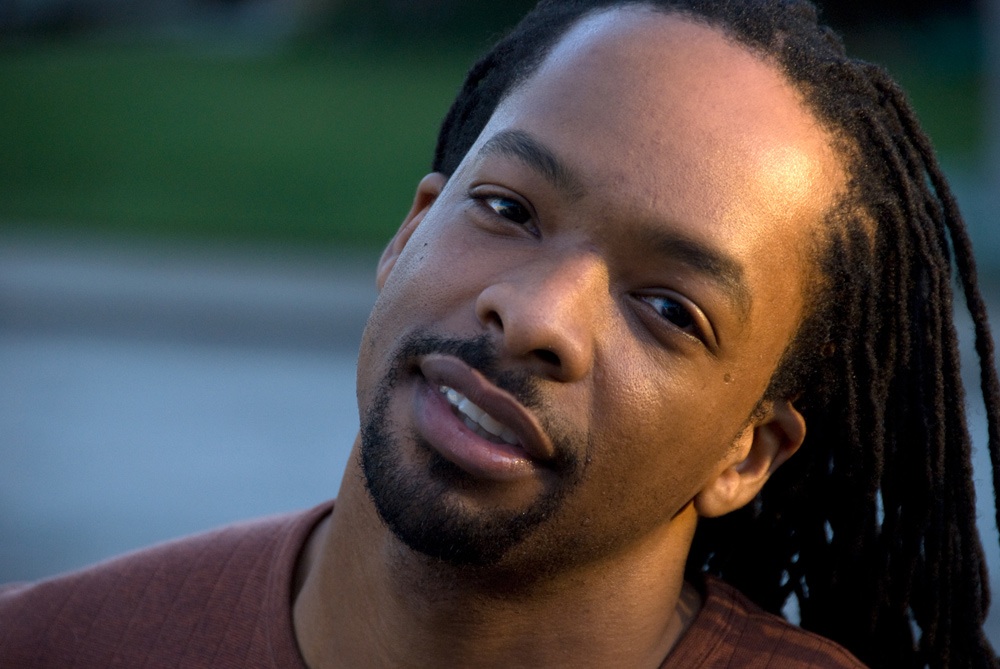
(From The New Testament © 2014 by Jericho Brown. Used by permission of Copper Canyon Press. Photo of Jericho Brown by John Lucas)

Anti-Drug Propaganda

Leonid Bershidsky warns of its dangers:

Perhaps propaganda is the most dangerous drug of all. The U.S. Congress appeared to understand the potentially corrosive effects back in the 1970s and 1980s, when it banned the dissemination on U.S. soil of government-funded media such as Voice of America, partly in an effort to prevent domestic propaganda (the ban is no longer in force). The no-holds-barred war of lies between the governments of Russia and Ukraine shows propaganda machines maintain their deadly effectiveness even today.

Governments’ power to influence public opinion should be restricted as tightly as the most dangerous drugs, and free media – where they still exist – need to pay special attention to how they relay government messages. Otherwise, when officials grow older and decide something was done wrong, their wisdom will fall on deaf ears.

Drug Czar Michael Botticelli recently stated that the marijuana legalization movement “sends the wrong message, particularly to the youth of our country.” But Jon Walker believes the real problem is the message sent by the government’s draconian drug policies:

To begin with there is the fact that the federal government keeps marijuana a schedule I drug, classifying it as having no accepted medical value despite significant evidence that it provides relief to patients with a range of conditions. By doing this the federal government is telling our young people that it is okay to completely disregard science if you don’t like the results. It also lets young people know their government doesn’t thinks relieving the suffering of the sick should be a priority.

The government also continues to spend billions of dollars and has arrested millions of Americans in our decades-long marijuana prohibition war, yet it has completely failed to stop marijuana from being widely used. From this young people learn the important lesson that you should never admit you made a mistake, no matter how expensive or destructive that mistake has been.

Give Millennials A Break

A new Pew study finds that the Internet hasn’t totally eroded the reading habits of Generation Y:

Millennials, like each generation that was young before them, tend to attract all kinds of ire from their elders for being superficial, self-obsessed, anti-intellectuals. But a study … from the Pew Research Center offers some vindication for the younger set. Millennials are reading more books than the over-30 crowd, Pew found in a survey of more than 6,000 Americans.

Some 88 percent of Americans younger than 30 said they read a book in the past year compared with 79 percent of those older than 30. At the same time, American readers’ relationship with public libraries is changing—with younger readers less likely to see public libraries as essential in their communities.

Meanwhile, Susan J. Matt, author of Homesickness: An American Historydefends the 22 percent of adults in their 20s and 30s who live with their parents. The idea that young adults should leave home, she argues, only took off in the 20th century:

By mid-century, experts were arguing that tightly bonded families were out of place in America. Sociologist W. Lloyd Warner explained that because the economy required individuals to move frequently, “families cannot be too closely attached to their kindred. . . or they will be held to one location, socially and economically maladapted.” Those who tried to maintain strong kin ties were criticized. In 1951, psychiatrist Edward Strecker, preoccupied with the Cold War and the need for a mobile fighting force, accused American mothers of keeping their “children enwombed psychologically,” failing to “untie the emotional apron string … which binds her children to her.” He dubbed these women the nation’s “gravest menace.”

Today, we continue to believe young adults should leave home. When they don’t, their living choices are chalked up to poor employment prospects. While economic realities surely play a part in their residential choices, the media give short shrift to other motives. The idea that families might be drawn together by feelings of affection is left out of the equation, as is the possibility that this generation wants to become something other than mobile individualists. Yet there’s considerable evidence that millennials hold values that center more on family and less on high powered careers. A recent poll found them far less concerned with financial success than the population at large. They also are closer to their parents, whom they fight with less, and talk with more than earlier generations.