The Confidence Gap

Grad student Rotem Ben-Shachar reflects on female attrition in the sciences:

The reason for the “leaky pipeline” is a combination of social, cultural, and psychological factorsbut they all contribute to a confidence gap that plagues female scientists, just as acutely as it plagues other professions. A recent survey of 193 graduate students in STEM fields at Duke showed that women consistently underestimate their abilities compared to men. In this study, Psychologist Lindsey Copeland found that 41 percent of men indicated that it is “definitely” true they have good technical skills (defined as the knowledge and abilities needed to accomplish mathematical, engineering, scientific, or computer-related duties), compared to only 11.5 percent of women.

I’ve noticed a similar distinction in the way men and women talk about their work. Men talk about how exciting their projects are; if they’re stuck on a project, they blame it on resources or lack of support from their advisor. Women talk about how they don’t know how to move on, the grant they didn’t get, how their results aren’t interesting. For men, the next step after graduating is obviously a postdoc. Women are already considering alternatives in case academia does not work out.

French In Translation

Claire Lundberg reviews William Alexander’s new book about the language:

I spent a lot of Flirting With French arguing with Alexander—pleading with him to just sign up for a class, for God’s sake. It’s no surprise to me—nor, probably, to you—that he doesn’t achieve fluency, and makes his greatest strides during a two-week Provence immersion class in the book’s final chapters. Studying French stresses out Alexander so much that he blames the language for his persistent heart arrhythmia. It was hard for me to relate to this Woody Allen level of neurosis: palpitations because you can’t remember when to use vous and when to use tu?

But perhaps I’m being unfair. French is scary, in part because of our stereotype of French people as haughty and rude—as David Sedaris puts it, in American films, “when someone makes a spectacular ass of himself, it’s always in a French restaurant, never a Japanese or Italian one.”

France also has, as Alexander reminds us, the venerable Académie française, an appointed body that has been meeting since the 17th century, whose purpose is to define and decide what exactly is and is not correct French. Most languages don’t have this kind of official governing body, and are free to grow dialects and adopt new slang without much fuss. However, in France there are official statements declaring common Anglicisms like le weekend and le shopping forbidden. It’s intimidating enough to cause occasional bouts of la panique.

Meanwhile, Hadley Freeman takes on the entire Francophile-lit genre:

After French Women Don’t Get Fat, French Women Don’t Get Facelifts, French Children Don’t Throw Food, Like a French Woman and French Women Are Just Better Than You So Shut Up About the War Already Because They’re Thinner and Sexier and We All Know What’s Really Important So Nyahhh!, yet another crucial addition to this delightful genre arrives called How To Be Parisian Wherever You are.

I’m afraid I haven’t read the whole thing due to a severe allergy to books that are predicated on national stereotypes so tired they would make the producers of ’Allo ’Allo! balk, but I did read an extract (hard-working journalist, me), and I can tell you, this book looks pretty spectacular. It was written, we are told, by “four stunning and accomplished French women … [who are] talented bohemian iconoclasts”. Coo! Stunning andiconoclastic? That is so Frrrrench, n’est-ce pas? So let’s see how this “iconoclastic” book shatters some French stereotypes. Well, we are told that French women “take their scooter to buy a baguette”. Take their scooter to buy a baguette? I’m sorry, is this a book about how to be French or a GCSE Tricolore text book? What next, “Monsieur Dupont habite à la Rochelle et il aime aller a la piscine”?

Is “Progress” Progressive?

9607555893_31107979d9_o

Jeremy Caradonna questions the value of “progress”:

Advocates of sustainability are not opposed to industrialization per se, and don’t seek a return to the Stone Age. But what they do oppose is the dubious narrative of progress… Along with Jean-Jacques Rousseau, they acknowledge the objective advancement of technology, but they don’t necessarily think that it has made us more virtuous, and they don’t assume that the key values of the Industrial Revolution are beyond reproach: social inequality for the sake of private wealth; economic growth at the expense of everything, including the integrity of the environment; and the assumption that mechanized newness is always a positive thing. Above all, sustainability-minded thinkers question whether the Industrial Revolution has jeopardized humankind’s ability to live happily and sustainably upon the Earth. Have the fossil-fueled good times put future generations at risk of returning to the same misery that industrialists were in such a rush to leave behind?

But what if we rethink the narrative of progress? What if we believe that the inventions in and after the Industrial Revolution have made some things better and some things worse? What if we adopt a more critical and skeptical attitude toward the values we’ve inherited from the past? Moreover, what if we write environmental factors back in to the story of progress? Suddenly, things begin to seem less rosy. Indeed, in many ways, the ecological crisis of the present day has roots in the Industrial Revolution.

(Photo of a Burning Man sculpture from the Flickr account of BLM Nevada)

The Dark Side Of Cop Cams

New York City Public Advocate Displays Police Wearable Cameras

Jacob Siegel worries about what happens to the footage:

Think of it like this: The police will have moved their evidence into a private warehouse staffed by private security guards and administrators. These private guards can see the boxes the evidence is stored in, how many and when they come in, but they’re not supposed to look inside. And instead of only keeping evidence related to criminal matters, this private warehouse is storing a bottomless pit of routine interactions between cops and citizens. Going 50 in a 35? Got stopped because you fit the description, but quickly released once the cops realized you weren’t the person they were looking for? There’s going to be a video of you in a private corporation’s digital records.

This isn’t abstract.

In Michael Brown’s case, outrage that the teenager’s fatal shooting wasn’t recorded was paired with a video released by Ferguson Police Chief Thomas Jackson, showing the teen appear to push a clerk and leave a store with a box of unpaid-for cigars. It shortly emerged that the officer who shot him had no knowledge of that earlier crime, and many accused the police chief of releasing the video to smear a dead man. The same massive evidence trove body cameras create can, if used selectively, humiliate and indict average citizens.

Also, Matt Taylor points out, cameras don’t always prevent police abuse:

Presumably, your average beat cop is less likely to go on a power trip and beat a vulnerable person senseless if he thinks he might have to explain the video to a grand jury afterward. But slapping cameras on police officers’ lapels is no panacea, and presents all sorts of tricky questions about privacy in this era of unchecked state surveillance. Besides, we know that, by way of example, cops in Albequerque, New Mexico, went ahead and killed a mentally ill homeless man on tape last year despite the officers’ cameras. Remember, Rodney King was beaten on tape (and so was Garner, for that matter)—for all the good it did him.

Previous Dish on cop cameras here.

(Photo: New York City Public Advocate Letitia James displays a video camera that police officers could wear on patrol during a press conference on August 21, 2014 in New York City.  By Andrew Burton/Getty Images)

What Do Smartwatches Mean For News?

Dan Shanoff wonders:

“Glance” is the name of the feature of the Apple Watch that let Watch-wearers skim through a series of not-quite-notifications. Maybe they are notifications, but only as a subset of a new class of ultra-brief news.

“Atomic unit” was a helpful metaphor, but we’re now talking about the proton/neutron level. Glance journalism makes tweets look like longform, typical news notifications (and even innovative atomized news apps) look like endless scroll, and [Zach] Seward’s list of essential Things (chart, gif, quote, stat) look unresponsive.

Face Of The Day

BAHRAIN-POLITICS-UNREST-DEMO

A Bahraini girl holds a placard during an anti-government protest in the village of Sitra, south of Manama, on September 12, 2014. “Ongoing violations of the rights to freedom of expression, peaceful assembly and association, and the targeting of human rights activists in Bahrain remain of serious concern,” Ravina Shamdasani, the spokeswoman for the office of the UN High Commissioner for Human Rights, said in a statement on September 5. By Mohammed Al-Shaikh/AFP/Getty Images.

Genes And IQ: An Update, Ctd

A reader quotes me:

“There’s not a huge debate about the heritability of IQ, but a huge amount of debate about how much intelligence can be tied to genes and how much to the environment.” You’ve been careful in the past not to let IQ stand as a proxy for intelligence, so I’m not sure why you absolutely conflate them here. Also, you have a false dichotomy here: genes and environment are not separate influences. Gene expression is mediated by the “environment”.

A well-known example of this is the desert locust, which has a solitary (grasshopper) and gregarious (locust) forms which were, at one time, thought to be different species. Which form develops depends on the social environment of the insect during its development (specifically, the gregarious form develops when its hind legs are often stimulated by other individuals due to crowding.) A particular pair of individuals, one solitary and one gregarious, may have exactly the same genome, but exhibit severe morphological differences upon full adulthood, and these differences are controlled entirely (or nearly entirely) by the genome.

And genomic expression is far more complicated than you make it sound.

There is rarely a straight gene-to-trait pathway of expression. A gene might regulate the expression of another gene, which turns off a separate gene and turns on two more, one of which slows down the expression of the first gene, another of which causes a side effect that … etc, etc. It’s a bewildering tangle of interactions that permeates the cell and well beyond. Do you think it’s possible to document the whole ecology of a rain forest: all of the interactions and feedback loops between plants, insects, animals, the air, the soil, bacteria, worms, sunlight, wind and weather, ocean currents, river sediment, etc, etc? Trying to find which genes affect intelligence is like trying to find particular Amazonian fish species that are responsible for global warming.

Another quotes the article I cited:

“A copy of each variant accounts for only 0.3 points on a standard IQ test (with a mean of 100 and standard deviation of 15).” With 126K points, the margin of error for something with a standard deviation of 15 and a 95% confidence interval (meaning that we’re 95% sure that this isn’t just chance) is about 2*15/355 = 0.085 IQ points, so at least the 0.3% looks to be statistically significant, although just barely, since the margin of error is more than 1/4 of the entire effect.  And the connection to IQ (as opposed to years of schooling) was based on a sample of 24,000, where the margin of error would be 2*15/155 = 0.2 IQ points, or nearly the entire effect.  So, I’m not sure whether these results are statistically significant – the algorithm for mapping the 126K data points of years of schooling through the 24K data points of IQ isn’t specified.

Worse, however, what they did is identify 6 variants that were associated with additional years of schooling.  If I told you that several of those variants were associated with Ashkenazy Jews, for example, I would have just found an expensive way of saying that Jews as a group spend more time in school than average.  Correlation really doesn’t equal causation.  My guess is that they found some genetic markers that are associated with some ethnic groups, and then “discovered” that those ethnic groups spend a little more time in school on average.

The author in the end says “We haven’t found nothing.”  But that’s most likely exactly what they found.

Another also scrutinizes the statistics:

I was rather surprised that you went there again:

What to make of this with respect to our cultural and political debate about genes and intelligence? For me, some relief that the area is so complex, and varied, and hard to decipher that we may have more time ahead before these things become more knowable, and thereby may avoid any of the worst social implications for longer than some of us feared.

As a scientist (albeit one completely unfamiliar with the field in question), a result that shows such a minuscule effect, well within the variance in the response of the system is equivalent to there being no effect at all. You should probably become more familiar with statistics but such a result essentially means that there is absolutely no correlation whatsoever between specific genetic markers and cognitive abilities. Such a small effect (an order of magnitude smaller than normal variance in IQ) is very likely the product of the random nature of the sample. Your statement seems to suggest that things are really complicated. They are not, at least when it comes to the conclusions of this study; there are no meaningful correlation between genetic variants and IQ.

Without knowing the literature at all, I am willing to bet that there are studies that find much larger correlations between socio-economic factors and IQ scores. Based on IQ scores of whites vs other groups, I am willing to say that such effects are perhaps an order of magnitude larger than the effects in this study.

Let it go (to quote from Frozen) ...

Everybody’s Working On The Weekend

8eff39f04

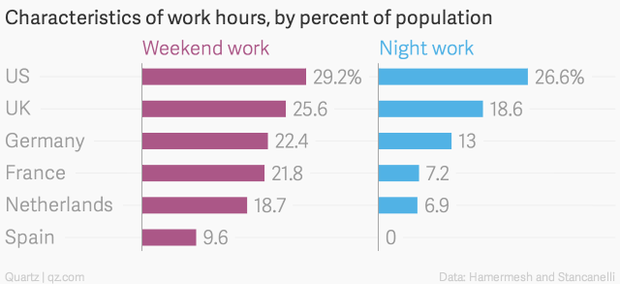
Looking at a new NBER study, Christopher Ingraham counts the ways Americans are overworked compared to our European peers. For one thing, we’re more likely to take that business call on a Saturday:

The U.S. has the highest incidence of people reporting any paid weekend work. 29 percent of Americans reported performing such work in the American Time Use Survey, more than three times the rate among Spanish workers. It’s important to note that this doesn’t necessarily mean that these workers are working 9 to 5 every weekend, only that they reported performing paid weekend work in a time use survey. This would include things like going into the office for a few hours to finish up a project.

The study showed that Americans are also more likely to work nights. Max Nisen notes the obvious origins of our weird work hours:

These strange work hours probably happen because Americans work so much and lack the enforced vacations and limitations on overtime that exist in some European countries. Nearly twice as many U.S. workers work 45+ hour weeks than in Germany, and more than twice as many do so than workers in France, the Netherlands, and Spain. As the work week grows longer, weekend and “strange” work becomes much more likely.This stands to reason: Someone moving from a comparatively standard week of 35 to 44 hours to a 55- to 64-hour week is almost twice as likely to let that work bleed into weekends and nights, according to the study. …

So what would happen to the U.S. if it adopted similar controls? According to the study, if the country adopted the French distribution of work hours, night and weekend work would drop substantially, but would still remain well above that of continental Europe.

Jordan Weissmann considers other explanations:

[T]he sheer time we spend working doesn’t explain why so many of us find ourselves staring into a glowing Outlook screen at 12:43 a.m. on a Wednesday. Even if Americans worked the same amount of time as the French, Dutch, or British, Hamermesh and Stancanelli find that we’d still be more likely to stay up late tooling around with Excel, reading memos, or doing whatever else it is that keeps us up at ungodly hours. It might be a cultural issue. It might be because we have fewer laws governing when people can and can’t be on the clock. Though it feels unlikely, there might even be a happy story here about enlightened American companies allowing their employees to use flexible schedules to accommodate their personal needs. Whatever the reasons, Americans  structure their workweeks differently than Europeans. We’re night owls and weekend MS Office warriors—which, in the eyes of the rest of the world, probably looks pretty nuts.

How Do You Solve A Problem Like ISIS?

A military approach alone won’t do the trick, Zack Beauchamp argues, emphasizing the extent to which Obama’s strategy depends on political factors largely outside his control:

Even assuming the Iraqi and Syrian rebel forces can be made strong enough to take on ISIS in purely military terms, there’s a list of everything that needs go right — politically — for Obama’s strategy to work out:

  1. The Iraqi government needs to stop repressing and systematically disenfranchising Sunnis. It also needs to accommodate their demands for positions of power in government in perpetuity, so ISIS doesn’t just pop back up after the US leaves.
  2. The US must avoid sending the signal that it’s coordinating with Iran, which would put it on the Shia side of a sectarian war.
  3. Syrian rebels armed and trained by the US don’t simply take their new weapons and defect to ISIS or Jabhat al-Nusra, the local al-Qaeda affiliate.
  4. US airstrikes and US allied military campaigns need to avoid killing large numbers of civilians, which could cause a pro-ISIS popular backlash.
  5. If the US actually does manage to demolish ISIS’s control on territory, it needs to ensure that neither Syrian President Bashar al-Assad nor al-Qaeda simply take over the land that ISIS has vacated.
  6. The United States has to do all of this without deploying ground troops or otherwise getting caught in a bloody, brutal quagmire.

For the outcome to end well, every single one of these events must go the right way. There’s a reason that one US General told the Washington Post that the new campaign in Syria is “harder than anything we’ve tried to do thus far in Iraq or Afghanistan.” Given how those wars ended up, that’s a pretty ominous comparison.

Deborah Avant also considers ISIS a fundamentally political challenge:

The US has done better at managing crises to roll back attacks in the Middle East. It has not been as successful translating these short-run gains into positive steps toward inclusive governance. Furthermore, US anointment in Iraq and Afghanistan has led to leaders with little legitimacy and little attention to US concerns. The last thing the US wants to do is to intervene in a way that pushes the various anti-government rebels in Iraq (and/or Syria) together with ISIS against perceived US puppets. Though less may not be enough, I agree with Joshua Rovner that less is more when it comes to US presence in the Middle East. A broad strategy involving many others is a good idea. Doing that under the mantle of an American coalition is not. A plan with the US in a supporting, background role has best chance for long run success.

Beyond that, however, what will the US and its allies do about the malaise upon which al-Baghdadi and others have been able to capitalize? … Messages about global citizenship, human security, and an inclusive global politics seemed to evince more hope in the 1990s – perhaps for good reason. The shreds of a hopeful message visible in parts of the Arab Spring have blown into hiding. The US talks more about how to combat extremism than about what might replace it.  Though some audiences in the US believe that America holds the keys to the future, many across the world do not.