#WhyIStayed, Ctd

The reactions to the Ray Rice story continue to roll in. CBS Sportscaster James Brown speaks out:

Amanda Marcotte rejects lines of commentary that suggest Ray Rice is a victim:

Because of this vast gulf in male and female experiences of domestic violence, unsurprisingly the impact also varies dramatically. On Tuesday, Catherine Cloutier of the Boston Globe published an examination of how much more seriously women’s lives are impacted by intimate partner violence. The CDC surveyed around 14,000 people to determine the impact of domestic violence on their lives. Men and women were somewhat similar in rates of having endured some kind of assault, at 27.5 percent for men and 29.7 percent for women.

But looking beyond counting individual touches, a different picture emerges. Twenty-four percent of female victims report feeling fearful, compared to 7 percent of men. One in five female victims suffer from PTSD symptoms, whereas only 1 in 20 male victims do. Only 3 percent of male victims suffer physical injury, but over 13 percent of female victims do. Twice as many female victims as male victims missed work because of domestic violence.

The disparity is likely the result of male abuse simply being way more violent and chronic than female abuse. Asking people if they’ve been hit once is relevant, of course, but in measuring the realities of domestic violence, the more important question is if you’re being hit frequently, being terrorized by violence on a regular basis, being stalked and controlled, or being threatened with your life if you try to leave.

Yes, no one should hit anyone else. But that statement is the beginning of the conversation about the problem of domestic violence, not the end of it.

And the Dish is channeling that conversation here. Josh Levin wants the NFL’s other abusers to held accountable:

The best analogy here is to the awful scourge of sexual assault on college campuses. In addition to going to local police, a student can have her complaint heard through a campus adjudication procedure, one that uses “the preponderance of evidence” as a standard of proof rather than a “beyond a reasonable doubt” standard. (As Emily Bazelon has explained, preponderance of the evidence means “reviewers must find only that it’s more likely than not that the sexual assault or harassment occurred.”) There are problems with these campus systems—the New York Times story on Hobart and William Smith Colleges offers a harrowing account of all that can go wrong—but at least they acknowledge the existence of something akin to institutional responsibility.

At least before TMZ released the Rice video, such a concept did not exist in the NFL. Teams have long operated on the assumption that they could say they’re “aware of the situation,” and then just pretend like nothing happened as soon as the news blew over. At some point, individual teams may decide that it makes sense for them to move to a preponderance-of-evidence standard—to decide that it’s in their best interest to cut a player if it’s more likely than not that he’s a domestic abuser. I don’t know if we’ve reached that point yet, but the Rice video has gotten us closer to that day. Seeing a sports star clock his fiancée in the face has changed something—for fans, for the media, and ultimately, I think, for the teams. If it doesn’t, then the NFL’s problem with domestic violence runs even deeper than we thought.

Alyssa Rosenberg finds wanting NFL Commissioner Goodell’s standard operating procedure:

When it becomes impossible to deny that bad news utterly, his task then becomes to respond in a way that has minimal impact on the NFL’s finances and on the week-by-week play on the field. As long as Goodell is willing to accept the public perception that he is dishonest or in denial, absorbing the damage on behalf of the league, I suppose it is a viable approach to protecting “the integrity of the NFL.” But no matter how much pain Goodell is willing to accept, this is a way of operating that leaves his league a little more battered with every incident. In life, unlike on the gridiron, sometimes it is better to take the hit and move expeditiously to heal from the damage.

Robert Silverman thinks the NFL needs more women:

If the league actually wants to solve the problem, instead of treating it as a particularly thorny public relations issue; if the league had a vested interest in trying to win back a semblance of trust from the 46 percent of their fan base that happens to be female and the unknown percentage of men who are equally repulsed? Here’s one solution: Hire more women and place them in positions of real power.

New Russia Sanctions: A Salvo In The Energy War?

The US imposed additional sanctions on Russia’s finance, energy, and defense sectors today over its involvement in the Ukraine crisis, on the heels of another round of sanctions from the EU:

The U.S. Treasury Department tightened on September 12 debt-financing restrictions for sanctioned banks from 90 days to 30 days. And it added Sberbank, Russia’s largest financial institution, to the list of state banks subject to the restriction.  It also prohibited the exporting of goods, services, and technology for Russian deepwater or offshore projects for five Russian firms: natural gas monopoly Gazprom Gazprom, its oil unit Gazprom Neft, Lukoil, Surgutneftgas, and Russia’s largest oil producer, Rosneft. Gazprom Neft and pipeline operator Transneft also have new debt restrictions of over 90 days’ maturity. … The European Union’s new sanctions include asset freezes on 24 senior officials and lawmakers, including nationalist firebrand Vladimir Zhirinosvky, bringing to 119 the number of people sanctioned by the bloc over the Ukraine conflict. The measures also include restrictions on financing for some state-controlled Russian companies such as Rosneft, Transneft, and Gazprom Neft.

Noting that the sanctions on Rosneft might freeze a $500 billion joint project with ExxonMobil to drill for oil in the arctic, Matthew Philips comments that “these latest energy sanctions could sever what are arguably the closest ties remaining between Russia and the West”:

In the two decades since the Cold War ended, Russian and American astronauts have worked together on the International Space Station, and the Russian military has helped the U.S. get equipment in and out of Afghanistan. But the strongest area of cooperation has come in the energy industry, where U.S. oil majors such as Exxon and Chevron(CVX) have entered into a number of joint ventures with Russia’s state-controlled energy giants Rosneft and Gazprom (GAZP:RM).

The Bloomberg View editors also tie the EU sanctions to the energy war:

Putin may have himself to blame for tipping the EU’s internal debate against him. By reducing natural gas deliveries to Poland and Slovakia this week, Russia made it clear that it still plans to escalate its effort to turn Ukraine into a failed state. Russia’s state gas company OAO Gazprom has cited maintenance work as the cause of the stoppages. That’s hard to believe. Poland and Slovakia happen to be the two countries that are reversing pipeline flows to pump natural gas from the EU into Ukraine, which Russia cut off from supply in June. The goal was to ensure that Poland doesn’t have enough gas to sell to Ukraine — which is exactly what happened. Slovakia has been warned.

Keith Johnson sees the Kremlin’s latest moves as an escalation in the gas war:

It’s not entirely clear whether the sudden drop in Russian gas exports to those countries is politically motivated or if there is a technical reason, such as maintenance on the Russian gas system or the pipelines themselves. Gazprom said that shipments to both countries remain unchanged. In any event, Polish officials said they have been assured by Russia that gas volumes will return to normal on Friday.

But Russian President Vladimir Putin made clear earlier this year that Moscow would aggressively go after countries that buy Russian gas and then turn around and ship it to Ukraine. That kind of energy trade, known as “reverse flow” because most of the gas pipelines pump fuel from east to west, has long incensed Gazprom and the Kremlin, which charge different countries different prices for gas and which rely on energy exports to maintain leverage over former client states in Central and Eastern Europe.

But Bershidsky calls sanctions on Russia a lose-lose proposition, particularly for Europe:

In this race to the bottom, Russia may prove the more resilient, if only because Putin’s authoritarian regime has a mandate from a majority of Russians to wage a new cold war. The food embargo and the price increases it caused in Russia did not drive down Putin’s approval ratings, and Russians have stoically accepted the ruble’s recent losses against the dollar. The currency depreciation can also help the government weather low raw materials prices by boosting the value of foreign-currency exports in ruble terms.

Europe, on the other hand, cannot take much more economic pain. A new slump could send some governments tumbling. In France, 62 percent of the population already wants President Francois Hollande to resign. The world is too interconnected economically, and the European recovery too fragile, to keep using trade disruptions as weapons. Even Ukraine is taking a hit from slumping metals prices: Steel and iron ore account for about a third of its exports.

This Is How Homophobia Ends

The relatively quiet, undemonstrative and yet decisive moment to allow self-identified gays to march in New York’s Saint Patrick’s Day parade is an almost text-book case of how homophobia can be undermined. There was mercifully no coercion – freedom of association is a critical principle for a free society. There was growing social pressure – from ordinary folk, organized gays, and, more critically, boycotts by New York politicians. No one is jumping up and down rubbing this quiet victory in. Yes, it took years of protest and anguish and anger to get here – and all the while, homophobia ran rampant. Cardinal Dolan has decided to remain the Grand Marshall of the parade, even with an explicitly gay group in its ranks – a remarkable turn-around from the past. The decision was a pragmatic one:

Dolan said Wednesday that the parade committee that operates the annual event “continues to have my confidence and support.” “Neither my predecessors as archbishop of New York nor I have ever determined who would or would not march in this parade … but have always appreciated the cooperation of parade organizers in keeping the parade close to its Catholic heritage,” he continued. Dolan concluded by praying “that the parade would continue to be a source of unity for all of us.”

Is that a sign that the Francis effect – downplaying the divisiveness of the issue in the Church – or just a sign that the society has evolved to a point where exclusion of gays seemed to counter “unity”?

My bet is that the threat of Guinness boycotting the parade was the final straw. The decision by the march’s organizers to include one gay group was unanimous. Bill Donohue is livid, of course. But even Donohue was reduced to merely arguing that a pro-life group be explicitly included in the parade alongside the gays – and when that didn’t transpire, he threw a tantrum and his organization – presumably him and his fax machine – will not be gracing the parade with its presence.

Too bad. He’s part of the New York Irish community and he belongs there as well. And what you see here, I suspect, is simply another reflection of greater informality in many religious groups and congregations, in favoring more inclusion without explicit rejections of orthodoxy. Michael Paulson has an interesting take on that development in American religion, especially with respect to gays and lesbians:

In the new results, 48 percent of congregations allow openly gay people in committed relationships to be members, up from 37 percent since the second study in 2006, and 27 percent of congregations allow them to serve as volunteer leaders, up from 18 percent.

Alas, Catholics are going backward – because inclusion was easier when gay couples couldn’t get married in a civil ceremony (creating a bizarre discrimination against those gays who have committed to one another for life). But the society moves on – as do congregations, as do public events.

Know change. And it may well come not with a bang, but a whimper.

Back From The Desert, Ctd

shirts111

This week we have aired various opinions from readers on the fantastic month of guest-blogging. Or how one puts it:

Unbelievably awesome viewpoints and people, even when I don’t agree. So well written. I am reading all of their stuff! In years past, I maybe skipped when Andrew went on vacation. Stupid me.

Another reader:

I have vastly enjoyed this rotation of guest bloggers. From the feminist libertarians to socialist Freddie, I have thoroughly enjoyed the quality of writing, the coherent world views (as opposed to reactionary bluthering), and diversity of opinion. I love disagreeing with such well-articulated philosophies. This is a fabulous place for great ideas and conversations. Much appreciated.

Another:

Can Andrew stay in Ptown another month?  Between DeBoer and Shepp and whoever “Dish Staff” may be, I see more of an emphasis on hard thought-provoking news instead of beards, male body hair, and dogs.

Another differs:

Ive followed you for years, through various iterations of your online presence, initially driven by getting your reaction to whatever was going on in the world. I eventually made the Dish a daily stop and started to appreciate the non-topical posts. It was fun getting to know someone more personally who I had admired for years.  I liked the fact that there was no public comments area, but that reader responses were often posted and engaged.  Maybe we risked getting a little too insular at times with recurring jokes and the development of some jargon, but I think it was still a welcoming online environment.

I’ve been on board with the move to independence and hiring staff from the beginning, but the blog has developed into more of an e-zine than a personal blog. This is accentuated, of course, with you on vacation. I guess all of this is to say, I like it, but this is not what I came here for.

Maybe it’s inevitable, as your site evolves, your audience will too.  Some like me may become less engaged, but you may add more new readers in the process.  But while there’s a lot of interesting content to be found on the web, mostly for free, there’s only one Andrew.

More feedback:

I am so sad to see Sue Halpern and Bill McKibben’s guest stint come to an end. I enjoyed their humane, sane, engaging, and thoughtful posts.  In particular, I’m grateful for McKibben’s posts about the golden age of radio. I have since listened to several of the podcasts/shows at Radiotopia and will certainly listen to many more – what a trove! I probably would not have come across it without his Dish post, so thank you. I also appreciated the posts on climate change and wish I could be in NY to join the protest. The variety, range, and quality of all the guest bloggers’ posts has made it a particularly stimulating month at the Dish. I especially loved Matthew Sitman’s “Reading Your Way Through Life” thread, as well as his post on Reinhold Niebuhr; and I appreciated everything posted by Freddie deBoer.

In the past, I’ve found myself checking the Dish less often (though still regularly) during Andrew’s vacations. But the opposite has been true these past few weeks. The Dish has served up quite a feast in his absence. Thanks again!

And props to another young blogger:

I really enjoyed Jonah’s post on expatriates – it caught my attention like nothing else has today. I don’t really have anything to contribute, personally, but I wanted to compliment his writing and perspective. I look forward to follow-up posts on different people’s experiences on a fascinating subject.

Read those here. Another reader:

I just wanted to voice my happiness with the content Elizabeth and Phoebe have provided thus far. I’ve really enjoyed reading their perspective on family leave, affirmative consent, and female sexuality. The Dish has always covered gender issues more than many people are aware, but it’s nice to get some more in depth editorial comment on those topics.

Another:

The stories that were commonplace in my other online spaces (Facebook, feminist blogs, women writers groups) were suddenly appearing on The Dish (and it made me realize I hadn’t seen as many of them before). Now, one of the reasons I come to The Dish is for stories I don’t find elsewhere. So it’s not like I need to see these stories of interest to women in yet another place. But. Their inclusion made me feel more like I belong here. And more importantly, for the majority of your readers, who I know are men, I’m glad they are seeing stories that focus on issues important to women.

Another adds, “I love Andrew, but the feminine energy these two ladies brought to the Dish was a refreshing change of pace.” As another puts it:

Nice to have a heterosexual female perspective from Phoebe with some splash of fashion!  Certainly rounds out all the talk of back hair.

But another woman dissents:

I’d like to respectfully disagree with the reader who wrote that he/she would miss Elizabeth Nolan Brown and Phoebe Maltz Bovy. I will not. Their posts struck me as the kind of unfocused, rambling conversations that my friends and I have. Nice and all, but rarely leading to new information or thoughts; these are “sharing” kind of conversations about our own experiences. I read The Dish because there is a lot of detailed information and sharp analysis/perspectives. Yes, the Dish turned into a sort of Jezebel, but for that I can go to Jezebel.

Another reader:

I’ve put off subscribing for far too long. I always had some excuse, usually “the internet should be free” which is obviously a cop out. In any case, the tipping point came last week and this, when you’ve let others like Elizabeth Nolan Brown and my personal friend Freddie deBoer guest-post. How can I not endorse a blog like yours, that has regularly featured other voices that ardently dissent to your own opinion? How can I not support a website that has on five different occasions featured my emailed comments?

I very often disagree with you. For example your reactionary stance on circumcision makes me roll my eyes every time you bring it up. And honestly I don’t care whether your blog’s economic model will work for others online. But the bottom line for me is that I want you to keep doing what you are doing, and by subscribing I can help you with that.

Another has a different line of reasoning:

I am laughing at myself as I write this – but here’s why I just became a brand new subscriber to the Dish: your guest bloggers are annoying! Sometimes the content is annoying, and sometimes it’s just that they expend an absurd amount of verbiage to make very simplistic points: droning on about Buzzfeed, say, in a treatise whose length you would devote only to a very thoughtful meditation on an important world event. I now fully appreciate how rare your talent and keen insight is, because it’s been made painfully evident by its absence this month. If this was a clever marketing scheme, well played.

One more:

I’m sure these emails get vetted by staff, which is good because this isn’t directed to Andrew anyway. I just wanted y’all to know that I am very much looking forward to Andrew’s hiatus. Of course I am a big fan of his, or I wouldn’t be a subscriber. But last year when he was on vacation I enjoyed the fresh takes on the topics and the change in “voice”. For what it’s worth, I believe the regular introduction of guest bloggers – even when Andrew is around – will only improve the Dish. So keep up the good work.

The Rebirth Of Political Correctness, Ctd

Nick Gillespie reacts to some freedom-of-speech controversies on campus:

A student publication at the university [of Western Ontario], The Gazette, published an irreverent special issue for incoming freshmen. Among the articles was a clearly satirical piece titled, “So you want to date a teaching assistant?” It included such tips as, “Do your research. Facebook stalk and get to know your TA. Drop in on his or her tutorials, and if you’re not in that class — make it happen…. Ask your own smart questions, answer others’ dumb questions, and make yourself known in the class. Better yet, stand out as a pupil of interest.” …

The piece immediately set off “a furor,” with the union representing T.A.s calling for the piece to be taken down for promoting sexual harassment and the university provost publicly castigating the paper for being “disrespectful.” The offending material was quickly pulled off from the paper’s website and the editors wrote a groveling, ritualistic apology, promising to report “on these issues in a more serious manner in the future.”

Gillespie fears the educational implications of such incidents:

We’re told that college is an absolute necessity in today’s advanced society. Higher education alone can cultivate the critical thinking skills and independence of thought that drives not just economic innovation but social progress too. Yet over the past 30 or so years, college has become an irony-free zone, one in which every utterance is subjected to withering cross-examinations for any possibility of offense across a multitude of race, class, gender and other dimensions.

Previous Dish on the subject here.

The Syrian Quagmire

SYRIA-CONFLICT

Douthat considers Obama’s case for war in Syria specifically and finds it lacking:

Writing in support of our initial northern Iraqi intervention, I argued that it passed tests that other Middle Eastern interventions, real and hypothetical, did not: There was a strong moral case for war and a clear near-term military objective and a tested ally to support and a plausible strategic vision (maintaining Kurdistan as a viable, American-friendly enclave, while possibly giving the government in Baghdad an incentive to get its act together) for what such an intervention could accomplish.

Based on what we’ve heard from the president, an expansion of the war to Syria does not pass enough of those tests to seem obviously wise or necessary or likely to succeed. We have no Kurd-like military partner in that country and we’re relying on Saudi training(!) to basically invent one, there isn’t even the semblance of a legitimate central government, and the actor most likely to profit from U.S. airstrikes is an Iranian-aligned dictator who makes Maliki look like Cincinnatus.

Josh Rogin sympathizes with the Free Syrian Army, whose leaders say that if the US provides them with arms, they will use them to fight Assad as well as ISIS:

[T]he Syrian opposition and the Free Syrian Army aren’t waiting for legal authorization to fight the Damascus regime; they are getting bombarded by Assad’s Syrian Arab Army every day, as it continues to commit mass murder of Syrian civilians through the siege of major cities, the dropping of barrel bombs, and the continued use of chlorine gas to kill innocents, according to international monitors. “The fight against ISIS is one part of a multi-front war in Syria. The brutal rule and poor governance of the Assad regime generated the conditions for ISIS become the global threat that it is today,” Syrian National Coalition President Hadi AlBahra told The Daily Beast on Thursday.

But Allahpundit thinks its crazy to expect the FSA to prevail, even with American backing:

Some dissenting U.S. analysts think there are moderates still in Syria we can work with but good luck picking them out of the gigantic crowd of Sunnis currently fighting Assad. For the sake of my own sanity, I need to assume that this whole “training the moderates” thing is just a big ruse being cooked up by the Pentagon as a pretext for inserting more reliable Sunni forces into the fray in Syria against ISIS. The Saudis have already offered to host the “training”; presumably, a whole bunch of the “Syrians” who end up being sent back onto the battlefield are going to be Saudi, Iraqi, and Jordanian regulars with U.S. special forces support. They could hit ISIS where it lives while posing as locals so as to spare their governments the political headache involved in sending their troops into the Syrian maelstrom. (They’d also suddenly be well positioned to threaten their other enemy, Assad.) If I’m wrong about that and we really are depending upon Syrian non-jihadis to somehow overrun ISIS in the east, hoo boy.

Jessica Schulberg points out that Washington has already been arming the Syrian rebels for a year, albeit covertly:

Obama’s decision to shift the Syrian training operation from the CIA to the Defense Department could also indicate that he sees a longer-term role for U.S. advisers in Syria than he did previously. The CIA’s advantage is that it is capable of carrying out small operations quickly, unencumbered by traditional bureaucratic restraints. The Defense Department, by contrast, requires authorization but is more capable of training a large, conventional fighting force. In this case, however, the $500 million Obama has requested from Congress for the Syrian opposition will likely prove inadequate. The U.S. has already spent over $2 billion in Syria, with little effect. It took more than $2 trillion of U.S. spending in Iraq to restore some semblance of a centralized government and military.

Juan Cole suspects that geopolitical considerations are at play here:

[I]n Iraq the outside great powers are on the same page. But in Syria, the Obama administration is setting up a future proxy war between itself and Russia once ISIL is defeated (if it can be), not so dissimilar from the Reagan proxy war in Afghanistan, which helped created al-Qaeda and led indirectly to the 9/11 attacks on the US. Obama had earlier argued against arming Syrian factions. My guess is that Saudi Arabia and other US allies in the region made tangible backing for the Free Syrian Army on Obama’s part a quid pro quo for joining in the fight against ISIL.

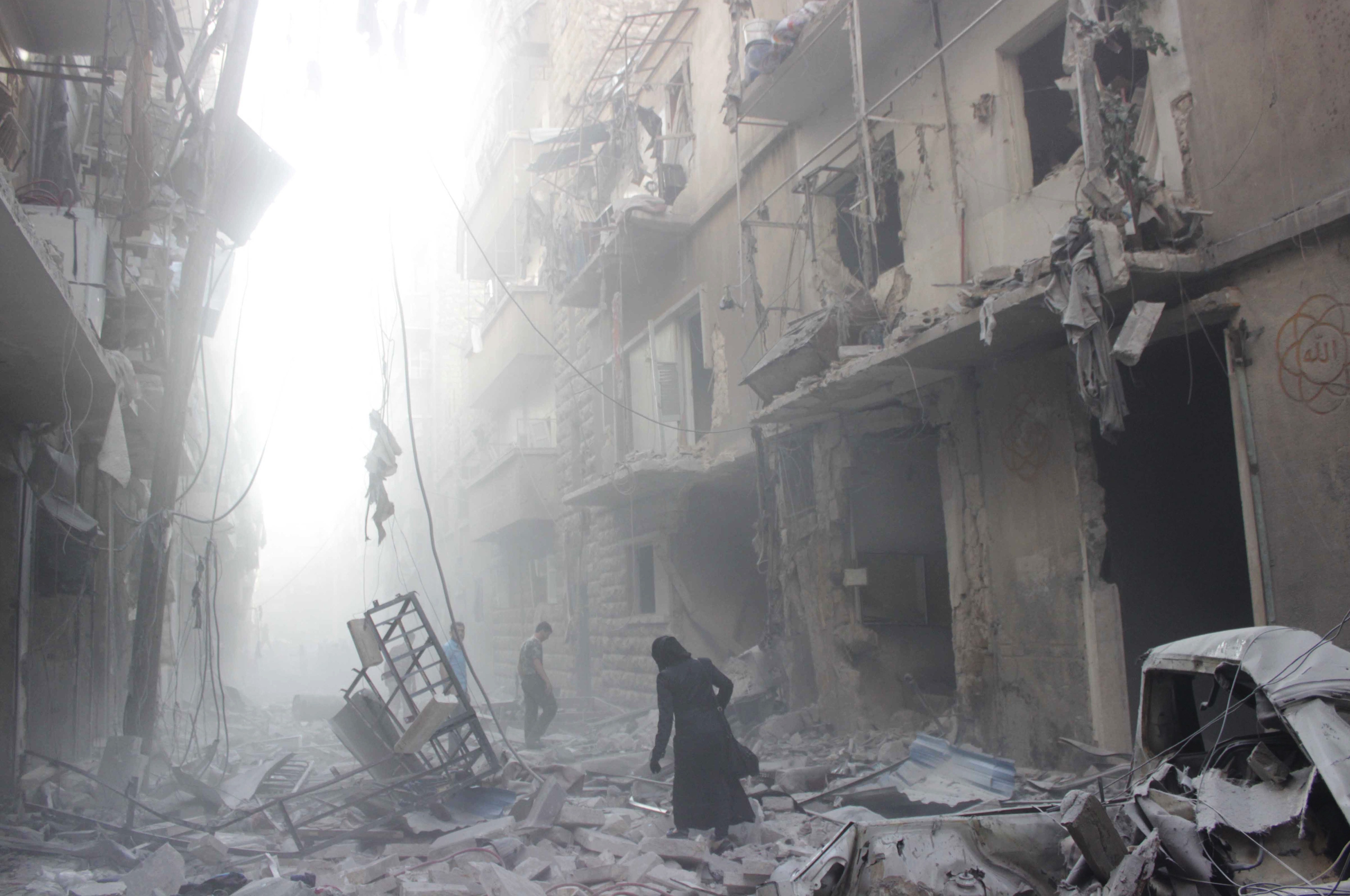
(Photo: A Syrian woman makes her way through debris following a air strike by government forces in the northern city of Aleppo on July 15, 2014. By Karam Al-Masri/AFP/Getty Images.)

Writing Tip: Don’t Write, Ctd

A reader responds to a recent post:

Don’t Write – the best tip that’s going round these days for inspiring authors. I agree with this advice for no other reason than it makes me feel better about my own writing. I completed a manuscript a little over a year ago and have been slowly refining it. I can go months without writing a single word and then suddenly out the blue I get inspired and write dialogue in my journal or an idea on a sticky pad. If I’m truly inspired I get out three to five pages worth of world building.

I do think about writing while washing dishes, taking a shower, folding the laundry.

When doing so I consider plot twist and turns, whether or not I should introduce a new character for the protagonist to contend with, or should I change the sex of a central character because it may work better with the overall theme of the story. Usually I don’t save my idea. I have to mull it all over for a while, taking the risk that I might forget.

Hayes’ guidance is liberating for a writer like me, where being a writer is more than actually writing. For me it is a process of thinking and then doing. Has it made me a better writer? I don’t know.  I don’t write novels for a living so there’s not a way for me to measure if I am improving. In my current profession I do technical writing and follow this same process with few to no complaints. But until I’ve finished revising my manuscript and get published I won’t know if my style of writing makes me a good writer worth reading. I do know that if I’m successful my style will be the one to recommend. I’ll be sure to give a shout out to Bill Hayes.

Still to just “Don’t Write” instead of growing frustrated with forced and unforced breaks is good advice to take. Writers block can build inspiration and momentum to slog it out to the end. To feel good about my writing I have to spend time away from the keyboard and journal. I have to be curious about the things that are happening around me so that my stories are told authentically and with empathy for the characters I develop.

I’ll only add one thing to the Writing Tip: Don’t Write, Live.

Andrew Asks Anything: Christian Wiman On Poetry And Faith

I was on break when Matt Sitman’s Deep Dish essay on Christian Wiman and the need to find new language for Christianity in modernity appeared. If you read the essay, you’ll see why Matt is such an integral part of the Dish team, both in terms of the depth of his reading, the elegance of his writing, and the miracle of his enduring faith. Matt and I also had a chance to sit down with Wiman and talk to him about what it really means to be an intelligent, modern person who is also a non-fundamentalist Christian.

Here’s a segment from our conversation when Wiman talks about his descent into unbelief, around his cancer diagnosis, and how he found a way forward through writing poetry that surprised him with its lingering hope. He rejects – as I do – any clear dividing line between belief and unbelief, believing that they both form a process in which belief can be transformed into something more real, and honest:


Dish subscribers can listen to the full podcast here. If you still need to subscribe, here’s the link. Matt’s Deep Dish essay on Wiman is here. A reader loved it:

I’m just writing to give a big thank you to Matt, Andrew, and Christian Wiman for the wonderful conversation, and an special thank you to Matt for his insightful, illuminating essay on Chris’s work. (I feel like I can use that rather intimate name after listening to the conversation this morning). I have long loved Chris’s work and enjoyed listening to him on the Poetry Foundation podcasts for years. What a joy (I use that word reservedly, but it is appropriate here) to hear him discuss his own work, as well as his faith.

As someone who was not raised in any religious tradition, it is a long, confusing, and often lonely path towards finding some way to acknowledge/accommodate/celebrate my strange knowing that God exists, that we are all somehow held by God. As you all acknowledged in your conversation, finding people who feel the same way, or similarly, so helps to ease that loneliness. I felt in communion with all three of you this morning as I walked through my neighborhood with my earbuds in, smiling at your jokes, nodding at so many of your observations. I didn’t feel lonely.

Abuse In The Public Eye, Ctd

A reader expands on this update and then some:

While I will not dispute that men can and are abused too, 85% of domestic violence victims are women, and women are most likely to be murdered by an intimate partner. On the specifics of the Rice situation, an examination of the tape with audio clearly shows that he spit on her, she reaches out to strike him (punch would be a stretch), they go into the elevator, he spits at her again, she lashes out back at him, he strikes her face, she strikes back and then he delivers the knock-out punch. I don’t know about you, but I don’t take kindly to being spit upon, especially by my fiancee. Clearly none of her attempts at striking him even landed and he connected with her head twice.

Yes, the video does indicate to me that there was previous violence and disrespectful action in their relationship.  But no sir, this is not a case of a man being abused and then finally saying enough and striking back. Also too, Ray Rice is maybe 5’7″ 205 and a trained boxer (oh, and plays the 2nd or 3rd most violent sport in the world), so there’s the small issue of strength and the dis-proportionality of response.

But hey, what do I know? I’m just a woman who grew up with domestic violence and has been abused myself. Your male writer may have a reason to be sensitive to male DV, but this ain’t that.

Another takes a different angle:

Please be courageous enough to explain to people that although we may be justified in showing moral outrage in the Ray Rice situation, there are still laws, and unless women educate themselves on laws, they will never be fully protected by them.

First, there is a notion out there that says provocation doesn’t exist. Sorry, it does.

It clearly exists with all laws, as provocation is the basis for any self-defense argument. Socially and morally we have double standards that benefit women, but there are no such double standards written in laws that allow women or people who are smaller to get away with something that their opposites cannot. Universal legal standard is if someone, no matter gender or size, attacks you (provocation), you have the right to respond with equal or lesser force (self defense).

Secondly, if we ignore all of what Janay did and just focus on Ray Rice’s action, he may have attacked her, but he also backed away. The moment where he retreated and then she charged him effectively made it impossible for the DA to prosecute him, hence her being arrested that night as well. Mutual combat. He retreated, she re-engaged him, menacing at that, and with further irony if his lawyer was good/shiesty enough he could argue he was defending himself.

#WhyIStayed is great. But unless women have a #WhyILearnedThe Law, the law will never be on their side.

But another underscores an essential point:

Proportionality matters.  If you are a muscle-bound, 210-pound man, you don’t punch someone half your size.  Ray Rice barely flinches when she touches him outside the elevator; he shrugs off her elbow (and looks like he slaps her). Meanwhile, Janay fell like a slow-motion rag doll.  It was horrifying – I’m surprised she didn’t get a severe neck injury from catching the hand rail on the way down.

That’s not self defense.  The only time it’s OK for a 210-pound guy to throw a left hook at a woman is if the woman in question is Ronda Rousey and you’re both in a cage match in a dystopian Hunger Games future.

And look at Ray Rice after he hits her.  He isn’t on his knees, trying to bring her to, and in disbelief of his own actions.  He’s trying to toss her dead weight out of the elevator.  Based on his actions alone, I’d be shocked if this was the first time he hit her.

Start talking about reality, your reader says?  Start talking about common sense.  You don’t hit someone unless there is no other option for your self defense.  Know your own strength. Don’t escalate a situation by getting in someone’s face.

Or as another puts it:

For your reader’s benefit, here’s one surprising trick men can use to protect themselves from physical abuse: Walk away. That’s all Ray Rice would have needed to do. Walk away. Don’t get on the elevator. Be a man.

More emails to come. Follow the entire thread here.