Haters Be Calling This War A “War”

How dare we. State Department spokeswoman Marie Harf tries to spin how dropping bombs on two countries to destroy an entity that has yet to attack the US doesn’t count as a preemptive war:

Allahpundit watches the clip:

Preventing a dangerous enemy from hitting the U.S. by hitting him first sounds pretty preemptive-y to me. If I understand her correctly, the reason this isn’t preemptive war a la Bush is because it isn’t war, period. A war is something you engage in against a nation-state; we don’t recognize ISIS’s caliphate, ergo, they’re just a bunch of terrorists and preemptive war against terrorists is simply counterterrorism. I think that’s why you’re seeing such a moronic sustained effort today among White House mouthpieces to avoid using terms like “war” and “victory,” with Harf refusing even to accept “war on terrorism” as a label at the beginning of the video [above]. (Obama himself never once described the new “effort” against ISIS as a “war” [Wednesday] night, by the way.) The parallels here to 2003 — preempting a threat to the U.S. by overthrowing a brutal regime in the heart of Iraq — are too obvious and too politically uncomfortable to adopt Bush-era terms like “war” and “preemption” too. And of course, the more you talk about it as a new “war,” the more the public’s left wondering why an Article I declaration of war by Congress is unnecessary.

Asawin Suebsaeng catches John Kerry making the same claim:

“If somebody wants to think about it as being a war with [ISIS], they can do so, but the fact is that it’s a major counterterrorism operation that will have many different moving parts,” Kerry said Thursday on CNN. “I don’t think people need to get into war fever on this,” he told CBS News’ Margaret Brennan. … It is true that this latest round of airstrikes and other actions against ISIS is not a war in the classic sense. It isn’t as flashy or big-budgeted as past wars, and significantly fewer boots are on the ground. It is not a war in the sense that war has not been declared, but by that standard, the one that Kerry fought in (that disastrous one that served as the basis of three Oliver Stone movies) wasn’t a war, either.

Froomkin interprets the attitude Obama projected in his Wednesday night address:

This was not going to be a huge deal, he indicated. He called it an “effort,” not a war, and stressed that “this effort will be different from the wars in Iraq and Afghanistan. It will not involve American combat troops fighting on foreign soil.” There was no talk of shock and awe; what Obama had in mind was a ”counterterrorism campaign” that “will be waged through a steady, relentless effort.” And Obama’s lack of any specificity regarding the scale of the effort, the timing, goals for partner participation, or any kind of metrics for success was either cover for him not really having a viable plan — or a brilliant rhetorical strategy to keep open the option of ratcheting everything back once the hysteria passes. Or both.

Mary Ellen O’Connell underlines that in international law, the kind of preemptive defensive operation the Obama administration envisions is still illegal:

Late last month, Yale law professor Harold Koh, the former legal adviser in Obama’s State Department, asserted that the United States had the right to attack ISIL under international law to “to avert humanitarian disaster and to protect U.S. nationals and vital interests.” But international law is clear: The right to use force in self-defense arises following a significant armed attack against a country when more such attacks are likely. The use of force in self-defense must target the territory of the state responsible for those attacks. The United States has faced only one such situation under current law: It occurred on Sept. 11, 2001, and led to the war against Afghanistan, which gave safe haven to Osama bin Laden and the al Qaeda forces that orchestrated and carried out the 9/11 attacks. There simply is no right under international law to resort to major military force to avert humanitarian disasters or to protect nationals or “interests.”

Indeed, the administration is trying to claim authority for this operation under the 2001 AUMF that opened the way for the war in Afghanistan. That’s transparently illegal too, but Massimo Calabresi doubts that will make a difference:

If Obama is breaking the law, don’t expect much to come of it in the short term. The consequences of Obama’s legal interpretation, beyond his own discomfort, are not likely very great. The Bush administration showed the bar for legally constraining presidential counterterrorist actions is high, and even when it is surmounted there are little or no penalties. Politically, the president has nothing to fear: no matter how angry they are about the new effort against ISIS, the left wing of Obama’s party isn’t going to impeach him, and the right won’t either, at least not for going after Islamic extremists. In the long term, perhaps Obama’s legal legerdemain will boost those who want to come up with new, clearer legal frameworks for international counterterrorism operations. But for now Obama, like Bush before him, seems determined to act without them.

And that scares the crap out of Jonathan Hafetz:

Going to war against ISIL through the rubric of the AUMF has significant implications. Among them is the deterioration of the levers of democratic accountability for waging armed conflict in an age of global terrorism. It suggests not only the relative ease with which the United States will go to war, but also the way in which new military actions are subsumed under a more generalized war against extremist groups. War is becoming increasingly open-ended, while also more able to avoid democratic checks, as each successive military operation gets subsumed within an existing–and ever growing–conflict. War doesn’t end; it just expands, all without the friction that the separation of powers is designed to provide.
Why Obama Launched Another War

President Obama Marks Anniversary Of September 11th Attacks At The Pentagon

I wish I could say that my fears have abated somewhat since returning from vacation and finding the country in a bout of total hysteria over ISIS. No, I know I have no legs to stand on when it comes to hysteria, and may be over-reacting to Obama as badly as the country seems to have over-reacted to ISIS.

But consider the following facts as they have emerged this week. The key element of any intervention – as argued by the president – is that we have clear regional allies on the ground. We don’t. The Turks are AWOL; the Saudis claim they will train some Sunni forces to fight ISIS (drawing Iran into bolstering its balancing Shiite force); the European allies are not joining the military air campaign; and the Arab world is deeply suspicious – even when faced with a movement almost every government there despises. Even Jordan refuses to say publicly it is in the fight – and Jordan may be one of the most vulnerable Sunni dictatorships out there.

So let’s be clear: we have waded into a war alone. We seem to regard the ISIS problem far more seriously than anyone in the actual region. We are therefore Americanizing this war almost as soon as it begins, which means that almost everyone in the region will be hoping for our defeat. The hatred for America is deeper than the fear of ISIS:

Even in Baghdad and across Syria, where the threat from ISIS is immediate, reactions were mixed. Members of Iraq’s Shiite majority cheered the prospect of American help. But many Sunni Muslims were cynical about battling an organization that evolved from jihadist groups fighting American occupation. “This is all a play,” said Abu Amer, 38, a government employee, who withheld his family name for his safety. “It is applying American political plans.”

So this is almost a text-book example of the dumb war Obama was elected to avoid. It vitiates everything he has said through his candidacy and presidency. Its potential consequences are utterly opaque and we have no exit plan in the wake of our defeat. And yes – there is no war in the Middle East that leads to victory. It is always some kind of version of defeat.

So you have to ask yourself why. This is a calm and smart president who has just launched a war with no provision for its cost, no end-date, no Congressional authorization, no troops on the ground who can really do the work, and no reliable allies. The worst possible reason is an emotional response to the beheadings and enormous political pressure before the mid-terms. If that’s why he acted, he deserves our contempt. But there is another reason that deserves to be taken seriously. Jeffrey Goldberg puts it this way:

The only possible way to slow ISIS’s progress, and to possibly reverse it in some more-than-negligible way, is to provide air cover and intelligence and logistics support to our hapless allies on the ground. A second reason: President Obama was careful not to speak of an imminent or specific ISIS threat to Americans, because none currently exists. But it is not implausible to argue that a Qaeda-inspired group of limitless cruelty and formidable financial resources, one that has an omnibus loathing for “infidels,” and one that has thousands of members who hold passports from countries that participate in the U.S. visa waiver program, poses a non-trivial threat to American civilians.

The first objective – containing it in Iraq – was underway before this new and open-ended war. It had modest success – although it also precipitated the bait of the beheadings, which gave us this new wave of war. See how things evolve? So the second one is the most plausible. Obama is scared that minimalism won’t be enough, that ISIS could grow in strength, that a new Caliphate could be the final result of a war to bring secular democracy to the Middle East.

So he is acting out of fear. He believes that if you hit ISIS more comprehensively now, you can perhaps keep it at bay. No such threat can be left to fester. If you’ve heard of this kind of mindset before, you’re not wrong. It’s Dick Cheney’s one percent doctrine all over again. In abandoning what he said just last year about unwinding the war machine, Obama holds that the United States must be constantly at war, bombing and drone-striking other sovereign nations in order to prevent terrorist enclaves from becoming more dangerous over time – even when they have made no direct threat to the US, even though they are consumed by their own regional conflicts. But even Cheney was forced to go to the Congress to get authorization. Obama will have no truck with that. This new emperor assesses the threat himself, makes decisions later, and informs us that, whatever we believe, we are now at war again. If no-drama Obama has caved to this kind of hysteria and over-reaction, then what future president will ever be able to stand firm and unwind the cycle? If the un-Cheney Obama has just endorsed a Cheney-like idea of what the executive branch can do on its own, he has all but assured us that a future Republican or Clinton will have a solid precedent to conduct war as if they were emperors.

I can’t believe I have to say this in the Obama era:

the only way the blight of this modern-medieval bloodlust can be turned back is if the Muslim world does it. If we do it, it comes back again more potently, fueled by hatred of the distant empire. If we do it, it gains strength. We may bomb it into some kind of submission, but it will only come back, like a virus, mutated and stronger. Why on earth do you think we are confronting ISIS anyway? It’s because we destroyed the country of Iraq, allowed al Qaeda a foothold, and ISIS exploited the shift to Shiite power in Iraq by becoming al Qaeda’s more brutal successor.

In fact, by intervening, we make a possible regional resolution of these centrifugal forces less likely. By meddling, we could postpone a potential resolution of this long, difficult struggle as the Arab Muslim world tries to come to terms with the modern world. We are actually forestalling a possible Arab future by conflating it with a fight against American intervention.

I’m trying not to despair. I know plenty of you will mock me for over-reacting. And maybe I am and this lack-luster, transparently pointless move is just a gesture to reassure a nervous public and Obama will prevent this whole thing from metastasizing. I sure hope so. I sure hope that by some miracle, this will have some effect. I hope that the Iraqis put behind their sectarian hatred and unite against these fanatics. I hope the people subjected to this new Caliphate rebel against its insanity and evil. I hope this new front doesn’t lead to a wider Shiite-Sunni war or to the collapse of the critical nuclear negotiations with Iran. I hope the president hasn’t just put out a sign to ISIS that says: “You want a war? Come and Fight America.”

But this blog was transformed on 9/11, and has been a searching, grueling attempt to find a way out of that terror and out of the huge errors we made thereafter. Obama, for me, was the only man able to get us there. And he has folded – and you can see he knows it by the wan, listless look on his face. His presidency may well now be consumed by this new war and be judged by it – just like his predecessor’s. And all because when Americans are faced with even the slightest possibility of future terror, they shit their pants and run to daddy.

You know a country gets the future it deserves. And ours may have just gotten a lot darker.

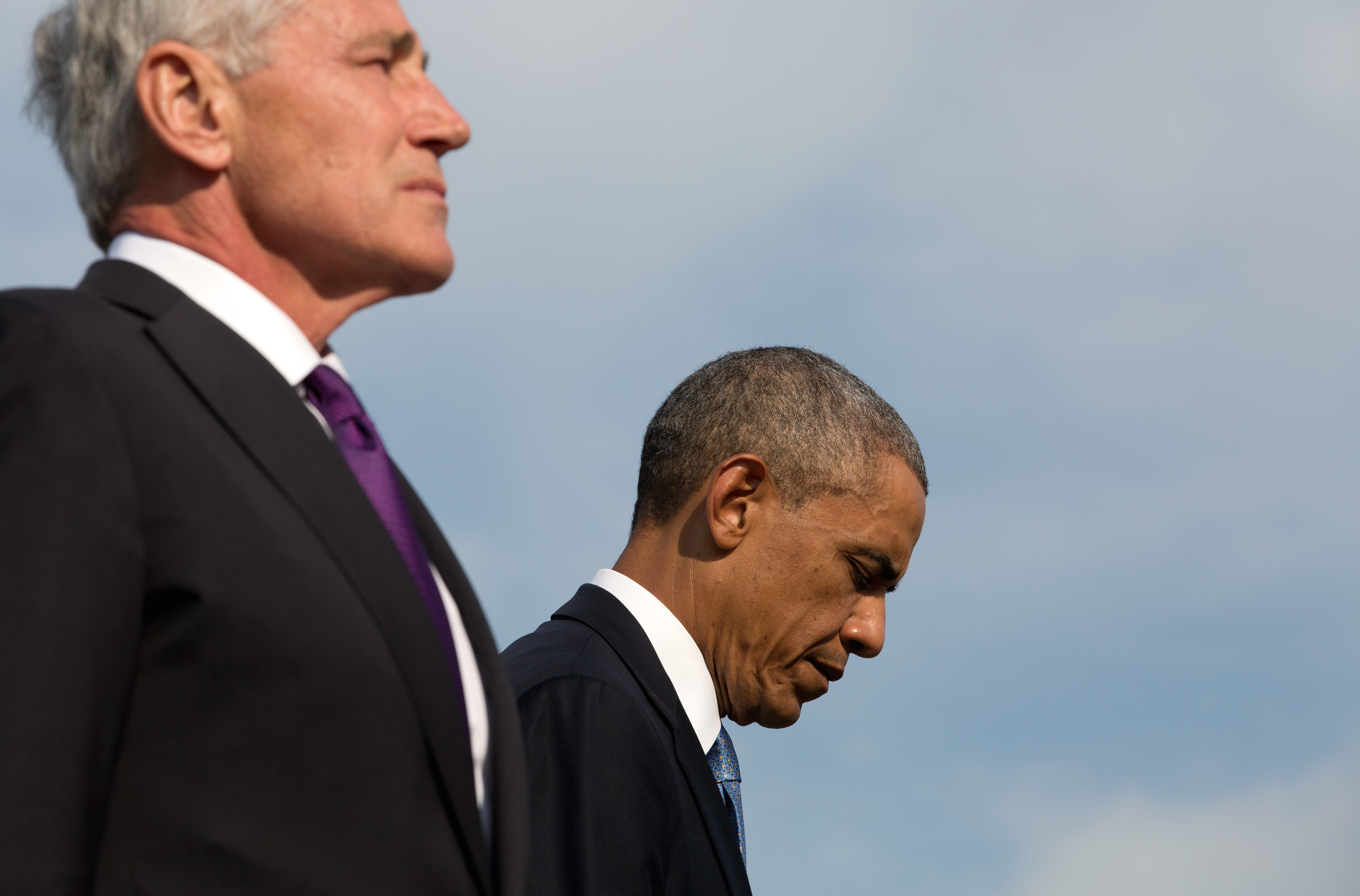
(Photo: U.S. President Barack Obama bows his head, as Defence Secretary Chuck Hagel looks on, during a ceremony to mark the 13th anniversary of the 9/11 terrorists attacks at the Pentagon Memorial on September 11, 2014. By Martin H. Simon-Pool/Getty Images)

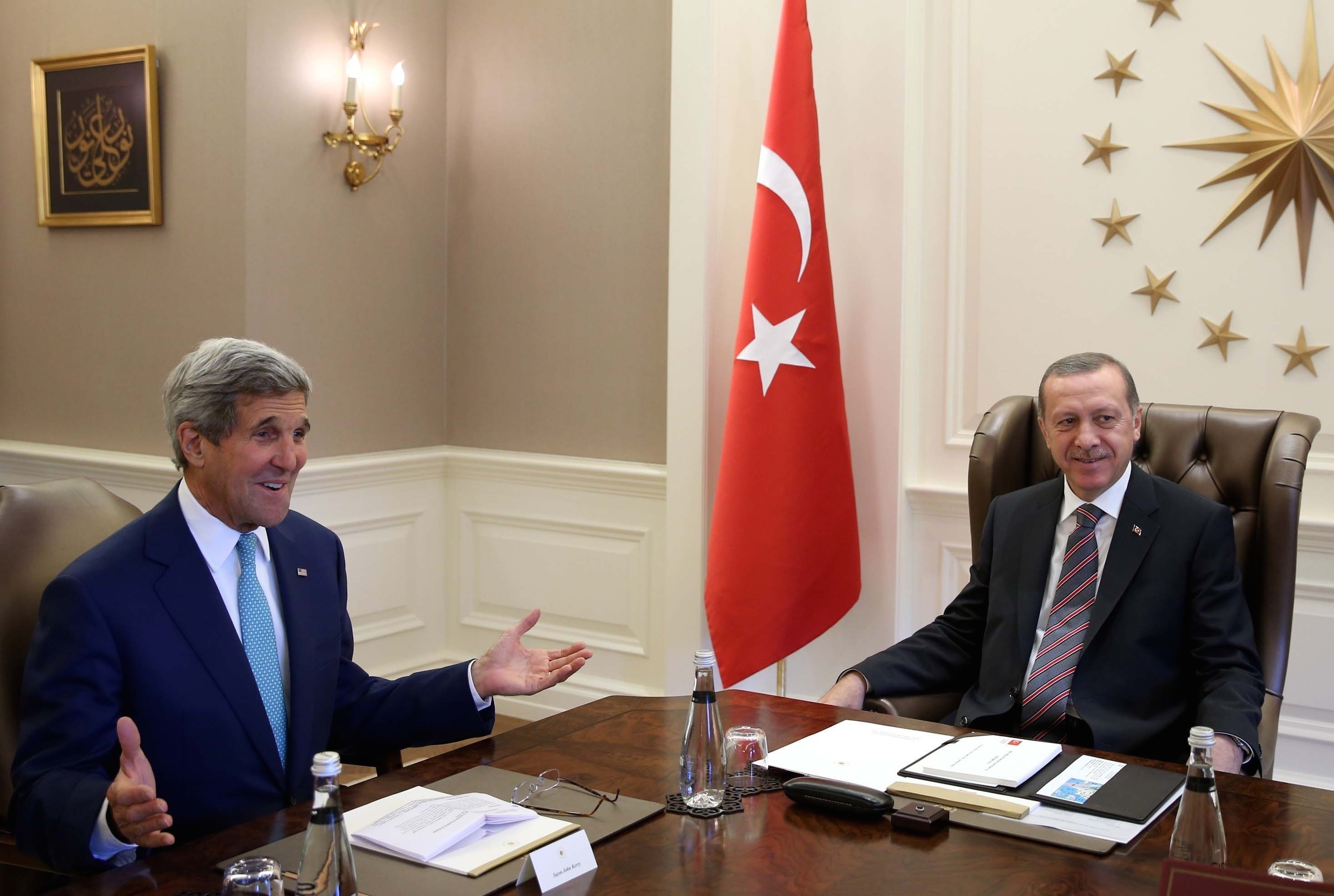
The Problem With Partners, Ctd

John Kerry - Recep Tayyip Erdogan

Thomas Seibert scrutinizes Turkey’s reluctance to commit to anything beyond a “passive role” in the war on ISIS:

Officially, Turkey argues it has to keep its operations low-key because a more active posture would endanger the life of 46 of its citizens held hostage by ISIS. The jihadists kidnapped the Turks and three of their Iraqi colleagues when they overran the Turkish consulate in the northern Iraqi city of Mosul in June. Ankara says it is trying to secure the hostages’ release, but has ordered a news blackout that makes it difficult to assess where those efforts stand. …

Even without the hostage situation, Ankara would face difficult options. Turkey could take part in Western strikes against ISIS and risk a backlash from the jihadists themselves and other Islamist groups in the region. Or Turkey could refuse to have anything to do with the strikes, angering its Western allies and being a mere spectator despite its ambition to become a regional leader. Faced with that choice, Ankara appears to have decided to muddle through, officially joining the alliance against ISIS, but keeping out militarily.

Shane Harris expects the US to depend heavily on Jordan, particularly its intelligence service:

Jordanian intelligence “is known to have networks in Iraq which date from 2003 [the year of the U.S. invasion] forward,” said Robert Blecher, the acting program director for the Middle East and North Africa at the International Crisis Group. “The Jordanians have good connections and have tapped them before,” Blecher added. They’ll have to do so again. But it’s not just Jordan’s spying prowess that the United States needs. Jordanian intelligence also has ins with Iraqi Sunni tribes aligned with the Islamic State. …

The Jordanians are also likely to provide logistical support to the American air campaign, which has so far launched more than 150 strikes against Islamic State fighters, vehicles, and artillery using drones and manned aircraft. (The CIA now says that the militant group has recruited as many as 31,500 fighters, up from an earlier estimate of 10,000.) Blecher said that Jordan has allowed the U.S. military to use its air bases throughout the past decade, though Jordanian officials are reluctant to acknowledge that. [Former Jordanian foreign minister Marwan] Muasher said the country will likely lend logistical support but that he didn’t envision a role in direct military operations.

Adam Taylor and Rick Noack round up some international reax to Obama’s speech. They notice that Egypt is also toeing the noncommittal line:

Perhaps in response to Obama’s speech, Egypt’s Egyptian Foreign Minister Sameh Shokri called Thursday for a global strategy for dealing with extremists. However, when a diplomat was asked whether Egypt would cooperate with Obama’s strategy against Islamic State, they offered a vague reassurance. “Cairo will discuss every effort which can be made by the alliance to eradicate the phenomenon of extremist groups in the region,” the unnamed diplomat told Asharq Al-Awsat.

Ed Krayewski is dismayed to see our allies abandon their own national security commitments and let America do most of the work:

Countries like Turkey and Saudi Arabia have given varying degrees of support to the virulent strains of Islam that feed extremists like those in ISIS. Yet ISIS is hardly a puppet. Whether they decide to move north to Turkey or south to Saudi Arabia will be a decision over which those two countries will likely have no influence. But why bother treating ISIS like a national security threat when the United States is doing it for you?

Saudi Arabia, Turkey, other nations in the region, Arab and otherwise, are all threatened by ISIS in a way the United States isn’t, and in a way I think their leaders intrinsically understand they’re not being threatened by other countries in the region despite the official propagandas. Though the U.S. is the worldwide leader in military spending, these countries have spent decades building their militaries. They ought to make the decision to use them or not, to work with other countries in the region or not, and not have those decisions deferred by U.S. action from afar.

Likewise, Rosa Brooks argues that we should step back and let our local “partners” fight this war themselves:

Obama says the United States will “lead” a coalition against IS, but the United States should instead step back and let other regional actors assume the lead. They have a strong incentive to combat IS (an incentive we undermine when we offer to do the job for them), and the common threat of IS may even help lead to slightly less chilly relations between Iran and Saudi Arabia (though I won’t hold my breath). Other Middle East powers also have greater ability than we do to understand local dynamics, not least of which because many share a common language with IS or with other actors in the mix. The Kurds and the Jordanians may need some U.S. help to protect their own territory, and other states may need intelligence or other forms of logistical assistance. But we can provide such support to any of our allies and partners without putting ourselves front and center in the effort to combat IS.

Keating notes that other than Russia, none of our rivals seems to have a problem with us bombing Syria—even the Damascus regime itself is signaling that they’re OK with it:

Another interesting wrinkle is the ramifications of this Amerian operation for Assad’s backers in Moscow. Russian Ambassador to the U.N. Vitaly Churkin said today that if the United States bombed Syrian territory “without the Syrian government’s consent,” it would “complicate international operations and will pose problems for Russia as well as for many other countries respecting international law, including China.” But Russia may be the only country bothered by Obama’s campaign. It appears the Syrian government isn’t going to object too much to the operation. China, which has concerns about its own citizens cooperating with ISIS, seems likely to offer quiet support. Even Iran seems finally to have found an American war in the Middle East it can get behind.

Judis isn’t impressed with Obama’s stated strategy for a number of reasons, one of which is that it ignores Iran:

In trying to answer IS’s challenge in Iraq, the United States needs Iran’s cooperation. Obama didn’t mention Iran at all in his speech but instead referred to “Arab” countries and even to the NATO countries that he claims are going to join the anti-IS coalition. Arab countries are imporant, and one NATO country, Turkey, also is.  But Iran is crucial. It’s the main backer of the Shiite Iraq government and of Assad.  What, at this point, is the American strategy toward working with or against Iran in the region?  And what can be done to ease relations between Iran and Saudi Arabia, which would be important to resolving conflicts in Iraq and Syria? How much bearing do the nuclear talks, which seem to have stalled, have on the possibility of cooperation with Iran in the region?

And the way Tom Ricks sees it, our perforce partnership with Iran is really the only news here:

I think the Iraq war is best seen as one continuous conflict since the Iraqi invasion of Kuwait in the summer of 1990. I remember getting on the Metro that morning, seeing the headline, and thinking, “Hey, we’re gonna go to war.” And so we did, with an air campaign followed by a short ground campaign. When that was over, we went back to several years of air campaigning, complemented by some covert operations on the ground. Then, in 2003, we had another major ground campaign. It was supposed to last a few months, but instead lasted 8 years. And now we are back to an air war, probably again supported by occasional covert ops. The biggest difference I can see is that where once some Americans said we were doing this to prevent Iran from gaining influence, now we are working alongside the Iranians in Iraq.

(Photo: U.S. Secretary of State John Kerry (L) meets Turkey’s President Recep Tayyip Erdogan (R) during Kerry’s official visit at Cankaya Palace in the capital Ankara, Turkey on September 12, 2014. By Kayhan Ozer/Anadolu Agency/Getty Images)

Civil Liberties Become A Lower Priority

This is depressing news:

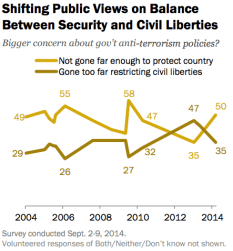
LibertyThe Pew Research Center poll shows 50 percent of Americans say the government has not gone far enough to protect the country, while 35 percent are more concerned about the government going too far to restrict civil liberties. That’s the most pro-security posture Americans have had on this question since 2009 and one of the highest on record since Sept. 11, 2001.

In contrast, 10 months ago, in the midst of several big Snowden leaks, significantly more Americans favored the civil liberties emphasis (47 percent) over taking additional steps to secure the homeland (35 percent).

The reason for the shift? People are scared.

And Gallup found that “Republican Party has expanded its historical edge over the Democratic Party in Americans’ minds as being better able to protect the U.S. from international terrorism and military threats.” Allahpundit digests that fact:

Incredible though it may seem, the GOP’s lead is wider on that question now than it was a year after 9/11, when Bush’s popularity was still stratospheric and Republicans ended up gaining seats in the midterms because of his terror-fighting cred. Looking at that and the Pew data above, I wonder how Rand Paul’s campaign will deal with the already building pressure for the GOP nominee to run as a member of the loud-and-proud party of hawks again. Maybe, as the fight against ISIS drags on, a new round of war fatigue will take the edge off these numbers or even reverse the trend. I don’t know, though: Republican voters stuck with Bush a long time on Iraq. As recently as last month, with 71 percent of the broader public saying that the Iraq war wasn’t worth it, more GOPers still said that it was worth it than that it wasn’t (46/44). Rand’s got a lot of work to do on the way to 2016.

The Clock Is Ticking On Climate Change

Plumer reads through a recent PricewaterhouseCoopers report (pdf), which calculated that “the world is steadily becoming less and less carbon-intensive.” That means “we need to burn fewer fossil fuels to generate a dollar’s worth of economic activity”:

But here’s the bad news: Carbon intensity isn’t falling fast enough. Between 2000 and 2013, carbon intensity fell by 0.9 percent per year. Last year, it fell by 1.2 percent. But the global economy grew fast enough to overcome that, so overall emissions rose. If these trends continue, we’re on track for about 4°C of global warming in the future, which many scientists have deemed extremely dangerous.

By contrast, if the world wants to a) keep growing and b)avoid more than 2°C of global warming (which is the current international goal), then carbon intensity will have to decline much, much faster — by roughly 6.2 percent per year between now and 2050.

James West further unpacks the report:

Overall, PricewaterhouseCoopers paints a bleak picture of a world that’s rapidly running out of time; the required effort to curb global emissions will continue to grow each year. “The timeline is also unforgiving. The [Intergovernmental Panel on Climate Change] and others have estimated that global emissions will need to peak around 2020 to meet a 2°C [3.6 degrees F] budget,” the report says. “This means that emissions from the developed economies need to be consistently falling, and emissions from major developing countries will also have to start declining from 2020 onwards.” G20 nations, for example, will need to cut their annual energy-related emissions by one-third by 2030, and by just over half by 2050. The pressure will be on the world’s governments to come up with a solution to this enormous challenge at the much-anticipated climate talks in Paris next year.

The Ground War To Come

IRAQ-CONFLICT

Larison suspects that it’s inevitable:

Escalation was always very likely, because that has been the pattern in U.S. interventions over the last twenty-five years. Obama already demonstrated in Libya that the U.S. would go far beyond the original stated goals of an intervention, and he is now on record saying that his greatest regret about the Libyan war was that the U.S. didn’t follow it up with a post-war military presence. That should be something to bear in mind when you next hear Obama pledge that there won’t be any American ground forces in combat in this new war. That’s why we should have expected this from Obama, but what made escalation even more likely is that our current political culture and foreign policy debate don’t really permit the U.S. to limit itself to small, achievable goals when it uses force overseas. That is especially true once administration officials irresponsibly stoke public fear about a group being an “imminent threat to every interest we have.” Sooner or later, the mismatch between the administration’s alarmist rhetoric and the initial “limited” action was going to be fixed by adopting a more aggressive policy.

Rich Lowry, for one, is ready to send in the infantry:

ISIL has occupied an enormous amount of territory in Iraq and Syria, including major population centers. That is why it declared a caliphate and why it has unprecedented resources. To defeat it, this territory must be taken back and it is unlikely to happen exclusively from the air—especially in the cities. It will take ground forces.

We hope to work with proxy forces, but they are motley groups that will almost certainly need vetting and advising by special operators working closely with them on the ground. But the president ruled out American ground forces. The cynical interpretation is that he is hoping to do enough against ISIL to satisfy domestic political opinion and keep the terror group at bay until he can hand off an incomplete campaign to his successor, who will be left with the difficult choice of whether to truly defeat ISIL.

James Jeffrey agrees that Obama was wrong to rule out boots on the ground:

[S]ometimes local forces are not enough. U.S. troops have capabilities they cannot approach, beginning with the crucial combat multipliers: “speed” and “decisiveness.” The commitment of even a few U.S. troops with actual ground combat missions signals credibility and seriousness. Such a troop presence can integrate rival local forces (as U.S. joint platoons did with the Kurds and Iraqi Army in 2010-2011), prevent friendly atrocities against civilians, and shape the goals of ground combat.

Still, local forces in Iraq and Syria should be the first choice, with commitment of our ground troops only an emergency contingency. Once in combat they introduce entirely new risks beyond those of drones or F-18 strikes, Special Forces trainers, and Navy SEALs. These risks begin with casualties. Ground combat is bloody.  While overall casualty rates are down from Vietnam, thousands have died in each of America’s last two wars, and tens of thousands have suffered serious wounds.

And Dov Zakheim argues that they’re necessary to hold the coalition together:

It is one thing to offer funds or training facilities, which Saudi Arabia is apparently willing to provide. It is quite another to deploy troops. Whether the Saudis, Emiratis, Jordanians, and others will be ready to do so absent American leadership on the ground is at best an open question. It is true that America led a coalition “from behind” in Libya. But that coalition did not commit ground troops; apart from very small numbers of European special forces, it was the Libyan rebels who provided the overwhelming majority of troops conducting operations on the ground against Muammar al-Qaddafi.  Moreover, the aftermath of that conflict hardly was a showpiece for coalition operations: Libya is now virtually a failed state.

Morrissey implies that Americans would come around to embrace another land war in the Middle East if only the president had the courage to give us one:

[I]t’s true that a move to send ground troops to deal with ISIS would create a large amount of political backlash, and would also call into question Obama’s endgame strategy in Afghanistan — even more so that ISIS has. If the American public won’t back a decision to put combat troops back into Iraq, then it would take a President willing to go it alone politically at home to give that order, and clearly that’s not the case with Obama. However, a lack of progress against ISIS will play badly for Obama too, and it will sap the resolve of Americans to see the job through to victory. We may end up looking weaker than we do now, especially if we can’t even get our traditional allies on board for just the 30,000-foot tactical decisions.

Highlighting some of the characteristics of the classic neocon freakout over ISIS, Chait observes that among this crowd, there’s no such thing as too much force:

The nub of neoconservatism is a belief that the only possible strategic failure is the insufficient use of military force. This is more of an atavistic reflex than a cogent form of thought. Cruz assails Obama, “Instead he suggested targeted attacks and focuses frankly on political issues that are peripheral from the central question of how we protect America from those who would take jihad to our nation.” Targeted is bad. Political is bad. Protecting is good. Here is [Jennifer] Rubin’s response:

[Obama] insisted, “This strategy of taking out terrorists who threaten us, while supporting partners on the front lines, is one that we have successfully pursued in Yemen and Somalia for years.” But if the Islamic State, which occupies vast territory and is highly trained and very well organized, than I suppose it won’t work.

That is not even an English sentence. Nonetheless, the underlying impulse is clear enough.

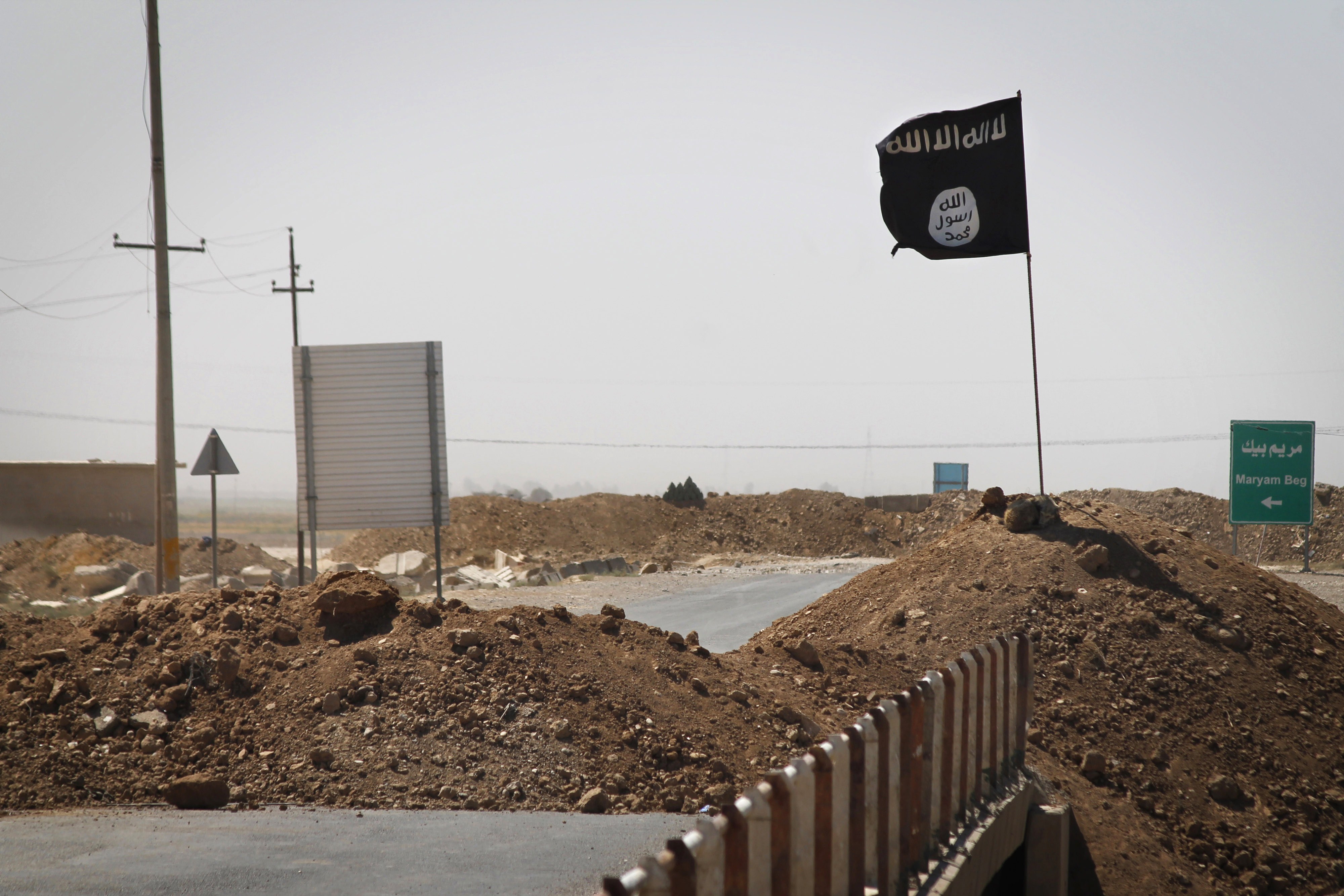
(Photo: A flag of the Islamic State is seen on the other side of a bridge at the frontline of fighting between Kurdish Peshmerga fighters and Islamist militants in Rashad, on the road between Kirkuk and Tikrit, on September 11, 2014. By JM Lopez/AFP/Getty Images)

Threat Inflation And The Case For War, Ctd

Beinart takes the MSM to task for swallowing the government’s line on the ISIS threat:

Many publications have uncritically accepted Secretary of Defense Chuck Hagel’s claim about the number of Americans who have gone to fight with ISIS—a figure that New America Foundation terrorism expert Peter Bergen argues is dramatically exaggerated. Other media commentary simply assumes that if Westerners go to fight with ISIS in Iraq or Syria, they’re destined to attack Europe or the United States. But that’s not true. Bergen notes, for instance, that of the 29 Americans who have gone to fight with the Somali jihadist group al-Shabab, none have tried to commit terrorism against the United States. One reason is that many of them ended up dead.

Press coverage of ISIS often ignores the fact that, in the past, the group has not targeted the American homeland. Jihadist groups, even monstrous ones, don’t inevitably go after the United States. Al-Qaeda began doing so as part of a specific strategy.

Keating stresses that for the most part, “the much-discussed threat of ISIS’s international fighters returning to their home countries to carry out attacks has been theoretical”:

As David Sterman pointed out in an analysis for the New America Foundation this week, “no one returning from or seeking to join a Syrian jihadist group has even been charged with plotting an attack inside the United States.”

Moner Mohammad Abu-Salha, the Florida man who returned to the U.S. for a time after training in Syria in 2012 and was under surveillance by the FBI, tried but failed to recruit friends to the cause, and eventually returned to Syria where he carried out a suicide bombing. If anything, greater U.S. involvement in the conflict will make ISIS—a group that until recently was most concerned with local territorial gains—more rather than less likely to target U.S. interests and citizens.

That’s what makes Yglesias uncomfortable with the way Obama talked up the threat on Wednesday night:

Public opinion always matters in politics and therefore in policymaking, but the fact of the matter is that the American people have this a bit mixed up. The beheadings are not the most alarming thing ISIS did this summer (try taking Mosul or genocidal violence against religious minority groups) and the rise of ISIS isn’t even the summer’s most alarming foreign policy crisis (try Russia’s invasion of Ukraine and apparent probing of Estonian and Finnish borders). There is no good reason for the United States to take maximal action against ISIS, not least because none of our potential partners in the region are going to.

Alarmist rhetoric and a policy of wise restraint make odd bedfellows. If the US catches some lucky breaks (or ISIS some bad ones) it may all work out for the best. But Obama’s speeches are writing checks his policy can’t necessarily cash. And eliminating ISIS’ ability to occasional kidnap westerners who travel into the conflict zone is much more difficult than eliminating its ability to capture new Iraqi cities or threaten major oil fields. If another shoe drops in a bad way, there is enormous risk that the president has set the country up for a cycle of unwise escalation.

The Scottish Vote Is Neck-And-Neck

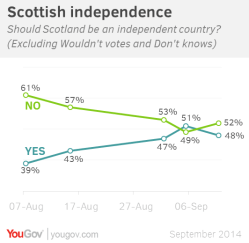
No has regained a slight lead:

Scotland VoteYouGov’s latest survey has No, on 52%, narrowly ahead of Yes, 48%, after excluding don’t knows. This is the first time No has gained ground since early August. Three previous polls over the past month had recorded successive four point increases in backing for independence. In early August Yes support stood at 39%; by last weekend it had climbed to 51%. …

A key reason for the renewed fears of independence is what might happen to people’s bank accounts. The biggest single advantage of the union cited by No voters is that the UK would have the resources to step in if Scotland faced another crisis of the kind that erupted in 2008.

Fraser Nelson focuses on the decline in support among the youngest voters:

You need to treat all Scottish polls with caution, due to the sample size and the fact that the turnout may be high enough to include people who polling companies don’t know exist. But YouGov found that the under-25s (the ones more likely to vote on the day, rather than by post) have switched form a 20-point lead for ‘yes’ to a 6-point lead for ‘no’ in under a week.

Now, 20pc of people born in Scotland have concluded that their future lies outside of Scotland. Being fully plugged into the network of the rest of the UK is an advantage: as a Scot in London I feel (and am treated) like a fellow countryman, not an immigrant. I have to say: it’s a good feeling, and one I’d certainly want to protect if I were a teenager mulling my future options.

Examining the coalitions for and against independence, Tom O’Grady argues that “the referendum has arguably ceased to be about independence at all”:

[T]he pro-independence coalition looks much like the types of groups that are rejecting conventional politics in Europe today more broadly. Younger and poorer voters show lower turnout in elections, are more likely to vote for anti-establishment fringe parties, and are scornful of traditional political elites. Overall, the Scottish National Party’s success has come partly from framing independence as a form of anti-establishment protest, as well as the sheer luck of holding a referendum that coincides with a Conservative government in the United Kingdom.

This means, though, that support for independence could ultimately prove fragile.

Adam Taylor profiles Alex Salmond, the leader of Scotland’s independence movement:

Salmond seems to divide opinion like few other politicians. He has substantial support, enough to be elected as first minister of Scotland, yet polls show almost as many are dissatisfied as satisfied with him. Strangely, women seem to have a particular problem with him: One recent poll from the Scottish paper Daily Record found that half of women surveyed saying his role makes them want to vote against independence. Salmond was described as “arrogant,” “ambitious” and “dishonest” by those polled.

Perhaps it’s logical that a man who espouses a radical plan would elicit both love and hate. But there’s an even bigger factor here: Salmond doesn’t just espouse a radical plan – he also promotes it very, very well.

Eric Posner approves of independence:

[W]hile it’s true that Scottish nationalists often make mystical arguments (as nationalists always do), the case for independence is based on serious policy considerations. Some Scots believe that independence would give Scotland sole ownership of valuable oil deposits off its coast in the North Sea. Although those resources may well be almost depleted, it is possible that advances in oil-extraction technology would enable Scotland to create an oil-financed welfare state like Norway’s.

More importantly, if Scotland were independent, Scots would control the whole array of policy instruments that Scotland now shares with the rest of the U.K.—above all, taxing and spending. The Scots would be able to govern themselves however they want—and that includes putting into place the more generous welfare state that the more right-leaning English public has denied them.

Though not against independence in principle, Megan McArdle has misgivings:

My basic position on this sort of thing is that if places want to be independent, they should be independent, unless the reason that they’re seeking independence is so they can have more freedom to oppress minority populations. Yet I can’t say this seems like a good idea, for reasons that my friend Alex Massie has ably outlined. Scotland is a net recipient of transfers from the U.K. government, so going it alone will probably require some belt tightening. The process of separating all the intertwined institutions, from banking to education, will be daunting.

But Justin Fox outlines how breaking off could be economically beneficial for Scotland:

What has made small countries so economically successful over the past few decades is less their smallness than the ways they’ve taken advantage of it. David Skilling, a former New Zealand government official and McKinsey consultant who now advises small-country governments and companies from a base in Singapore, has spent as much time thinking and writing about the strengths and weaknesses of small states as anybody. In a 2012 paper that should be required reading in Scotland, he lists two main characteristics of successful small states:

1. They’re cohesive, and thus able to make policy decisions quickly and stick with them.

2. They tend to make good policy decisions, in part because they’re very aware of the world around them and what it takes to compete in it.

Ilya Somin searches for historical parallels:

One relevant precedent is the experience of the “Velvet Divorce” between Slovakia and the Czech Republic, whose success is sometimes cited by Scottish independence advocates as a possible model for their own breakup with Britain. Like many Scottish nationalists, advocates of Slovak independence wanted to break away from their larger, richer, partner, in part so they could pursue more interventionist economic policies. But, with the loss of Czech subsidies, independent Slovakia ended up having to pursue much more free market-oriented policies than before, which led to impressive growth. The Czech Republic, freed from having to pay the subsidies, also pursued relatively free market policies, and both nations are among the great success stories of Eastern Europe.

Like Slovakia, an independent Scotland might adopt more free market policies out of necessity. And the rump UK (like the Czechs before it), might move in the same direction. The secession of Scotland would deprive the more interventionist Labor Party of 41 seats in the House of Commons, while costing the Conservatives only one. The center of gravity of British politics would, at least to some extent, move in a more pro-market direction, just as the Czech Republic’s did relative to those of united Czechoslovakia.

Jason Sorens watches the markets:

So far capital markets seem to be telling us that the economic costs of independence to Scotland would be significant but not catastrophic, and that they would be virtually nil to the rest of Britain. How much of those costs are due to the policies Scotland would implement after independence, rather than secession as such? It is difficult to know, but the differential returns to particular firms give us a clue. Transportation companies have closer links to the state, so a more statist policy regime might not hurt them. Financial companies might lose because of the lender of last resort issue (Scotland might not have a credible one). Energy and engineering companies might lose because nationalists want to tax oil heavily to fund social programs. Also, stricter environmental laws may hurt the electric utility SSE, which lost heavily on Monday.

Speculatively, then, capital markets seem to be telling us that the costs of secession as such are modest, but that the costs of dramatically different economic policies are substantial.

And Simon Lester doesn’t see what all the fuss is about:

In terms of war and peace, there have been no Mel Gibson sightings that I’m aware of. On trade, there may be some bureaucratic challenges, but it seems clear the goal is for Scotland to join the EU and be part of its large, single market. As for trade with the rest of the world, Scotland will take on the EU’s trade policy–which is not perfect of course–but has followed the trend toward liberalization that the rest of the world has pursued over the past few decades. In all likelihood, Scotland will continue to search for export markets for its whisky and allow the free flow of imports.

If Scottish independence meant it would become like North Korea, I’d be concerned. But it doesn’t seem like that’s the path it is on. With the exception of a few regions, we live in a highly integrated, peaceful world. Scottish independence would not change that.

Previous Dish on Scottish independence here.


Abuse In The Public Eye, Ctd

A reader broadens the conversation on domestic violence:

I watched with full video of the Ray Rice incident, and one of the first things I noticed is that outside the elevator, when Ray is waiting for his fiancée (now wife) Janay, she walks by and hits him in the face. She definitely did not connect hard, but it is clear she did connect. Then inside the elevator, she attempts to elbow and punch him in the head, and when he retreats, she comes at him with her fists up in a fighting stance. It is only at this point that Ray punches her. You can see the full video here. [Update: Another notes, “It has been reported (ESPN etc.) that Rice spit in Janay’s face twice – before they entered the elevator and right after they entered the elevator, and her physical movements were reactions to both events.”]

I am a man and I was once the victim of domestic violence from a woman. She would hit me and take advantage of the fact that I would never hit back.

It is likely that this was not the first time Janay hit Ray, and based on the fact that she had no hesitation to square off with him, she may have done it many times before and he never hit her back. He may have gotten tired of this and warned her he would start hitting back.

It is certainly wrong of Ray to punch Janay. It is also wrong for Janay to punch Ray. It is certainly wrong to blame the victim, and at the moment Ray hit Janay, she was the victim. But every other time she hit him, including just moments before he hit her, he was the victim, and being the victim of
repeated domestic violence can make someone stop thinking clearly.

It seems we all want to talk about Ray punching Janay, but no one wants to talk about the punches Janay directed at Ray. Until we do that, we aren’t really talking about the truth of what happened there and what happens all the time in our society. We are only talking about a made-up narrative that does not match reality. So let’s start talking about reality. We need to talk about how men can avoid being the victims of violence from women, and what they can do to protect themselves without striking back.

Update from a reader, who elaborates on the first update:

I have no idea what video your reader watched, but it doesn’t appear to be the same one the rest of the world did. While, yes, Janay Rice lightly taps Ray Rice on the chest before they get in the elevator, I don’t think you could even call that a “hit”. It’s somewhere between a light brush and a tap, and it doesn’t look particularly malicious – let alone violent. Also, when the two are in the elevator, Ray Rice is closing in on her, and it looks like he’s trying to intimidate her when she sort of pushes him away. He spits on her, etc. Then, she clearly loses her temper and moves toward him, and he knocks her the hell out.

This statement, from your reader, gives the game away: “We need to talk about how men can avoid being the victims of violence from women, and what they can do to protect themselves without striking back.”

Yes, men certainly can be the victims of domestic violence – I’ve been one myself. But treating the issue as if it’s even remotely an equal problem is the trademark of a men’s rights advocate, who sees the plight of poor, oppressed men as equal to the violence propagated toward women – this would be laughable, if it weren’t so tragic. Men are far, far more likely to injure, abuse and murder their partner than women are; it’s not a remotely equal situation, and treating it as such undermines the very real danger millions of American women are facing every single day.