Who Ted Cruz Won’t Stand With

Cruz got booed off stage at a Christian event:

Peter Grier provides background:

On Wednesday night, the Texas GOP senator gave a keynote address at a gala sponsored by a group named In Defense of Christians. The organization’s objective is to focus public attention on the plight of persecuted Middle East Christian groups. Near the end of his speech, Senator Cruz said, “Christians have no greater ally than Israel.” At this point, some in the audience started to boo, according to eyewitness accounts and video of the incident. Cruz continued with, “Those who hate Israel hate America. Those who hate Jews hate Christians.” At that point, the boos got louder and things began to get out of hand. Eventually, Cruz decided he could not continue.

Elizabeth Dias determines that “Cruz’s problem was one of context”:

First, he pinned his remarks to the conflict between Israel and Hamas when one of the group’s primary agenda points was actually the plight of Iraqi Christians. Second, Christians are far from a monolithic group, especially when it comes to views on policy on Israel and the Middle East. The American evangelicals Cruz typically addresses tend to be worlds apart historically, culturally, theologically, and politically from the Christian leaders in attendance.

Larison feels that “Cruz was completely out of line to set some kind of ideological litmus test for the attendees that requires them to endorse the ‘pro-Israel’ views that Cruz happens to hold”:

Cruz is free to hold those views, and many of his voters agree with him, but it is obnoxious to demand that others, including many Arab Christian clergy in attendance, subscribe to those views in order to obtain Cruz’s sympathy for their plight. Not only is “standing with Israel” irrelevant to the reason for the summit, but as this incident has proven it is a completely unnecessary distraction from the work of the organization that sponsored the event.

Jonathan Tobin sees the story differently:

Today, Christians find themselves under tremendous pressure in a region where true freedom of religion only really exists in Israel. Yet some who claim to represent Christians are once again outspoken in their hate for Israel and even absurdly blaming the Jews for their plight at the hands of hostile Palestinian Islamists. Instead of making common cause with Jews who are also targeted because of their faith, some Christian groups have become among the most outspoken advocates of hate against Israel.

But Dreher doesn’t think that is the issue at hand:

Anti-Semitism among Christians, Arab and otherwise, is appalling, but it doesn’t sound like that’s what was at issue here. Ted Cruz came to this event apparently seeking to score points with a domestic US political constituencies at the expense of the desperate need for international Christian solidarity in the face of horrendous persecution by ISIS and other radical Islamic groups. To add to the insult, now Breitbart, a leading website of movement conservatism, questions the Christianity of these Arab men and women in that Washington room.

This is beyond infuriating. Arab Christians in the Middle East face persecution and death every day, simply because they are Christian. And this Dr. Susan Berry person on Breitbart distorts the truth — saying that Cruz was booed because he supported Israel, when in fact he was booed because he turned his speech into a pro-Israel lecture to a hostile audience — and then writes as if the only thing worth knowing about the Christians in that audience is that some of them had met with Hezbollah.

Pascal-Emmanuel Gobry, who calls himself “a full-throated supporter of Israel,” was disgusted by Cruz’s antics. He contends that Cruz was “using one of the world’s most beleaguered minorities as a prop for his own self-aggrandizement”:

Cruz tarred and attacked one of the most powerless and beleaguered minorities in the world, solely for personal political gain. He was speaking truth to the powerless. He was strong against the weak.

In the end, what was most striking about Cruz’s tirade was the last phrase: “If you will not stand with Israel and the Jews, then I will not stand with you.” Cruz was literally standing in a room with his fellow Christians. In the Bible, the idea of the fellowship of Christian believers is a very important one, and to break fellowship is to put oneself outside the community. What Cruz was saying was that agreeing to his views on Israel was more important as a badge of fellowship than believing in Jesus Christ.

Omar Baddar calls out Cruz for conflating “Israel” with “Jews”:

When the crowd booed Cruz for praising Israel as an ally of Christians, he responded by saying “those who hate Jews hate Christians.” That would be an interesting argument, except no one in the crowd was booing Jews. In fact, the transcript and audio recording of the speech clearly show that when Cruz said, “Tonight we are all united in defense of Jews,” the crowd was united in applause. And Cruz’s ending statement of “if you will not stand with Israel and the Jews” demonstrates an inexcusable conflation of the Jewish people, on the one hand, and Israel on the other. The former is an ethno-religious group, and hostility toward them is indeed hateful bigotry, which should be opposed by all people of conscience. The latter, however, is a state with an egregious record of violations of human rights and international law.

And Jonathan Bernstein hopes that we’re “not really going to pretend that Ted Cruz had a ‘Sister Souljah Moment’ when he stormed off”:

A true Republican Sister Souljah moment wouldn’t involve taking on opponents of Israel. Rather, it could be a smackdown of Republican-aligned fans of Israel who use extreme language. Or it could involve going to some mainstream conservative event hosted by opponents of comprehensive immigration reform and bashing someone who had used extreme anti-immigrant language. Or (as Rand Paul did) questioning Republican efforts to raise hurdles to voting.

You know what would be a real Sister Souljah moment for Cruz? Denouncing his own father’s comments.

But He Defends Your Right To Drink It

Joseph Stromberg questions the safety and value of raw milk:

Raw milk might be more dangerous and no more nutritious than pasteurized milk. But this issue isn’t entirely black-and-white. For a few reasons, it’s unfair to paint raw milk proponents as recklessly anti-science, like those who oppose vaccination. For one, even though raw milk may be riskier than pasteurized milk, that doesn’t necessarily mean it’s the riskiest food out there. Milk is a relatively low-risk food to begin with, and some researchers estimate that the risk of getting sick from drinking raw milk is still lower than from eating home-cooked chicken or hamburgers.

The CDC provides detailed data on disease outbreaks caused by contaminated food going back to 1998, and during that time, raw milk or cheese have been involved in 149 different incidents (that doesn’t mean it’s the contaminated ingredient in each instance, just that it was suspected). It’s tough to find a good comparison, because raw milk is an uncommonly-consumed food. But raw oysters, for instance, were involved in 144 incidents.

A Growing Industry In Colorado

CO Marijuana Sales

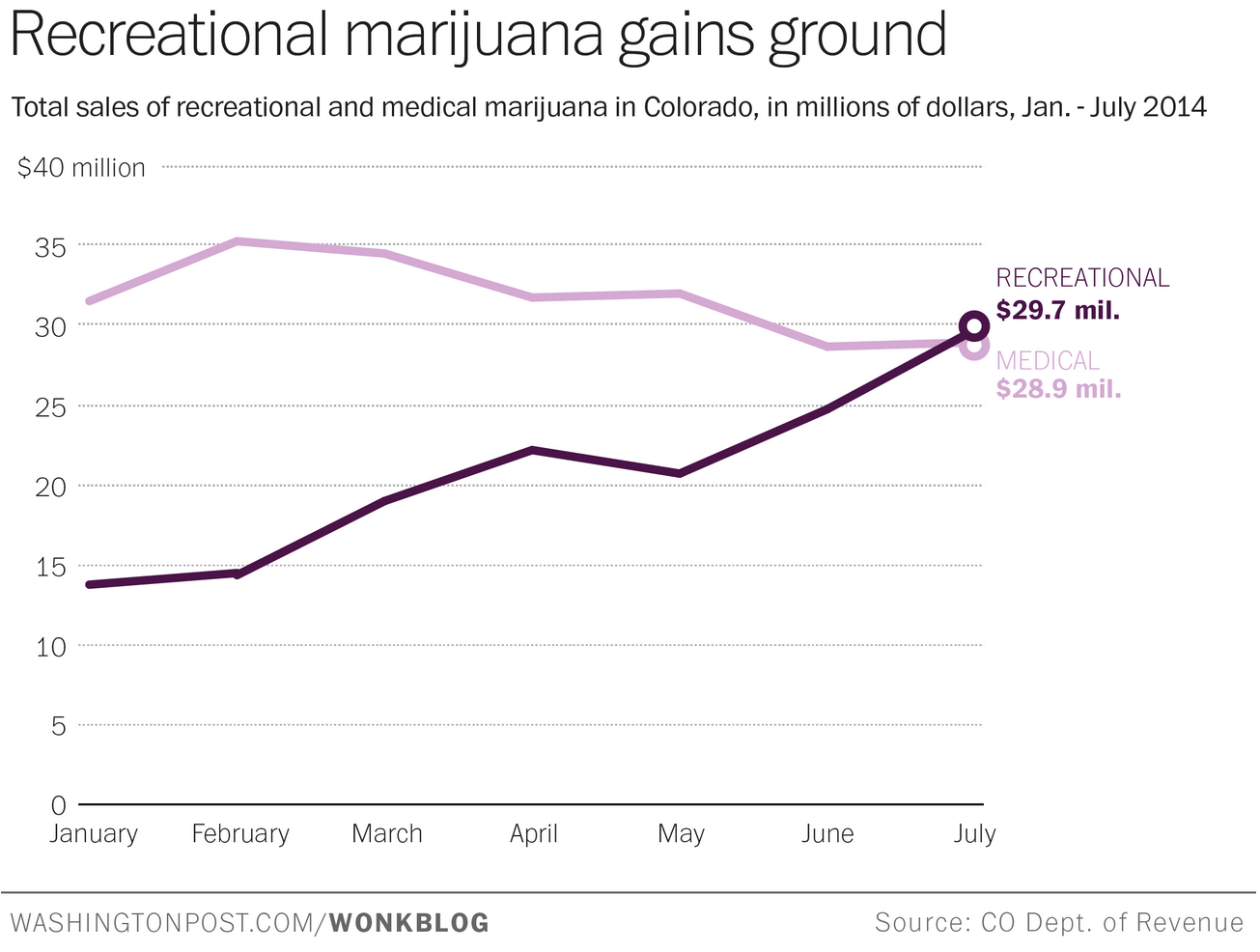
Colorado’s recreational marijuana sales have now surpassed medical marijuana sales:

Many legalization proponents welcomed the latest sales figures. But they don’t necessarily mean the imminent demise of Colorado’s black market. “I don’t think the increase in sales necessarily reflects a decrease in the black market, although it may,” Brookings’ [John] Hudak said in an interview. The sales increase could be due to “increases in marijuana tourism – an industry growing pretty rapidly in the state.”

A cultural shift is also likely under way, as more residents dip their feet in the recreational market. “It might reflect a relaxation of state residents where people are coming around and saying ‘Ok, this is real, this is legit and I’m not going to get arrested for it.’”

Katy Steinmetz keeps an eye on marijuana tax revenue:

During the month of July, the state received $838,711 from a 2.9% tax on medical marijuana, meaning that patients spent an estimated $28.9 million at dispensaries. The state meanwhile raked in $2.97 million from a 10% sales tax on retail marijuana, putting those sales at about $29.7 million, according to calculations by theCannabist.

Though that amounts to a less than $1 million gap between retail and medical sales, this is a small victory for champions of legalization who have argued that the experiment will be profitable for the state, as revenues have lagged behind some expectations.

Early this week, Jon Walker passed along a poll finding that Coloradans have no regrets – 55 percent support the legalization law:

Although a sizable minority still doesn’t like the new law there is little active opposition to it. Only 8 percent of adults say they are trying to have the law overturned. On the other hand, roughly half of the people who favor the new law say they are actively supporting it. Both the raw numbers and the intensity of support are with the pro-legalization side.

If voters and politicians in other states are “waiting to see” how legalization goes in Colorado the general consensus seems to be that it has gone pretty well. Most Coloradans are happy with legalization and would do it all over again.

Pregnant With Depression, Ctd

Andrew Solomon has a fascinating piece on the subject:

While the drugs are risky, depression during pregnancy is at least as problematical. Animal studies show that stressed mammalian mothers are likely to have offspring with poor neurodevelopment. Pregnant women experiencing depression or anxiety are under greater stress and may have altered neurobiology themselves, which could affect fetal development via changes in the uterine environment. Indeed, untreated depression during pregnancy is associated with increased miscarriage rates, preterm birth, and low birth weight—some of the very risks associated with maternal use of S.S.R.I.s. Depressed mothers are at increased risk for preeclampsia. Recent research has shown that the fetus of a depressed, expectant mother has alterations in the microstructure of the right amygdala. There is even some evidence that mothers who are extremely stressed during their first trimesters may be more likely to have children who later develop schizophrenia. …

At the same time, it is important not to blame mothers for their children’s neurological challenges. The shadow of the “refrigerator mother,” who was said to cause autism, falls long across this research. It may be counterproductive to tell women under stresses they cannot avoid that they are damaging their children by being unhappy—or by being treated for their distress. Blaming some women for injuring their children by taking antidepressants and others for injuring their children because they are depressed creates a no-win situation that is itself depressing.

There is no universal right answer here, and, under those circumstances, quoting the studies may seem counterproductive. But women need the leeway to make their own choices—to look, as one does in many areas of health care, at two unsatisfactory options and select between them, and to do so with as much information as possible.

Previous Dish on the subject here.

What Will Happen To The Wilderness?

11003816304_980e987f46_b

Fifty years ago last week, Lyndon Johnson signed into law the Wilderness Act. David Biello assesses what’s happened since:

[M]ost wilderness in the continental U.S. is not untrammeled land. Wilderness areas are often former working landscapes—the Orwellian phrase created by the logging industry to explain away clear cuts—whether they were cleared for logging or farming over the course of the 19th century and early 20th centuries in places like the Adirondacks. The great forest that once covered the eastern U.S. has been re-growing for the last 50 years, even if its primeval quality may be illusory, given the exotic animals and plants that now live there. And, in this era of global warming, even the Artic and other remote spots show signs of human trammeling—whether the leavings are plastic detritus or a changed climate.

How he thinks about the future of the wild:

Wilderness poses this fundamental question at least: what kind of place do we want for our home? Will our terrestrial abode retain an abundance of plants, animals, microbes and fungi like the world Homo sapiens was first born into? Or will the Earth become a vast monoculture, a grim subset of nominally wild species that co-exist in symbiosis with modern human civilization, like rats and seagulls? “Is being an asteroid the great purpose of our species—to steal the lives and homes of millions of species and billions of creatures?” asks political scientist David Johns of Portland State University, in his essay in “Keeping the Wild.”

In the end, wilderness is a state of mind. The natural world can only persist now as a deliberate act of human will. That will require firm human purpose as a gesture of humility, yes, but also a form of self-protection. “This is not really an ‘environmental problem.’ It’s a human problem,” writes environmental historian Roderick Frazier Nash of the University of California, Santa Barbara. “What needs to be conquered now is not the wilderness, but ourselves.”

Update from a reader:

In David Biello’s article, the word “untrammeled” is misused. To be trammeled means to be restricted, such as a trammel used on a horse. To be untrammeled means to be not restricted or hampered. (I learned what “untrammeled” meant in 1972, in my first weeks of Park Ranger training at Grand Canyon National Park.)

The Wilderness Act says that wilderness is an area that is “untrammeled by man, where man himself is a visitor who does not remain.” So wilderness is a place that is unrestricted by mankind, or as noted in Wikipedia, “meaning the forces of nature operate unrestrained and unaltered.”

In this article, “untrammeled” is confused with a word like “untrampled.” (It’s a frequent mistake.) For example, the author writes: “And, in this era of global warming, even the Artic [sic] and other remote spots show signs of human trammeling—whether the leavings are plastic detritus or a changed climate.” This is a clear misuse of the word “trammeling.” Biello should be informed of this mistake and a clarification from you might be in order.

(Photo by Jocelyn Kinghorn)

The Quality Of Britishness, Ctd

A reader quotes a previous one:

“Separation of Scotland has more than political implications. For many of us who do not have any vote in the matter, it carries profound implications about our identity, and what our nationality means.” Yeah, I feel this pain. I’m as Scottish as it gets, and I don’t have a vote in the matter either. I was born in Scotland, hold (only) a UK passport, have lived in England and the US, and now live in Canada. If independence happens, my life is turned upside down. The practical and emotional effects would be unimaginable. Every little page of immigration paperwork, my right to travel freely, my relationship to “home” – whatever that is – all in limbo. If I’m reading the propaganda – sorry, the White Paper – correctly, we will be forcibly repatriated to a new state while living abroad! God help us all.

Expat Scots will suffer as much disruption from this independence experiment as anyone, maybe more. But we do not get a vote. That makes me furious. I mean, 16 and 17 year olds living in Scotland have been franchised especially for this occasion, but I don’t get to play? Am I supposed to hope that they have my best interests at heart?

So I have to sit here, watch, and stew, while the future of my home, my nation and my identity is decided for me. Forgive me, but fuck the whole thing.

Another view:

I’m puzzled by your readers who worry about being unable to feel British if the Scots vote to secede. If, say, France were to leave the EU, does that mean I could no longer feel European?

Of course not. Europe is more than its political institutions. The concept of Britishness is not defined by the scope of the Westminster parliament.

I hope the Scots vote for independence, because I think they will create a kinder, fairer and happier society than the UK has become. Perhaps one day they’ll invite those of us in north-east England to join them: my roots are English not Scottish, but culturally, politically and geographically I feel closer to Scotland than I do to London.

Another draws a distinction:

To get a bit technical about it, Scotland cannot separate from Britain – at least not without employing a tremendous amount of earth-moving equipment. “Britain” is a geographic term, not a political one. It is, of course, short for “Great Britain,” the name of an island called such because it is the largest of the many British Isles.  Scotland can leave the UK, but it is stuck in Britain forever. The Scottish will always be British. If sharing an island with the English and the Welsh is part of the Scottish identity, then separating from the UK will not take that part away.

Another reader:

The letter you posted from the descendant of the Jacobite veteran of Culloden at first surprised me. How can an American, whose family has been in the USA since before the USA existed, be thrilled that “we” might be out from the English thumb?  You and your ancestors have been free of the English thumb for more than 250 years!

This is an example of how ancient political issues in Europe find a long echo in America. My own family is immigrant Irish, and like so many others, my ancestors came to America to escape the civil unrest in Ireland during the late 1800s and early 1900s.  They were devoutly Catholic, adamantly anti-British, and staunchly Republican.

I visited Ireland for the first time in the weeks after the Omagh bombing, and I was surprised to find that the locals I met were quite cool to me, and rather keen to have me on my way.  After awhile I realized that this was because they did not particularly trust Irish-Americans like me.  My – and so many others like me – views on Northern Ireland came to me almost unchanged from Grandpa’s views in 1916.  I think that is why there was such support for Irish republicanism (i.e. terrorism) from the succeeding generations of Irish Americans.  The locals were in no mood for another American’s nostalgia for Grandpa’s stories and how Grandma sang Republican songs as a lullaby.

In short, it caused me to realize that Ireland didn’t stop when Grandpa stepped on the boat at Westport. Obviously this phenomenon is not confined to the Irish-American experience, and can last far longer than the few generations of my family’s experience.

Another shifts focus:

As a Canadian, I’m fascinated by the parallels between England/Scotland and Canada/Quebec. Consider the following rewrite of your original post:

It’s a prickly country, bristling often at [Canada], its exports to [Ottawa] often having more than a bit of a chip on their shoulders. … It’s politically well to the left of [the rest of Canada], and is a big net beneficiary of [Canada’s] Treasury. After a while, if you’re [an anglophone Canadian], and right-of-center, and taxed to the hilt, endlessly subsidizing the [Quebecois] in return for their thinly veiled disdain, you get a bit irritated. Deep, deep down in my [Canadian] soul, there’s a “fuck ‘em” urging to come out.

This, I think, accurately captures some of the feeling in anglophone Canada around the time of the last referendum on sovereignty in 1995. The interesting thing to note is the way Quebecois separatist sentiment has ebbed and flowed over the years. When times are good, the separatists seem to lose sight of the real economic difficulties that an independent Quebec would face: concerns related to a separate currency or monetary union, how to divide up things like the national debt, what’s going to happen to growth and investment after the split, etc. – in short, many of the same issues facing Scotland. When times are not so good, the citizens of Quebec seem to recognize the benefits that they receive from remaining part of Canada and talk of separation largely disappears. This suggests to me that support for Scottish independence may move in the same way – greater support in good times and less when times are tough.

There is an important difference, however, between Canada and Britain: the division of powers between the provinces and the federal government in Canada is much more clearly defined than in Britain. The responsibilities of the federal government and the province of Quebec, while they have been tweaked over the years, are largely fixed by the constitution and other legislation; the situation in Britain seems much less well defined and, as a result, it seems like the politicians and citizens of Britain are more likely to misunderstand or misrepresent the relationship.

What I mean by this is that Scots who feel that Scotland should be independent have more latitude to feel that they’re getting a raw deal, since the deal they have is not really all that well defined. Similarly, the English who want to say “fuck ’em” to the Scots have more latitude to feel that the Scots are getting more than their fair share, again because the terms of the deal are not well defined.

One solution to this would be for Britain to hold a “constitutional conference” with the goal of spelling out, exactly, what exactly is the status of Scotland, England, Wales, and Northern Ireland – are they states in the American sense? Are they provinces in the Canadian sense? Are they something else? Removal of the uncertainty around this relationship might go some way toward resolving Scottish complaints about the union.

Another also looks at the Quebec parallel:

The aftermath of Quebec’s “no” vote was ugly – the reason the referendum lost was because the non-francophone minorities voted nearly unanimously against succession (many Native Americans – or First Nations as is the term up there – swore they would never be part of an independent Quebec given the ugly history with the Catholic church/Provincial government). After the defeat the leader of the successionists basically said they lost because of “money and foreigners” (many read money as “Jews” and foreigners was easy enough to understand). There was also more uncertainty surrounding that vote – nobody knew how Canada would have reacted to a “yes” vote. After the defeat, the Canadian Supreme Court issued a ruling that set out future ground rules for succession, but at the time of the 1994 vote there was no agreement re: potential currencies, etc. so the economic uncertainty was even greater.

And yet, it was 49-51%

My view from afar: If Scotland can’t even stay a part of the U.K., the Middle East is doomed to unravel into goodness knows how many tribal mini-states.

Update from a reader:

I just got a little taste of your life! A reader responded to my comment by saying:

How can an American, whose family has been in the USA since before the USA existed, be thrilled that “we” might be out from the English thumb? You and your ancestors have been free of the English thumb for more than 250 years!

I didn’t mean our family in America is under the English thumb. I meant we would be thrilled the Scots in Scotland were finally free of the English!

How you do this day in and day out, with people parsing every word you write, is beyond me.

The Best Of The Dish Today

New York Commemorates 13th Anniversary Of September 11th Attacks

So we now discover that Turkey will not participate in the coalition against ISIS. Turkey will not go to war against an Islamist insurgent group that controls territory on Turkey’s own border. They are scared of what ISIS will do to 49 hostages seized in Mosul:

Ankara is therefore reluctant to take a stronger role in the coalition against ISIS militants in apparent fear of aggravating the hostage situation. “Our hands and arms are tied because of the hostages,” the official told AFP. Turkey can open Incirlik Air Base in the south for logistical and humanitarian operations in any US-led operation, according to the official who stressed that the base would not be used for lethal air strikes. “Turkey will not take part in any combat mission, nor supply weapons,” he said.

So the only Muslim country in the coalition assembled in Wales is just doing humanitarian stuff. That’s how dire they believe the threat from ISIS is – and they live next door! Without Turkey, we are left with the Saudis on one side and the Iranians on the other. In other words, a Shiite-Sunni alliance against extremist Sunnis. That sounds like a strategy that won’t end in tears, doesn’t it? And notice who’s really on the hook now: the US, as always. The Brits too – for all their harrumphing – also won’t conduct air-strikes.

The Congress, under these circumstances, should demand a vote and tell the president no. If you agree, call your representative.

On another note – and because you are Dishheads and because the great Joe McGinniss is dead, I feel obliged to link to this story on the latest reality show brawl involving the entire Palin clan (except for Trig who, you might have noticed, has disappeared from the public eye the moment he wasn’t politically useful to bolster Palin’s pro-life credentials). This blog-post about the ill-fated party is priceless:

Just about the time when some people might have had one too many, a Track Palin stumbles out of a stretch Hummer, and immediately spots an ex-boyfriend of Willow’s. Track isn’t happy with this guy, the story goes. There’s words, and more. The owner of the house gets involved, and he probably wished he hadn’t. At this point, he’s up against nearly the whole Palin tribe: Palin women screaming. Palin men thumping their chests. Word is that Bristol has a particularly strong right hook, which she employed repeatedly, and it’s something to hear when Sarah screams, “Don’t you know who I am!” …

As people were leaving in a cab, Track was seen on the street, shirtless, flipping people off, with Sarah right behind him, and Todd somewhere in the foreground, tending to his bloody nose.

And, for some reason, we’re still listening to that crackpot John McCain on foreign policy. Seriously, after Palin and Iraq, does he have no shame left? Do TV’s bookers?

Today, I broke ranks with a president I still want to support and I still admire – because I sincerely believe this latest pragmatic pirouette is dangerous to our national security, and terribly damaging for the process to slowly move away from anti-terror over-reach. We aired the bullshit legal rationale for the war; and demanded a simple answer to why we are doing this again – and expanding its scope to Syria. Readers had their say about last night’s speech here.

Plus: a classic beard of the week; a defense of Britishness as an inclusive nationality; and continued our thread on domestic violence and #whyistayed. The most popular post of the day were my live-blog of the speech last night and A Pragmatism Too Far? Many of today’s posts were updated with your emails – read them all here.  You can always leave your unfiltered comments at our Facebook page and @sullydish. 20 more readers became subscribers today. You can join them here – and get access to all the readons and Deep Dish – for a little as $1.99 month. Gift subscriptions are available here. Dish t-shirts and polos are for sale here. A reader writes:

After six months of reading your site, the frustration of not being able to read below the fold got to me and I finally subscribed. I read The Economist for the hard news and you for the unique insights you bring to current news. I consider myself a Terry Pratchett humanist and I often find myself in both agreement and vehement disagreement with you, often within the same story. Please keep up the good work.

The Dish team will as well. I’m on my way to Portland, Oregon, to speak at the International Cannabis Business Association at the Oregon Convention Center. I’ll be speaking at 9.30 am PST on Saturday, if you want to say hi.

I gotta rush for the plane now … so see you in the morning.

(Photo: A woman places flowers in the inscribed names along the edge of the North Pool Memorial site during observances at the site of the World Trade Center on September 11, 2014 in New York City. By Justin Lane-Pool/Getty Images)

The Trauma We Endured

455263680

Marking today’s anniversary, Damon Linker recalls the months after 9/11:

Those were deranging times. I was so fearful in those days that I actually expressed regret to a friend that the fourth plane had failed to destroy the White House. The thing I feared most in those initial weeks after the attacks, you see, was that we would hesitate in striking back against our enemies. I wanted assurance of our national resolve, and I thought that nothing short of a vision of the White House in ruins would guarantee it.

I’m not proud that I had such thoughts and fears. But I wasn’t the only one. Some members of the Bush administration obviously had them, too.

He pleads with the country to break out of this mindset:

The United States is about to embark on yet another war in the Middle East in a desperate, clumsy effort to clean up the mess created in large part by the one started as a wildly excessive response to a single morning of murder in lower Manhattan. Although I never supported the Iraq War, I understand how smart, well-meaning people were able to convince themselves it was an absolutely necessary response to a dire threat. I spent several months 13 years ago stuck in that state of mind.

But then I got over my trauma and came to my senses. I’m still waiting for more of my fellow citizens to do the same.

Ellen S. Bakalian reflects on life without her husband, who was killed on 9/11:

A few months ago, I found myself in my attic at 11 p.m., tearing through boxes marked with Jeff’s initials, looking for a button-down shirt and tie for my 15-year-old daughter, Maggie.

Her lacrosse team had decided to wear men’s shirts and ties to school the next day to get pumped for a game. It sounds like fun, unless your father is dead and you don’t have a man’s shirt and tie in your house. I had not planned to open boxes that had been closed for almost 13 years on that particular night, but that’s what I was doing. I knew I saved at least one monogrammed shirt, but where was it? I could hear Maggie in her room crying tears for her father, who was killed in the World Trade Center when she was not yet 3 years old.

It’s a small-seeming thing, but these are the moments that loom large in my house. It’s those moments of sudden realization that Jeff should be here—and they always give me pause.

After his death, I saved some of Jeff’s clothes because I did not know what the girls would want. Maggie was so little, and Charlotte wasn’t even a year old. One day, I figured, they would either laugh at me for saving his favorite T-shirts, or they would be happy to have them. Turns out I was right to save what I did; they wear their father’s Miami Hurricanes and Rochester football shirts to school on spirit days. This summer, they found all his sweatshirts, and now they fight over them.

John Avlon, who worked as Giuliani’s speechwriter, remembers NYC after the attacks:

One unseasonably warm night in early December I went walking down from my office toward ground zero. I walked without a coat, wanting to take a break and refocus my mind. We had written nearly four hundred eulogies for the mayor and his surrogates to deliver over the past three months, as many as forty-five in a single weekend, with the mayor attending up to nine wakes and memorials in the course of each of his marathon 18-hour days. The relentless pace required us to impose a certain degree of emotional distance to get the job done. But now the feelings of heartache increased as the workload diminished.

Rescue workers had been laboring at ground zero every hour since the disaster. At night the site was lit by spotlights, like a movie set. Fires had burned there for eighty days, rekindling when a lower level of the underground fire was exposed to the oxygen in the air. Now tourists and well-wishers on pilgrimage sought out the site, standing at great distances, taking pictures of the hulking wreckage and skeletal spires looming over the fences. There were flowers left against every gate and poetry scribbled out of paper taped to the lampposts. The missing-person posters that had appeared around the city in the days after the attacks had given way to heart-wrenching good-byes, handwritten cards with photographs promising them that we would never forget. Family members still gathered at the platform set up on the edge of the site and gazed at their loved ones’ last resting place with haunted eyes.

The largest mass grave in America existed uneasily as both hallowed ground and deconstruction site. The scope of the destruction, the size of the wound cut into the heart of our city, remained humbling and retrained its ability to inspire calm outrage, cold purposefulness.

Josh Robin spoke with Giuliani:

[T]he former mayor concedes that even as he steeled us in those days of throat-burning dust, he, too, was barely holding it together. Maybe we shouldn’t be surprised. Mark Twain famously said courage is resistance to fear, mastery of fear—not absence of fear. In retrospect, Giuliani’s doubt oozed during his first news conference—four hours or so after the North Tower collapsed. A reporter asked him how many were dead.

“The number of casualties will be more than any of us can bear, ultimately,” he said then.

Molly Knight Raskin tells the story of Danny Lewin, 9/11’s first victim:

[B]efore any of the horror unfolded that day, a little-known act of heroism is likely to have taken place on Flight 11 when Lewin—an Israeli-American who served in one of the most elite counterterrorism units of the Israel Defense Force (IDF)—rose from his seat and engaged in a struggle with one of the terrorists to try to thwart the hijacking. During the struggle Lewin was killed, making him the very first victim of the 9/11 attacks.

Until now, Lewin’s story has remained untold—mainly out of respect for friends and family who closely guarded their memories of the brilliant commando turned computer scientist. In addition, the official reports of what happened on Flight 11 were, for some time, conflicting and confusing. A memo mistakenly released by the Federal Aviation Administration stated that terrorist Satam al-Suqami shot and killed Lewin with a single bullet around 9:20 a.m. (obviously inaccurate, as the plane crashed at 8:46 a.m.). But almost as soon as the memo was leaked, FAA officials claimed it was written in error and that Lewin had been stabbed, not shot.

The 9/11 Commission concurred in its final report, issued four years later, offering a more detailed summary: Based on dozens of interviews with those who spoke with two of the plane’s flight attendants during the hijacking, the commission determined that al-Suqami most likely killed Lewin by slashing his throat from behind as he attempted, single-handedly, to try to stop the hijacking. The time of his death was reported to be somewhere between 8:15 and 8:20 a.m.

Dreher shares his memories of that day:

We were New Yorkers on 9/11. Because I was a newspaper reporter, and because the last words I said to my wife before running across the Brooklyn Bridge to the burning towers was, “I’m going to get as close as I can,” and because she could not reach me by mobile phone after the first tower collapsed, so she thought I was dead, and because like every other New Yorker we lived through that horrible autumn of smoke and stench and funerals, and missing posters on every public surface, and PTSD, and anger, constant anger, and fear, and conversations about whether or not it would be worth living if a dirty bomb went off in Manhattan — because of all these things, it is a blessing that 9/11 feels like just another day now. I never thought it would.

My next thought is guilt. Am I forgetting them? I am forgetting them. For a long time, years after that day, I believed that I was obliged to maintain the traumatic bond with that day, as a matter of honor. Never forget. But you can’t live like that. You can exist like that, but you can’t live like that.

There is the old woman I know, long divorced, who cannot let go of her bad marriage. She has built an entire identity around the memory of her abusive ex-husband, and her own victimization. It has ruined her. As far as I can tell, the man was horrible to her. But this was 30, 40 years ago. She’s as angry as if it were yesterday, and if you naively pity her and try to ease her pain, she will turn on you as uncaring and disloyal. Her bad marriage, with all its hate and pain, is the event that gives her life meaning. I didn’t know her before the divorce, but I imagine that she was a beautiful, caring woman. Now, the memory of her suffering has disfigured her.

(Photo: A woman bows her head in prayer during 13th anniversary ceremonies commemorating the September 11th attacks at the Wall of Names at the Flight 93 National Monument in Shanksville, Pennsylvania. By Jeff Swensen/Getty Images)

A Poem For September 11th

Mass MOCA

Dish poetry editor Alice Quinn writes:

Today I was researching poetry which Jenny Holzer has used in her phenomenally moving installations over the years, and I came upon this video of her PROJECTIONS with poems by Wislawa Szymborska for MASS MoCA in North Adams, Massachusetts, which I found excruciatingly powerful to view on this day. Holzer features “Tortures” and “The Joy of Writing,” poems which can be found in View with a Grain of Sand: Selected Poems of Wislawa Szymborska, translated from the Polish by Stanislaw Baranczak and Clare Cavanagh (Harcourt Brace & Co.). The video can be viewed here.

At The New Yorker, where I was poetry editor for many years, just after September 11, 2001, we ran Adam Zagajewski’s poem “Try to Praise the Mutilated World” on the back page of the magazine. It had arrived on my desk – miraculously – days before the event, and it seemed so natural that a Polish poet would supply the poem we all needed to read.

“Try to Praise the Mutilated World” by Adam Zagajewski (translated, from the Polish, by Clare Cavanagh):

Try to praise the mutilated world.
Remember June’s long days,
and wild strawberries, drops of wine, the dew.
The nettles that methodically overgrow
the abandoned homesteads of exiles.
You must praise the mutilated world.
You watched the stylish yachts and ships;
one of them had a long trip ahead of it,
while salty oblivion awaited others.
You’ve seen the refugees going nowhere,
you’ve heard the executioners sing joyfully.
You should praise the mutilated world.
Remember the moments when we were together
in a white room and the curtain fluttered.
Return in thought to the concert where music flared.
You gathered acorns in the park in autumn
and leaves eddied over the earth’s scars.
Praise the mutilated world
and the gray feather a thrush lost,
and the gentle light that strays and vanishes
and returns.

(From Without End: New and Selected Poems by Adam Zagajewski, translated by several translators. Translation © 2002, and used by permission of, Farrar, Straus & Giroux. Photo of Jenny Holzer Mass MoCA exhibit by Flickr user Amy.)

Accounting For The Caliphate

Howard J. Shatz has been studying the finances of ISIS and its precursors since 2006. He offers perhaps the most comprehensive view we’ve seen so far of how the group spends its money:

ISIL historically has paid its members (yes, it maintains payroll sheets) based on a flat monthly rate per person and then additional fixed amounts for each wife, child and dependent unmarried adult woman in the household. In Anbar, Iraq, the rate was $491 per year in 2005 and 2006, and then about $245 per year per dependent; the rate was similar in Mosul in 2007 and 2008. These payments to family are meant to continue if the ISIL member is captured or killed—a primitive form of life insurance. If enough members are captured and killed, however, these costs start to mount.

ISIL also pays rent for its members in some cases—payments that might be bonuses to high-performing members, although we cannot be sure—and medical expenses for some members and their families. In the past, the group has sometimes hired lawyers to help get captured members out of jail. And it runs safe-houses and has to buy equipment. Guidelines published by a predecessor of the group say that expense reimbursements should be filled out in triplicate and explain where each copy goes within the organization. We don’t know for sure whether ISIL today is making money or even breaking even, but at least in Anbar from 2005 to 2006, the money was being spent as fast as it came in.

His takeaway:

Even if ISIL is making $3 million per day—at the higher end of the various estimates out there—then it makes slightly more than $1 billion per year. Just to be conservative, in case ISIL is doing more business than we’re aware of, let’s double that to $2 billion per year. Although exact totals are difficult to find, in 2013, before ISIL’s advance, the Iraqi government spent far more than $2 billion per year running the governorates ISIL now controls, including salaries to civil servants, other costs of service provision and investment spending. That means ISIL likely isn’t keeping up the same level of service that the Iraqi government once did. True, ISIL need not maintain that level—it hardly rules with the consent of the governed. But it’s not only a problem that those under its rule can rebel, as happened in 2007 and 2008; with the exception of oil, the group’s continued revenue-raising also depends on there being enough money to skim and extort from the economy, and this requires some minimum level of services and economic activity.