Two Critical Passages

Here are two passages from a released preview of the president’s imminent speech (stay tuned for live coverage):

So tonight, with a new Iraqi government in place, and following consultations with allies abroad and Congress at home, I can announce that America will lead a broad coalition to roll back this terrorist threat. Our objective is clear: we will degrade, and ultimately destroy, ISIL through a comprehensive and sustained counter-terrorism strategy.

Ultimately destroy.” Softened but still clearly putting the US on the hook if ISIS endures, as it surely will. And notice the thin reed of a “new Iraqi government” – with still critical posts to be filled, no real unity among the various sects and factions, and an army that dissolves into sectarianism or total capitulation when ISIS attacks. Then this:

I want the American people to understand how this effort will be different from the wars in Iraq and Afghanistan. It will not involve American combat troops fighting on foreign soil. This counter-terrorism campaign will be waged through a steady, relentless effort to take out ISIL wherever they exist using our air power and our support for partner forces on the ground. This strategy of taking out terrorists who threaten us, while supporting partners on the front lines, is one that we have successfully pursued in Yemen and Somalia for years.

“Partner forces” on the ground? I sure hope he names them – and how many troops they will bring to bear. That’s a pretty important factor right there, isn’t it?

Here’s one thing the American people also need to understand. Anything we do over there will win us no friends and make us infinitely more enemies than we now have. Let’s have no illusions about that. We cannot “win” in Iraq; we cannot destroy sectarian or Salafist militias from the air; we can only lose to a greater or lesser extent. Before we jump into any new war, we should ask: Are we prepared to lose indefinitely – and keep creating as many terrorists as we kill? Are we really ready for a forever war across the world? Because we’re just re-starting one in earnest – in the vortex of what’s left of Iraq and Syria.

Quote For The Day II

“[It is] easy for us to provoke and bait this administration. All that we have to do is to send two mujahidin to the furthest point east to raise a piece of cloth on which is written al-Qaeda, in order to make the generals race there and cause America to suffer human, economic, and political losses. … This is in addition to our having experience in using guerrilla warfare and the war of attrition to fight tyrannical superpowers, as we, alongside the mujahidin, bled Russia for 10 years, until it went bankrupt and was forced to withdraw in defeat,” – Osama bin Laden, 2004.

Teaching Ferguson

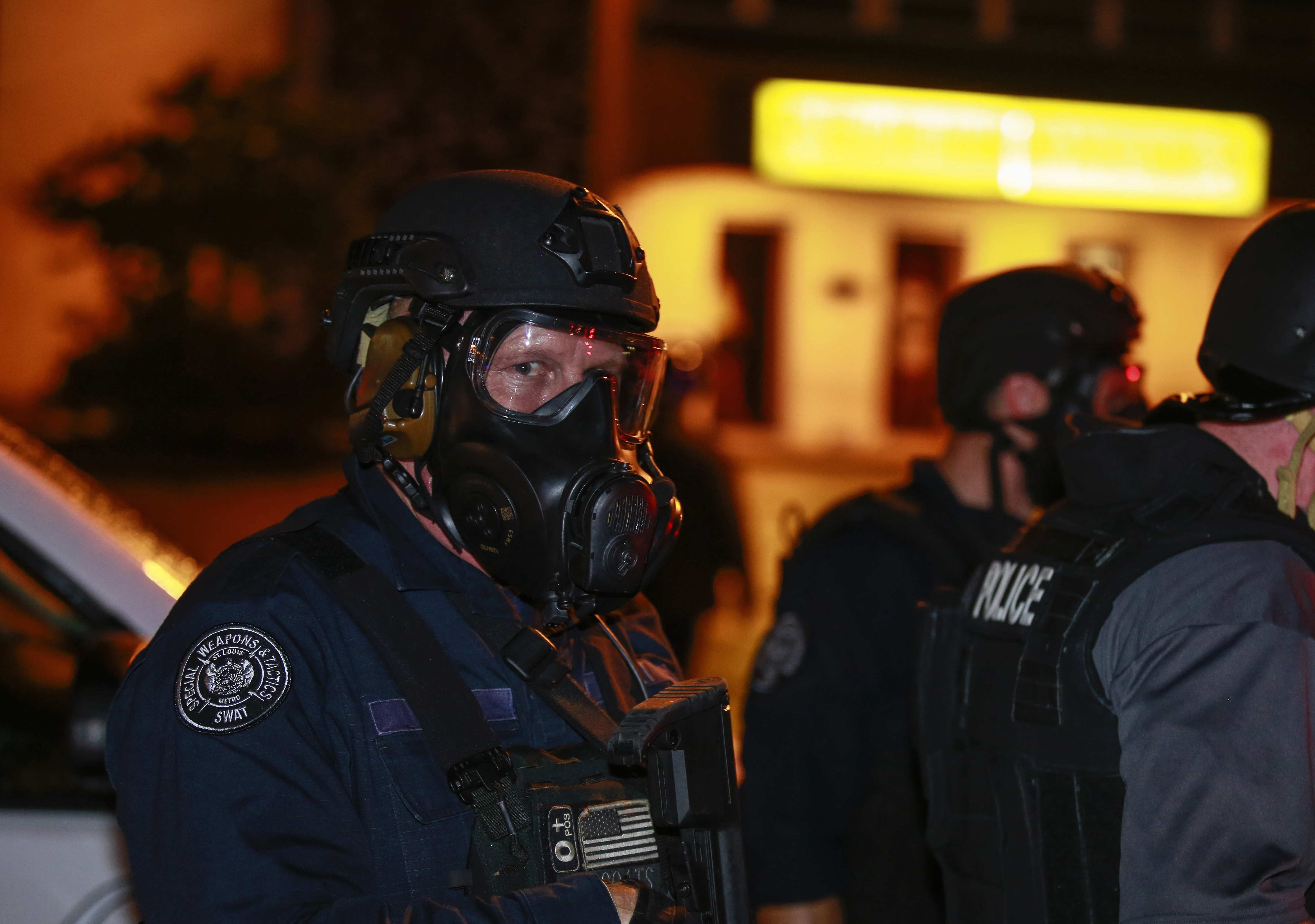
Protest over death of black teen Michael Brown in Ferguson

Rebecca Schuman explores the ways colleges have brought “living history” into the classroom:

The desire among professors and students to explore the context of the Brown shooting has resulted in an informal nationwide movement, in fact, loosely gathered under the hashtag #FergusonSyllabus (begun by Georgetown professor Marcia Chatelain). Participants from a variety of disciplines have offered articles, books, blog posts, videos, and more to help teachers help their students understand what is happening here.

This “syllabus” is certainly far removed from the esoteric fare your average freshman encounters—sure, The Epic of Gilgamesh and drosophila flies are important, but their immediate relevance to 18-year-olds is often a bit of a stretch. The events of Ferguson—and, more broadly, the workings of the U.S. criminal justice system, and the racial and economic segregation of our cities—are, on the other hand, palpable around them now. To transform the needless death of a young man to a “teachable moment” may feel heartless, but that doesn’t mean our students shouldn’t learn from it. In fact, they’re eager to.

(Photo: Police forces in Ferguson, Missouri, a suburb of St. Louis, on August 17, 2014. By Bilgin Sasmaz/Anadolu Agency/Getty Images)

The Red Tape Around Abortion

Elizabeth Nolan Brown discusses the significance of a 72-hour waiting period for abortion:

In effect, waiting-period rules like the one Missouri Republicans are pushing just make it logistically harder for women to exercise their right to an abortion. Yesterday I wrote about a Pennsylvania woman who ordered the abortion pill illegally online because the nearest clinic was more than 70 miles away. Some on social media scoffed at the idea that 70 miles was too far to travel—but because of mandatory waiting periods and other bureaucratic nonsense, what could be a one- or two-visit procedure actually requires three or four separate visits.

This is why it’s such bullshit when anti-abortion types talk about how it’s just an extra day or two wait; it’s just a requirement that only a physician can physically hand a woman the abortion pill; it’s just one or two clinics that will close down due to hospitals refusing admitting-privileges to abortion doctors… Taken individually, none of the restrictions may seem that nefarious. But these restrictions don’t exist in a vacuum. And the cumulative effect is absolutely to create a climate where the time and capital required to terminate a pregnancy becomes prohibitive for large numbers of women.

Emily Shire, meanwhile, is uncomfortable with differentiating between “good” and “bad” abortions:

When female politicians like Davis describe their abortions, they generally fit this narrative: a tortured, loving mother acting out of almost pure medical necessity. After Rep. Jackie Speier (D-CA) revealed on the House floor that she’d had an abortion, she made it abundantly clear that it was due to the fact the fetus “could not survive.” Her candor was a purposeful rebuke to Republican accusations that abortion is “a procedure that is either welcomed or done cavalierly, or done without any thought,” she said. Her speech was powerful—and it also conveyed the attitude that abortion wasn’t a real choice for her. In fact, following her speech, Speier released a press statement to dispel any accusations that she wanted to have an abortion: “Today some news reports are implying that I wanted my pregnancy to end, but that is simply not true. I lost my baby.”

It is this kind of abortion narrative that is easiest for people to digest, and there are many cases like this. They are as emotionally-wrought and heartbreaking as Davis describes. But there are also many reasons for having abortions that generate far more judgment and stigma.

Recent Dish on Wendy Davis’ abortion revelation here.

Face Of The Day

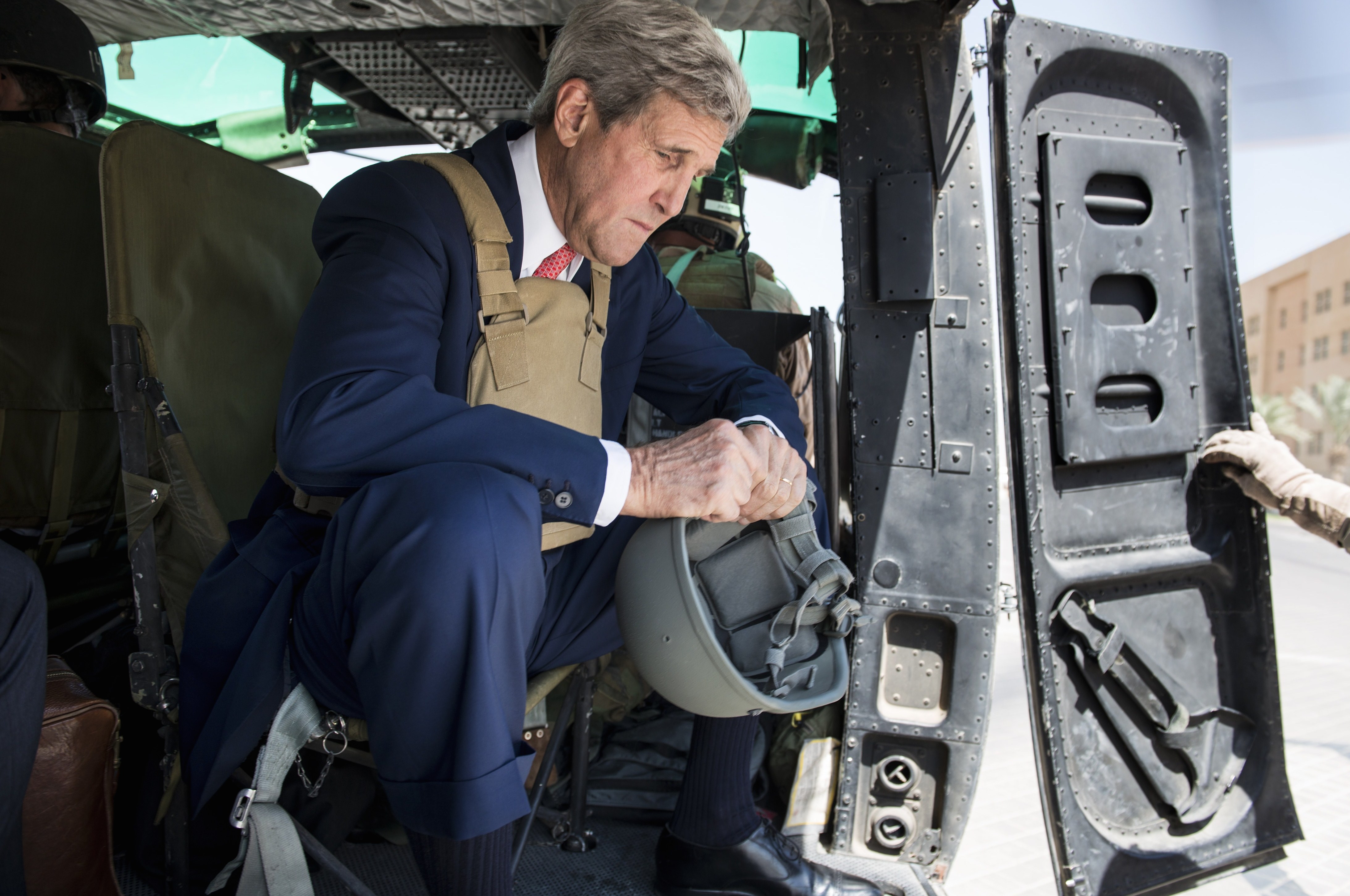
IRAQ-US-DIPLOMACY-KERRY

US Secretary of State John Kerry waits in a helicopter in Baghdad on September 10, 2014. Kerry flew into Iraq today for talks with its new leaders on their role in a long-awaited new strategy against Islamic State jihadists to be unveiled by President Barack Obama tonight. By Brendan Smialowski/AFP/Getty Images.

Only Thinking About Their Bottom Lines

The NYT recently reported that several think tanks have “received tens of millions of dollars from foreign governments in recent years while pushing United States government officials to adopt policies that often reflect the donors’ priorities”:

The money is increasingly transforming the once-staid think-tank world into a muscular arm of foreign governments’ lobbying in Washington. And it has set off troubling questions about intellectual freedom: Some scholars say they have been pressured to reach conclusions friendly to the government financing the research.

Tom Medvetz asks, “How can journalists report on think tanks without becoming complicit in this system?”

First, they could approach the commonsense distinction between “policy advice” and lobbying with a bit less credulity. Why should any tax-exempt organization that doesn’t voluntarily disclose its own financial records be described as a source of “independent policy advice”? Reporters could also stop lending credence to the dubious metaphor that portrays think tanks as founts of “academic scholarship.” (Again, the Times article is a case in point: Even as the authors paint a vivid picture of a constitutively impure system, they insist on calling think tanks’ staff members “scholars.”) I don’t mean to suggest that actually existing scholars are somehow immune to market or political forces. They are not, and they should be subject to the same kinds of scrutiny as think tanks. But we should remember that scholarship refers in principle to a system marked by relative transparency and self-regulation through peer review, and that its results are not meant to be for sale.

John B. Judis remembers the good ol’ days:

Some history is in order for those who think it has always been that way. The first policy groups, which originated early in the last century and only later became called “think tanks,” included the Brookings Institution (which was formed out of three other policy groups), the Carnegie Endowment for International Peace, and the Twentieth Century Fund (now the Century Foundation). They were products of the Progressive Era idea of using social science to produce policy research that, in the words of Robert Brookings, would be “free from any political or pecuniary interest.”

Andrew Carnegie gave his think tank an endowment of $10 million in order to free it from having to raise money. Brookings, who had retired from business to devote himself to philanthropy, generously funded his. The scholars at these groups had definite ideas, but the groups resisted attempts by outside group to shape their conclusions.

Inside The Mind Of A “Jihadi Tourist”

https://twitter.com/LifeofMujahid/statuses/485452312228675585

Michael Muhammad Knight almost became one in Chechnya. He describes what motivated him to go and what ultimately held him back:

For me, wanting to go to Chechnya wasn’t reducible to my “Muslim rage” or “hatred for the West.” This may be hard to believe, but I thought about the war in terms of compassion. Like so many Americans moved by their love of country to serve in the armed forces, I yearned to fight oppression and protect the safety and dignity of others. I believed that this world was in bad shape. I placed my faith in somewhat magical solutions claiming that the world could be fixed by a renewal of authentic Islam and a truly Islamic system of government. But I also believed that working toward justice was more valuable than my own life.

Eventually, I decided to stay in Islamabad. And the people who eventually convinced me not to fight weren’t the kinds of Muslims propped up in the media as liberal, West-friendly reformers. They were deeply conservative; some would call them “intolerant.” In the same learning environment in which I was told that my non-Muslim mother would burn in eternal hellfire, I was also told that I could achieve more good in the world as a scholar than as a soldier, and that I should strive to be more than a body in a ditch. These traditionalists reminded me of Muhammad’s statement that the ink of scholars was holier than the blood of martyrs.

The Trail Of Tear Gas

Yiannis Baboulias looks at the market for tear gas:

‘Non-lethal technologies’ are in demand, and governments are spoilt for choice. If you have been gassed in Egypt, Palestine or America, it was most likely with Combined Systems products made in the US. The Bahrainis use French tear gas. The Greek police is supplied by five different companies from all over the world; the canisters I have seen in use were made by Condor in Brazil. Tear gas is the perfect tool for governments increasingly inclined to look on the public as a potential source of disturbance, rather than the source of their democratic mandate. An independent study earlier this year estimated that the market is currently worth $1.6 billion.

He describes his own experience of the chemicals:

As soon as a canister explodes in your vicinity, your skin starts burning. It becomes hard to breathe because you’re producing so much mucus, your eyes shut involuntarily and it feels as if your head is about to melt. The canister itself is dangerous. It gets hot as the CS [2-chlorobenzalmalononitrile, the most common type of tear gas], solid in the unopened canister, is turned into an aerosol; touch it without heavy-duty gloves, and it can burn. Prolonged exposure causes severe respiratory problems and heart attacks; it can cause pregnant women to miscarry and can kill people who suffer from asthma and other bronchial problems.

In Rush To War, No Time For The Law, Ctd

Allahpundit despairs at how many members of Congress are eager to sidestep a vote on a war with ISIS. If they don’t exert some control over this process now, he warns, they’re not any more likely to do so if and when our military commitment starts to snowball:

What’s important is keeping Congress as politically comfortable as possible, and the less power they retain, the easier that becomes. Some members justify their deference to O in terms of the assets he plans to use: Bernie Sanders told the NYT he’s okay with letting Obama bomb who he wants as long as ground troops aren’t sent in, the key distinction being … I don’t know. I guess the president has inherent authority to put airmen’s lives at risk but not infantry’s? Does that make any sense? … They’re not going to cut the money off once men are in harm’s way. And they’re certainly not going to vote on an AUMF later, as Sanders’s airstrikes-yes-infantry-no formulation seems to imagine. Once they’ve allowed Obama to wage war unilaterally from the air, it’s the easiest thing in the world to let him wage war unilaterally on the ground too. If anything, Congress will be even more eager to have its fingerprints off of ground operations.

Cody Poplin compares the several proposed AUMFs currently being circulated on Capitol Hill. But their authors might just be wasting paper, as Obama is signaling that he already has all the permission he needs. Matt Welch cuts him no slack for flouting the Constitution:

In last year’s run-up to what once seemed like inevitable war against Syria, the president made what can be interpreted as an incoherent claim: that he had enough legal cover to start bombing Syria, but that he would nonetheless seek congressional approval. When that approval was not forthcoming, the president decided on a diplomatic solution instead. But note how he treated the congressional-authorization question one year ago today:

[E]ven though I possess the authority to order military strikes, I believed it was right, in the absence of a direct or imminent threat to our security, to take this debate to Congress. I believe our democracy is stronger when the President acts with the support of Congress. And I believe that America acts more effectively abroad when we stand together.

So either the president no longer believes these things, or he finds such beliefs to be an untenable hindrance in the waging of his latest war. At any rate, as in his more blatant nose-thumbing of Congress over U.S.-led regime change in Libya, Obama’s position on the constitutionality of war is essentially the opposite of what it was when he first sought the presidency.

But of course, as Steven Mihm points out, the American tradition of presidents going to war without explicit Congressional authorization goes all the way back to George Washington:

Washington sought “buy in” to go after the Indian tribes that began attacking white settlers on the western frontier in the late 1780s. Like the Islamic State today, they posed a threat that was at once amorphous, hard to reach, and even harder to combat. The Miami and Shawnee tribes of the Ohio River Valley had scalped and murdered settlers, stolen livestock and taken civilians captive. In 1789, Washington dutifully went to Congress, and warned lawmakers that it might be necessary to “punish aggressors” on the western frontier. Congress, preoccupied by other matters, declared that it wouldn’t “hesitate to concur in such further measures” that Washington had in mind. No formal vote authorizing war was held.

Meanwhile, Josh Rogin and Tim Mak note that the $5 billion Counterterrorism Partnership Fund Obama first proposed in May is back in play:

Several top Democratic and Republican senators told The Daily Beast on Friday that the administration has given Congress zero details about the proposed fund and consultations have been next to nonexistent. But Democrats said that was perfectly fine with them. “I support doing what we need to do to defeat ISIS,” Senate Foreign Relations Committee Chairman Robert Menendez told The Daily Beast when asked about the fund. Senate appropriators are already preparing to hand Obama the $5 billion. The draft of the defense appropriations bill would give the Pentagon $4 billion of the funds. The draft of the State Department and foreign operations appropriations bill contains the other $1 billion. All the money would be classified as war funding in the overseas contingency operations part of the defense budget.